

March Jewelry Sales Rise 5% as Premium Buying Grows, While Lab-Grown Supply Faces a Reckoning
Home
News And Media March Jewelry Sales Rise 5% as Premium Buying Grows, While Lab-Grown Supply Faces a Reckoning SHOP NOWHome
News And Media March Jewelry Sales Rise 5% as Premium Buying Grows, While Lab-Grown Supply Faces a Reckoning SHOP NOWApr, 15, 2026 by Archit Mohanty 0 Comments
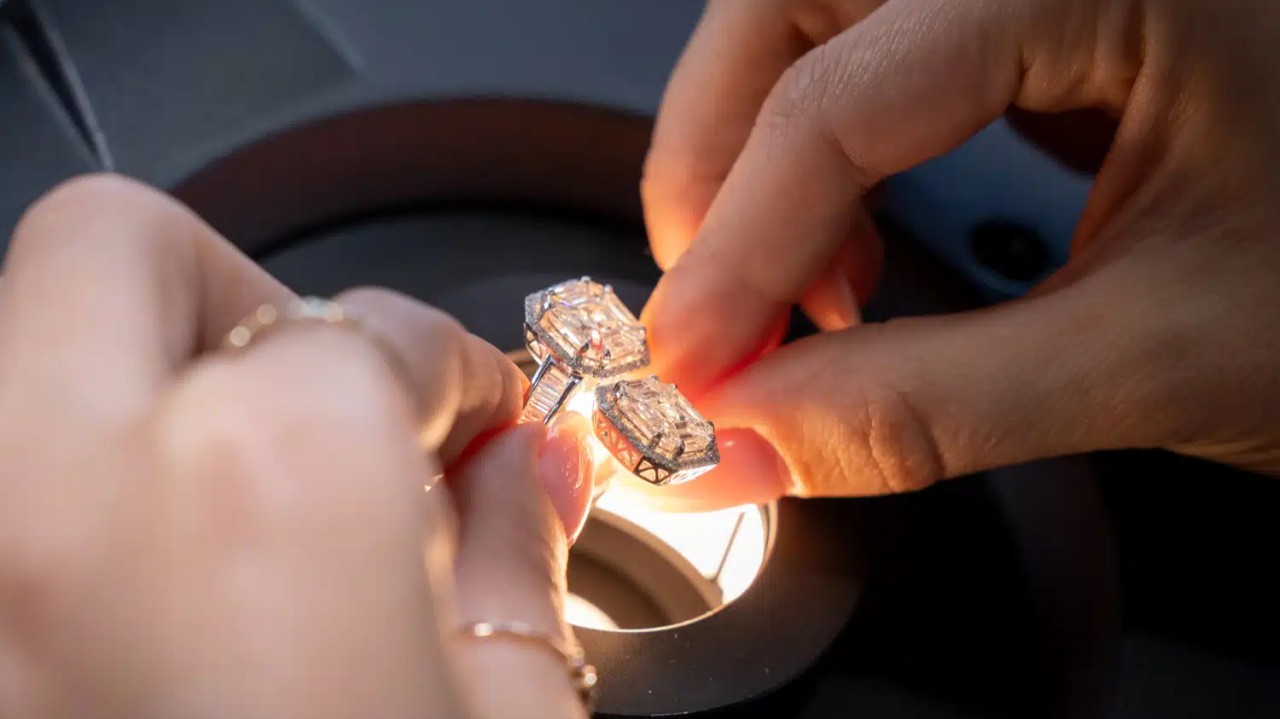
The March 2026 jewelry market data tells a story of two parallel realities. On one hand, total sales are climbing, driven by affluent consumers spending more per piece. On the other hand, the lab-grown diamond sector is rapidly approaching a structural oversupply crisis that could reshape the industry.
This report analyzes the numbers, explores the underlying trends, and examines what these shifts mean for retailers, manufacturers, and investors.
Total jewelry sales rose 5% year‑over‑year in March, but unit sales fell 10%. This divergence marks a clear shift in buying behavior. Consumers are purchasing fewer items yet spending significantly more per transaction. Average retail prices increased in the low double digits, with revenue growth driven almost entirely by higher‑priced jewelry.
Data from independent jewelers tells a similar story. According to the Edge Retail Academy, gross sales for independent jewelers rose 12% in March, driven by an 18% rise in average retail sale, while unit sales declined 5%. The South region led with a 21% increase, followed by the Northeast at 11% and the Midwest at 8%. Tenoris, a firm that tracks jewelry and gem sales at 2,500 U.S. specialty jewelry retailers, estimates overall jewelry sales among specialty jewelers grew 5.6% in 2025.
This trend is not confined to the United States. Hong Kong‑based Chow Tai Fook reported an 18% increase in sales and Luk Fook posted 26% growth during the October–December period. In India, Titan Company’s jewelry income rose 24% for the quarter, while Australia‑based Michael Hill reported a 3% increase. The breadth of growth across so many major players suggests a genuine structural shift rather than a short‑term anomaly.
Perhaps the most telling statistic is the breakdown by price point. Items below $1,000 have been declining since September 2025. Meanwhile, items above $2,500 are driving growth in March. This bifurcation often called "jewelry premiumization" reflects a K‑shaped economic recovery in which higher‑income consumers continue spending while middle‑ and lower‑income buyers pull back.
Tenoris gave this trend its formal name in January 2026, noting a 12% year‑on‑year rise in demand for high‑end pieces. The trend is visible across both custom and finished jewelry, and it has significant implications for retailers’ inventory strategies.
Luxury jewelry showed a stronger pre‑Valentine’s Day sales surge in 2026 compared to 2025, indicating higher intent among buyers who chose the category. According to a Tenoris Valentine’s Day survey, jewelry spending surged during the week leading up to February 14, with February sales rising 10.7% driven primarily by higher‑income shoppers purchasing expensive pieces and pushing the average transaction value sharply higher.
The broader luxury goods sector provides useful context. According to Bain & Company and Euromonitor, luxury sales grew by 3% in 2025, reaching $1.5 trillion. Jewelry is gaining market share compared to other luxury categories such as luxury cars.
Category‑level performance in March reinforces the premiumization thesis:
Diamonds: Sales +15%, average retail sale +17%, unit sales –1%
Colored Stones & Pearls: Sales +31%, average retail sale +41%, unit sales –7%
Sterling Silver & Alternative Metals: Sales +5%, average retail sale +15%, unit sales –9%
The colored stones category stands out as the top performer, delivering 31% sales growth alongside a 41% increase in average retail sale. This suggests consumers are increasingly seeking rarity and uniqueness rather than simply following traditional diamond purchases.
While premium natural diamonds thrive, the lab‑grown diamond market is entering a difficult new phase. Inventory is growing fast, but sales are not keeping up, creating a clear structural imbalance.
The most critical metric is the inventory‑to‑sales ratio. In 2020, the ratio was in the high single digits. Now, it has climbed to the low double digits an increase of approximately 50%.
According to Tenoris data cited in industry reports, the U.S. lab‑grown diamond inventory‑to‑sales ratio reached the low double digits in March 2026, compared to high single digits in 2020, representing nearly a 50% increase. A separate report from IDACN notes that in the U.S. retail market, jewelers’ lab‑grown diamond stock‑to‑sales ratio climbed to 8.6:1, meaning retailers hold 8.6 lab‑grown stones in inventory for every 1 they sell.
The price collapse has been dramatic. The average price of a 1.5‑carat lab‑grown diamond has plummeted 86%, from $10,750 in 2015 to $1,455 in 2025. Wholesale prices for 1‑carat VS1 F‑G‑H lab‑grown diamonds have fallen 95% since 2018, while retail prices have dropped 76%. In China, 1‑carat low‑quality rounds are down 74% from 2021 peaks.
Despite these price declines, lab‑grown diamonds have achieved dominant market penetration. Lab‑grown stones now hold approximately 50% of the U.S. engagement ring market. Among more than 10,000 U.S. couples surveyed who married in 2025, 61% chose a lab‑grown diamond for their engagement ring, according to The Knot’s Real Weddings Study. In the United States, lab‑grown diamonds account for 70% of global sales of lab‑grown diamond jewelry. Milla Export one of the largest manufactuer of Lab-grown diamonds from Surat.
The diamond industry is particularly susceptible to the bullwhip effect the phenomenon where small changes in consumer demand translate into progressively larger fluctuations as they move up the supply chain.
Industry consultant Pranay Narvekar of Pharos Beam Consulting explains that retailers typically sit on a year’s stock, if not more, which means the effects are much more pronounced in diamonds than in other industries. A 15% drop in retail demand could result in a 33% decrease at the polished and jewelry level, and up to a 70% reduction in mining activity.
For lab‑grown diamonds, the bullwhip effect is already visible. Lower prices made lab‑grown diamonds more accessible to a broader consumer base. Easy payment terms boosted buying. Memo availability increased supply. Consumer acceptance grew quickly. All of these factors supported rapid market expansion.
But now, the reverse dynamics are taking hold. Consumers may reduce lab‑grown purchasing as prices continue to fall (the perception of falling value discourages purchases). Retailers will cut new orders to manage bloated inventory. Manufacturers will be left with excess stock that cannot be moved. Large volumes of memo goods may return to the market simultaneously, flooding an already oversupplied pipeline. The midstream cutters, polishers, and wholesalers could face heavy inventory pressure.
This dynamic is already playing out in China, where overcapacity has reached extreme levels. The central Chinese province of Henan now produces over 70% of the world’s lab‑grown diamonds for jewelry. Prod‑sales ratios in Henan reached 12.73% in the first half of 2025. The result has been an 80% price plunge and a "sudden halt" in what was once a booming sector.
For retailers, the implications of these trends are significant:
1. Premiumization Requires Inventory Rethinking Retailers are holding more high‑end natural diamond inventory to meet demand for pieces above $2,500. This requires greater capital commitment per unit, but margins remain healthier in the premium segment.
2. Lab‑Grown Exposure Is Becoming a Real Risk Lab‑grown prices are under pressure as inventory accumulates. Lower‑priced lab‑grown jewelry (below $1,000) is already slowing. Independent retailers with significant lab‑grown exposure may feel the pressure first. Capital is getting locked in stock that takes longer to sell.
3. The Natural Diamond Supply Constraint Benefits Premium Players Natural diamond supply remains at multi‑decade lows, with global output estimated at just over 100 million carats in 2025 the lowest annual output since 1992. In 2026, supply is forecast to only moderately rebound to around 105 million carats, down from over 150 million as recently as nine years ago.
De Beers has cut its 2026 production guidance to 21–26 million carats, down from a previous 26–29 million carats. This supply constraint means that premium natural diamonds are likely to maintain their value proposition even as lab‑grown prices collapse.
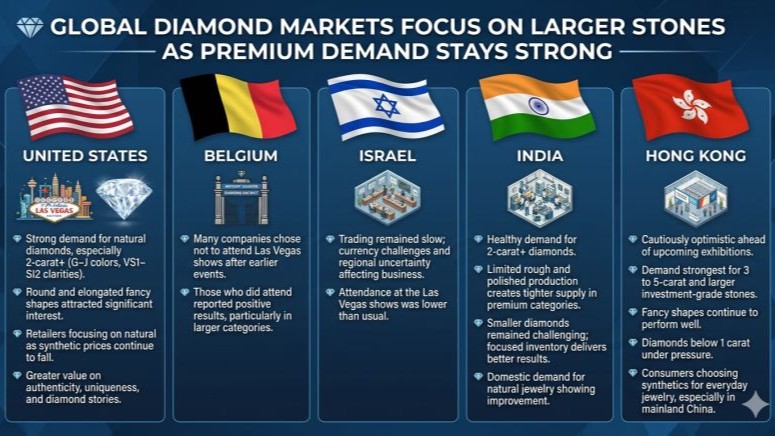
4. Larger Diamonds Are Resilient Price data from Rapaport shows a clear divide: the RapNet Diamond Index for 1‑carat diamonds fell 2.3% in December, while 0.30‑carat and 0.50‑carat goods dropped 9.3% and 6.4% respectively. The 3‑carat index edged up. Larger stones remain resilient as affluent buyers prioritize size and quality.
5. Natural Diamonds Still Dominate Revenue and Profit Despite lab‑grown diamonds capturing 55% of unit sales at some retailers, natural diamonds still contribute 76% of revenue and 82% of gross profit. This underscores the importance of maintaining a balanced inventory that prioritizes high‑margin natural diamonds.
For Retailers:
Reassess lab‑grown inventory levels and turn rates.
Focus on premium natural diamonds, colored gemstones, and custom pieces.
Consider that lab‑grown memo goods may flood back into the market, putting additional downward pressure on prices.
Leverage data analytics to understand which price points are driving growth in your specific market.
For Manufacturers and Wholesalers:
The bullwhip effect means that even modest retail slowdowns in lab‑grown sales will be amplified significantly upstream
Prepare for potential inventory write‑downs on lab‑grown goods
Diversify product mix to include higher‑margin natural stones and colored gemstones
For Investors:
Natural diamond mining companies with cost‑efficient operations and high‑quality output are positioned for relative stability
Lab‑grown diamond producers face a challenging margin environment as oversupply persists
Watch for consolidation in the lab‑grown sector as weaker players exit
He points to the U.S. wealth effect driven by over $100 trillion of inheritances over the next 20 years, which he believes will fuel the greatest market for luxury diamonds the world has ever seen. He predicts that 20% of diamonds will account for more than 80% of sales value.
In a rapidly shifting market, having the right platform to buy and sell diamonds and jewelry is essential. CaratX connects the diamond, gemstone, jewelry, and pearl industry on a single interconnected marketplace, reducing costs for buyers and sellers alike.
Sell diamonds and jewelry to B2B and B2C buyers in 18+ international countries → Register as a CaratX Seller
Shop natural diamonds at competitive prices → Browse Natural Diamonds on CaratX
Shop gemstones from the CaratX marketplace at unbeatable prices → Shop Gemstones
Explore CaratX pricing and seller plans → CaratX Pricing Information
Learn about diamond quality with the CaratX Diamond Guide → CaratX Diamond Guide
Shop jewelry for every occasion → Browse Jewelry on CaratX
Consumers are shifting toward higher‑priced, premium jewelry pieces. This "premiumization" trend means revenue growth comes from higher average transaction values rather than increased volume. Items below $1,000 are declining, while items above $2,500 are driving growth.
The bullwhip effect refers to how small changes in consumer demand become amplified as they move up the supply chain. In diamonds, where retailers hold a year or more of inventory, a small retail slowdown can cause a 30–70% reduction in upstream demand. This effect is particularly intense in the lab‑grown diamond sector right now.
Lab‑grown diamonds have no intrinsic scarcity, and their prices have fallen 86–95% over the past decade. Unlike natural diamonds, lab‑grown stones have minimal to no resale value. For investment purposes, premium natural diamonds remain the preferred option due to supply constraints and sustained luxury demand.
Retailers should carefully monitor lab‑grown inventory turn rates. With inventory‑to‑sales ratios at double digits, many retailers are holding excessive lab‑grown stock. Consider reducing lab‑grown orders, focusing memo goods rather than owned inventory, and prioritizing premium natural diamonds and colored gemstones where margins are healthier.
Industry analysts expect premiumization to continue through 2026 and beyond. Gold prices have surged above $5,100 per ounce, making lightweight, lower‑value pieces less economically viable. Affluent consumers continue to allocate spending to high‑end jewelry as a store of value and a luxury statement.
Follow CaratX for more insightful and educational content on the diamond and jewelry industry. Visit CaratX.com to start buying or selling diamonds, gemstones, and jewelry today.
Aug, 06, 2022
Aug, 06, 2022


0 Comments
Please login to leave a reply.