
Natural Diamond Market 2026 -
May, 18, 2026 by Archit Mohanty 0 Comments
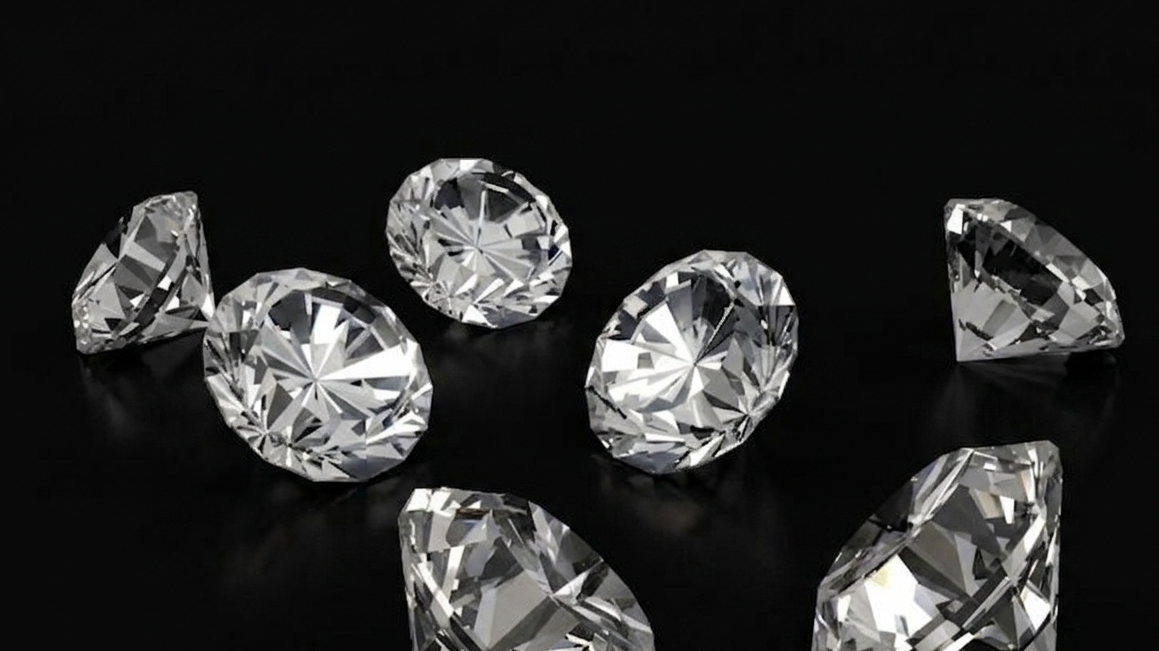
Natural diamonds are billions of years old, formed under intense heat and pressure deep within the Earth. For centuries, they have been treasured as symbols of love, commitment, and status. Today, the natural diamond market is at a pivotal moment, with 2026 emerging as a year of recovery and stabilization after the major corrections of 2023 and 2024.
The 2026 Recovery: A Market Rebalancing
The global natural diamond market entered 2026 with cautious optimism. Following three consecutive years of recession, early signs of recovery have become increasingly evident. The Gem & Jewellery Export Promotion Council (GJEPC) notes that while price stability is expected to return by mid-2026, this stability should not be mistaken for growth. Instead, the market is undergoing a fundamental rebalancing, with premium categories leading the way.
Supply constraints are playing a significant role in this recovery. Global natural diamond production is forecast to moderately rebound to around 105 million carats in 2026, but this remains significantly below the peak of over 150 million carats seen just nine years ago. Major producers like De Beers have adjusted their production guidance downward, with the company now targeting 21–26 million carats in 2026, down from a previous 26–29 million carats.
Price Trends: Commercial vs. Premium
The price divergence between commercial and premium diamonds has become one of the defining features of the 2026 market. Commercial diamond prices remain approximately 15% to 30% lower compared to their 2022 peaks, reflecting sustained pressure from laboratory-grown alternatives and shifting consumer preferences.
However, premium diamonds specifically those in the D to F color range with VS clarity and higher are showing much stronger performance. These categories have achieved stable pricing, with some segments experiencing up to 5% price recovery. According to Alrosa, the segment of stones over 3 carats has remained the most stable, with prices for 5-carat diamonds climbing 8.4% quarter-on-quarter in early 2026.
The (RAPI) for 1-carat diamonds declined 1.7% in March 2026, contributing to a 4.2% overall decline in the first quarter. Yet this masks a more nuanced reality. While smaller diamonds face headwinds, demand for 2-carat and larger diamonds remains exceptionally strong, supported by increasingly tight supply.
Diamond Shape Trends: The Rise of Elongated Fancy Shapes
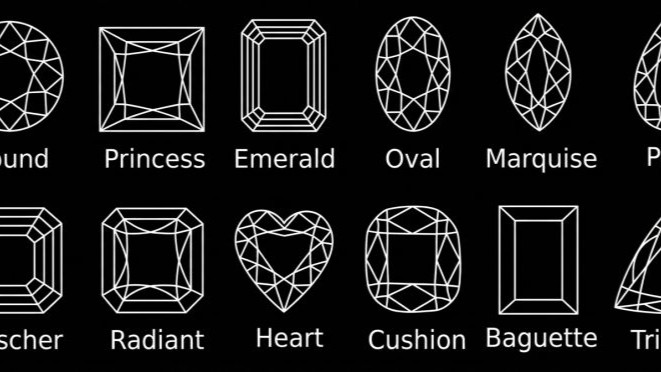
Round Brilliant diamonds continue to dominate the market, maintaining approximately 55% to 60% global share. Yet fancy shapes are gaining significant momentum, reshaping consumer preferences in 2026.
Whiteflash sales data shows Oval diamonds trailing rounds with 11.6% market share, making them the most popular fancy shape. Pear accounts for 5.9%, Emerald for 5.7%, Radiant for 5.3%, and Cushion for 3.7%. However, these percentages tell only part of the story. In the premium segment, particularly for stones of 2 carats and larger, long fancy shapes are consistently outperforming rounds.
Long Cushion cuts are particularly noteworthy, trading at a 20% to 25% premium over their square counterparts. The US market shows solid demand for elongated Ovals of good shape and quality in the D-I color and VS-SI clarity categories. Emerald cuts maintain strong luxury appeal, prized for their understated, architectural beauty and “hall-of-mirrors” effect.
Fast-growing categories include Oval Brilliant, Cushion Cut, and Radiant Cut diamonds. These elongated shapes offer superior finger coverage and a modern aesthetic that appeals to younger consumers, particularly Gen Z, which the Natural Diamond Council identifies as the fastest-increasing segment in 2026.
Color Demand Segmentation: A Four-Tier Market
Diamond color demand in 2026 is highly segmented, reflecting the market’s bifurcation:
D–F Colors (Colorless): Premium stable market. These top-tier colors are in consistent demand for investment-grade stones and high-end jewelry. Steady investment demand exists for 3 to 10 carat D-F, IF-VVS goods. For emerald cuts, buyers should target D-F colors to ensure a pure, icy appearance.
G–H Colors (Near Colorless): Highest global demand. These represent the sweet spot for value-conscious buyers, offering the appearance of colorless diamonds when set at a fraction of the price of D-F stones.
I–J Colors (Faint Color): Commercial market focus. These grades are popular for fashion jewelry and more accessible pieces, though they have seen price declines in the 1-carat category.
Fancy Colors: Strong rarity and collector demand. As supply tightens following the closure of the Argyle mine, markets in India and the Middle East are driving demand for natural colored diamonds. The estimated wholesale value of fancy color diamonds entering the market in 2024 exceeded $4.5 billion. Pink Fancy Intense, 1 carat, led price increases in Q1 2026 with a 1.9% gain.
Carat Size Trends: The Shift Toward Larger Stones
The demand for larger diamonds is one of the most significant trends of 2026. The 1 to 2 carat range remains the core global demand category, but the real growth is occurring in larger sizes.
According to industry experts, demand is shifting toward stones from 1.2 carats and above, especially elongated fancy shapes. The 2 to 3 carat segment is seeing particularly strong demand in the United States and Middle East markets. In fact, those buying 2-, 3-, 4-, or 5-carat diamonds still overwhelmingly prefer natural diamonds, a healthy sign for the industry.
The price performance across sizes tells a clear story. While the RAPI for 1-carat stones fell 1.4% in April 2026, the 3-carat category edged up 0.3%, maintaining recent stability. Small stones (0.30 carat and 0.50 carat) have shown some recovery in recent months, but the sustained strength remains in the larger categories.
Regional Demand: A Tale of Four Markets
The regional breakdown of diamond demand in 2026 reveals distinct patterns:
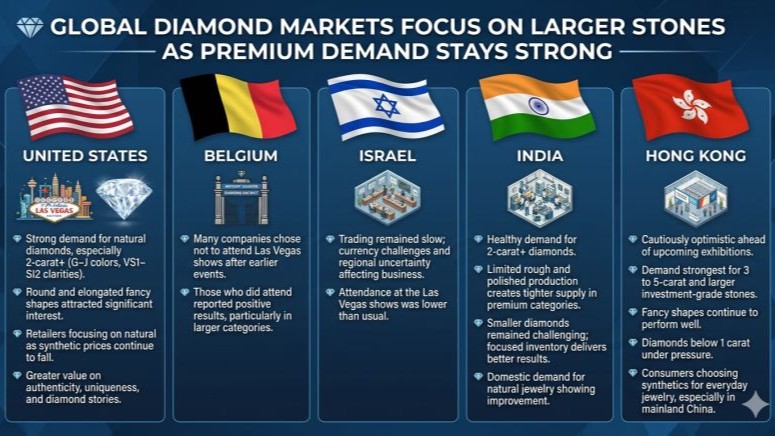
United States: Premium diamond demand is estimated up 2% to 4%. The US continues leading the global luxury jewelry and bridal market, particularly for larger certified diamonds and fancy shapes. US specialty jewelers’ natural-diamond jewelry sales increased 2.1% in 2025, with the average price rising 10% as consumers opt for larger, higher-quality stones. The US market remains the best source of demand despite competition from synthetics.
The Natural Diamond Council reports that more than 40% of women’s natural-diamond jewelry sales by value were self-purchases, indicating a broader consumer base beyond traditional bridal occasions. Signet Jewelers has noted that both natural and lab-grown diamonds show potential for growth in 2026, as both markets stabilize.
Europe: Market stabilization is estimated around 1% to 3%. Luxury jewelry demand remains selective but steady in premium categories. Traditional natural diamond demand in European luxury segments is stabilizing, though laboratory-grown alternatives are gaining market share in fashion and accessible jewelry, potentially capturing over 30% of that segment. Antwerp traded almost 20% more diamonds by volume in the first quarter of 2026 compared to the same period in 2025, though only 3.7% by value.
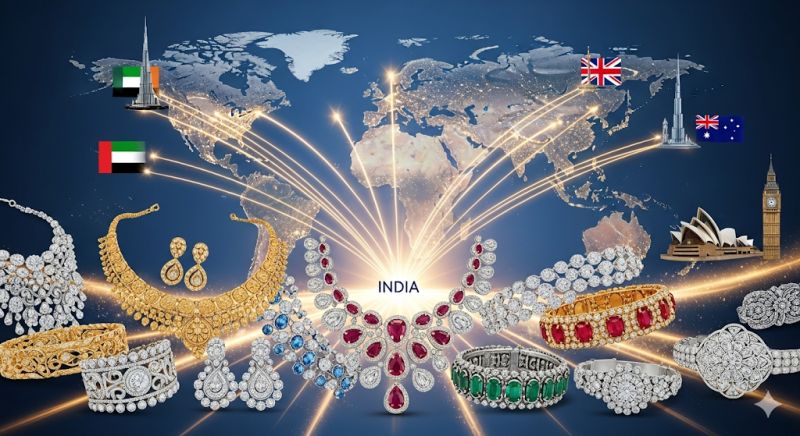
Dubai / UAE: Luxury diamond trade activity is estimated up 5% to 8%. Dubai continues growing as one of the world’s major trading hubs for high-end diamonds and jewelry. The Dubai Multi Commodities Centre (DMCC) has become a world-leading hub specifically for diamonds and precious stones.
Diamond trade in Dubai reached USD 38.3 billion in 2023, up 2% year-on-year, representing a 5-year compound annual growth rate of 11%. The UAE remains the largest trade hub for rough diamonds, with USD 21.3 billion worth of rough diamonds traded in 2023.
The January 2026 launch of the Dubai Gold District in Deira housing more than 1,000 gold and jewellery retailers signals Dubai’s continued commitment to expanding its position as a global jewellery trading hub.
India: Wedding and bridal demand is estimated up 6% to 10%. India’s growing middle and premium jewelry market continues supporting natural diamond demand. India has emerged as the second-largest diamond jewelry market globally, accounting for 12% of global demand, up from 10% in 2019, trailing only the United States at 53%.
The India luxury diamond jewelry market is projected to witness a CAGR of 8.48% from FY2026 to FY2033, growing from USD 1.14 billion in FY2025 to USD 2.19 billion in FY2033. During robust wedding seasons, jewelry retailers anticipate sales growth of 15% to 20% over normal periods.
India also chairs the Kimberley Process in 2026, centering on its “3Cs Vision” of Confidence, Credibility, and Compliance aimed at strengthening trust in the global diamond trade.
China and Hong Kong: These markets remain slower compared to other regions. Trading reflects global trends with 2-carat and larger diamonds steady, but the US market remains the best source of demand.
Supply Dynamics: Multi-Decade Lows
The supply side of the natural diamond market in 2026 is characterized by historically low production levels. Global rough diamond production has fallen dramatically from over 150 million carats nine years ago to a forecast of around 105 million carats in 2026. This represents a decline of approximately 30% from peak levels.
Major producers have adjusted their strategies accordingly. De Beers reduced its production guidance for 2026 to 21–26 million carats, down from 26–29 million carats previously.
This supply constraint has created a bifurcated market where premium categories face shortages while commercial goods remain abundant. Premium merchandise is in short supply, with prices firm. For 5-9 carat rough diamonds, gem as well as near-gem qualities are up a low-to-mid-teens percentage year-to-date 2026 according to the Zimnisky Global Rough Diamond Price Index.
The Lab-Grown Dynamic:
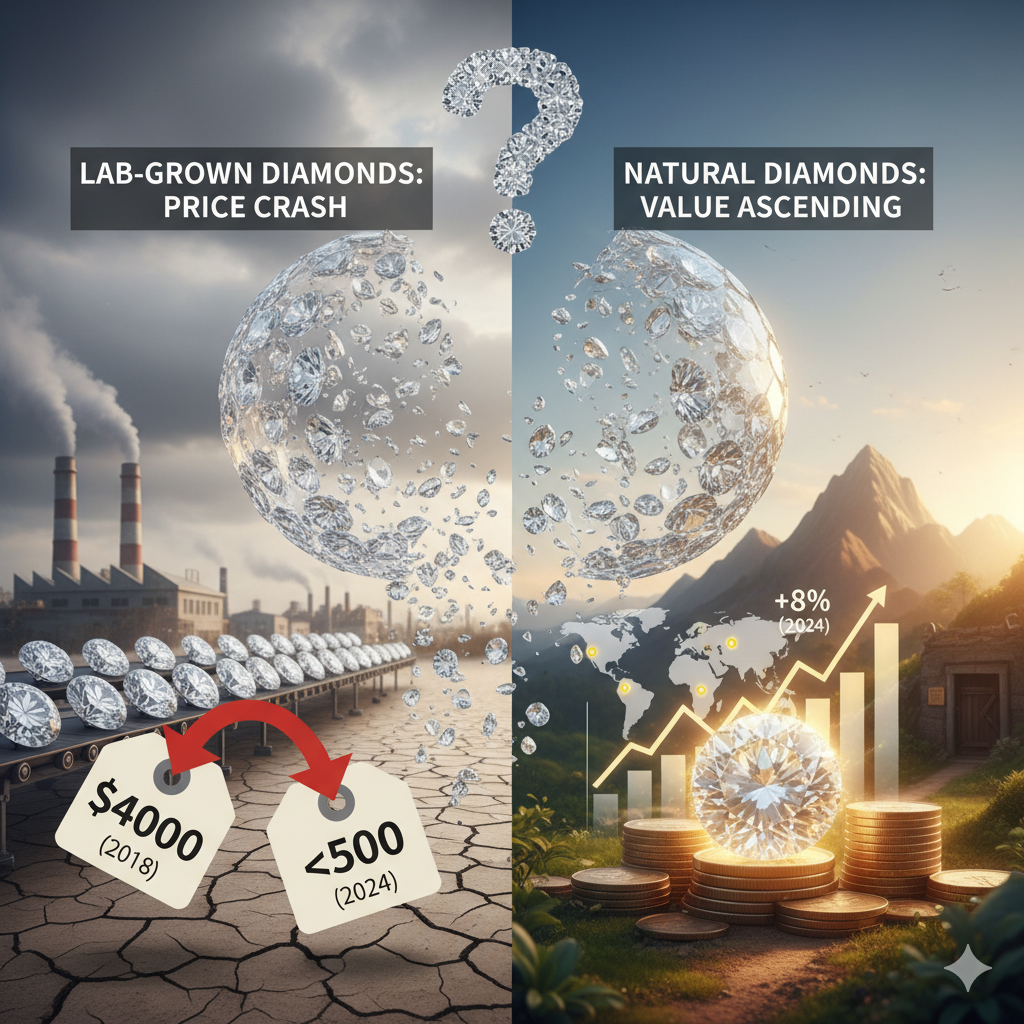
The relationship between natural and laboratory-grown diamonds continues to evolve in 2026. Synthetics have taken over the near-gem market and still hold about 50% of the US engagement ring market. Younger consumers are leaning toward synthetics, while older customers prefer natural stones.
However, the natural diamond market’s premium positioning remains intact. Natural diamonds are valued for their rarity, geological formation process, and emotional significance qualities that laboratory-grown stones cannot replicate.
The stabilization of lab-grown diamond prices which had been falling precipitously is also noteworthy.
Shop Natural Diamonds & Fine Jewelry on CaratX
Ready to explore the finest natural diamonds and gemstones? CaratX connects you with a global marketplace of certified diamonds, fine jewelry, and gemstones at unbeatable prices.
Shop Natural Diamonds
Browse our extensive inventory of certified natural diamonds across all shapes, sizes, and grades. Whether you’re looking for a classic Round Brilliant or a trending Oval cut, find your perfect stone at CaratX – Natural Diamonds.
Shop Now: https://www.caratx.com
Shop Gemstones
Discover a world of colored gemstones from sapphires and rubies to emeralds and fancy color diamonds. Our marketplace offers exceptional quality and value.
Shop Now: https://www.caratx.com
For Sellers: Expand Your Business Internationally
Sellers can register on the CaratX marketplace to start selling to B2B and B2C buyers across 18+ international countries. Join a growing community of diamond and jewelry professionals.
Register as a Seller: https://www.caratx.com/register
Sell Jewelry Internationally
Our CaratX seller plan enables jewelry manufacturers and designers to reach international buyers effortlessly. List your collection and start selling today.
Learn More: https://www.caratx.com/register
Pricing & Plans
For detailed information about our pricing structure and seller plans, visit our pricing page.
View Pricing: https://caratx.com/generic-pages/launch-your-products-on-caratx
Frequently Asked Questions (FAQ)
1. Are natural diamond prices expected to recover fully in 2026?
Industry experts anticipate a gradual recovery rather than a full return to 2022 peak levels. While premium categories (D-F color, VS clarity+) are showing signs of price stabilization and modest recovery of up to 5%, commercial diamonds remain 15–30% below peak levels. According to GJEPC, price stability is expected by mid-2026, but stability should not be mistaken for growth. The market is entering the early stages of recovery, with long-term implications for both natural and lab-grown sectors.
2. Are lab-grown diamonds affecting natural diamond prices?
Yes, laboratory-grown diamonds have significantly impacted the commercial end of the natural diamond market. Synthetics have taken over the near-gem market and hold about 50% of the US engagement ring market. However, premium natural diamonds particularly larger stones (2+ carats) and those with exceptional color and clarity have maintained their value proposition.
3. What is the most popular diamond shape in 2026?
Round Brilliant diamonds remain the global leader with approximately 55–60% market share. However, fancy shapes are gaining significant ground. Oval leads among fancy shapes at 11.6% market share, followed by Pear (5.9%), Emerald (5.7%), Radiant (5.3%), and Cushion (3.7%). In the premium 2-carat-and-larger segment, long fancy shapes like Ovals, Marquises, and Emeralds are consistently outperforming rounds.
4. Which diamond color grade offers the best value?
For the best value in 2026, target G-H color grades. These diamonds appear colorless when set but cost a fraction of D-F stones. If your setting is yellow or rose gold, you can stretch further to I-J grades. For emerald cuts or other step-cut shapes that show color more readily, consider D-F colors to ensure a pure, icy appearance.
5. Is now a good time to buy natural diamonds?
For buyers seeking premium-quality stones (D-F color, VS clarity+, 2+ carats), 2026 presents favorable conditions. Prices have stabilized after significant declines, and supply constraints suggest limited downside risk.
For commercial-grade diamonds, buyers may find competitive pricing, though further pressure from lab-grown alternatives cannot be ruled out. Investment-grade stones (5+ carats, D-F, IF-VVS) continue to show resilience, with specific categories like 4-carat D/VS1 rounds rising 6.4% in Q1 2026.
Visit CaratX to explore our collection or register as a seller to expand your business internationally.
How do I get started as a seller on CaratX?
Sellers can register on the CaratX marketplace to connect with B2B and B2C buyers across 18+ international countries. The registration process is straightforward:
Visit CaratX Registration Page
Purchase your seller Plan
List your diamond and jewelry inventory
Start reaching international buyers
For detailed pricing information, visit our pricing page.
Follow CaratX for insightful and educational content on the natural diamond market, gemstones, and jewelry trends. Join our community of diamond professionals and enthusiasts to stay informed about market developments, pricing trends, and investment opportunities.
CaratX – Your Global Marketplace for Natural Diamonds, Gemstones & Fine Jewelry
Shop Diamonds: https://caratx.com/shop
Shop Gemstones: https://caratx.com/search-results/gemstones
Sell Internationally: https://www.caratx.com/register
View Pricing Plans: https://caratx.com/generic-pages/launch-your-products-on-caratx
Recent Posts
Popular Posts
Aug, 06, 2022
Aug, 06, 2022
Related Posts
0 Comments
Please login to leave a reply.