

The US jewelry market is undergoing one of the most consequential structural shifts in a generation.
Home
News And Media The US jewelry market is undergoing one of the most consequential structural shifts in a generation. SHOP NOWHome
News And Media The US jewelry market is undergoing one of the most consequential structural shifts in a generation. SHOP NOWMay, 18, 2026 by Archit Mohanty 0 Comments
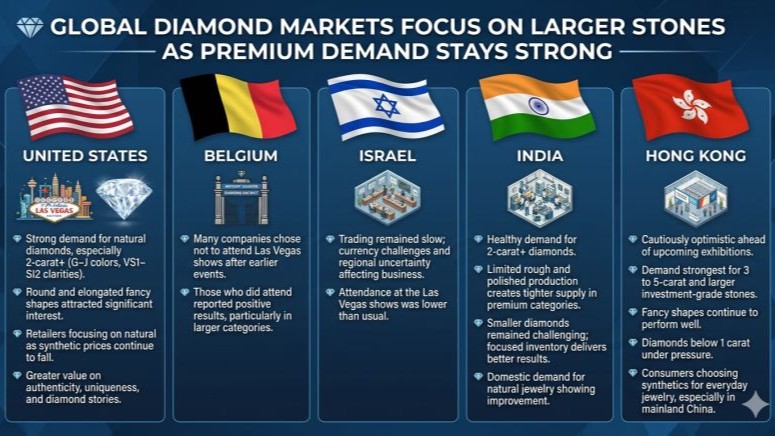
Consumers are buying fewer pieces, yet they are spending significantly more per purchase. In April 2026, average spending per jewelry item jumped 21% year‑on‑year, the highest increase ever recorded. Premium and fine jewelry categories, particularly finished diamond jewelry and high‑value natural diamond pieces, are driving this growth, while the market for loose diamonds, especially smaller natural stones, continues to face mounting pressure.
At the same time, the diamond industry is splitting in two: lab‑grown diamonds have captured over 45% of US bridal purchases by unit volume, yet natural diamonds continue to command strong revenue share in higher‑end and branded segments. For retailers, manufacturers, and investors, understanding these parallel trends and knowing how to position inventory, pricing, and marketing accordingly, is no longer optional. It is a strategic imperative.
The US jewelry market reached approximately $77.5 billion in 2025, with 80% of that share held by fine jewelry made from gold, platinum, and diamonds. But the headline growth number masks a deeper reconfiguration. According to a K‑shaped analysis by industry economist Edahn Golan, American jewelry buyers are splitting into two distinct groups:
Lower‑price segment (below $1,500): Spending less overall, buying fewer pieces, and revenue in this tier has generally declined. The one notable exception is lab‑grown diamond jewelry, which continues to grow in volume, though largely in simple, lower‑value items.
Higher‑price segment (above $1,500): Spending significantly more overall, with strong demand for bridal jewelry, diamond stud earrings, tennis bracelets, and natural diamond pieces. This segment’s increase in total spending is driven by more units being bought, not just higher prices.
This pattern, which Golan describes as a “classic K‑shaped market,” is the engine behind the jewelry premiumization trend.
For specialty jewelry retailers, the impact is already showing in the numbers. Overall revenue for specialty jewelers increased 7% year‑on‑year, driven almost entirely by rising average ticket size.
The average purchase price of finished jewelry (excluding custom work and loose gemstones) surged 25%. Moreover, average consumer spending per jewelry item has increased every single month since September 2024, and for the past nine consecutive months those increases have remained in double digits.
The divergence is not just between consumer groups, it is also between product categories.
Premium jewelry (high‑value natural diamond pieces, branded bridal, tennis bracelets, diamond necklaces, luxury earrings): Sales increased 14% year‑on‑year.
Lower‑priced jewelry categories: Revenue fell 17%, while unit sales dropped 20%.
Within the finished diamond jewelry segment, certain niches are thriving disproportionately. Diamond strand necklaces, traditionally a low‑volume item, saw sales more than double. Tennis bracelets and wedding sets both recorded double‑digit demand growth. Diamond stud earrings also posted handsome revenue gains.
Meanwhile, total retail revenue from both natural and lab‑grown loose diamonds took a hit in early 2026, with loose natural diamond sales falling once again, a downturn that industry analysts have flagged as a “red flag” for the custom engagement market.
This is perhaps the most actionable takeaway for anyone in the diamond trade. The diamond market in 2026 is not just about natural versus lab‑grown, it is also about form. Consumers are increasingly choosing ready‑to‑wear jewelry pieces rather than purchasing loose stones separately.
Recent market data shows that revenue from certain finished diamond jewelry categories increased by more than 30%, helping support overall jewelry sales growth. Revenue for finished diamond jewelry as a whole increased by a mid‑single‑digit percentage, while the average selling price of jewelry items saw a double‑digit increase.
At the same time, the loose diamond market continues facing significant pressure. Loose natural diamonds lost additional market share during April, with revenue declining by a mid‑single‑digit percentage. For loose lab‑grown diamonds, unit sales saw their first decline in tracking history, a milestone that suggests the explosive volume growth of previous years may be moderating, even as prices show no real recovery.
One of the biggest reasons behind this shift is the engagement ring market. Couples now regularly shop together, and a growing number of buyers want a finished, ready‑to‑wear piece rather than the custom‑design process that loose stones require.
Lab‑grown diamonds have achieved remarkable market penetration. In 2026, lab‑grown diamonds account for:
21% of the global diamond market (up from negligible share a decade ago)
Over 45% of US bridal purchases by unit volume up from under 10% in 2021.
61% of engagement ring center stones according to The Knot’s 2026 Real Weddings Study, based on more than 10,000 surveyed couples.
Lab‑grown diamonds now cost 73–83% less than comparable natural diamonds, and wholesale prices have crashed 96% since 2018, reaching around $168 per carat for commercial grades.
However and this is the nuance many market commentators miss even though lab‑grown diamonds are increasing in unit sales, natural diamond engagement rings are still maintaining strong revenue share. Buyers continue spending significant money on premium natural diamonds, especially in higher‑end jewelry categories.
As noted in the Gjepc report, “Long‑term demand remains intact, particularly at higher price points, but survival will depend on sharper differentiation, renewed marketing focus and a conscious effort to protect the luxury perception that has underpinned the category for decades”.
“The U.S. wealth effect driven by over $100 trillion of inheritances over the next 20 years will fuel the greatest market for luxury diamonds the world has ever seen. There will be excess demand for the best quality, rarest diamonds. 20 percent of diamonds will account for more than 80 percent of sales value”.
For industry participants, the implication is clear: the future of the jewelry business is not about volume, it is about value. Retailers focused on premium jewelry are benefiting the most. The average purchase price of finished jewelry (excluding custom work and loose gemstones) surged 25%, and specialty retailers saw overall revenue increase 7% year‑on‑year entirely due to higher average ticket size.
To thrive in this environment:
For retailers and B2B sellers: Stocking finished, ready‑to‑wear high‑value pieces (diamond rings, tennis bracelets, diamond necklaces, luxury earrings, and branded bridal jewelry) is essential, while reducing reliance on loose stones, especially in lower price tiers.
For diamond and gemstone suppliers: The premiumization trend means that quality and uniqueness command premium pricing. Sourcing and offering high‑clarity, well‑cut, certified stones will differentiate your inventory in a market flooded with lower‑grade commercial material.
For B2C platforms and marketplaces: Understanding the shift toward finished jewelry and the bifurcation between lab‑grown volume and natural‑diamond value is critical for curation, merchandising, and pricing strategy.
Whether you are a seller looking to expand internationally, a buyer searching for competitively priced natural diamonds and gemstones, or a retailer wanting to tap into B2B and B2C channels, CaratX provides the infrastructure to compete in today’s premium‑focused, finished‑jewelry‑led diamond market.
CaratX opens doors to over 18+ international countries, enabling sellers to reach a global audience of B2B and B2C buyers. By listing finished diamond jewelry, loose diamonds, and gemstones on the CaratX marketplace, sellers gain exposure to buyers actively seeking high‑value premium inventory.
Start selling to diamonds in 18+ International countries – www.caratx.com/register
Sellers register on CaratX marketplace here to start selling to B2B and B2C buyers – www.caratx.com/register
You can now sell Jewelry Internationally to buyers through our CaratX seller plan – www.caratx.com/register
CaratX offers an extensive selection of natural diamonds, gemstones, and finished jewelry at competitive, transparent prices. With advanced search and filtering, buyers can source exactly the stones or finished pieces they need to meet the growing demand for premium, ready‑to‑wear luxury.
Shop gemstones from our CaratX marketplace at unbeatable price – https://caratx.com/search-results/gemstones
Shop natural diamonds from here – https://caratx.com/search-results/Natural
CaratX maintains a clear, straightforward pricing structure designed to support sellers of all sizes, from individual artisans to large‑scale wholesalers.
More details about our Pricing, check here – https://caratx.com/generic-pages/launch-your-products-on-caratx
Start Selling (Registration): https://www.caratx.com/register
Shop Natural Diamonds: https://caratx.com/search-results/Natural
Shop Gemstones: https://caratx.com/search-results/gemstones
Pricing Page: https://caratx.com/generic-pages/launch-your-products-on-caratx
The market is growing in value but shrinking in volume. Total jewelry sales revenue continues to rise, driven by higher spending per item (premiumization). However, unit sales especially for items priced below $1,500 are declining. The US jewelry market is projected to grow at a low single‑digit CAGR (1.02–4.5% depending on segment) through 2032, with fine jewelry making up 80% of market share.
In unit volume, yes especially in the bridal segment. Lab‑grown diamonds now account for over 45% of US engagement ring purchases by unit, and 61% of center stones. In revenue terms, however, natural diamonds still hold the majority share, particularly in higher‑priced, premium categories. The market is bifurcated: lab‑grown dominates volume and lower‑price tiers, while natural diamonds retain value in luxury segments.
Consumers increasingly prefer ready‑to‑wear luxury jewelry rather than buying loose stones and arranging custom settings. The engagement ring market has shifted toward finished pieces, and retailers report that custom work using loose stones has slowed. Additionally, specialty jewelers rely on loose stones primarily for custom engagement work a segment currently under pressure from rising lab‑grown penetration and changing consumer behavior.
CaratX provides a direct pathway to 18+ international countries, enabling sellers to reach both B2B and B2C buyers globally. By registering on the CaratX marketplace, sellers can list finished jewelry, loose diamonds, and gemstones, and access a global audience actively seeking premium inventory. Start at www.caratx.com/register.
The US jewelry market in 2026 is not a single story. It is a story of polarization: premium vs. mass‑market, finished vs. loose, natural diamonds (high end) vs. lab‑grown diamonds (volume). For businesses that recognize these fault lines and position accordingly focusing on high‑value finished jewelry, leveraging international B2B/B2C channels like CaratX, and aligning inventory with premiumization the opportunities are substantial. Those that fail to adapt, however, risk being caught in the shrinking middle.
Stay ahead of the curve with CaratX, your gateway to global diamond and jewelry markets.
Follow CaratX for such Insightful and educational Content.
Start selling to diamonds in 18+ International countries – www.caratx.com/register.
Sellers register on CaratX marketplace here to start selling to B2B and B2C buyers – www.caratx.com/register.
You can now sell Jewelry Internationally to buyers through our CaratX seller plan – www.caratx.com/register.
Shop gemstones from our CaratX marketplace at unbeatable price – www.caratx.com.
Shop natural diamonds from here – www.caratx.com.
More details about our Pricing, check here – https://caratx.com/generic-pages/launch-your-products-on-caratx.
Aug, 06, 2022
Aug, 06, 2022
Oct, 16, 2025
0 Comments
Please login to leave a reply.