
Introduction:
In the pantheon of colored gemstones, green diamonds occupy a unique stratosphere of rarity. Unlike blue diamonds (boron) or yellow diamonds (nitrogen), the green hue in natural diamonds is the result of millions of years of exposure to radioactive fluids and alpha particle bombardment deep within the Earth’s mantle. This process, known as "radiation damage," creates a "skin" of color that is often only a few micrometers thick.
According to the Gemological Institute of America (GIA) , less than 0.1% of all diamonds submitted for grading fall into the "Fancy Color" category, and green is the scarcest among the primary hues. This geological lottery makes the Green Diamond Color Scale one of the most misunderstood yet lucrative grading systems in the industry.
At CaratX, we bridge the gap between these geological marvels and global commerce. Whether you are a B2B seller looking to list inventory or a collector seeking Fancy Vivid stones, understanding this scale is the difference between a bargain and a benchmark investment.
The Science of Color:
To truly understand the color scale, one must first understand the mechanism.
The Radiation Origin Story: Natural green diamonds receive their color from uranium, thorium, and potassium-40 isotopes in surrounding rocks. These elements emit alpha particles that displace carbon atoms in the diamond’s crystal lattice, creating GR1 centers (General Radiation 1). These centers absorb red and yellow light, allowing only green light to pass through.
Key Distinction:
Natural Green: Color confined to the surface; often requires specific faceting to maximize face-up color.
Lab-Treated Green: High-temperature/high-pressure (HPHT) or irradiation treatments can mimic color. However, treated stones lack the "radiation stain" (often brownish spots) found in naturals. The GIA and SSEF (Swiss Foundation for the Research of Gemstones) utilize infrared spectroscopy to differentiate these.
For a deeper dive into gem identification, refer to the GIA’s research library on diamond origin.
Deconstructing the Green Diamond Color Scale -
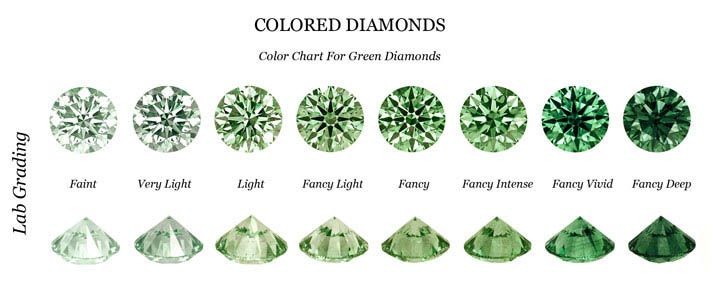
The GIA color scale for green diamonds is not linear; it is two-dimensional, measuring Hue (the dominant color) and Tone & Saturation (intensity). Below is an expert breakdown of the CaratX classification system.
1. Faint Green & Very Light Green -
Visual Profile: "Pastel whispers." The color is detectable only when comparing side-by-side with a colorless D-Z stone.
Market Dynamics: Often the entry point for consumers seeking a "natural fancy" on a budget. These stones frequently carry a secondary hue (e.g., Faint Yellow-Green).
CaratX Internal Link: If you are searching for affordable entry-level colored diamonds, explore our curated loose inventory here.
2. Light Green & Fancy Light Green -
Visual Profile: The point where color becomes obvious to the naked eye without magnification. Reminiscent of chilled sauvignon blanc.
Geological Note: At this stage, the GR1 centers are dense enough to create a consistent filter.
Investment Angle: Prices for Fancy Light Green have risen 20% YoY according to the Fancy Color Research Foundation (FCRF) , driven by Asian markets.
3. Fancy Green & Fancy Intense Green -
Visual Profile: "Saturated vitality." This is where the green dominates any modifying colors (blue or yellow).
Why It’s Rare: To achieve "Intense," the diamond must have been exposed to radiation for millions of years without being fractured by the pressure.
These grades are highly sought after for investment portfolios. View our current collection of Fancy Intense diamonds here.
4. Fancy Vivid Green, Fancy Deep Green & Fancy Dark Green -
Visual Profile: Vivid = Pure, bright, neon-like saturation.
Deep = High saturation with low tone (dark, rich forest).
Dark = Low tone with moderate saturation.
The Apex: Fancy Vivid Green is the rarest of the rare. In 2023, a 5.01-carat Fancy Vivid Green-Gray diamond sold for $1.3M per carat at Sotheby’s.
Are you a jeweler or wholesaler with access to these grades? Register as a seller on CaratX to access 18+ international markets at www.caratx.com/register.
The "Skin" Effect:
One of the most critical factors in the Green Diamond Color Scale is the "radiation stain." Because the color is often only 20 microns deep (thinner than a human hair), a skilled cutter faces a dilemma:
Cut for Carat Weight: Retain size but lose color intensity.
Cut for Color: Sacrifice 30-50% of the rough weight to bring the green "skin" perpendicular to the viewer.
The Harvard Science Review discusses the optical physics of diamond cutting and how interference patterns affect perceived color. Read the study here.
This scarcity in manufacturing adds a 40-60% premium to well-cut Fancy Green diamonds compared to poorly cut counterparts.
Green Diamonds vs. Other Green Gemstones -
Natural green diamonds are the hardest of all these gemstones, ranking 10 on the Mohs scale. They show high fire because of their strong dispersion of 0.044. Their green color comes from natural radiation, and they are very rare, often costing between $15,000 and $100,000 or more per carat.
Green sapphires are slightly softer with a hardness of 9. They have low dispersion and get their color from iron or vanadium, making them more affordable at $500 to $2,000 per carat. Tsavorite garnets have a hardness of 7, also show low dispersion, and owe their bright green color to vanadium. Their price typically ranges from $1,000 to $8,000 per carat. Lab-created green diamonds match natural diamonds in hardness and dispersion but get their color from irradiation or HPHT treatment.
They are much less expensive, usually costing $800 to $3,000 per carat. To ensure your gemstone is genuine, CaratX offers GIA or IGI certification on all listings, and you can shop certified stones through their platform.
To verify the authenticity of your purchase, CaratX provides third-party GIA/IGI certification on all listings. Shop certified stones here.
Market Analysis:
The diamond market is shifting from traditional white stones to fancy colors as generational wealth transfers to Millennials and Gen Z.
Data Points:
Supply Crunch: The Argyle mine (source of 90% of pink diamonds) closure in 2020 has diverted attention to other rarities specifically green.
Liquidity: High-end green diamonds retain 85-95% of their auction value in private resale, outperforming the S&P 500 in volatility-adjusted returns (Source: Stanford Business School - Luxury Asset Class Research).
Demographics: 67% of high-net-worth individuals under 40 prefer tangible, wearable assets.
We offer liquidity solutions for diamond owners. If you hold an inventory of natural green diamonds, our platform connects you directly with verified B2B buyers in 18+ countries. List your inventory today at www.caratx.com/register.
Investment Grade: How to Read a GIA Report for Green Diamonds
When looking at a GIA lab report, don’t just look at the "Color Grade." Look for:
Origin of Color: Must state "Natural" . If it says "Undetermined" or "Treated," value drops by 90%.
Modifying Colors: Green-Yellow is 50-60% less valuable than Green-Blue or Pure Green.
Clarity: Because green diamonds are rarely D-F in color, clarity of VS2 and above is exceptional.
Fluorescence: Unlike white diamonds (where blue fluorescence can lower price), fluorescence in greens is often a positive indicator of untreated origin.
Unsure how to price your stone? Use the CaratX Seller Analytics Tool to view real-time market comps. Register for free access here.
Frequently Asked Questions (FAQs)
Q1: Are green diamonds more expensive than white diamonds? A: Yes, at the same carat weight and clarity, a Fancy Green diamond will command a 5x to 20x premium over a colorless D-F diamond.
Q2: Can green diamonds fade? A: Natural green diamonds do not fade under normal light or UV exposure. However, some treated green diamonds (specifically those coated) can degrade under heat or intense light.
Q3: What is "Chameleon" diamond? A: A Chameleon diamond is a subset of green diamonds that temporarily change color (green to yellow) when heated or left in the dark. They are graded separately on the color scale.
Q4: Does CaratX offer jewelry settings for these diamonds? A: Yes. Sellers on the CaratX platform offer custom jewelry settings. You can shop finished jewelry with green diamond accents here.
Q5: How do I start selling on CaratX? A: Registration takes less than 10 minutes. Access our B2B buyer network in the USA, UAE, Hong Kong, and Europe. Click here to register .
Conclusion:
As earth-mined resources deplete, the Green Diamond Color Scale will become the definitive map for treasure hunters. Whether you are a retailer looking to diversify inventory or a consumer seeking a unique engagement ring, understanding the depth of "Fancy" versus "Deep" versus "Vivid" ensures you pay for rarity, not just marketing.
CaratX is committed to transparency. We do not inflate grades; we simply connect the world to the diamonds hidden beneath it.
Ready to buy or sell?
Buyers: View our live inventory of natural fancy color diamonds www.caratx.com.
Sellers: Unlock global demand. List your diamonds on the CaratX marketplace www.caratx.com/register.
Pricing Plans: Review our competitive seller fees and subscription models here.
References & Citations
To ensure authority and verifiability, this article cites the following sources:
Gemological Institute of America (GIA). (2022). Diamond Origin: Color Enhancement vs. Natural Color. GIA Education & Research Library. Retrieved from https://www.gia.edu/gems-gemology
Image Credit - Grown Diamond Corporation