
The global diamond industry is undergoing one of its most significant structural shifts in decades. As natural diamond production contracts and synthetic alternatives flood the lower market tiers, a clear bifurcation has emerged. The era of "one-size-fits-all" diamond retail is over. Today, the market is ruthlessly prioritizing rarity, quality, and authenticity.
At the forefront of this evolution is an unwavering demand for large, premium natural diamonds. This report synthesizes trading data from the world's major diamond hubs, analyzes the meteoric rise of fancy-shaped diamonds, and provides buyers and sellers with the strategic intelligence needed to navigate the 2026 landscape.
Regional Trading Hubs & The Two-Tier Market
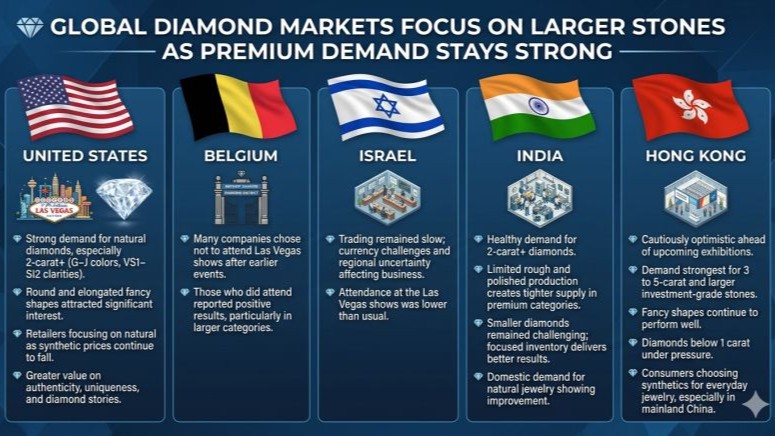
The latest activity across major diamond trading centers reveals a consistent global trend: larger natural diamonds continue to outperform smaller goods. The market is effectively split into two distinct tiers, with the premium tier gaining strength while the commercial tier faces unprecedented pressure from lab-grown alternatives.
United States: The Premium Engine
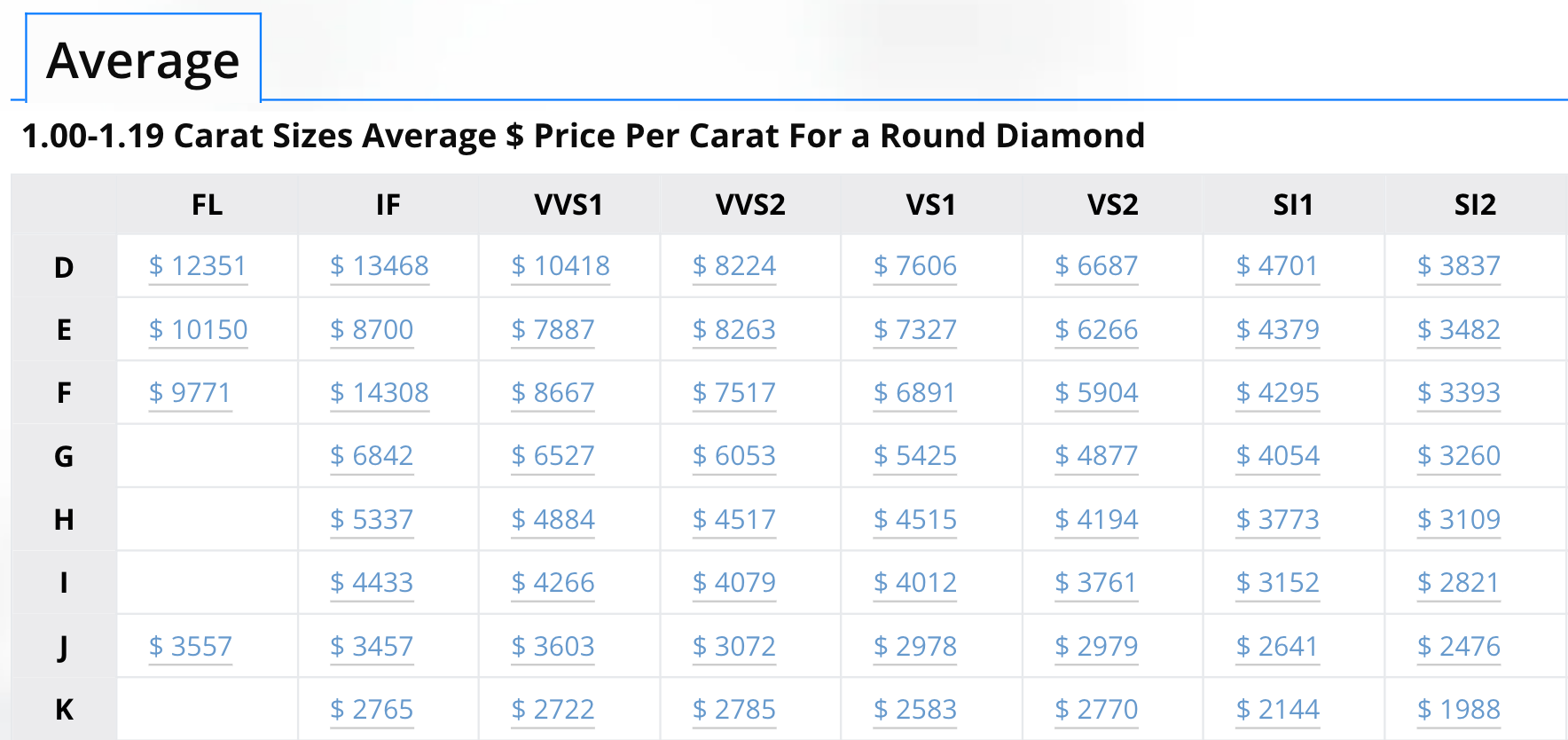
The Las Vegas jewelry shows served as the definitive barometer for US market sentiment. Demand for 2-carat and larger stones in the robust G–J color and VS1–SI2 clarity ranges was exceptionally strong. Round diamonds remain the benchmark, but elongated fancy shapes attracted significant interest from retailers eager to offer differentiated inventory.
The strategic shift is being driven by pricing dynamics. As synthetic diamond prices continue their structural decline, US retailers are pivoting hard into the natural diamond narrative, placing greater value on authenticity, uniqueness, and the story behind each gem. This aligns perfectly with the De Beers Consumer Sentiment data, which shows that gifting now accounts for 44% of natural diamond demand (compared to 25% for bridal), indicating a market driven by emotional resonance rather than just tradition.
India: Manufacturing Powerhouse & Emerging Market
India presents a fascinating dual dynamic. As the world's largest cutting and polishing center, Indian manufacturers and dealers reported healthy demand for 2-carat and larger diamonds. The constraint is now on the supply side, with limited production of rough and premium polished diamonds creating tight supply in these categories. Conversely, smaller diamonds remain challenging.
Simultaneously, domestic demand for natural diamond jewelry is showing strong signs of improvement. The domestic natural diamond jewellery market is valued at ₹49,700 crore and is projected to reach ₹150,000 crore by 2030. India recorded its fourth consecutive year of double-digit growth in natural diamond demand in 2025.
Hong Kong & China: Contrasting Fortunes
Market sentiment in Hong Kong remains cautiously optimistic ahead of upcoming jewelry exhibitions. 3 to 5-carat diamonds and larger investment-grade stones are seeing the strongest demand, driven by high-net-worth buyers treating them as portable stores of value.
However, the Chinese mainland tells a different story. Diamonds below 1 carat remain under pressure, with many consumers choosing synthetic diamonds for everyday jewelry. This regional divergence underscores the need for targeted inventory strategies based on local consumer behavior.
Sellers can register on the CaratX marketplace here to reach 18+ international countries and tap into the growing global demand for premium natural stones.
For a broader selection, shop natural diamonds directly from our marketplace here.
The Rise of Fancy Shapes -
Perhaps the most defining trend of 2026 is the consumer shift away from traditional round brilliants toward elongated fancy shapes. This is not a fleeting fad; it is a fundamental realignment in consumer preference, driven by a desire for individuality, larger visual appearance, and unique elegance.
The Reign of the Marquise -
The Marquise cut diamond has ascended to the pinnacle of the fancy shape market. Its dramatic, navette shape offers unparalleled elegance and remarkable finger elongation. Crucially, high-quality Marquise diamonds are currently commanding the highest price premiums among all fancy shapes not due to hype, but due to scarcity. A well-proportioned, "bow-tie-free" Marquise is rare, making top-tier stones exceedingly difficult to source.
Find rare, high-quality Marquise diamonds and other investment-grade stones available on our marketplace here.
Premium on the "Long" Look -
Long Cushion cuts are selling quickly, often trading at a 20% to 25% premium compared to standard square cushion cuts. Similarly, Long Radiant and Emerald cuts are seeing a surge in desirability.
The reason for this premium is rooted in both supply and demand. An elongated diamond offers more "face-up" size per carat than a round stone of the same weight, maximizing visual impact while maintaining carat weight efficiency. Furthermore, well-cut fancy shapes are becoming increasingly difficult to find as miners and cutters optimize for yield over aesthetics.
Cut Quality & The Certification Imperative
While shape captures the consumer's eye, cut quality determines the diamond's soul. In the premium market segment, poor proportions are a deal-breaker, even in popular shapes.
Why Cut Quality Drives Value -
The GIA (Gemological Institute of America) has established the global standard through its 4Cs system Color, Clarity, Cut, and Carat Weight. Among these, cut is the most complex and technically difficult to analyze, yet it has the greatest impact on a stone's beauty. An expertly cut diamond will appear brilliant even with lower color and clarity grades, while a poorly cut diamond even with top specifications will look dull.
Key insights regarding cut grading:
Round brilliants receive official GIA cut grades ranging from Excellent to Poor
Fancy shapes (oval, marquise, emerald, cushion) do not receive a unified cut grade; instead, their quality is assessed through proportions, symmetry, and polish
Well-cut fancy shapes often command premium prices, while poorly proportioned fancy stones can be difficult to sell regardless of their carat weight
For the science behind these characteristics, read CaratX's Diamond Type Classification: Guide to Geology, Rarity and Smart Buying here and explore the Ultimate Guide to Diamond Carat Size and Cut here.
Authenticity, Sustainability & The Kimberley Process -
Today's diamond buyer, particularly Millennials and Gen Z, demands more than a shiny stone. They demand provable provenance. According to De Beers' acquisition data, Millennials accounted for 55% of natural diamond demand, while Gen Z emerged as the second-largest buying generation, contributing 23% of demand value. Gen Z consumers spend nearly twice as much per purchase as Baby Boomers.
The 3Cs Framework: Credibility, Compliance, Consumer Confidence
Under India's 2026 Chairship of the Kimberley Process (KP), the industry has rallied around a new 3Cs framework. The recent KP Intersessional Meeting in Mumbai concluded with a unified focus on reinforcing trust in ethically sourced natural diamonds through:
Credibility: Strengthening certification systems and independent auditing
Compliance: Enhancing monitoring of the Kimberley Process Certification Scheme (KPCS)
Consumer Confidence: Improving communication about responsible sourcing
The discussion moved beyond mere conflict-free compliance to include sustainability, blockchain traceability, and community impact.
Supply-Demand Dynamics & Future Outlook
The macroeconomic picture for natural diamonds is one of tightening supply and resilient premium demand. De Beers forecasts global rough diamond production will fall from approximately 105 million carats in 2026 to 96 million carats by 2030.
Academic Validation of Market Trends -
Rigorous academic research confirms these market shifts. A peer-reviewed study published in the Journal of Gems & Gemmology notes: "The natural diamond sector maintains value and market stability through controlled extraction volumes and enhanced certification systems". The same analysis concludes that "scarcity, historical significance, and emotional resonance of natural diamonds will provide core support for the industry's recovery and sustainable development".
Key Market Drivers Going Forward
Declining natural diamond production → Tightening supply of premium stones
Falling synthetic diamond prices → Widening perceived value gap; natural stones retain premium positioning
Shift in consumer behavior → Self-purchase and gifting now dominate bridal demand
Rise of fancy shapes → Marquise, elongated cushion, and emerald cuts command 20–25% premiums over square equivalents
Frequently Asked Questions (FAQs)
1. Why are larger diamonds outperforming smaller ones in the 2026 market? Larger diamonds are perceived as more durable stores of value and are benefiting from a "flight to quality" among high-net-worth buyers. Academic research confirms that markets are shifting toward "large carat and high clarity" stones as synthetic alternatives compress prices in the lower tiers.
2. Is cut quality more important than carat weight? Yes. The GIA notes that cut has the greatest impact on a stone's beauty. A well-cut diamond will appear brilliant even with lower color and clarity grades, while a poorly cut diamond regardless of carat weight will look dull. For expert guidance, explore the Diamond Guide on the CaratX website here.
3. What should I look for when buying a fancy-shaped diamond? For Marquise and oval cuts, prioritize length-to-width ratios (typically 1.50–2.00 for optimal elegance). Always check for "bow-tie" effect minimization. Long cushion cuts are currently trading at a premium of 20–25% compared to square cushions due to their rarity.
4. Are lab-grown diamonds a good investment? While lab-grown diamonds are chemically identical to natural diamonds, their prices continue to decline due to technological improvements and oversupply. Natural diamonds maintain a premium positioning due to their geological rarity, emotional resonance, and controlled supply.
5. How can I verify if my diamond is conflict-free? Look for the Kimberley Process Certification Scheme (KPCS). The KP is an international certification initiative (under UN Resolution 55/56) that tracks diamonds from mine to market to ensure they do not finance civil wars.
Ready to Capitalize on the 2026 Diamond Market Shift?
The window for sellers of premium natural diamonds and fancy-shaped stones has never been wider. Connect with a global audience of B2B and B2C buyers across 18+ international countries.
Sellers: Register on the CaratX Marketplace here — Start selling diamonds, gemstones, and jewelry internationally today.
Buyers: Shop Natural Diamonds and Gemstones here — Access unbeatable prices on premium investment-grade stones.
Jewelry Sellers: Explore our Seller Plan for International Jewelry Sales here — Expand your reach without excessive fees.
Pricing & Plans: More details about our seller plans are available here .
Follow CaratX for more insightful and educational content on the global diamond markets.