
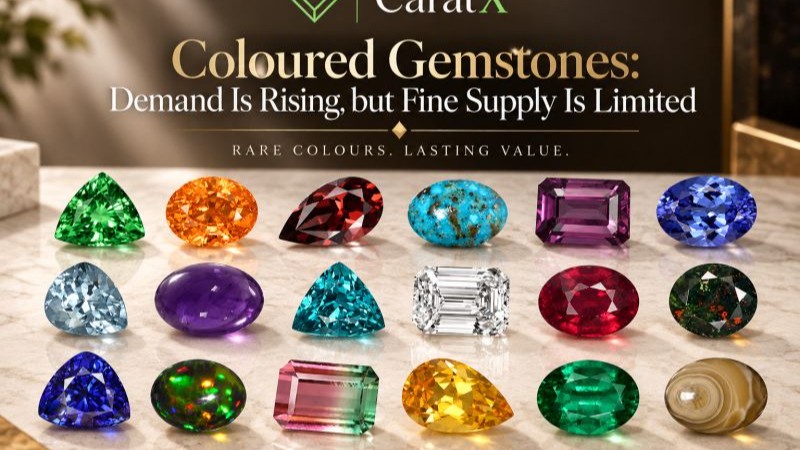
The coloured gemstone market has moved from the margins offine jewelleryinto its centre. What was once a niche pursuit for collectors and connoisseurs has become a defining category for independent jewellers, luxury houses, and a new generation of buyers who value individuality, provenance, and the irreplaceable beauty of stones formed by nature rather than grown in a lab.
But this rise in demand is colliding with a hard geological reality: fine-quality colouredgemstonesare finite. You cannot manufacture a Kashmir sapphire. You cannot scale a Burmese ruby deposit. You cannot rush a Colombianemeraldout of the earth. The market is expanding, but the supply of the very best stones is contracting and that tension is reshaping prices, buying strategies, and the entire coloured gemstone value chain.
This article examines the forces driving demand, the supply constraints that define the market, the specific gems capturing attention, and what buyers and sellers need to know in 2026 and beyond.
The Market in Numbers:
The global coloured gemstone market is expanding at a pace that would be remarkable in any luxury category. Estimates place the market at approximately US$106.8 billion in 2025, with a projected 7% annual growth rate through 2033. Other forecasts paint an even more aggressive picture, with some analysts projecting compound annual growth rates exceeding 20% over the same period.
The variation reflects differing methodologies and scope definitions, but the directional signal is unmistakable:coloured gemstonesare becoming a larger share of the fine jewellery pie.
The retail data tells a complementary story. At independent jewellers in the United States,coloured-stone jewellerysales increased by more than 4% in 2025, while the average purchase value rose nearly 12%. Unit sales, however, declined by approximately 8%. This is not a market of volume; it is a market of value. Buyers are choosing fewer pieces, but they are choosing better pieces stones with stronger colour, better clarity, and more distinctive character.
This pattern higher average tickets, lower unit volumes is consistent across the coloured gemstone sector. It reflects a buyer who is more informed, more selective, and more willing to pay a premium for something genuinely rare. It also reflects the simple arithmetic of scarcity: when fine stones are hard to find, the ones that do come to market command higher prices.
GIA's Tucson 2026 Report:
The Tucson Gem Show remains the global barometer for the coloured gemstone trade. The Gemological Institute of America's (GIA) 2026 Tucson report, published inGems & Gemology, captured a market defined by strong demand for distinctive material and growing anxiety about supply.
Several themes emerged with clarity:
Fancy-colour sapphires dominated buyer interest. According to exhibitors carrying a wide variety of gem materials,fancy-colour sapphiresparticularly pinks and purples, as well as teals and greens were the most popular stones at the show. This represents a meaningful shift from the traditional focus on blue sapphire alone. Buyers are actively seeking colour diversity, and they are willing to pay for it.
Montana sapphire commanded exceptional prices. Strong U.S. and international demand for Montana sapphire drove prices for stones over one carat to exceptional levels, reportedly due to increased global awareness and an unpredictable supply of rough. Montana sapphire has moved beyond a domestic curiosity to become a globally recognised American gemstone.
Garnets sold very well. Sales of unheated "opalescent" or "sleepy" stones continued to be strong, indicating a market appetite for gems with unusual optical character.
Star rubies and sapphires were among the hottest items. Followed by cat's-eye stones, including cat's-eye moonstone. Phenomena stones gems that display asterism, chatoyancy, or colour change are capturing buyer imagination in a way that standard faceted stones sometimes cannot.
High-end and unusual items sold quickly. Vendors with premium goods at attractive price points reported brisk sales, even as foot traffic appeared lower at some venues. The market is bifurcating: commodity material struggles, while exceptional material finds eager buyers.
The GIA report also noted that 80% of coloured gemstones are mined by small-scale and artisanal miners, a fact that has profound implications for supply predictability, ethical sourcing, and the ability of the market to respond to demand signals.
The Supply Constraint:
The defining feature of the coloured gemstone market in 2026 is not demand, it is supply. Natural gemstones depend on what nature produces, in the quantities and qualities that geological processes happen to yield. When demand increases, you cannot simply turn up a dial. You cannot open a factory. You cannot grow a Kashmir sapphire in a crucible and call it the same thing.
This constraint is not theoretical. It is visible in every major coloured gemstone category.
Sapphire: The Premium Segment Dries Up
The Gemports Sapphire Transaction Index (GTI) for Q3 2025 described a market marked by "a deepening supply shortage of the most coveted material". The critical factor is the extreme scarcity of high-quality, unheated blue sapphire, particularly in sizes of 5 carats and above.
This is not a temporary disruption. New discoveries have been offset by the depletion of existing mines, leading to inconsistency in overall sapphire supply over the last few decades. Resource depletion in traditional districts such as Myanmar and Tanzania has intensified scarcity of high-quality rough.
The stones that do come to market certified, unheated, with vivid saturation and eye-clean clarity command a rarity premium that continues to climb.
For serious buyers, the "unheated" status has become non-negotiable. Traditional heat treatment, while widely accepted, lowers a stone's long-term appreciation potential. The value is concentrating in a vanishingly small pool of certified, natural-colour large stones.
Prices for 5-carat-plus unheated sapphires increased by approximately 2% to 4% over a single quarter in Q3 2025, a modest but steady climb that reflects strong underlying demand from collectors and high-end jewellery houses seeking definitive, non-reproducible assets.
Spinel: Demand Exceeds Supply
Spinelhas been one of the quiet success stories of the coloured gemstone market. For centuries, it masqueraded as ruby, the Black Prince's Ruby in the British Imperial Crown is actually a red spinel but in recent decades it has emerged as a gemstone in its own right.
GIA's buyer's guide is unambiguous: "demand exceeds supply". The most commercially important colours are red and pink, but cobalt-blue spinel can be exceptionally valuable. Fine-quality rough is so scarce that most is cut in non-standard sizes to save weight, rather than in calibrated industry sizes.
The price trajectory tells the story. Spinel prices have increased more than tenfold in the last five to ten years, depending on colour and origin. A red spinel sold in 2016 for $7,700 was replaced by an insurance company in 2023 for $38,000, a nearly fivefold increase in seven years. Sourcing top spinel has become increasingly difficult, and the price gap between ruby and spinel is shrinking as popularity grows.
Montana Sapphire:
Montana sapphire occupies a unique position in the market. It is American-mined, ethically produced under strict environmental regulations, and increasingly sought after both domestically and internationally. The colours are distinctive blues and teals, but also bicolour and parti-colour stones, yellows, oranges, and pinks.
But the supply is inherently limited. Yogo Gulch, the source of Montana's most famous saturated true blues, currently has no new material coming out. Rock Creek and the Missouri River are producing, but almost all Montana sapphire material finishes in small sizes; polished stones over 1 carat are rare.
The unpredictability of supply combined with growing global awareness has driven prices for stones over one carat to exceptional levels. Montana sapphire is not a volume product. It is a connoisseur's stone, and it is priced accordingly.
Ruby and Emerald:
Rubyandemerald, alongside sapphire, form the "Big Three" of the coloured gemstone world. Both are experiencing supply pressures that mirror sapphire's trajectory.
Fine rubies from Burma (Myanmar) and fine emeralds from Colombia have become harder to come by, according to dealers at the 2026 Tucson show. Demand for fine rubies, blue sapphires, andhigh-quality emeraldswas steady across both retailers and private clients, but the major challenge was sourcing.
The market is responding with geographic diversification. Mozambique has emerged as a significant ruby source, and Ethiopia and Brazil have added new emerald supply. But these new sources, while welcome, do not fully replace the legendary material from the traditional deposits. The very best stones, the ones that set auction records and anchor museum collections remain vanishingly rare.
Why Buyers Are Turning to Coloured Gemstones -
The supply constraint is only half the story. The demand side is equally important, and it is driven by forces that are unlikely to reverse.
Diamonds Are No Longer the Default -
For generations, diamonds were the unexamined choice forengagement ringsand fine jewellery. That default is eroding. As diamond prices have softened andlab-grown diamondshave flooded the market, buyers have begun to question what makes a stone valuable. The answer, increasingly, is rarity and coloured gemstones offer rarity in a way that diamonds, for all their sparkle, often do not.
A high-quality Kashmir sapphire is rarer than most large D-colour diamonds. A fine red spinel is rarer than ruby of similar appearance in many cases. Buyers who understand this are gravitating toward coloured stones not as a compromise, but as an upgrade in exclusivity.
The Rise of the Informed Buyer -
Today's coloured gemstone buyer is more educated than ever. GIA's online gemology courses, gem identification programmes, and coloured stone grading resources have democratised access to gemological knowledge. Buyers know the difference between heated and unheated stones. They understand the significance of origin. They ask for lab reports.
This education has shifted the conversation from "Is it pretty?" to "Is it rare, is it natural, and is it well-documented?" That shift favours coloured gemstones, which have a depth of provenance and character that mass-market diamonds often lack.
Distinctiveness as a Value Proposition -
The most important trend in coloured gemstone demand is the search for distinctiveness. Buyers are no longer satisfied with a standard blue sapphire or a standard red ruby. They want fancy colours pinks, purples, teals, greens, yellows, oranges. They want unusual varieties spinel, tourmaline, garnet, zircon, moonstone. They want stones with optical phenomena star rubies, cat's-eye sapphires, colour-change gems. They want bicolour and tricolour stones that display multiple colours in a single crystal.
This is not a passing fad. It reflects a deeper cultural shift: in a world of mass production and lab-grown uniformity, natural gemstones offer something that cannot be replicated. Their imperfections, their inclusions, their colour zoning, these are not flaws to be hidden. They are signatures of authenticity.
A World of Natural Beauty:
The coloured gemstone world is vast, but several stones are driving the current market conversation.
Ruby:
Ruby is the red variety of corundum, coloured by chromium. The most coveted rubies possess a vivid, slightly purplish-red known as "pigeon's blood" in Burmese origin stones, a term steeped in tradition and value. Ruby ranks 9 on the Mohs scale, second only to diamond among natural gemstones, making it suitable for everyday wear in rings.
The supply challenge is acute. Top Burmese and Colombian stones have become harder to come by, and dealers report that sourcing is the major challenge. For buyers seeking ruby, the CaratX blog offers a deep dive into how fake rubies are grown in a lab and how to spot them, as well as a guide to Mozambique rubies and how new discoveries are reshaping the market.
Shop rubies on CaratX → https://caratx.com/search?query=Ruby
Sapphire: Beyond Blue
Sapphire is also corundum, but it comes in virtually every colour except red.Blue sapphireremains the most commercially important, but fancy-colour sapphires pinks, purples, teals, greens, yellows, oranges are the fastest-growing segment.
The market for fine blue sapphire is bifurcating. Heated material is relatively available and price-stable. Unheated, certified, high-quality blue sapphire particularly 5 carats and above is scarce and appreciating. Buyers who understand this distinction are positioning themselves in the unheated segment.
Montana sapphire deserves special mention. It is American, ethically mined, and uniquely coloured. But supply is unpredictable and limited. Stones over one carat are rare and priced accordingly.
The CaratX blog explores Ceylon sapphire, fancy sapphires, and the science behind sapphire colour in depth.
Shop sapphires on CaratX → https://caratx.com/search?query=Sapphire
Emerald:
Emerald is the green to bluish-green variety of beryl, coloured by chromium and/or vanadium. What distinguishes emerald from less expensive green beryl is the depth and saturation of its colour. Emeralds are famously included their internal fractures and inclusions are often described as "jardin" (French for garden). These inclusions are not defects; they are part of the stone's identity.
Fine Colombian emeralds remain the benchmark, but supply is constrained. Buyers are increasingly open to emeralds from Zambia, Brazil, and Ethiopia, provided the colour and clarity meet their standards. The CaratX blog examines why some gemstones are green and the science behind emerald's colour.
Shop emeralds on CaratX → https://caratx.com/search?query=Emerald
Spinel:
Spinel is magnesium aluminium oxide (MgAl₂O₄), crystallising in the cubic system and forming in metamorphic rocks, particularly marble and schist. It scores 8 on the Mohs scale, harder than emerald and tanzanite, making it well-suited for engagement rings.
The most valued spinel colours are vivid reds and cobalt blues, though bright pinks and oranges are also highly sought. Fine-colour spinel is rare above five carats. The price trajectory has been extraordinary, and supply remains constrained.
CaratX has explored colour-change spinel in depth, and the 31-hue wheel that helps separate fine spinel from ruby in the marketplace.
Shop spinel and other gemstones on CaratX → https://caratx.com/search?query=Spinel
Tourmaline:
Tourmalineis one of the most colour-diverse gemstones in existence. It occurs in every hue of the spectrum, and some crystals display multiple colours in a single stone bicolour and tricolour tourmaline. Paraíba tourmaline, with its vivid neon blue-green, is among the most valuable coloured gemstones in the world.
Tourmaline's versatility and colour range make it a favourite among designers and buyers seeking something genuinely unique. The CaratX gemstone guide covers tourmaline alongside 38 other gemstones.
Garnet, Amethyst, Citrine, and Beyond -
The coloured gemstone market extends far beyond the Big Three. Garnet sold very well at Tucson 2026, particularly unheated "opalescent" stones. Amethyst remains one of the most popular and accessible purple gemstones.Citrineoffers warm yellow and golden tones at accessible price points.
How to Evaluate a Coloured Gemstone -
A gemstone's beauty and value are determined by a combination of factors. Understanding these factors is essential for anyone buying coloured gemstones, whether as a collector, a retailer, or a first-time buyer.
Colour:
In coloured gemstones, colour is king. For stones like ruby, sapphire, and emerald, colour typically accounts for up to 60% of the value in high-end stones. Gemologists break colour down into three components:
Hue : The basic colour family red, orange, yellow, green, blue, violet. The most valuable stones exhibit a pure, spectral hue.
Tone : The lightness or darkness of the colour. Stones that are too light or too dark lose value.
Saturation : The intensity or purity of the colour. Vivid saturation commands the highest premiums.
The GIA Colored Stone Grading System provides a standardised framework for describing colour using hue, tone, and saturation. CaratX has developed a 31-hue wheel that refines this system for practical use in the marketplace.
Clarity:
Clarity refers to the presence of inclusions and blemishes. In coloured gemstones, clarity expectations vary by species. A flawless emerald is virtually unheard of; the presence of jardin is expected and accepted. A spinel, by contrast, is expected to be relatively free of inclusions in pastel colours, though saturated reds and blues may have some inclusions.
The key is to understand what is normal for the gemstone species and variety, and to evaluate clarity in that context.
Cut:
Cut is often underestimated in coloured gemstones. A well-cut stone returns light evenly across its surface, creating brilliance and life. A poorly cut stone one with a window (a transparent area that lets light pass through without reflection) or excessive extinction (dark areas that absorb light) will look dull regardless of colour quality.
Because fine coloured gemstone rough is so scarce, cutters often prioritise weight retention over ideal proportions. This makes well-cut coloured gemstones even rarer and more valuable.
Carat Weight:
In coloured gemstones, size and rarity are directly linked. A 5-carat fine blue sapphire is not simply five times rarer than a 1-carat stone; it is exponentially rarer. The same applies to ruby, emerald, and spinel. Large fine stones are the exception, not the rule.
Treatment:
Treatment is a critical consideration. Heat treatment is common and widely accepted for sapphire and ruby, but unheated stones command significant premiums. Emerald treatment with oil or resin is standard, but the degree of treatment affects value. Disclosure of treatment is essential, and reputable sellers provide full transparency.
The American Gem Trade Association (AGTA) maintains a Code of Ethics and Gemstone Information Manual that sets standards for disclosure in the coloured gemstone trade. Buyers should insist on disclosure and, for significant purchases, a lab report from an independent laboratory such as GIA.
Selling Coloured Gemstones in a Constrained Market -
For jewellers, designers, and dealers, the coloured gemstone market presents both opportunity and challenge. Demand is rising, but supply is limited. The sellers who thrive will be those who adapt to this reality.
Focus on quality over quantity. In a market where fine stones are scarce, every fine stone is valuable. Curate carefully. Build relationships with suppliers who can deliver consistent quality.
Tell the story. Buyers want to know where a stone came from, how it was mined, and what makes it special. Provenance is not just a marketing angle; it is a value driver.
Invest in education. The more you know about coloured gemstones their geology, their treatment, their grading, the better you can serve your customers and the more confident you will be in your buying decisions.
Use the right platform. CaratXconnects sellers with B2B and B2C buyers across 18+ international countries. Sellers can register on the CaratX marketplace to reach retailers, designers, and collectors who are actively seeking coloured gemstones.
Start selling on CaratX → www.caratx.com/register
Recommended Reads from CaratX -
The Ultimate Guide to Colored Gemstone Valuation: Beyond Carats and Into the Rainbow— How colour, clarity, cut, and rarity determine value in the coloured gemstone market.
Beyond the Hue: A Connoisseur's Dive into Why Colour is Everything in Gemstones, But Not the Only Thing— A deeper look at the nuances of colour grading and why it matters.
39 Gemstones to Know: A Colorful Guide for Gem Lovers— From ruby to sphene, a comprehensive guide to the gemstone spectrum.
Why Gem Prices Are Climbing and What Retailers Should Expect in 2025— The supply chain dynamics behind rising coloured gemstone prices.
The Colour-Change Spinel: In-Depth Understanding— The science and symbolism of one of nature's most fascinating gemstones.
Frequently Asked Questions -
Are coloured gemstones a good investment? Fine-quality, untreated coloured gemstones have shown strong long-term appreciation, particularly in the top tiers of the market. However, like any investment, they carry risk. Buy stones you love, from reputable sources, with proper documentation. The Gemports Sapphire Transaction Index tracks market performance for sapphire and ruby.
What is the difference between heated and unheated gemstones? Heating is a treatment that can improve a gemstone's colour and clarity. It is widely accepted for sapphire and ruby, but unheated stones, which have not been treated command significant premiums, especially for large, fine-quality stones.
How do I know if a gemstone is natural or lab-grown? Natural gemstones form in the earth over millions of years. Lab-grown gemstones are created in a laboratory but have the same chemical and physical properties. A reputable laboratory report from GIA or another independent lab will confirm whether a stone is natural or lab-grown. GIA's Gem Identification resources explain the differences.
What is the most valuable coloured gemstone? Value depends on colour, clarity, cut, size, rarity, and treatment. Fine Burmese rubies, Kashmir sapphires, and Colombian emeralds are among the most valuable. Fine red spinel and Paraíba tourmaline also command exceptional prices.
Where can I buy coloured gemstones? CaratX connects buyers with gemstones from over 16 countries and 200+ artisan sellers. You can shop gemstones on the CaratX marketplace or browse our full range of premium diamonds and gemstones.
How should I care for coloured gemstones? Care depends on the gemstone's hardness and treatment. Ruby and sapphire (Mohs 9) are durable and suitable for everyday wear. Emerald (Mohs 7.5–8) requires more care due to its inclusions. Avoid ultrasonic cleaners for emeralds and treated stones. Consult the AGTA Gemstone Information Manual for specific care guidance.
Start Selling or Shopping on CaratX -
CaratXconnects the diamond, gemstone, jewellery, and pearl industry on a single global marketplace. We bring thousands of unique jewellery pieces, loose diamonds, gemstones, and pearls from over 16 countries and 200+ artisan sellers to buyers around the world.
For sellers: Register on CaratX to start selling to B2B and B2C buyers in 18+ international countries. Our specialised marketplace ensures your products reach serious buyers who are actively seeking diamonds, gemstones, and fine jewellery.
Start selling on CaratX → https://caratx.com/sell-on-caratx
For buyers: Shop gemstones from the CaratX marketplace at competitive prices. Browse our collection of premium diamonds and gemstones, each hand-selected for brilliance, quality, and unique beauty.
Shop gemstones on CaratX → https://caratx.com/search?query=gemstones
For more details: Learn about our pricing and seller plans on ourLaunch Your Products on CaratX page.