
Diamondshave captivated humanity for centuries with their brilliance, fire, and timeless beauty. But there is one aspect of these preciousgemstonesthat remains shrouded in mystery for many buyers, sellers, and even industry professionals: diamond fluorescence. When exposed to ultraviolet (UV) light, some diamonds emit a visible glow, a phenomenon that has sparked debate, influenced pricing, and even served as a tool for identifying natural versus synthetic stones.
In this guide, we will explore the science behind diamond fluorescence, the specific defect centers that cause different glow colors, how fluorescence affects diamond value, and why understanding this characteristic is essential for anyone buying or selling diamonds in today's global marketplace.
What Is Diamond Fluorescence?
Fluorescence is the emission of visible light by a substance when it absorbs electromagnetic radiation in this case, ultraviolet (UV) light. When a diamond is exposed to long-wave UV rays from sources like sunlight or fluorescent lighting, it can emit a visible glow that persists only as long as the UV source remains active.
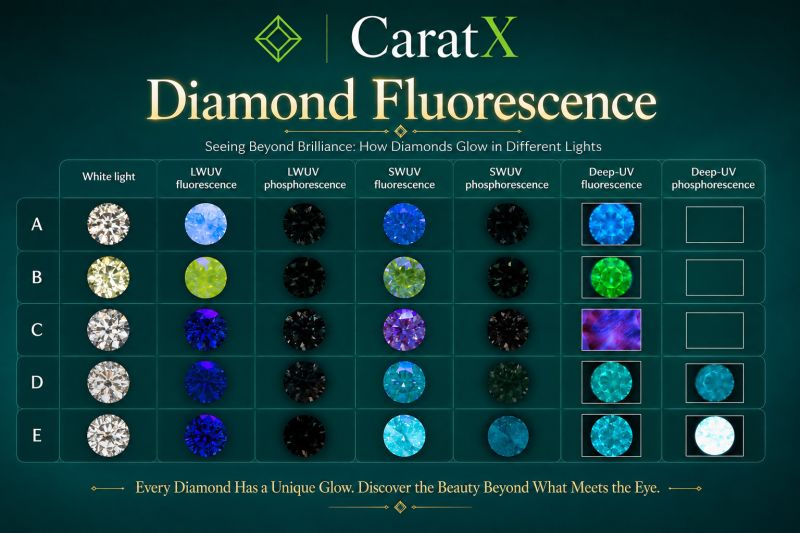
Interestingly, only about 25% to 35% of diamonds exhibit some degree of fluorescence when exposed to long-wave UV light. Among those that do fluoresce, more than 95% emit a blue glow, while a rare few produce other colors such as yellow, green, orange, or red.
The cause of this fascinating phenomenon lies deep within the diamond's crystal lattice at the atomic level.
The Science Behind Fluorescence:
Diamonds are composed almost entirely of carbon atoms arranged in a crystalline structure. However,natural diamonds often contain impurities and structural irregularities known as defect centers or color centers that interact with light in unique ways.
When UV light strikes a diamond, these defect centers absorb the energy and re-emit it as visible light. The specific color of the fluorescence depends entirely on the type of defect center present and its electronic configuration.
Let us examine the most important defect centers responsible for diamond fluorescence.
N3 Center → Blue Fluorescence
The N3 center is the most common cause of blue fluorescence in natural diamonds and by far the most frequently observed fluorescence color in the gem trade.
The N3 center consists of three nitrogen atoms surrounding a single vacancy (a missing carbon atom) in the diamond lattice. This defect produces a characteristic zero-phonon line (ZPL) at 415.2 nm and a broad emission band spanning approximately 400–550 nm.
GIA research has shown that N3-related emission reaches its maximum intensity at 395 nm excitation energy and is not excited above 430 nm.
The N3 center is so prevalent in natural diamonds that its presence and the resulting blue fluorescence has become a reliable indicator of natural origin. The deep blue, N3-related fluorescence is so common among mined diamonds that the color itself can often verify that a diamond is not synthetic. In fact, the N3 center has been detected in approximately 93% of fancy red diamondsgraded at GIA.
The N3 center also plays a critical role in distinguishing natural from synthetic diamonds. The DiamondSure instrument, developed by the Diamond Trading Company, operates by detecting the presence of the N3 center a defect that is not produced by normal diamond synthesis processes.
H3 and H4 Centers → Green Fluorescence
The H3 and H4 centers are responsible for producing green and yellow-green fluorescence in diamonds.
The H3 center consists of a vacancy trapped at an A aggregate of nitrogen specifically, two nitrogen atoms separated by a vacancy, with the structure (N-V-N)⁰. It has a zero-phonon line at 503.2 nm and commonly produces green luminescence with visible-light stimulation.
The H4 center consists of four nitrogen atoms separated by two vacancies (4N-2V). It has a ZPL at 496 nm and typically produces green fluorescence as well.
Both H3 and H4 centers can occur naturally or be created through treatment processes. Research has shown that while both produce green fluorescence, H3 fluorescence appears more yellowish-green, whereas H4 produces a purer green fluorescence.
These defect centers are particularly important in the study ofnatural green diamondsand diamonds with yellowish-green body colors.
NV⁰ Center → Orange Fluorescence
The neutral nitrogen-vacancy center (NV⁰) is a nitrogen-related defect that produces orange fluorescence.
The NV center is formed when a single nitrogen atom combines with a vacancy in the diamond lattice. The neutral state (NV⁰) has a zero-phonon line at 575 nm and produces orange fluorescence.
The NV center can exist in two charge states:
NV⁰ (neutral) → ZPL at 575 nm → Orange fluorescence
NV⁻ (negatively charged) → ZPL at 637 nm → Red fluorescence
The relative intensity of these two centers determines whether the observed fluorescence appears more orange or more red.
NV⁻ Center → Red Fluorescence
The negatively charged nitrogen-vacancy center (NV⁻) contributes to red fluorescence in diamonds.
The NV⁻ center has a zero-phonon line at 637 nm and, alongside its strong sidebands at longer wavelengths, produces a distinct red glow.
While most natural type IIa diamonds show blue fluorescence due to N3 centers or dislocations, rare specimens can exhibit bright red fluorescence when they contain high concentrations of NV centers.
The NV center has gained significant attention beyond gemology, it is now at the forefront of emerging optical quantum technologies. Photoluminescent defects in diamond, particularly the NV color center, are being studied for applications in quantum computing, magnetic field sensing, and imaging.
GR1 Center → Vacancy-Related
The GR1 center is fundamentally different from the nitrogen-related defects discussed above. It is linked to missing carbon atoms (vacancies) and radiation damage.
The GR1 center is believed to be a neutral vacancy (V⁰) defect with a zero-phonon line at 741.2 nm.
This defect is a typical radiation-induced defect created when carbon atoms are displaced from their normal positions in the diamond lattice either through natural radiation exposure or laboratory treatment.
The GR1 center is particularly important when studying irradiated green diamonds. However, it is essential to understand that the presence of GR1 does not simply mean green fluorescence, it indicates radiation damage and vacancy formation.
The thermal behavior of the GR1 center provides valuable insights: vacancies begin to move at approximately 500°C, and the GR1 center begins to decrease until it disappears at around 800°C. This temperature-dependent behavior is crucial for understanding the treatment history of diamonds.
Diamond Fluorescence vs. Diamond Color: Understanding the Difference
One of the most common misconceptions about diamond fluorescence is confusing it with diamond body color.
Diamond color refers to the permanent hue of the diamond as seen in normal white light ranging from colorless (D grade) to yellow, brown, or fancy colors like pink, blue, or green. This color is caused by absorption of visible light by defect centers.
Diamond fluorescence, by contrast, is a temporary reaction to UV light the diamond only glows when exposed to UV radiation and stops glowing when the UV source is removed.
Some defect centers can cause both body color and fluorescence, but they are distinct optical phenomena. For example, the N3 center causes blue fluorescence but does not necessarily produce a blue body color in fact, N3 absorption at 415 nm encroaches on the blue end of the visible spectrum and can affect the body color of diamonds.
How Fluorescence Affects Diamond Value -
The impact of fluorescence on diamond value is complex and often misunderstood. The relationship between fluorescence and price depends on several factors, including:
Color Grade -
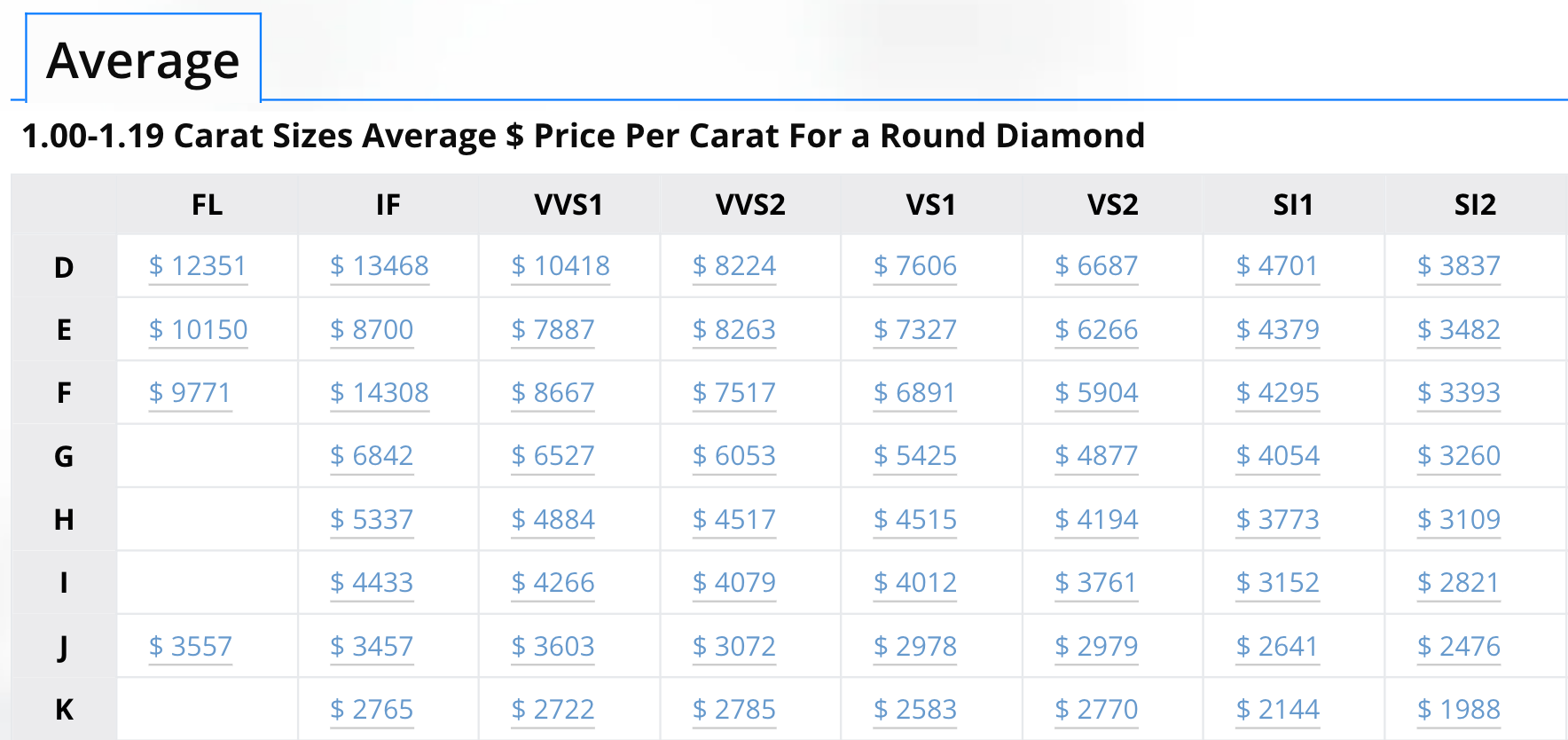
D-to-H color range: Diamonds with bluish fluorescence in this range are often considered less desirable than similar diamonds without fluorescence. Some believe that bluish fluorescence may cause these higher-color diamonds to appear hazy or oily.
I-to-N color range: Diamonds with medium to strong bluish fluorescence may command a slightly higher per-carat price than diamonds with similar color grades that do not fluoresce. This is because the blue fluorescence can counteract the yellowish tint in lower-color diamonds, making them appear more colorless in UV-rich daylight.
Intensity Level -
GIA describes diamond fluorescence intensity under long-wave UV light using five categories: None, Faint, Medium, Strong, and Very Strong.
Strong or Very Strong blue fluorescence in higher color grades (D-F) may result in price reductions of approximately 5 to 15%
Faint fluorescence typically has minimal to no impact on price.
In some cases, strong fluorescence can reduce prices by as much as 25%.
The Haziness Question -
One of the most persistent myths about fluorescence is that it causes diamonds to appear hazy or milky. GIA research has shown that blue fluorescence has little to no impact on transparency except in extremely rare cases where a diamond has a light-scattering defect.
These defects cause haziness that can sometimes be intensified by strong fluorescence, but fluorescence does not cause haziness by itself. This "overblue" hazy effect occurs in fewer than 0.2% of fluorescent diamonds submitted to GIA.
Fluorescence as an Identification Tool -
Beyond its aesthetic and commercial implications, diamond fluorescence serves as a valuable tool for gemological identification:
Distinguishing Natural from Synthetic -
The N3 center is present in most natural diamonds but is not produced by normal diamond synthesis processes. The deep blue N3-related fluorescence is so prevalent among mined diamonds that it can often verify that a diamond is not synthetic.
Identifying Treatment -
The presence of the GR1 center can indicate radiation damage from either natural sources or laboratory treatment. The thermal behavior of GR1 disappearing at temperatures above 800°C provides clues about whether a diamond has been heated.
Advanced Imaging Techniques -
Instruments like the DiamondView use short-wave UV light to excite fluorescence and reveal growth patterns and defect distributions that are invisible to the naked eye.
These fluorescence patterns help scientists understand:
The original distribution of impurities during diamond growth.
The incorporation and migration of atomic defects.
Whether a diamond is natural or synthetic.
The Role of Diamond Fluorescence in the Modern Diamond Trade -
For diamond sellers, understanding fluorescence is not just academic, it has real commercial implications.
AtCaratX, we connect diamond sellers to buyers in over 18 countries through our global B2B and B2C marketplace. Understanding fluorescence allows sellers to:
Accurately describe their diamonds to buyers.
Price diamonds appropriately based on fluorescence characteristics.
Identify market opportunities for example, lower-color diamonds with strong blue fluorescence can offer excellent value.
Distinguish natural from synthetic stones.
Whether you are a wholesaler, retailer, jeweler, or broker,CaratXprovides the platform to sell diamonds, gemstones, and jewelryto a global audience.
Start Selling on CaratX Today -
Ready to take your diamond business global?CaratXconnects you to buyers in over 18 countries through our AI-powered B2B and B2C marketplace.
Register as a Seller– Start selling to B2B wholesalers and B2C retail buyers.
Shop Natural Diamonds– Browse our collection of natural diamonds at competitive prices.
Shop Gemstones– Find gemstones from our global marketplace.
Learn About Our Pricing– Explore our seller plans and transaction fees.
Recommended Reads from CaratX -
Global Diamond Markets Show Growing Confidence After Las Vegas: The 2026 Recovery Takes Shape– An in-depth analysis of post-Las Vegas jewelry show trends, regional market opportunities, and the structural divergence between natural and lab-grown diamonds as the 2026 recovery solidifies.
Belief, a Bitcoin Ransom, and 50,000 Products: How CaratX Survived and Scaled– The founder’s firsthand account of building CaratX from the ground up to over 50,000 products, including the gripping story of surviving a Bitcoin ransomware attack and emerging stronger.
JCK Las Vegas 2026: The Great Diamond Market Reset – 10 Key Takeaways for a New Era– Ten essential insights from JCK Las Vegas 2026, covering the "K-shaped" market divergence, surging demand for 2+ carat diamonds, and how soaring gold prices are reshaping consumer spending.
Small Diamond Prices Show Early Signs of Recovery: A Detailed Market Analysis for May 2026– A data-driven breakdown of the stabilization in small diamond prices, including a 2.1% month-over-month increase for 0.30-carat diamonds and the consumer demand surge driven by U.S. Mother's Day spending.
Why Red Diamonds Are the Rarest of All Natural Colored Diamonds– An exploration of the geological origins and extraordinary investment value of red diamonds—the rarest of all natural fancy-color diamonds on Earth.
The Definitive 2025 Guide: Moissanite vs Diamonds – Science & Market Revolution– A comprehensive scientific and market-based comparison between moissanite and diamonds, covering geology, optical properties, and evolving consumer trends.
Color Code of the Earth: Decoding the Secret Language of Gemstones– A journey into the geology of colored gemstones—how millions of years of extreme pressure, temperature, and chemical conditions create nature's most vibrant treasures.
Diamond Facets – Understanding the Architecture of Brilliance– A deep dive into the optical science of diamond cutting: the function of crown and pavilion facets, and how they work together to produce brilliance, fire, and scintillation.
More Related Blog Content from CaratX -
The following CaratX blog posts are highly relevant to diamond fluorescence, diamond science, and current industry trends:
The Diamond Market Right Now: What's Trending & What Is Hot– An overview of the ongoing transformation in the diamond industry, including shifting consumer preferences and the impact of economic uncertainty on global markets.
India's Diamond Export: A 20-Year Low, Global Shifts, and the Lab-Grown Diamond Surge– An examination of why India's diamond exports have hit a two-decade low, alongside the effects of U.S. tariffs and the rapid rise of lab-grown diamonds.
GIA Expands International Lab Services Amid U.S. Tariffs: A Strategic Shift in Diamond Grading– How the Gemological Institute of America is expanding its laboratory services in Dubai and Hong Kong in response to new U.S. diamond import tariffs.
The Fiery Rarity: Unlocking the Secrets of Orange Diamonds– A deep dive into the atomic anomalies involving nitrogen and plastic deformation that create the stunningly rare orange diamond.
Facets of a Diamond: The Star Facet – Understanding the Essential Brilliance Enhancer– A detailed look at why the star facet though one of the smallest on a diamond plays a massive role in overall light performance and visual appeal.
How the U.S. Is Reshaping Global Diamond Trade – A Deep Dive into Challenges, Strategies, and Opportunities– An analysis of how the $55 billion U.S. diamond market which accounts for over half of global demand is being disrupted by new tariff policies and what that means for international sellers.
Frequently Asked Questions -
Q1: Is diamond fluorescence good or bad?
A: Neither, it depends on the context. For diamonds in the I-to-N color range, blue fluorescence can be beneficial by making the diamond appear whiter. For D-to-H color range diamonds, strong blue fluorescence may reduce value. The effect on appearance is minimal in the vast majority of cases.
Q2: Can all diamonds fluoresce?
A: No. Only about 25% to 35% of diamonds exhibit fluorescence when exposed to long-wave UV light.
Q3: What color fluorescence is most common?
A: Blue is by far the most common, accounting for more than 95% of fluorescent diamonds.
Q4: Does fluorescence affect diamond clarity?
A: No. Fluorescence is independent of clarity and is not a grading factor like the GIA 4Cs (Color, Clarity, Cut, and Carat Weight).
Q5: Can fluorescence be seen in normal light?
A: Usually not. Fluorescence is only visible under UV light (such as sunlight or fluorescent lighting). The glow stops when the UV source is removed.
Q6: What causes different fluorescence colors?
A: Different defect centers in the diamond lattice:
N3 → Blue
H3/H4 → Green
NV⁰ → Orange
NV⁻ → Red
GR1 → Vacancy-related (radiation damage)
Q7: Is fluorescence a sign of a treated diamond?
A: Not necessarily. Many natural diamonds fluoresce. However, the presence of certain defects like GR1 can indicate radiation damage from either natural or laboratory sources.