
Introduction:
Blue diamondsoccupy a singular place in the world ofgemstones. They are among the rarest natural diamonds on Earth, and their mesmerizing blue hue has captivated collectors, scientists, and royalty for centuries. From the legendaryHope Diamondat the Smithsonian to record-breaking auction stones like the Mellon Blue, these gems represent the intersection of extraordinary geology, extreme rarity, and breathtaking beauty.
According to research from the Gemological Institute of America (GIA),less than 0.02% of all diamonds minedare classified as natural blue diamonds. This extreme scarcity, combined with their unique scientific origin story, makes them one of the most fascinating categories in all of gemology.
In this guide, we will explore the science behind blue diamond color, the GIA color grading scale, their incredible geological formation deep within the Earth's mantle, market dynamics, and what buyers need to know when considering a blue diamond purchase. Whether you are a collector, investor, or simply a gemstone enthusiast, this article will provide you with authoritative, research-backed insights into the world of blue diamonds.
The Science Behind the Blue: Boron and Type IIb Diamonds
What Makes a Diamond Blue?
The beautiful blue color in natural blue diamonds is primarily connected to tiny amounts of boron inside the diamond's crystal structure. Boron is an element that absorbs red, yellow, and green light, leaving only the blue spectrum to be transmitted through the stone. This selective light absorption is what creates the signature blue appearance.
Mostnatural blue diamondswith unmodified blue color are classified as Type IIb, a rare diamond type containing boron within the carbon lattice. Type IIb diamonds are statistical outliers in thediamondworld. While most diamonds contain nitrogen impurities (Type Ia), Type IIb diamonds are distinguished by the presence of boron, which not only imparts color but also makes these diamonds electrically conductive.
The Boron Anomaly -
Boron is a rare element that is typically found near the Earth's surface, concentrated in ocean sediments and the oceanic crust. Its presence deep within the Earth's mantle, where diamonds form is unexpected and scientifically challenging to explain.
According to research published byGIA, natural type IIb diamonds typically contain extremely small concentrations of uncompensated boron, ranging from about 0.24 to 0.36 parts per million (ppm). For comparison, the famous Blue Moon diamond was found to contain 0.26 ± 0.04 ppm of uncompensated boron.
The concentration of boron directly correlates with color intensity. Research from GIA has shown that uncompensated boron concentrations range from 25 parts per billion (ppb) for a Faint blue diamond up to 1,500 ppb for a Fancy Vivid blue diamond. This relationship between boron concentration and color saturation is fundamental to understanding blue diamond value.
The GIA Color Grading Scale for Blue Diamonds -
Understanding Fancy Color Grading -
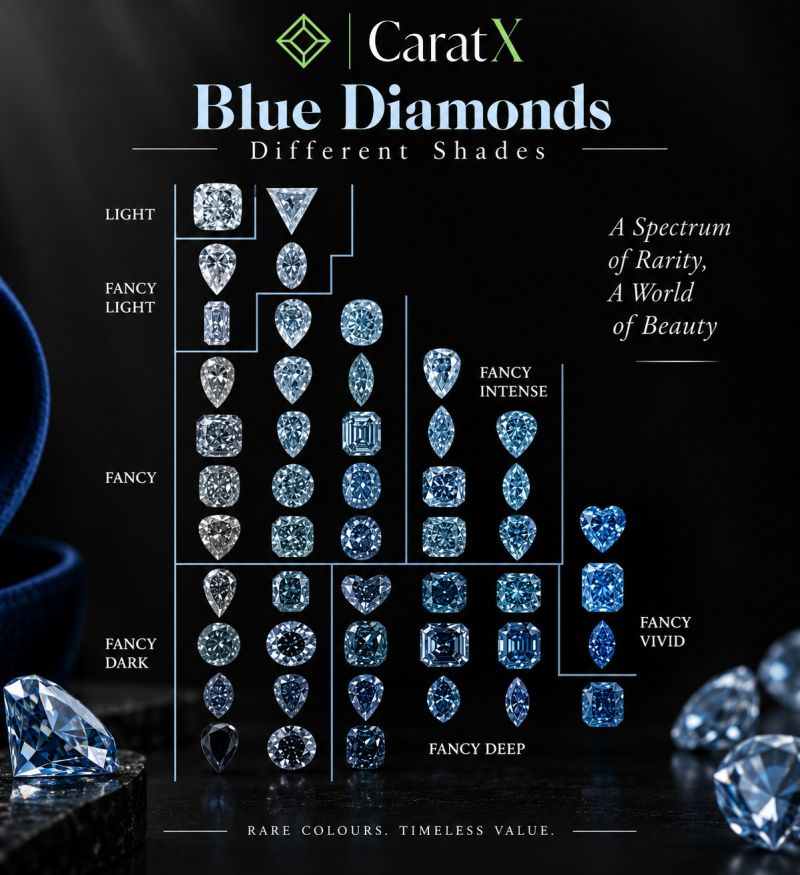
Unlike colorless diamonds, which are graded on the absence of color using the D-to-Z scale, fancy colored diamonds like blues are evaluated using a three-dimensional system: hue, tone, and saturation. The GIA Colored Diamond Grading System uses a nine-tier scale to describe color intensity. For blue diamonds, the grades from palest to most intense are:
- Faint Blue – The lightest blue grade, with minimal saturation.
- Very Light Blue – Soft and delicate color with a gentle blue presence.
- Light Blue – A slightly more noticeable blue hue.
- Fancy Light Blue – A clearer, more noticeable blue that is still light in tone.
- Fancy Blue – A balanced and attractive blue shade that represents the midpoint of the grading scale.
- Fancy Intense Blue – Stronger and more saturated color with significant visual impact.
- Fancy Vivid Blue – Bright, rich, and highly saturated blue — the pinnacle of color intensity.
- Fancy Deep Blue – Darker blue with strong color depth.
- Fancy Dark Blue – A very dark blue appearance with deep, moody tones.
Detailed Breakdown of Each Grade -
Very Light Blue diamonds exhibit a soft and delicate color, often with a grayish or steely undertone. These are among the most accessible entry points intoblue diamondownership.
Fancy Light Blue represents a clearer, more noticeable blue. According to the International Gem Society, due to the extreme rarity ofblue diamonds, gem graders rate nearly any diamond with a discernible blue hue as Fancy Light or better.
Fancy Blue is a balanced and attractive shade that represents a true "blue" appearance without excessive darkness or lightness.
Fancy Intense Blue diamonds display stronger saturation and are significantly rarer than lower intensity grades. The Cullinan Dream, a 24.18-carat Fancy IntenseBlue diamond, exemplifies this prestigious grade.
Fancy Vivid Blue represents the absolute pinnacle of blue diamond color. These stones account for only a small fraction of fancy-color diamonds discovered worldwide. Their exceptional rarity drives prices to 100% or more per carat above comparable Fancy Intense diamonds.
Fancy Deep Blue and Fancy Dark Blue are darker in tone. The legendary Hope Diamond is classified as a Fancy Deep Grayish Blue diamond.
Secondary Colors and Modifiers -
It is important to note that some natural blue diamonds can also have gray or violet-blue tones, giving them a distinctly different look. The most common secondary hues are gray and green. While a pure blue hue without secondary colors is most valuable, grayish-blue and greenish-blue diamonds can offer beautiful alternatives at more accessible price points.
Formation and Origin:
The Superdeep Origin of Blue Diamonds -
One of the most remarkable scientific discoveries about blue diamonds is their extraordinary depth of formation. Groundbreaking research published in the journalNaturein 2018 revealed that blue diamonds form at extreme depths approximately four times deeper than most other diamonds reaching 410 miles (660 km) or more into the Earth's lower mantle.
The minerals identified in these inclusions are only found together at extremely high pressures, confirming that Type IIb diamonds formed at least as deep as the transition zone (410–660 km), reaching into the lower mantle.
The Role of Subduction and Ancient Oceans -
How did boron, an element concentrated at the Earth's surface end up in diamonds forming hundreds of kilometers underground? The answer lies in plate tectonics and subduction.
According to research fromCarnegie Science, the boron in blue diamonds originated from ancient seafloors that were transported deep into the Earth's interior when one tectonic plate slid beneath another, a process known as subduction.
When seawater infiltrates the ocean floor, it causes chemical reactions that deposit boron into the oceanic lithosphere. This boron is incorporated into water-rich minerals like serpentine. When these hydrated minerals are subducted to lower mantle depths, the increased temperature and pressure break them down, releasing a boron-enriched fluid that triggers diamond growth.
This discovery reveals not only that blue diamonds are among the deepest diamonds ever found, but also that boron and water can be carried from the ocean deep into the mantle evidence of a super-deep hydrological cycle.
Implications for Earth Science -
The study of blue diamonds has profound implications for our understanding of Earth's deep interior. As Carnegie's Steven Shirey noted, "Most previous studies of super-deep diamonds had been carried out on diamonds of low quality.
But between our finding that the world's biggest and most-valuable colorless diamonds formed from metallic liquid deep inside Earth's mantle and this new discovery that blue diamonds also have super-deep origins, we now know that the finest gem-quality diamonds come from the farthest down in our planet".
Rarity and Value: The Market for Blue Diamonds
Extreme Scarcity -
Blue diamonds are among the rarest natural diamonds. According to GIA research,less than 0.02% of all diamonds minedare classified as natural blue diamonds. The rarity of high-quality blue diamonds is even more pronounced: GIA statistical analysis indicates that fewer than 100 high-quality stones (Fancy Vivid or Fancy Deep grades) reach the market annually.
Price and Investment Performance -
The extreme rarity of blue diamonds translates directly into exceptional value. At the highest end of the spectrum, Fancy Vivid Blue diamonds can cost anywhere from $50,000 to over $500,000 per carat, with exceptional stones exceeding $1 million per carat.
Recent auction results underscore the extraordinary value of blue diamonds:
The Mellon Blue, a 9.51-carat Fancy Vivid Blue diamond, sold for $25.5 million at Christie's Geneva in November 2025, establishing a price of approximately $2.7 million per carat.
The De Beers Cullinan Blue, a 15.10-carat Fancy Vivid Blue diamond, achieved record-breaking prices at auction.
Premium blue diamonds have appreciated over 300% in the past decade, substantially outpacing colorless diamond appreciation.
Famous Blue Diamonds -
The Hope Diamond remains the most famous blue diamond in the world. Weighing 45.52 carats, it is the largest known fancy deep blue diamond and is housed at the Smithsonian's National Museum of Natural History in Washington, D.C.. The Hope Diamond's history spans centuries, having passed through the hands of royalty and heiresses before being donated to the Smithsonian in 1958.
The Cullinan Mine in South Africa (formerly the Premier Mine) is the primary source of the world's rarest blue diamonds. Located near Pretoria, this mine has produced some of the most famous blue diamonds in history, including the Cullinan Blue.
The Wittelsbach-Graff Diamond is another legendary blue diamond, known for its deep blue color and historical significance. Like the Hope Diamond, it is classified as a Type IIb diamond.
Buying Guide:
AtCaratX, every natural blue diamond listing comes with proper certification, ensuring transparency and confidence for buyers. The CaratX marketplace connects discerning buyers with a curated selection ofcertified natural diamonds, gemstones, and fine jewelry from trusted sellers across 18+ countries.
Factors That Influence Value -
- Color Grade: As with all fancy colored diamonds, color is the most important value factor. Fancy Vivid Blue commands the highest premiums.
- Saturation and Tone: Stronger saturation and balanced tone (neither too light nor too dark) are most desirable.
- Secondary Hues: Pure blue without gray or green modifiers is most valuable. However, grayish-blue diamonds can offer excellent value.
- Carat Weight: Larger blue diamonds are exponentially rarer. The Hope Diamond at 45.52 carats remains the largest known.
- Clarity: While clarity is important, it is secondary to color in fancy colored diamonds. Many blue diamonds have inclusions that are tolerated if the color is exceptional.
- Fluorescence: Blue fluorescence is common in diamonds and generally does not negatively impact value in colored diamonds.
Natural vs. Lab-Grown Blue Diamonds -
Lab-grownblue diamonds offer a more affordable alternative to natural blue diamonds. These stones are created using chemical vapor deposition (CVD) with boron doping to achieve the blue color.
While they share the same physical and chemical properties as natural diamonds, their origin and value proposition are different.CaratX's marketplacesupports both natural and lab-grown diamonds, giving sellers the flexibility to serve different customer segments.
For sellers looking to list blue diamonds on CaratX, the platform offers a streamlined registration process.Register as a sellerto start selling to B2B and B2C buyers in 18+ international countries.
Recommended Reads from CaratX -
Explore these related articles and resources from CaratX to deepen your understanding of fancy colored diamonds and the global diamond market:
Why Fancy Color Diamonds Are Capturing Attention in 2026: The Complete Investor & Collector's Guide— A guide to the fancy color diamond market, including investment insights and grading fundamentals.
Beyond the Hope: Geological Rarity, Market Dynamics, and Billion-Year Journey of the World's Rarest Diamonds— Delve into the science and economics of the world's rarest diamonds, including Type IIb blues.
The Guide to Fancy Colored Diamonds: Nature's Most Rare and Vibrant Gems— An overview of all fancy color diamonds, including blue, pink, yellow, and green varieties.
The Types of Natural Diamond Colors: A Complete Guide— Understand the full spectrum of natural diamond colors and their geological origins.
Pink & Blue Diamonds in 2026: Market Selectivity, Rarity, and Investment Outlook— Market analysis focusing on the pink and blue diamond segments.
Not All Blues Are the Same: A Deep Dive into Sapphire, Spinel, Diamond & Tanzanite— Compare blue diamonds with other blue gemstones to understand their unique qualities.
The Art of Buying Loose Diamonds: Your Buyer's Guide— Essential advice on evaluating the 4Cs and purchasing certified diamonds.
Shop Blue Diamonds on CaratX— Browse certified natural blue diamonds from verified sellers across 18+ countries.
Shop Natural Diamonds on CaratX— Explore the full range of natural diamonds, including fancy colors.
Launch Your Products on CaratX— Sellers can learn about pricing, fees, and how to list blue diamonds and other gemstones on the CaratX marketplace.
Frequently Asked Questions -
1. What makes blue diamonds blue?
Blue diamonds get their color from trace amounts of boron incorporated into the diamond's crystal structure. Boron absorbs red, yellow, and green light, leaving only blue light to be transmitted.
2. Are blue diamonds rare?
Yes, extremely rare. Less than 0.02% of all diamonds mined are classified as natural blue diamonds. High-quality Fancy Vivid or Fancy Deep blue diamonds are even rarer, with fewer than 100 reaching the market annually.
3. Where do blue diamonds come from?
Blue diamonds form at extreme depths approximately 410 miles (660 km) or more in the Earth's lower mantle. The boron responsible for their color originated in ancient seafloors that were subducted deep into the Earth's interior.
4. What is a Type IIb diamond?
Type IIb is a rare diamond classification characterized by the presence of boron in the crystal lattice. Type IIb diamonds are electrically conductive and are the primary type of natural blue diamonds.
5. How are blue diamonds graded?
Blue diamonds are graded using the GIA Colored Diamond Grading System, which evaluates hue, tone, and saturation. The scale ranges from Faint Blue to Fancy Vivid Blue and Fancy Dark Blue.
6. What is the most famous blue diamond?
The Hope Diamond is the most famous blue diamond. Weighing 45.52 carats, it is classified as a Fancy Deep Grayish Blue diamond and is housed at the Smithsonian Institution.
7. Can blue diamonds be lab-grown?
Yes. Lab-grown blue diamonds are created using CVD with boron doping. They offer a more affordable alternative to natural blue diamonds while sharing the same physical and chemical properties.
8. How much do blue diamonds cost?
Prices vary widely based on color grade, carat weight, and clarity. Fancy Vivid Blue diamonds can range from $50,000 to over $500,000 per carat, with exceptional stones exceeding $1 million per carat.
Follow CaratX for such insightful and educational content.
Start selling diamonds in 18+ international countries —www.caratx.com/register
Sellers register on the CaratX marketplace to start selling to B2B and B2C buyers —www.caratx.com/register
Shop gemstones from the CaratX marketplace at unbeatable prices —www.caratx.com
Shop natural diamonds —www.caratx.com
More details about pricing —Launch Your Products on CaratX