
Introduction: One Mineral, Infinite Colors
Imagine a single mineral that can produce the deepest, most passionate red the color of love and power and simultaneously the coolest, most serene blue the color of the sky and sea. This is not fantasy; this is the reality of corundum, one of nature's most remarkable mineral species.
Corundum is a crystalline form of aluminum oxide (Al₂O₃) that, in its pure state, is completely colorless. Yet when trace elements find their way into its crystal structure during formation, this humble mineral transforms into some of the most coveted gemstones on Earth:rubyandsapphire.
For millennia, these gemstones have captivated humanity adorned royalty, inspired legends, and driven exploration across continents. Today, they continue to fascinate collectors, investors, and jewelry enthusiasts alike.
In this guide, we'll explore everything from the geological origins of corundum to the subtle chemistry that creates its rainbow of colors, and provide practical guidance for buyers and sellers in today's global gemstone market.
What Is Corundum?
Chemical Composition and Crystal Structure -
Corundum is composed of aluminum oxide (Al₂O₃), with aluminum and oxygen atoms arranged in a hexagonal close-packed structure. This arrangement gives corundum its exceptional physical properties, including remarkable hardness and durability.
Key Properties of Corundum:
Chemical Formula: Al₂O₃
Crystal System: Trigonal (often appearing hexagonal in outline)
Hardness: 9 on the Mohs scale second only to diamond
Specific Gravity: Approximately 4.00
Refractive Index: 1.762 to 1.770
Birefringence: 0.008 to 0.010
Cleavage: None; basal parting present
Toughness: Excellent
Why Is Corundum So Hard -
The strength of corundum comes from the strong ionic bonds between aluminum and oxygen atoms in its crystal lattice. This structure makes it highly resistant to scratching and abrasion which is why corundum is also used industrially as an abrasive (the mineralemery).
According to theGemological Institute of America (GIA), corundum's hardness and resistance to weathering mean it frequently survives the geological processes that destroy its host rocks, eventually concentrating in alluvial deposits where miners can recover it.
Ruby: The Red Corundum
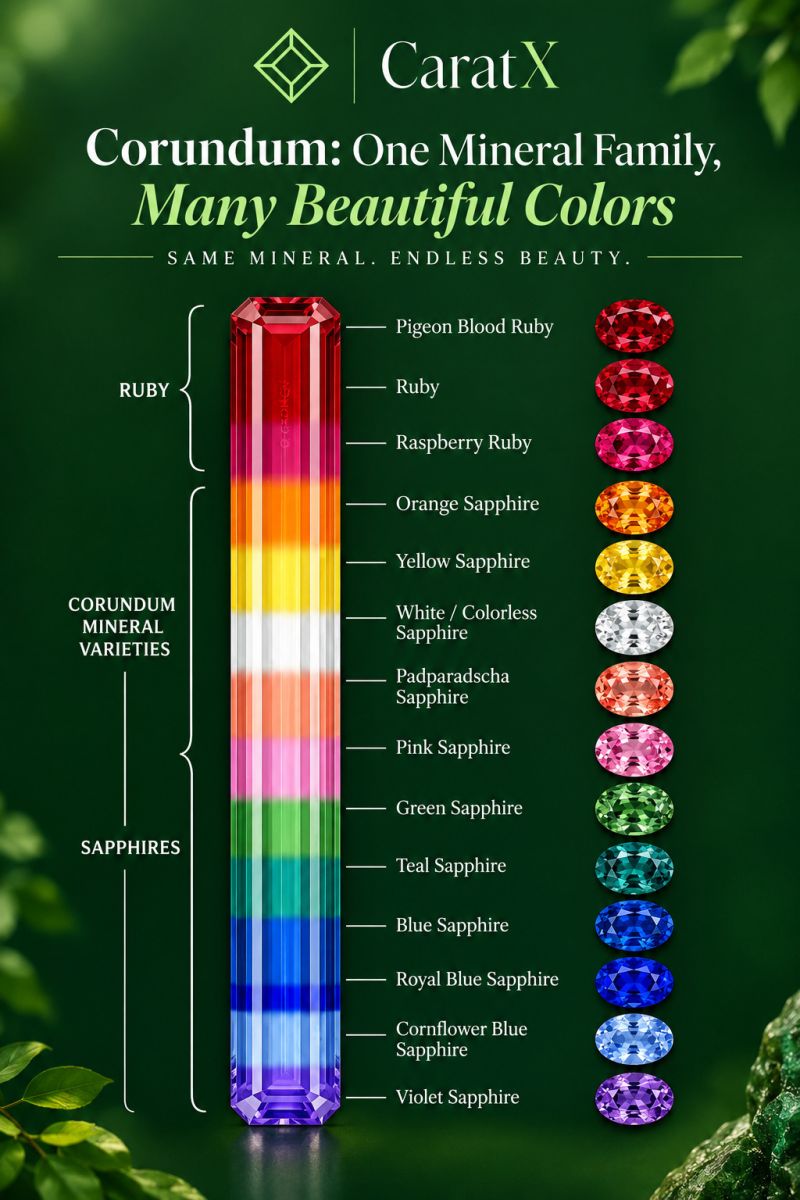
Rubiesare defined simply as red corundum. But the range of red shades that nature produces and the names given to them tell a far richer story.
What Makes Ruby Red?
The red color ofrubycomes from the presence of chromium (Cr³⁺) ions substituting for aluminum in the corundum crystal structure. When chromium is present at concentrations of roughly 0.5% or more, the crystal absorbs yellow and green light while transmitting red, giving the gem its characteristic color.
TheCalifornia Institute of Technology (Caltech)explains that ruby's red color is due specifically to its Cr³⁺ content, and the absorption spectrum shows sharp features from chromium that are responsible for the gem's distinctive appearance.
Varieties of Ruby -
Pigeon Blood Ruby -
The most prized color in the ruby world is "pigeon's blood" a vivid, rich red with a slight purplish or pinkish undertone that possesses a soft, glowing fluorescence. Historically associated withrubiesfrom Myanmar (formerly Burma), this color grade represents the pinnacle of ruby quality.
According toFlorida State University, pigeon blood rubies are described as "deep purplish red" and represent "the most highly prized color variation".
Classic Ruby -
Classic rubiesrange from bright to deep red tones. The GIA Laboratory uses a controlled set of masterstones to determine whether corundum qualifies as ruby, with the principle that red must be the dominant hue. Thai rubies, for example, tend toward a violet-red hue, while the finest stones typically come from Myanmar.
Raspberry Ruby -
A beautiful pinkish-red shade, raspberry rubies occupy the boundary betweenpinksapphire and ruby, a distinction that has been debated by gemologists for over a century.
The Ruby-Sapphire Boundary:
One of the most fascinating aspects of corundum gemology is the distinction between ruby and pink sapphire. Scientifically, both are corundum colored by chromium. The difference lies primarily in chromium concentration: rubies contain roughly 0.5% chromium while pink sapphires contain roughly 0.05%.
However, the boundary between pink and red is ultimately subjective. Before the 20th century, pink was considered "light red," and some rubies were described as "pink rubies." Over the course of the 20th century, the terminology shifted, and "pink sapphire" became the standard term.
Sapphire: Corundum in Every Other Color
While ruby claims the red spectrum,sapphireencompasses every other color of corundum. This means sapphires come in blue, yellow, pink, green, orange, purple, white, and even black.
What Makes Sapphire Blue?
The classicblue sapphiregets its color from charge transfer between iron and titanium ions (Fe²⁺–Ti⁴⁺) within the crystal structure. This mechanism is fundamentally different from chromium-based coloring in rubies, which explains why blue sapphires and red rubies can coexist in the same mineral family.
According toCaltech, "Blue sapphire derives its color from the Fe²⁺–Ti⁴⁺ and the Fe²⁺–Fe³⁺ intervalance charge transfer". Researchers fromWestern Sydney Universityconfirm that "Fe²⁺, Fe³⁺, and Ti⁴⁺ ionic interactions color sapphires".
Varieties of Sapphire -
Blue Sapphire -
The most well-known sapphire variety,blue sapphiresrange from pale cornflower blue to deep midnight blue. The finestblue sapphireshistorically come from Kashmir, Myanmar, and Sri Lanka.
Padparadscha Sapphire -
Perhaps the most coveted sapphire variety after blue, padparadscha is an extremely rare pinkish-orange to orange-pink sapphire. The name derives from the Sinhalese word for "lotus flower".
According to the GIA, padparadscha sapphires should range "from light to medium pinkish orange to orange-pink". The term was initially applied to stones from Sri Lanka, though today padparadscha sapphires also come from Madagascar and Tanzania.
Yellow Sapphire -
Yellow sapphiresowe their color to O⁻ ions (hole centers) alone or interacting with Fe³⁺. These bright to golden-hued gems are increasingly popular infine jewelry.
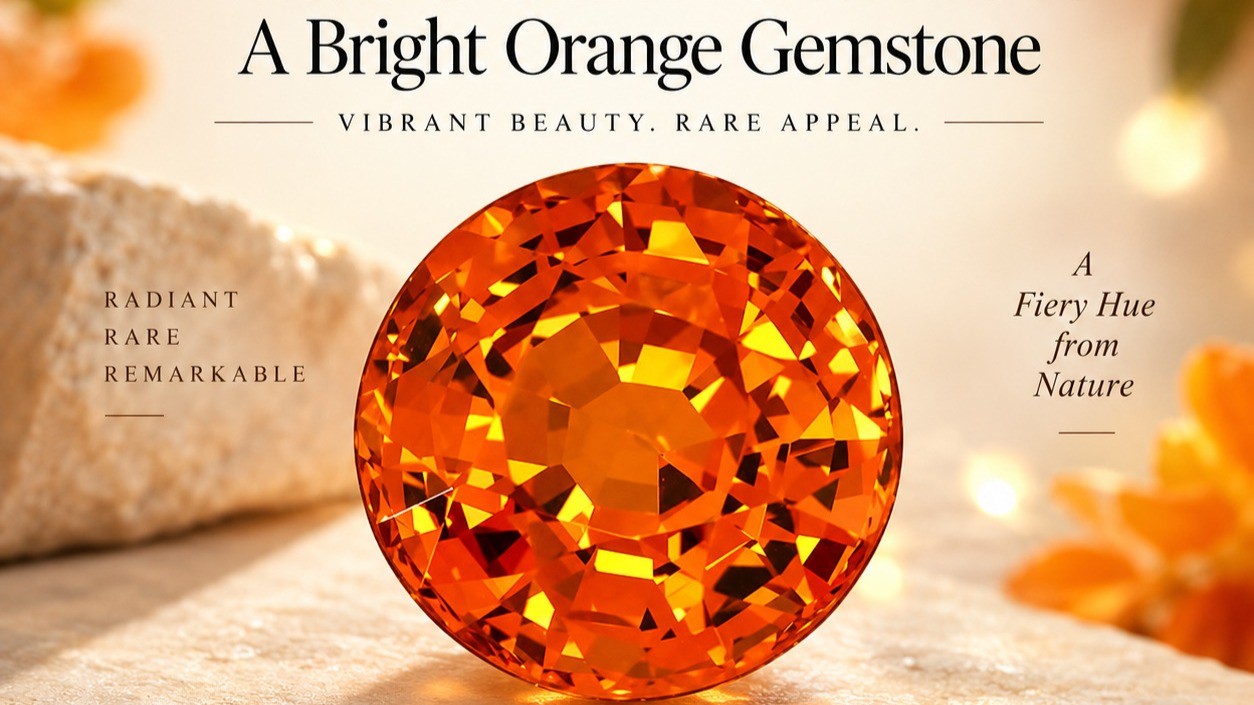
Orange Sapphire -
Warm and vibrant, orange sapphires share the same color mechanisms as yellow sapphires but with different concentrations and combinations of trace elements.
Pink Sapphire -
Pink sapphires range from soft pastel to vivid pink and as discussed above, share the same chromium coloring as rubies. The difference is simply the concentration of chromium.
Green Sapphire -
Green sapphires contain a mixture of the blue and yellow color mechanisms. They are relatively rare compared to blue and yellow varieties.
White Sapphire -
Pure corundum without significant trace elements is completely colorless. White sapphires serve as an alternative to diamonds in jewelry, offering excellent durability at a more accessible price point.
How Does Corundum Form? The Geology Behind the Gems
Understanding where corundum comes from adds another dimension to appreciating these remarkable gems.
Primary Deposits: Where Corundum Is Born
Geologists classify primary corundum deposits into two main types:
1. Magmatic Deposits -
These form from cooling magma deep within the Earth. Magmatic corundum deposits include gem corundum in alkali basalts (as found in eastern Australia) and sapphire in lamprophyre and syenite (as in Montana, USA, and Garba Tula, Kenya).
The GIA explains that sapphire and ruby from alkali basalt-related deposits contain glassy silicate melt inclusions that represent "some primordial magma from when the gem corundum was growing". This indicates a magmatic origin from deep within the Earth.
2. Metamorphic Deposits -
These form when existing rocks are subjected to intense heat and pressure. Metamorphic deposits are further divided into:
Metamorphic deposits sensu stricto: Found in marble or mafic and ultramafic rocks. Examples include ruby deposits in marble from Myanmar's Mogok Stone Tract.
Metamorphic-metasomatic deposits: Characterized by high fluid-rock interaction, including plumasite and shear zone-related deposits.
Secondary Deposits:
Most corundum gems are recovered from secondary (placer) deposits sediments where the mineral has been concentrated by erosion and water action. Because of its hardness and resistance to weathering, corundum survives the breakdown of its host rocks and accumulates in river gravels and alluvial deposits.
According to theGIA, today most sapphires are produced from gem placers related to alkali basalts, while placer deposits in metamorphic environments (like those in Sri Lanka and Madagascar) produce the highest-quality sapphires.
Phenomenal Corundum: Stars and Color Change
Beyond color varieties, corundum can exhibit extraordinary optical phenomena.
Star Rubies and Star Sapphires -
When corundum contains oriented needle-like inclusions of rutile (titanium dioxide), it can display asterism, a six-rayed star that appears to float across the surface of the cabochon-cut gem. The star effect occurs when light reflects from these oriented inclusions.
Color-Change Corundum -
Some corundum gems display a change of color when viewed under different light sources. This phenomenon, similar to that seen inalexandrite, occurs due to specific combinations of trace elements that create different absorption spectra under daylight versus incandescent light.
Treatments and Enhancements -
Like many gemstones, corundum is frequently treated to improve its color and clarity. Understanding these treatments is essential for informed buying and selling.
Heat Treatment -
Heat treatment is the most common and widely accepted treatment for corundum. According to GIA research, heat treatment can improve color and clarity in ruby and sapphire. Temperatures can exceed 1500°C.
The GIA notes that "successful heat treatment of corundum can require temperatures close to the melting point of the gem". However, determining whether a stone has been heated especially at low temperatures remains a challenge for gemologists.
Other Treatments -
Flux healing: Used to fill fractures in rubies.
Beryllium diffusion: Used to create or enhance orange and yellow colors in sapphire.
Glass filling: Used to improve clarity in lower-quality corundum.
The History and Lore of Ruby and Sapphire -
Rubyandsapphirehave been treasured for thousands of years. According to the GIA, "ruby and sapphire have been the most important colored gemstones for several thousand years".
Ruby: The King of Gems
In ancient Hindu writings, the ruby represents the power of the sun. Rubies were offered to Buddha in China and to Krishna in India. An ancient belief held that dreaming of rubies meant "the coming of success in money matters and love".
Sapphire:
The ancient Persians believed the earth rested on a giant sapphire, and that the blue of the sky was a reflection of this celestial stone.Sapphireshave long been associated with heavenly or celestial qualities.
The Conundrum of Corundum -
Until about two hundred years ago, no gemological distinction was made between ruby and spinel. It was not until the advancement of mineral science in the 17th and 18th centuries that ruby and sapphire were properly understood as varieties of corundum.
In 1805, Rene Just Haüy formally combined rubies and sapphires into the mineral group now known as corundum.
Synthetic Corundum: Man-Made Gems
Synthetic rubies and sapphires have been produced since the early 1900s, primarily using the Verneuil method. Today, synthetic corundum is produced by various methods including flux growth and pulling techniques.
While synthetic corundum has the same chemical and physical properties as natural corundum, it lacks the rarity and value of natural gems. However, synthetic star rubies and sapphires can be quite large, the GIA has examined synthetic star rubies weighing up to 4,759 carats.
Buying and Selling Corundum: What to Look For
Quality Factors -
The value of ruby and sapphire depends on four main factors:
Color: The most important factor. For rubies, vivid red with fluorescence (pigeon's blood) is most prized. For sapphires, medium to medium-dark blue (royal blue) or the rare padparadscha color commands premium prices.
Clarity: Eye-clean stones (no visible inclusions) are more valuable, though some inclusions can be acceptable or even desirable (as in star gems).
Cut: Proper cutting maximizes color and brilliance.
Carat Weight: Larger stones are exponentially more valuable per carat.
Treatments and Disclosure -
Always ask about treatments. TheGIAand other reputable gemological laboratories provide origin and treatment reports that can verify a stone's natural origin and any treatments it has undergone.
Pricing -
High-quality corundum commands extraordinary prices. According to GIA market reports, fine untreated corundum can wholesale for $10,000 to $50,000 per carat or more.
Conclusion:
Ruby and sapphire are indeed made of the same mineral corundum. The main difference is color, but that difference is profound. One mineral family, a whole rainbow of gemstones.
From the passionate red of pigeon's blood ruby to the serene blue of Kashmir sapphire, from the rare sunset hues of padparadscha to the pure clarity of white sapphire, corundum offers something for every taste and every budget. Its remarkable hardness and durability ensure that a ruby or sapphire purchased today will be treasured for generations to come.
Whether you're a collector seeking the finest pigeon's blood ruby, an investor looking for rare padparadscha, or simply someone who appreciates the beauty of these remarkable gems, understanding corundum its science, its history, and its varieties deepens the appreciation of every stone.
Shop Natural Diamonds– Explore our curated collection of natural diamonds from trusted sources.
Shop Gemstones– Discover a wide range of gemstones including ruby, sapphire, and more at unbeatable prices.
Sellers Register on CaratX Marketplace– Start selling to B2B and B2C buyers across 18+ international countries.
Sell Jewelry Internationally– Expand your business globally through our CaratX seller plan.
Pricing and Launch Details– Learn more about our pricing structure and how to launch your products on CaratX.
Recommended Reads from CaratX -
Enhance your knowledge of corundum and the fascinating world of gemstones with these carefully curated articles from the CaratX Blog:
Sri Lanka: The Island of Beautiful Gemstones– A deep dive into one of the world's most important sources of high-quality sapphires and rubies, exploring the island's unique geology and mining history.
A Comprehensive Guide to Optical Phenomena in Gemstones– Understand the science behind asterism (the star effect) in star rubies and star sapphires, along with other mesmerizing light effects seen in corundum.
Blue Gemstones: Nature's Most Beautiful Shades of Blue– A detailed exploration of blue sapphires and how trace elements like iron and titanium create the iconic blue hues of corundum.
How Fake Rubies Are Grown in a Lab (and How to Spot Them)– Learn about the Verneuil process and other synthetic methods used to create man-made corundum, plus expert tips on distinguishing lab-grown from natural rubies.
The Ultimate Guide to Colored Gemstone Valuation– Discover the key quality factors color, clarity, cut, and carat weight that determine the price of rubies, sapphires, and other colored gems.
The Definitive Guide to H-FH Gemstone Treatment– An authoritative breakdown of heat treatment and flux-healing processes commonly applied to corundum, including their market impact and ethical considerations for buyers.
Fancy Sapphires: The Colorful Side of the Sapphire World– Explore the entire rainbow of corundum beyond blue and red, from padparadscha and yellow to pink, green, and white sapphires.
Beyond the Hue: A Connoisseur's Dive into Color– An in-depth analysis of what makes "pigeon's blood" ruby and "royal blue" sapphire so exceptional, going beyond basic color grading.
White Gemstones: Properties, Value, and Buying Guide– A comprehensive guide to white sapphire (colorless corundum) as a durable and affordable alternative to diamonds.
Not All Blues Are the Same: A Deep Dive into Sapphire, Spinel, Diamond & Tanzanite– A comparative analysis that distinguishes blue sapphire from other popular blue gemstones, with insights into their geological formation.
Frequently Asked Questions -
1. Are ruby and sapphire the same mineral?
Yes. Both ruby and sapphire are varieties of the mineral corundum (Al₂O₃). The only difference is their color ruby is red corundum, while sapphire is corundum of any other color.
2. What makes ruby red?
Ruby gets its red color from chromium (Cr³⁺) ions substituting for aluminum in the corundum crystal structure. Higher concentrations of chromium produce deeper red colors.
3. What makes sapphire blue?
Blue sapphire gets its color from charge transfer between iron and titanium ions (Fe²⁺–Ti⁴⁺) within the crystal structure.
4. What is padparadscha sapphire?
Padparadscha is an extremely rare pinkish-orange to orange-pink sapphire. The name comes from the Sinhalese word for "lotus flower".
5. What is the difference between ruby and pink sapphire?
Both are colored by chromium. Rubies contain roughly 0.5% chromium while pink sapphires contain roughly 0.05%. The boundary between the two is subjective and varies among gemological organizations.
6. How hard is corundum?
Corundum measures 9 on the Mohs hardness scale—second only to diamond (10).
7. Where are rubies and sapphires found?
Major sources include Myanmar, Sri Lanka, Thailand, Mozambique, Madagascar, Australia, and the United States (Montana).
8. Are rubies and sapphires treated?
Yes. Heat treatment is very common and widely accepted. Other treatments include flux healing, beryllium diffusion, and glass filling.
9. What is a star ruby or star sapphire?
Star rubies and sapphires display a six-rayed star (asterism) caused by oriented rutile inclusions within the crystal.
10. Can corundum be synthesized?
Yes. Synthetic rubies and sapphires have been produced since the early 1900s using methods such as the Verneuil process.