
Introduction:
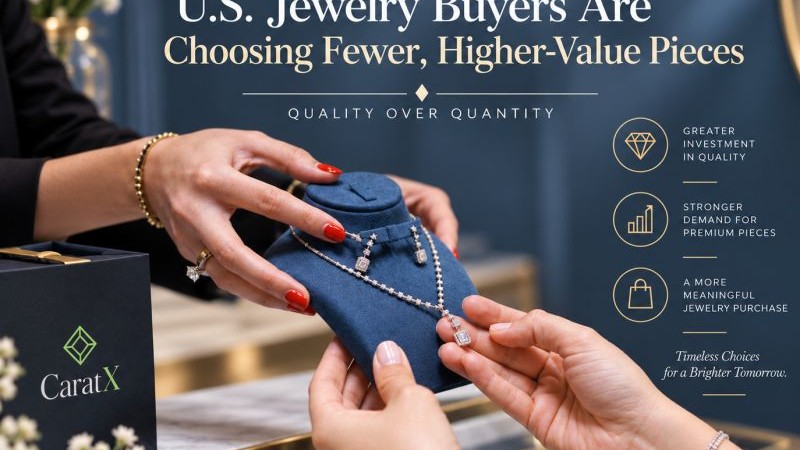
The U.S. jewelry market is undergoing its most significant structural transformation in decades. American consumers are not abandoning jewelry far from it. Instead, they are fundamentally redefining how they engage with it. The era of "more is more" has given way to a philosophy of "fewer, but better."
Recent market data paints a compelling picture of this shift. In July 2026, U.S. jewelry revenue climbed 11% year-over-year even as the number of items sold declined by 4%, with the average spending per piece rising 16%. The pattern intensified in June, when revenue surged 13% while the average purchase price soared 20%. Across the entire first half of 2026, jewelry sales grew 8.6%, with average spending per item up 19%.
This is not a temporary fluctuation. It represents a permanent recalibration of consumer psychology, driven by the powerful convergence of a K-shaped economy, shifting generational preferences, and a growing bifurcation between natural and lab-grown diamond markets. For industry professionals from retailers and wholesalers to manufacturers and marketplace platforms likeCaratXunderstanding this new calculus is essential for survival and growth.
This article provides a data-driven analysis of the 2026 U.S. jewelry market, explores which categories are winning, examines the strategic implications for businesses, and charts a path forward for capturing value in this evolving landscape.
Part I: The K-Shaped Consumer Revolution
Understanding the Divide -
The single most important concept for jewelry industry professionals in 2026 is the "K-shaped consumer." The K-shape describes a market that has split into two diverging trajectories: one segment of consumers is pulling back, while the other continues to expand its spending. The middle of the market the proverbial "middle class" of jewelry consumption is shrinking rapidly.
The National Jeweler's detailed analysis, authored by Edahn Golan of Tenoris, describes this phenomenon in stark terms. The first group of consumers is spending less overall and buying fewer pieces, particularlyjewelrypriced below $1,500. Revenue from this lower-price segment has generally declined, with the one notable exception beinglab-grown diamond jewelry.
The second group is moving in precisely the opposite direction. Shoppers buying jewelry priced above $1,500 are spending significantly more overall. Their purchasing behavior continues to emphasizebridal jewelry,diamond stud earrings, andtennis bracelets, most often set with natural diamonds. As Golan himself notes, "The middle of the market is shrinking. Businesses that try to serve everyone risk serving no one particularly well".
The "Price Up, Units Down" Dynamic -
This K-shaped divide has manifested in what industry analysts call the "price up, units down" dynamic. In May 2026, U.S. jewelry sales increased 1.8% year-over-year while the average purchase price rose 19.6%. Year-to-date revenue at specialty jewelers was up 7.6%, reflecting strength in overall sales despite weaker unit performance.
The April 2026 figures were even more dramatic. Consumer spending on jewelry surged to a record 21% increase in average retail spending per item, according to the latest retail analysis by Tenoris. The report noted that the increase was driven by continued demand for higher-value jewelry purchases, even as unit sales trends remained comparatively softer.
The data reflects an ongoing shift toward premium jewelry consumption, with consumers opting for fewer but more expensive pieces.
What's Driving the Shift?
Several powerful forces are converging to reshape consumer behavior:
Rising Gold and Material Costs: Gold and silver prices have surged significantly, energy costs have risen, and tariffs have changed repeatedly. Each of these factors has affected manufacturing costs and ultimately the prices consumers see in stores.
Economic Uncertainty and Financial Stress: Consumers are increasingly feeling financial pressure, with data pointing to rising financial stress. Those seeking lower price points are gravitating toward silver jewelry and jewelry set with lab-grown diamonds.
Value Consciousness: Consumers are becoming more intentional about their purchases. The buyer in 2026 is more informed, more intentional, and more willing to spend but only when the product feels genuinely right.
Generational Shifts: Gen Z has emerged as a powerful force in the diamond market. Despite representing only 18% of the U.S. population, Gen Z contributes nearly a quarter (23%) ofnatural diamonddemand by value, making them the second-largest consumer group. Their average purchase price of $4,080 is nearly double that of Baby Boomers.
The Natural Diamond Renaissance -
Resilient Growth Amid Market Turbulence -
Contrary to some predictions of decline, natural diamond jewelry has demonstrated remarkable resilience. De Beers' 2026 Diamond Report, based on a comprehensive study of 18,500 American women aged 18 to 74, reveals that natural diamonds remain the most desired luxury jewelry category.
Eleven percent of women rankednatural diamond jewelryas their most desired luxury gift significantly ahead of lab-grown diamonds (8%),other gemstones(5%), and pure gold jewelry (4%).
Natural diamond sales increased 4% year-over-year during the fourth quarter of 2025 and 9% during the first quarter of 2026. This growth came even as fewer pieces were sold, with higher average prices helping to support overall sales.
The Power of Premium -
The natural diamond category is benefiting enormously from the premiumization trend. The average price paid for a natural diamond jewelry piece in the U.S. climbed from $3,242 in 2023 to $4,063 in 2025, a 25% increase. This rise was primarily driven by consumers seeking larger carat weights, with the average total carat weight increasing from 1.65 carats to 1.86 carats.
This pattern aligns with broader market data showing thathigher-priced items, particularly those above $2,500, saw increased demand in May 2026.Diamond jewelrysales rose modestly in the week leading up to Mother's Day, with higher average spending per item offsetting lower unit sales.
Desert Diamonds: A Bright Spot
One of the most compelling stories within the natural diamond market is the rise of Desert Diamonds. De Beers' strategic differentiation play has delivered exceptional results. During Q4 2025 and Q1 2026, natural diamond sales increased 4% and 9% respectively, but Desert Diamond sales surged 15% and 19% in the same periods significantly outperforming the broader market.
This success demonstrates that when natural diamonds are positioned with a compelling narrative of rarity, provenance, and unique beauty, consumers respond enthusiastically. The differentiation strategy has proven that authenticity and emotional resonance still carry immense value in the diamond market.
The Gen Z Effect -
Perhaps the most surprising development in the natural diamond market is the rise of Gen Z as a dominant consumer group. Average purchase prices for natural diamonds have reached $4,080, nearly double the Baby Boomer average. They purchase or receive diamonds at a higher frequency (1.83 times per year) compared to the all-generation average of 1.7 times.
While bridal jewelry still dominates Gen Z diamond purchases at 45%, birthdays and other gift-giving occasions account for 17%, significantly higher than the 13% all-generation average. Gen Z views diamonds as symbols of identity and self-expression, and they rely heavily on social media for pre-purchase information.
Crucially, the non-bridal market has become a major growth engine. Non-wedding occasions now account for three-quarters of total U.S. natural diamond demand, driven by celebrations of new jobs, promotions, personal achievements, and self-purchase.
The Lab-Grown Diamond Paradox -
Growth in Volume, Pressure on Price -
The lab-grown diamond segment presents a fascinating paradox in the 2026 market. While unit sales continue to grow particularly forjewelrypriced below $500 average spending per lab-grown item has remained flat. This divergence is explained by the dramatic decline in lab-grown diamond wholesale prices.
According to diamond industry analyst Edahn Golan's Q1 2026 wholesale price list, midstream prices for loose lab-grown diamonds fell another 14% year-over-year. While this decline is significant, it represents a moderation from the previous year's plunge of over 40%. In Q2 2026, wholesale LGD prices fell an average of 13% year-over-year, with prices for 1.50-1.99 carat diamonds declining 11% and 2-carat stones falling 20%.
The lab-grown diamonds market is projected to grow from $27.95 billion in 2025 to $30.16 billion in 2026 at a compound annual growth rate of 7.9%, reaching $40.8 billion by 2030. This growth is driven by advancements in synthetic diamond production technology, rising demand for ethical jewelry, and increased consumer awareness of the environmental impact of natural diamond mining.
The Two-Tier Market Emerges -
The market has effectively bifurcated into two distinct tiers. Natural diamonds are seeing more growth at higher price points, while lab-grown diamonds are gaining more sales in the lower-priced segment. This pattern is consistent across multiple data sources and reflects fundamentally different consumer motivations.
At the lower end of the market, lab-grown diamonds have become the primary driver of volume. The affordability of lab-grown diamond jewelry now 70-80% more affordable than natural diamonds of comparable specifications has made diamond jewelry accessible to a much broader consumer base.
This has been particularly transformative in categories like stud earrings, where simple, well-designed pieces at accessible price points continue to attract steady demand.
What This Means for Retailers -
For retailers, the lab-grown segment presents both opportunity and challenge. The opportunity lies in volume: lower-priced lab-grown jewelry attracts a broader customer base and generates foot traffic. The challenge lies in margin compression: as wholesale prices continue to fall, retailers must manage inventory carefully to avoid being caught with depreciating stock.
The strategic approach for retailers targeting the lower-price segment is clear: go heavy on lab-grown diamonds, offer competitive pricing, and build a business model around being a higher-volume retailer.
Category Deep Dive — The Winners
Tennis Bracelets:
If there is a single jewelry category that best embodies the "fewer, higher-value" trend, it is thetennis bracelet. In the first half of 2026, bracelets, particularly tennis bracelets generated the highest revenue among all jewelry categories. Revenue increased 14% compared with the first half of 2025, while average spending per item rose by double digits.
The resurgence of thetennis bracelethas been driven by a combination of celebrity influence and shifting consumer preferences. Zendaya's tennis-themed press tour looks prompted a 133% spike in online searches for tennis-style jewelry, according to British jewelry retailer The Diamond Store. Coco Gauff's Wimbledon appearances and Meghan Markle's elegant choices have further cemented the tennis bracelet's status as a must-have piece.
But thetennis bracelet'sappeal goes beyond celebrity endorsement. The category has evolved from formal wear into everyday luxury. As one industry analysis notes, "Tennis bracelets will continue moving from formal jewelry into everyday collections" with smaller stones and more versatile designs.
Lab-grown diamonds have also democratized the look, with high street retailers offering ultra-affordable versions, while premium natural diamond tennis bracelets continue to command exceptional demand in auction rooms and luxury retail.
De Beers has capitalized on this trend by launching Desert Diamonds Icons that include tennis bracelets. The campaign has already begun reshaping consumer demand, with natural diamond sales at U.S. independents rising 4% in Q4 2025 and 9% in Q1 2026.
Pearl Jewelry: The Surprise Performer
Pearl jewelryhas emerged as one of the most surprisingly strong performers of 2026. The pearl jewelry market is projected to expand from $15.6 billion in 2026 to $23.0 billion by 2031, registering a CAGR of 8.1%.
The data on pearl sales in the U.S. market is striking. Pearl strands andnecklacessaw sales increase 40% in May 2026, with average retail sale surging 58% to $1,059, while units declined 12%. Edge Retail Academy data from nearly 2,000 fine jewelry retailers shows that the average U.S. pearl retail transaction increased by 35% year-over-year in April 2026, with gross profit margins reaching 57.6%.
This growth is being driven by a design reinvention that is shifting pearls away from formal-only positioning and expanding demand among younger and more diverse buyer cohorts. Premium brands like TASAKI and Mikimoto are recasting pearls as daily-wear design statements rather than ceremonial accessories. Luxury spending resilience is also reframing pearls as appreciating assets, with some companies offering pearl exchange programs that position them as stores of wealth similar to gold.
Layered Necklaces and Pendants -
Consumer interest in layered diamond necklaces has grown by approximately 26%, driven primarily by the self-purchase trend. More than 40% of women's diamond jewelry sales by value are now self-purchases, buyers buying for themselves rather than waiting for a gift occasion. Pendants and layered necklaces are the entry point into this behavior and represent a significant volume opportunity for retailers.
Personalization and Vintage Inspiration -
Multiple trend reports, including data from Pinterest Predicts 2026, point to individuality and self-expression as the dominant consumer mood. Vintage and Art Deco-inspired motifs, geometric forms, and reimagined heirloom styles are performing well across U.S. and UAE markets. Customization now represents 18% of fine jewelry sales globally, and retailers offering even basic personalization options are seeing stronger conversion rates.
Diamond Stud Earrings -
Diamond stud earringsremain the most consistent volume category across every market globally. Classic solitaire studs and lab-grown pave hoops are both flagged as top-selling styles heading into 2026. The category benefits from a high repeat purchase rate, strong gifting demand, and accessible entry price points.
Part V: Strategic Implications for Jewelry Businesses
The Retail Playbook for 2026
The K-shaped market demands a bifurcated strategy. Retailers must choose their lane and execute with precision.
For those targeting the lower-price segment: The playbook is clear, go heavy on lab-grown diamonds, offer competitive pricing, and build a business model around being a higher-volume retailer. The lab-grown diamond category continues to attract new customers, particularly younger buyers who are entering the diamond market for the first time.
For those targeting higher-end consumers: The strategy is fundamentally different. Stores must communicate luxury through every touchpoint: fewer pieces on display, more space around each item, and stronger storytelling around craftsmanship and materials. The buying experience must feel curated and exclusive, not transactional.
Inventory Management in a Volatile Market -
Inventory strategy becomes critical in a bifurcated market. Retailers serving the higher-end segment need to curate carefully, focusing on pieces that tell a story and justify their premium. Retailers serving the lower-price segment need to manage lab-grown inventory carefully to avoid depreciation losses as wholesale prices continue to decline.
The natural diamond supply chain is also tightening. Kimberley Process data shows global rough diamond production fell to approximately 98.8 million carats in 2025, the lowest level of the 21st century, down about 8% year-over-year. This supply constraint supports the premiumization trend for natural diamonds but requires careful inventory planning.
The Role of Technology and Online Marketplaces -
Technology is reshaping how jewelry businesses operate. Platforms likeCaratXare connecting the diamond, gemstone, jewelry, and pearl industry on a global marketplace, reducing costs for buyers and sellers alike. CaratX brings thousands of unique jewelry pieces, loose diamonds, gemstones, and pearls from over 16 countries and 200+ artisan sellers.
For retailers looking to expand their inventory without significant capital investment, marketplace platforms offer access to a broader range of products. For sellers from individual artisans to large manufacturers, these platforms provide a professional storefront dedicated to diamonds and fine jewelry, with options for both B2B and B2C transactions.
The shift to e-commerce has been accelerated by changing consumer behaviors. As noted in CaratX's analysis of technology in jewelry retail, "In today's jewelry market, technology in jewelry retail isn't just an upgrade; it's a game-changer".
Part VI: The Road Ahead, Holiday 2026 and Beyond -
Holiday Season Expectations -
Despite economic uncertainty, current market trends show continued growth in the U.S. jewelry industry during 2026, with the holiday season expected to be a particularly important period. The premiumization trend is likely to continue, with higher-value pieces driving revenue growth.
Mother's Day 2026 provided a preview of what to expect, accounting for roughly one-third of May's jewelry revenue. In the week leading up to the holiday, diamond jewelry sales rose modestly, with higher average spending per item offsetting lower unit sales.
The Structural Reset -
The diamond industry is not experiencing a cyclical downturn, it is undergoing a structural reset. As one industry analysis puts it, the natural diamond market is "in the throes of its most profound reset in a generation". The global diamond market has split into three distinct segments:
The lower segment (0.3-0.99 carats, lower quality): This segment is collapsing as consumers shift to lab-grown alternatives. A 1-carat SI-clarity natural diamond saw prices plunge 24.1% in 2025.
The bridal segment (1-carat rounds): This segment is holding steady, supported by emotional significance and tradition.
The premium segment (large, high-quality stones): This segment remains robust, driven by scarcity and investment value.
Advice for Industry Professionals -
For jewelry professionals navigating this complex landscape, several principles stand out:
Know your customer: The K-shaped market means your customers are either value-seekers or premium buyers. Design your business to serve one segment exceptionally well rather than both adequately.
Invest in education: Whether you're selling natural diamonds or lab-grown, product knowledge and storytelling ability are your greatest competitive advantages.
Leverage technology: Online marketplaces, e-commerce platforms, and AI-powered tools are no longer optional, they are essential infrastructure for modern jewelry businesses.
Stay informed: The market is moving quickly. Subscribe to industry publications, attend trade shows, and monitor data from sources like Tenoris, De Beers, and the Natural Diamond Council.
Adapt your inventory: The premiumization trend demands a different product mix than the volume-driven approach of the past. Curate carefully and tell compelling stories about the pieces you sell.
Recommended Reads from CaratX -
Explore these in-depth resources fromCaratXto deepen your understanding of the diamond and jewelry market:
Lab-Grown Diamonds vs. Natural Diamonds: The Ultimate 2025 Buyer's and Sellers Guide— A comparison of natural and lab-grown diamonds, covering formation, value, market dynamics, and buying considerations. The guide notes that for the first time, over 52% of engagement rings sold now feature lab-grown diamonds, marking a mainstream movement driven by sustainability and affordability.
2026 Natural Diamond Market Report: Premium Demand Surges as Millennials and Gen Z Redefine Luxury Gifting— An in-depth analysis of natural diamond market trends, including the growing premium demand and bifurcation between natural and lab-grown segments. The report highlights that 11% of consumers prefer natural diamond jewelry versus 8% for lab-grown, with Millennials representing 32% of buyers and accounting for 55% of total demand value.
The Types of Natural Diamond Colors: A Complete Guide— Discover the fascinating world of naturally colored diamonds, from rare reds to stunning blues, and understand what drives their value. The guide covers white (colorless), yellow, brown, blue, pink, red, green, and other fancy colors, explaining the GIA color grading system for fancy colored diamonds.
Natural Diamond Jewellery Trends: Insights from the NDC Report— Explore current trends in natural diamond jewelry, including which cuts, styles, and settings are resonating with today's consumers. Based on data from over 2,000 specialty jewelers, the report reveals that round diamonds account for 82% of center stones, while bridal jewelry represents 33% of all natural diamond jewelry sales.
Hong Kong Diamond Market Report 2026: Natural vs. Synthetic, Consumer Trends and Mother's Day Demand— A detailed look at one of Asia's most important diamond markets and how the natural vs. lab-grown dynamic is playing out. According to NielsenIQ's 2026 survey, 75% of Hong Kong consumers plan to purchase jewelry in the next 12 months, with 76% specifically considering natural diamonds.
Sri Lanka: The Island of Beautiful Gemstones— Explore the rich gemstone heritage of Sri Lanka, one of the world's most important sources of fine sapphires, rubies, spinels, garnets, chrysoberyl, alexandrite, tourmaline, zircon, and moonstone. Known in Sanskrit as "Ratna-Dweepa" (Island of Gems), Sri Lanka's gem wealth is unparalleled.
The Ultimate Guide to Colored Gemstone Valuation: Beyond Carats and Into the Rainbow— Understand how colored gemstones are valued, from hue and saturation to clarity and origin. The guide emphasizes that in colored gemstones, color is king, often accounting for over 50% of a stone's value, with the ideal tone typically in the medium to medium-dark range.
The Complete Guide to Gemstone Verification: How to Check Authenticity, Quality, and Value— Learn how to verify gemstone authenticity and quality, including the role of inclusions and certification. The guide covers preliminary visual assessment, 10x loupe examination, and identifying key inclusion types that distinguish natural from synthetic stones.
Blue Gemstones: Nature's Most Beautiful Shades of Blue— A comprehensive guide to blue gemstones, from classic sapphires to rare tanzanite and aquamarine. The guide explains how trace elements like iron and titanium create the mesmerizing blue hues and covers the most valuable blue gemstone varieties.
Understanding Diamond Color – A Comprehensive Guide— A detailed guide to the GIA diamond color scale from D (completely colorless) to Z (noticeably yellow or brown), explaining how color impacts both appearance and value, and covering fancy colored diamonds beyond the Z scale.
Global Diamond Market Overview: A Tale of Two Markets— An analysis of the global diamond market's polarization in 2026, with demand below $2,500 weakening while purchases in the $2,500–$5,000 range remain the market's core. The report notes that US specialty jewelers' natural-diamond jewelry sales increased 2.1% in 2025, with average prices rising 10%.
Start Selling Internationally with CaratX -
Ready to expand your jewelry business to international markets?CaratXconnects you with B2B and B2C buyers across 18+ countries.
Whether you're a retailer looking to source diamonds and gemstones at competitive prices, or a manufacturer seeking to reach new markets, our marketplace platform provides the tools and reach you need.
For Sellers:Register on CaratXto start selling to B2B and B2C buyers internationally. Our seller plans offer flexible options to suit businesses of all sizes, from individual artisans to large-scale manufacturers.
For Buyers:Shop gemstonesandnatural diamondsfrom our global marketplace at unbeatable prices. With thousands of listings from over 200 artisan sellers across 16+ countries, you'll find exactly what your customers are looking for.
More Details: For information about our pricing and seller plans, visit ourLaunch Your Products page.
Frequently Asked Questions (FAQs)
Q1: Are U.S. jewelry consumers really buying less jewelry?
Yes and no. Unit sales have declined, particularly for lower-priced jewelry. However, total revenue is growing because consumers are spending significantly more per item. In June 2026, revenue rose 13% year-over-year while average purchase prices increased 20%. The market is not shrinking, it is concentrating.
Q2: Should retailers focus on natural diamonds or lab-grown diamonds?
It depends on your target customer. If you are targeting higher-income buyers and premium price points, natural diamonds particularly those with compelling provenance stories, offer stronger margins and long-term value retention. If you are targeting volume and younger, value-conscious buyers, lab-grown diamonds offer accessibility and growth potential. Many successful retailers carry both but present them as distinct categories with different value propositions.
Q3: Why are tennis bracelets performing so well?
Tennis bracelets occupy a sweet spot in the current market: they are perceived as high-value, versatile pieces that can be worn daily, and they benefit from strong celebrity endorsements. Revenue in the category rose 14% in H1 2026, with average spending per item rising by double digits. The category also appeals across price points, from affordable lab-grown versions to high-end natural diamond pieces.
Q4: Are pearl jewelry sales really growing?
Absolutely. Pearl strands and necklaces saw sales increase 40% in May 2026, with average retail sale surging 58%. The pearl jewelry market is projected to reach $23 billion by 2031. The growth is driven by design innovation that has repositioned pearls as contemporary, everyday luxury rather than formal-only accessories.
Q5: How can smaller retailers compete with large chains?
Smaller retailers can compete by specializing. Focus on a specific customer segment—either premium natural diamond buyers or value-focused lab-grown shoppers—and execute exceptionally well. Invest in staff training, leverage online marketplaces like CaratX to expand your product range without inventory risk, and build deep relationships with your customer base through personalized service.
Q6: What is the K-shaped market, and how does it affect my jewelry business?
The K-shaped market describes the divergence of consumer spending: one segment (higher-income) is spending more, while the other (lower-income and middle-income) is pulling back. For jewelry retailers, this means the middle of the market is shrinking. You must decide which end of the K you want to serve and build your business model accordingly.
Q7: Will lab-grown diamond prices continue to fall?
Most analysts expect continued price declines, though at a slower pace than the dramatic drops of 2024-2025. Wholesale lab-grown diamond prices fell 14% in Q1 2026 and 13% in Q2 2026. While some stabilization may occur, the fundamental economics of lab-grown diamond production, where supply can be scaled almost infinitely, suggest that prices will remain under pressure.
Q8: How important is sales training for selling higher-value jewelry?
Extremely important. Customers spending $2,500 or more on a piece of jewelry expect expert guidance, product knowledge, and trusted service. As one industry CEO put it, "especially with today's highly educated and sophisticated luxury consumers, this investment pays dividends in our business on a daily basis." Formal training programs, certification courses, and continuous education are essential for retailers targeting the premium segment.