

The Diamond Table: The Architectural Marvel Controlling Light, Fire, and Brilliance
Home
News And Media The Diamond Table: The Architectural Marvel Controlling Light, Fire, and Brilliance SHOP NOWHome
News And Media The Diamond Table: The Architectural Marvel Controlling Light, Fire, and Brilliance SHOP NOWMar, 23, 2026 by Archit Mohanty 0 Comments
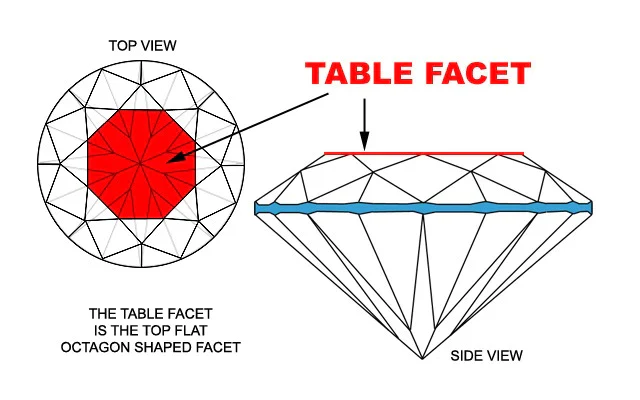
When we gaze upon a round brilliant diamond, our eyes are drawn to its fiery flashes and crystalline brightness. But few people realize that the single most influential factor controlling this visual symphony is not just the cut grade, but a specific, often overlooked feature: the table.
The table is the largest facet on a diamond the flat, horizontal surface on the top of the stone. While it appears simple, it acts as a window and a mirror, dictating the diamond's personality. Too small, and the diamond becomes a dark, fiery mystery. Too large, and it becomes a flat, glassy mirror devoid of life.
In this deep-dive guide, we will explore the science, history, and modern standards of diamond table size, helping you understand why this percentage is the true "key to balance." Whether you are a buyer seeking the perfect sparkle or a seller looking to articulate value, mastering the table is essential.
In gemological terms, the table is the largest facet of a diamond, located on the top of the stone. In a Round Brilliant Cut the most popular shape the table is an octagonal shape surrounded by eight star facets and eight bezel facets.
How is it measured? Table size is never measured in millimeters alone because diamonds vary in overall size. Instead, it is expressed as a percentage. The formula is simple:
Table Percentage=(Table DiameterGirdle Diameter)×100Table Percentage=(Girdle DiameterTable Diameter)×100
For example, if a diamond has a total width (girdle diameter) of 6.5 mm and the table measures 3.9 mm across, the table percentage is 60%.
This percentage is the industry shorthand for predicting how a diamond will perform optically.
To understand why the table percentage matters, we must look at the physics of light performance. A diamond acts as a complex light trap. When light enters the diamond, it can take three paths:
Refraction & Return (Brilliance): Light enters the table, travels down to the pavilion facets, reflects internally, and returns out through the table to the viewer’s eye. This creates brightness.
Dispersion (Fire): Light splits into spectral colors (red, blue, green) as it exits. This creates fire.
Leakage (Loss): Light exits through the bottom or sides of the diamond, resulting in a dark or dull appearance.
The table governs the "aperture" of this system.
A smaller table acts like a small window. It forces light to bounce more extensively against the pavilion facets before exiting. This maximizes dispersion (fire) but can reduce overall brightness, making the diamond appear darker in low light.
A larger table acts like a large window. It allows more light to enter and exit directly. This maximizes brightness (scintillation) but reduces the distance light travels inside, diminishing the spectral dispersion (fire).
According to research from the Gemological Institute of America (GIA) , the interplay between the table and the crown angle is the most critical relationship in determining a diamond's final appearance. You can read more about their cut grading system on their official site: GIA Cut Grading.
The ideal table percentage has not always been what it is today. The evolution of the diamond table tells the story of technology and changing tastes.
Before the invention of modern saws, diamonds were cut by cleaving or grinding. To preserve carat weight (which was and is the primary driver of value), cutters left the table very small. Historical diamonds often featured tables between 40% and 50%. While these diamonds displayed intense fire, they often lacked the crisp brilliance modern buyers crave.
The introduction of the rotary diamond saw revolutionized the industry. Cutters could now slice rough stones with precision. During the mid-century, there was a trend toward maximizing spread making a 1-carat diamond look like a 1.5-carat diamond from the top. This led to "spread" cuts with tables exceeding 70%.
With the advent of computer modeling in the 1990s and 2000s, the industry settled on a balanced approach. Modern cutters realized that maximizing beauty (light return) was more valuable than simply maximizing spread.
Today, the consensus among major grading laboratories is that the sweet spot for a round brilliant diamond lies between 53% and 63%, with "Ideal" often pegged between 54% and 57% for the strictest standards (like AGS Ideal).
If you are shopping on CaratX for natural diamonds, you will notice that most high-quality inventory falls within the 52% to 66% range. However, within that range, the balance shifts.
To help you visualize the difference, here is how table size interacts with other elements of the diamond:
Diamonds with a table percentage below 52% are considered small table diamonds. They typically produce high fire (dispersion), creating strong colorful flashes, but have lower overall brightness, making them ideal for collectors who value color play over white light.
Diamonds with a table percentage between 53% and 58% fall into the ideal or premium category. This range offers the best balance of light return, fire, and brilliance, and is often referred to as the “sweet spot,” commonly associated with Triple Excellent (GIA) or Ideal (AGS) cut grades.
Diamonds with a table percentage between 59% and 63% are classified as modern large table diamonds. They deliver higher brightness with moderate fire and are preferred by buyers who like a “crushed ice” appearance or want maximum visual spread for a given carat weight.
Diamonds with a table percentage above 64% are considered oversized table diamonds. These often have a glassy look and carry a higher risk of light leakage, resulting in dark centers, and are generally not recommended for brilliance as they prioritize perceived size over beauty.
To see real-time examples of diamonds with ideal table percentages, explore our Round Cut Diamonds collection at CaratX Round Diamonds. You can filter by cut grade to see how table percentage correlates with overall quality.
When purchasing a diamond, whether for personal use or inventory, the table size is a non-negotiable factor for liquidity. Diamonds with "steep/deep" combinations (where the table is too large relative to the crown angle) are often graded as "Good" or "Fair" by the GIA. These diamonds are harder to resell.
In the wholesale B2B market, such as the platform offered by CaratX, buyers are increasingly sophisticated.
For sellers, listing diamonds with verified ideal proportions (including table percentage) results in faster turnover. If you are a seller looking to move inventory to 18+ international countries, ensuring your stock falls within the 54%-60% table range for rounds is a strategic advantage.
While we focus on the Round Brilliant, the table’s role changes in fancy shapes. Understanding these nuances is crucial whether you are shopping for jewelry or selling gemstones.
Emerald Cut: The table is the defining feature. In emerald cuts, the table is often significantly larger (65% to 70%) because the cut relies on "hall-of-mirrors" reflections rather than fire. A table that is too large in an emerald cut, however, can lead to a dull, glassy look.
Princess Cut: Table percentages vary widely. A smaller table in a princess cut typically results in more brilliance, while a larger table gives a more modern, open face.
Oval & Pear: Because these shapes are susceptible to the "bow-tie" effect (a dark area across the center), the table size must be balanced carefully with the depth percentage to minimize this darkness.
For those sourcing fancy shapes, CaratX offers a wide array of gemstones and diamonds where you can examine these specific proportions.
One of the most common traps for consumers is the "spread" illusion. A diamond with a 64% table and a shallow depth may look larger than a diamond of the same carat weight with a 55% table.
However, the shallow diamond is likely to suffer from light leakage. You are essentially paying for a carat weight that looks big on paper but lacks the "sparkle factor" that gives a diamond its value.
The Rule: Always prioritize cut quality over carat weight. A smaller carat diamond with a perfect table (55%) will look brighter and more beautiful than a larger carat diamond with a poorly proportioned table (65%).
The Gemological Institute of America: The GIA is the world’s foremost authority on diamond grading. Their research establishes that the relationship between crown angle and table size determines the "face-up" appearance. According to their Diamond Cut Classification System, the "Excellent" grade requires a table size typically between 53% and 63%, but the sweet spot is narrower depending on the crown angle.
American Gem Society: The AGS uses a more stringent standard than the GIA. Their 0–10 scale (0 being ideal) often requires table percentages between 54% and 57% for a round brilliant to achieve the "0" or "1" grade. Reference: AGS Cut Grading
The International Gem Society: A non-profit dedicated to gemology education, IGS provides extensive resources on proportion ratios. They highlight that while tables are important, they cannot be judged in isolation; they must be paired with pavilion depth and crown height. Reference: IGS Diamond Proportions
To help you navigate the market and find the perfect diamond based on these technical specifications, CaratX offers a suite of tools and products. Integrating these into your workflow ensures you get the best value.
Sell Your Diamonds: If you are a seller looking to move inventory with ideal proportions, the global marketplace is waiting. The CaratX platform connects you with B2B and B2C buyers across 18+ countries. List your well-proportioned diamonds today: Sellers Register Here.
Shop by Precision: For buyers, we recommend starting with our Natural Diamonds inventory. Use the advanced filters to narrow your search to "Excellent" cut grades, which inherently ensures your table percentage is within the ideal range: Shop Natural Diamonds.
Explore Gemstones: The principles of table size aren't exclusive to diamonds. Sapphires, rubies, and moissanite also rely on precise cutting.
Explore our Gemstone Marketplace for precision-cut stones: Shop Gemstones.
Sell Jewelry: Are you a jewelry manufacturer? You can now list finished jewelry internationally. The same principles of light performance apply to the diamonds set within your designs.
Check out our Seller Plan for Jewelry: CaratX Jewelry Registration.
Unsure about how to price your ideal-cut inventory? Our transparent pricing model ensures you get the best market rate. View Pricing Details.
The diamond table is not just a flat surface; it is the interface between the stone and the observer. In the round brilliant cut, a well-balanced table (typically between 54% and 60%) is the secret to achieving the perfect marriage of brightness (brilliance) and color flashes (fire).
As technology evolves, so does the precision of cutting. However, the physics remain constant. Whether you are a collector, a retail jeweler, or a wholesaler, understanding table size allows you to separate exceptional diamonds from merely average ones.
We invite you to experience the difference of precision-cut diamonds. Explore the curated selection at CaratX, where transparency in cut quality meets global accessibility.
Q: Is a 60% table good for a diamond? A: Yes, a 60% table is generally considered very good. It falls within the modern "Excellent" range for GIA. It typically offers a great balance of brightness and fire, though for strict ideal cut standards (like AGS 0), 55%-57% is slightly preferred.
Q: What is the worst table percentage for a diamond? A: Tables above 66% often result in a "fisheye" effect where you see a dark ring around the outer edge of the stone. Tables below 50% often make the diamond look too deep and dark, sacrificing spread for excessive fire.
Q: Does table size affect the price of a diamond? A: Indirectly, yes. While tables are not priced directly, they are a component of the Cut Grade. Diamonds with "Excellent" or "Ideal" cut grades (which require optimal table percentages) command a premium of 15% to 30% over "Good" or "Fair" cut diamonds.
Q: How can I see the table size of a diamond on CaratX? A: All certified diamonds listed on CaratX include the GIA or IGI laboratory report. You can view the "Proportions" section of the report to see the exact table percentage listed.
Image Credit - Fiona Diamonds

Aug, 06, 2022
Aug, 06, 2022


0 Comments
Please login to leave a reply.