
On the morning of October 19, 2025, the Louvre’s Galerie d’Apollon, the gilded hall that houses France’s crown jewels became the scene of one of the most audacious museum robberies in modern history.
Armed with angle grinders and a stolen mechanical lift, a gang of thieves breached the gallery through a balcony window overlooking the Seine, smashed display cases, and fled with an estimated €88 million (approximately $102 million) in historic jewels. They were inside for less than four minutes.
But in their frantic escape, the thieves made a fateful mistake: they dropped one of the most precious pieces of the loot the crown of Empress Eugenie de Montijo, wife of Napoleon III, onto the pavement below. Badly crushed and deformed, the crown was recovered near the museum and transferred to the Louvre’s department of decorative arts the following day. What followed was a remarkable story of survival, scientific assessment, and the quiet heroism of conservation.
This is the story of that crown, its creation, its near-destruction, its restoration, and the deeper lessons it holds for anyone who buys, sells, or treasuresfine jewelryandgemstones.
A Crown Born of Imperial Ambition -
The crown was not merely a piece of jewelry. It was a political statement.
Commissioned by Emperor Napoleon III in 1855, the crown was created for Empress Eugenie de Montijo to be presented at the Paris Universal Exposition, a world’s fair designed to showcase the grandeur of the Second French Empire. Napoleon III wanted to impress the world by displaying the historic Diamonds of the Crown of France, a collection that had survived revolutions, auctions, and the fall of monarchies .
The emperor turned to Alexandre-Gabriel Lemonnier, his official jeweler, who had been named Jeweler of the Crown in 1853. Lemonnier collaborated with the jeweler J.-P. Maheu on the construction and mounting of the stones, while the sculptor Auguste Fanniere and the chaser Joseph Fanniere modeled the iconic eagle-shaped arches. The result was a masterpiece of 19th-century French craftsmanship.
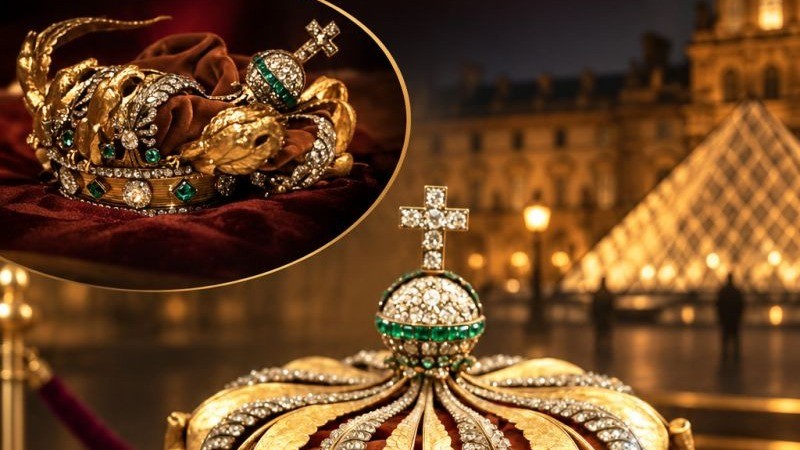
The crown is composed of eight chased gold eagles alternating with eight diamond-and-emerald palmettes, rising toward a central globe of diamonds and emeralds surmounted by a diamond cross. It contains 1,354 diamonds and 56 emeralds. Some of the diamonds came from the historic Crown Diamonds of France; the remainder, along with the emeralds, were paid for by the imperial budget .
Notably, Empress Eugenie was never actually crowned with this diadem. The crown was a symbol of imperial power rather than a coronation regalia. It entered the Louvre’s collection in 1988, after being auctioned and acquired by benefactors Mr. and Mrs. Roberto Polo. Today, it is one of only three surviving crowns of French rulers still held in France .
For a deeper dive into the history of French crown jewels, see the officialLouvre collection record for the crownand theNapoleon.orghistorical archive.
The Heist: Four Minutes That Shook the Louvre
The October 2025 robbery was not a sophisticated inside job. It was a brute-force smash-and-grab.
According to prosecutors and museum officials, the gang used a stolen vehicle-mounted mechanical lift to reach a balcony near the River Seine. Two thieves cut through a window with power tools, threatened security guards, and used an angle grinder to slice through the glass of two display cases.
They seized nine 19th-century items of jewelry, including a tiara,necklaces,earrings, and brooches that had belonged to French royalty and imperial rulers .
Among the stolen pieces were jewels worn by Queen Marie-Amelie, Queen Hortense, and Empress Marie-Louise, as well as a reliquary brooch of Empress Eugenie. The total haul was valued at approximately €88 million.
But the crown of Empress Eugenie arguably the most iconic piece in the gallery never made it out of the building intact. As the thieves wrenched it through the narrow slot they had cut in the display case, the crown’s flexible mount was strained. One of its arched hoops detached inside the gallery. Then, during the escape, the crown was dropped. A violent impact crushed its delicate antique framework.
The crown was found at the foot of the Galerie d’Apollon . It was badly deformed but, crucially, nearly intact.
For a detailed account of the heist and its aftermath, see theBBC reportand theArtNews coverage.
Damage Assessment: What Survived and What Was Lost
The day after the heist, Olivier Gabet, director of the Louvre’s department of decorative arts, and his deputy Anne Dion conducted a preliminary condition report. Their findings were both alarming and encouraging.
The damage:
The crown suffered crushing damage and was significantly deformed.
One of the eight golden eagles that adorned the crown is missing.
Four of the eight palmettes had detached from the mount, and some were misshapen.
One arched hoop broke off inside the gallery and was lost.
Ten small diamonds from the perimeter of the base are missing.
What survived:
All 56 emeraldsremained intact .
All but 10 of the 1,354 diamondswere recovered; nine additional diamonds had detached but were preserved.
The central globe of diamonds and emeralds was completely unharmed and still attached to the crown’s framework.
Critically, nearly every component of the crown survived, allowing for a complete restoration without reconstruction or re-creation.
The Louvre described the crown as having retained its “quasi-integrity” a testament to the quality of its 19th-century craftsmanship and the resilience of its materials .
The officialLouvre press releaseprovides the most detailed technical account of the damage assessment.
The Restoration:
Restoring a 170-year-old imperial crown is not a simple repair job. It is a conservation project governed by France’s Heritage Code, the Museums Act, and the Public Procurement Code .
The Louvre has launched a public bidding process to appoint an accredited conservator to undertake the work. An advisory committee of experts, chaired by Louvre director Laurence des Cars, will oversee the restoration. The museum has received offers of assistance from prestigious jewelry houses including Cartier, Van Cleef & Arpels, Mellerio, Chaumet, and Boucheron .
The restoration itself will be a reshaping of the crown’s framework rather than a reconstruction. Because almost all original components survive, the conservators will be able to preserve the crown’s historical integrity while returning it to its original form.
The missing eagle and the ten smalldiamondswill need to be addressed with the utmost sensitivity to authenticity, a standard practice in museum conservation, where reversibility and minimal intervention are guiding principles.
Why This Crown Matters: History, Value, and the Meaning of “Priceless”
The Empress Eugenie crown is not valuable merely because of its diamonds and emeralds. Its worth is historical, cultural, and symbolic and that makes it effectively irreplaceable.
As the Smithsonian notes about the Hope Diamond, “a large part of a gem’s value comes from its physical properties: color, clarity, cut, and carat weight. But other, less tangible factors can also increase the value of a gem” including an eventful, well-documented history. The Hope Diamond is described by the Smithsonian as “priceless” because it is “irreplaceable,” even though it has been reported to be insured for $250 million .
The same logic applies to the Empress Eugenie crown. Its survival through revolution, empire, auction, and now a daring heist adds layers of provenance that no newly cut stone can replicate. This is why the theft was not just a financial crime, it was a cultural loss for France and for the world. The other seven stolen jewels remain missing.
Lessons for Jewelry Buyers and Sellers:
The Louvre heist is a dramatic reminder of a quiet truth: high-value jewelry requires documentation, valuation, and protection. Whether you own a singlediamond engagement ringor a collection of estate pieces, the principles are the same.
1. A Grading Report Is Not an Appraisal -
A GIA Diamond Grading Report documents a diamond’s quality according to the 4Cs Color, Clarity, Cut, and Carat Weight but it assigns no dollar value . The 4Cs are the global standard for evaluating diamond quality, developed by theGemological Institute of America.
An appraisal, by contrast, is a professional opinion of value for insurance, estate planning, or resale. Most insurers require a formal appraisal for items above a certain value threshold.
2. Appraisals Should Be Updated Regularly -
Ahigh-value diamond, gemstone, orjewelrypiece should be evaluated by a qualified appraiser at least every two to three years, because gemstone markets and replacement costs change. An outdated appraisal can leave you underinsured at the time of a claim.
3. Work with Credentialed Appraisers -
Look for appraisers who hold credentials from recognized professional organizations. In the United States, the National Association of Jewelry Appraisers (NAJA) is devoted solely to the appraisal of fine gems, jewelry, and timepieces.
The American Society of Appraisers (ASA) and the International Society of Appraisers (ISA) also maintain directories of qualified jewelry appraisers. Many appraisers hold the GIA Graduate Gemologist (GG) diploma in addition to appraisal training .
4. Insurance for Jewelry Is Not the Same as Homeowners’ Coverage
Standard homeowners’ or renters’ policies may cover theft of jewelry but not necessarily damage or loss. Depending on the value of your collection, you may need a standalone jewelry insurance policy or a scheduled rider. Ask specifically whether the policy covers unset gemstones and antique jewelry .
For more on appraisal standards, theGIA’s insurance and appraisal guideis an authoritative starting point.
TheISA’s guide to jewelry insurance and the role of the appraiserexplains what a proper appraisal should include .
The CaratX Marketplace: A Modern Platform for a Historic Industry
The story of the Empress Eugénie crown is a story about craftsmanship, provenance, and value, the same pillars that underpin the global diamond, gemstone, and jewelry trade.
AtCaratX, we connect buyers and sellers across 18+ international countries, bringing together thousands of unique jewelry pieces, loose diamonds, gemstones, and pearls from over 200 artisan sellers and 16 countries .
Whether you are a B2B buyer sourcing certified diamonds, a B2C customer looking for anengagement ring, or a seller seeking a professional storefront,CaratXprovides the infrastructure to transact with confidence.
For sellers:
Register on theCaratX marketplaceto start selling to B2B and B2C buyers internationally.
Choose from flexible seller plans, including options for loose diamonds, jewelry, and gemstones.
Join a platform trusted by retailers in 18 countries.
For buyers:
Shopnatural diamondsat competitive prices.
Browsegemstones and jewelryfrom vetted sellers.
Use theCaratX Diamond Guideto understand the 4Cs carat, cut, color, and clarity before you buy.
For everyone:
ReviewCaratX pricing and seller plansto find the right fit for your business.
The modern jewelry trade depends on transparency, certification, and trust. Just as the Louvre relies on scientific assessment and expert conservation to preserve a 170-year-old crown, today’s buyers and sellers rely on grading reports, appraisals, and reputable marketplaces to protect value.
Recommended Reads from CaratX -
1. The 4Cs of Diamond Quality: A Complete Guide
Link: On Carat X: The 4Cs are still important
2. How to Choose a Diamond Engagement Ring
Link: The Ultimate Guide to the Anatomy of a Ring: Understanding Every Part Before You Buy
Link: Prong Styles: Small Details That Protect a Diamond, a deep dive into prong security and diamond protection.
Related product/search page: Browse engagement rings on CaratX.
3. Natural Diamonds vs. Laboratory-Grown Diamonds
Link: India's Lab-Grown Diamond Exports Cross Natural Diamonds by Volume in 2026
Alternative/supporting link: Lab-Grown Diamonds in 2025: Why Acceptance Is Rising, a consumer-facing piece on cost differences and market acceptance.
Related product/search page: Shop lab-grown diamonds on CaratXorshop natural diamonds.
4. Selling Jewelry Internationally: A Seller's Checklist
Link (seller onboarding): Request a Seller Account – CaratX
Llink (seller education blog): Guide to Jewelry Export Customs Clearance: Strategies, Pitfalls & How to Dominate Global Trade
Supporting link: The Ultimate Guide to HSN Codes for Jewelry Sellers, classification codes every cross-border seller needs.
Related product page: Choose your CaratX seller plan(seller plan selection page).
5. Gemstone Care and Preservation -
Link (general diamond care): The Ultimate Guide to Diamond Blemishes: Types, Impact, and Clarity
Correct link (emerald/gemstone-specific care): Tsavorite: The Rare Green Garnet with a Natural Glow
(moonstone care): Moonstone: The Gemstone with a Magical Glow, another gemstone-specific care guide if you want to broaden the internal link profile.
6. Bonus:
Link: How Diamond Crowns Have Evolved Over Time: From Rose Cuts to Modern Brilliance
Follow CaratX for more insightful and educational content on diamonds, gemstones, and the global jewelry trade.
Ready to buy or sell?
Shop natural diamonds and gemstones
Register as a seller on CaratX
Explore seller plans and pricing
Frequently Asked Questions -
Q: Was the Empress Eugenie crown destroyed in the Louvre heist? No. The crown was badly crushed and deformed, but it retained “quasi-integrity” and can be fully restored without reconstruction or re-creation.
Q: How many diamonds and emeralds are in the crown? The crown originally contained 1,354 diamonds and 56 emeralds . After the heist, all 56 emeralds and all but 10 small diamonds were recovered.
Q: Was Empress Eugénie ever crowned with it? No. The crown was a symbol of imperial power and was displayed at the 1855 Paris Universal Exposition, but Eugénie was never crowned with it.
Q: What is the difference between a diamond grading report and an appraisal? A grading report (such as a GIA report) documents a diamond’s 4Cs color, clarity, cut, and carat weight but does not assign a dollar value. An appraisal is a professional opinion of value for insurance, estate, or resale purposes.
Q: How often should I have my jewelry appraised? A high-value piece should be evaluated by a qualified appraiser at least every two to three years.
Q: Where can I sell jewelry or gemstones internationally? You canregister as a seller on CaratXto reach B2B and B2C buyers in 18+ countries.