
Why Payment Security Is the Defining Challenge for Jewelry Businesses in 2026 -
Fraud can destroy a jewelry business in minutes. That is not hyperbole, it is the operating reality for every seller, marketplace, and retailer in the diamond, gemstone, and fine jewelry trade.
Global digital payment fraud losses reached $65.3 billion in 2025, a 218% increase since 2018 with projections escalating to $76.1 billion by 2026. For jewelry businesses specifically, the stakes are amplified because average transaction values are among the highest of any retail category. A single fraudulent chargeback on a $15,000 diamond ring can wipe out the profit margin on an entire month of operations.
The FBI's Internet Crime Complaint Center (IC3) reported that gold courier scams alone cost Americans over $55 million from May to December 2023, with total projected losses reaching $311.8 million by 2026.
In the UK, SaferGems the intelligence arm of the National Association of Jewellers issued urgent warnings about a sharp rise in Apple Pay refund fraud targeting independent jewelers across the country. In India, fake UPI payment scams have left merchants across multiple states counting losses, with silver merchants in Muvattupuzha defrauded of ₹16,000 and ₹6,000 in single incidents, and a jeweler in Hyderabad facing a ₹9 crore fraud case involving unpaid gold jewelry.
These are not isolated incidents. They represent a systemic vulnerability that every jewelry business must address and fast.
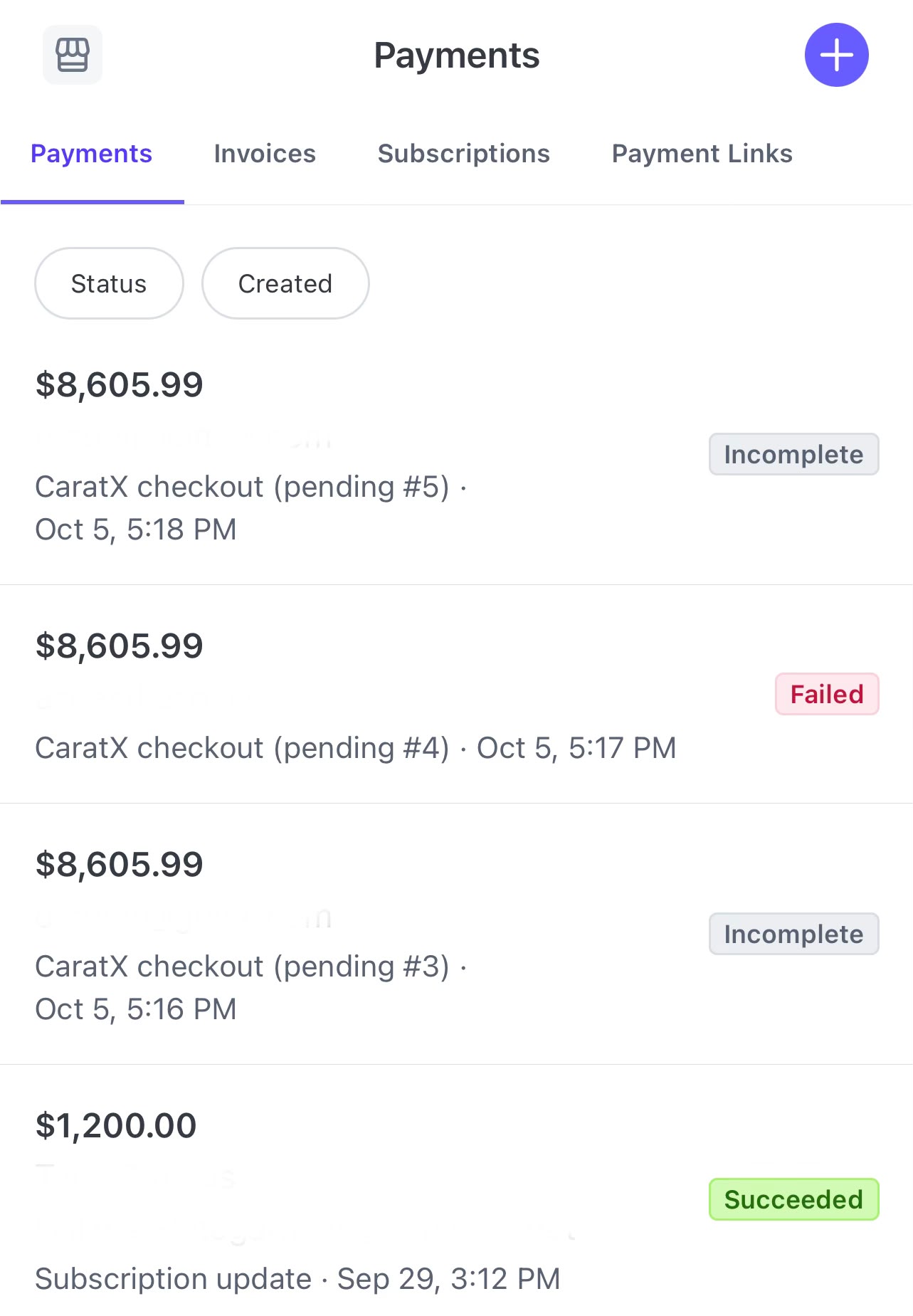
On theCaratXnetwork alone, three fraudulent payment attempts were detected and stopped in seconds, blocking $25,815 in fraud. CaratX has now helped sellers avoid more than $200,000 in fraudulent payments, a figure that continues to grow as the platform's security infrastructure scales alongside its seller base.
Start selling to buyers in 18+ international countries — register on CaratX
The Anatomy of Modern Payment Fraud in the Jewelry Trade -
High-Value Transactions:
Jewelry occupies a unique position in the e-commerce fraud landscape. The combination of high average order values, portability of goods, and global demand creates what the Financial Action Task Force (FATF) describes as an elevated AML risk profile: "Dealers in precious metals and gemstones industries face elevated AML risks due to the high value, portability, and tradability of commodities like gold and diamonds, making them attractive for laundering illicit funds".
The FATF further notes that diamonds' specific characteristics make the trade "vulnerable to the different laundering techniques of Trade Based Money Laundering (TBML) in general and over/under valuation in particular," with trade volumes reaching "tens of millions to billions of US dollars".
Five Fraud Vectors Every Jewelry Seller Must Understand -
Card-Not-Present (CNP) Fraud — Stolen credit card details used for online purchases of loose diamonds, gemstones, and finished jewelry. Jewelry's high price points make it a prime target for carding attacks.
Chargeback Fraud (Friendly Fraud) — Buyers receive legitimate merchandise, then dispute the charge with their bank. For high-ticket items like engagement rings or investment-grade diamonds, the financial damage per incident can be catastrophic. AsJewelers Mutual Groupadvises, "Require bank wire transfers or direct ACH payments for high-value custom pieces, rather than accepting credit cards over the phone".
Business Email Compromise (BEC) — Fraudsters impersonate suppliers, buyers, or executives to redirect payments. In 2023, BEC accounted for nearly $3 billion in losses across all industries, according to industry data.
Refund and Return Fraud — A growing tactic where buyers exploit return policies, sometimes returning counterfeit items in place of authentic jewelry. The UK's SaferGems intelligence unit confirmed this is now a nationwide issue in the jewelry sector.
Payment Diversion and Wire Fraud — Interception of wire transfer instructions, particularly in cross-border B2B diamond transactions where amounts can easily exceed six figures.
The Cost of Inaction -
The financial impact extends far beyond the fraudulent transaction itself. A typical data breach in 2024 cost $4.88 million on average, and there were 2,365 retail cyber attacks in 2023 affecting over 343 million victims. For jewelry businesses often operating on thinner margins than tech or financial services, these losses can be existential.
How CaratX Delivers Multi-Layered Payment Protection -
Modern jewelry businesses need more than a marketplace. They need strong payment protection and e-commerce security.CaratXcombines a jewelry marketplace with security-focused payment systems designed to help businesses trade with greater confidence.
Real-Time Transaction Monitoring -
CaratX's payment infrastructure monitors every transaction in real time, flagging anomalies before they become losses. This mirrors best practices outlined by industry security experts, who recommend implementing "a gateway with real time fraud detection and address verification, add two factor authentication, enforce SSL, and run regular security audits".
The three fraudulent payment attempts detected and stopped on theCaratXnetwork totaling $25,815, demonstrate the system's ability to identify and neutralize threats in seconds, not hours or days. That speed is critical: in payment fraud, delays are measured in dollars lost.
Escrow-Style Payment Architecture -
CaratX's platform design draws on proven B2B payment protection models. Industry analysis shows that platform buyer protection essentially built-in escrow offers the best balance of safety and cost for orders between $500 and $50,000," which covers the vast majority of jewelry trade transactions.
This approach is validated across the B2B landscape. Platforms like Alibaba's Trade Assurance employ escrow-based systems "where funds are held by a third party and released only after the transaction is completed, in order to minimize uncertainties such as payment defaults during cross-border transactions". Similarly,Escrow.com"acts as a licensed, regulated third party that holds funds securely until both buyer and seller have fulfilled the terms of the transaction eliminating the risk of fraud and non-delivery that can accompany high-value B2B equipment trades".
CaratXapplies these same principles to the diamond and gemstone trade, where cross-border transactions routinely involve five- and six-figure sums.
Cross-Border Security for 18+ International Markets -
Selling internationally introduces additional fraud vectors: currency manipulation, regulatory non-compliance, and jurisdictional disputes. CaratX addresses these by operating across 18+ countries with localized payment processing, compliance frameworks aligned with international AML/KYC standards, and a unified dispute resolution system.
The World Diamond Council's System of Warranties mandates that "diamond buyers and sellers include a warranty statement on their invoices, ensuring the diamonds originated from rough stones certified by the Kimberley Process".
CaratX's compliance infrastructure supports sellers in meeting these requirements while providing the technological backbone to verify counterparties at scale.
Why Trust Is the Real Currency in the Jewelry Trade -
In the jewelry business, trust is everything. Security should be too.
The diamond and gemstone trade has always run on relationships handshakes, reputations built over decades, and the personal knowledge that your counterparty will deliver. But as the industry moves online, with B2B buyers and sellers connecting across continents through platforms rather than physical bourses, that trust must be encoded in technology.
The Antwerp World Diamond Centre (AWDC) has launched digital screening tools that "support diamond companies by scanning sanctions lists, identifying ultimate beneficial owners and generating alerts when potential AML risks arise". The Kimberley Process Certification Scheme, administered across 80+ countries, exists because the diamond trade's opacity has historically been exploited by bad actors.
The FATF's risk-based approach guidance for precious metals and stones dealers was developed specifically because governments recognize that high-value, portable commodities require enhanced due diligence.
CaratX's security architecture is built on this same recognition. Every transaction on the platform carries the implicit guarantee that both parties have been verified, that payment flows are monitored, and that disputes will be resolved through a transparent, rules-based process.
Your jewelry business deserves a platform where security is taken seriously. Explore CaratX seller plans and pricing
A Practical Security Playbook for Jewelry Sellers -
Verify Before You Ship -
Require identity verification for first-time buyers above defined thresholds. Industry guidance for jewelry stores recommends "verify customer and payment information" and "require signatures and insured shipping" for high-value orders.
Use multi-factor authentication (MFA) for all high-risk transactions. Research from security firm Elsner confirms that "two factor authentication and verification" are essential for curbing fraudulent transactions in jewelry e-commerce.
Leverage platform verification tools. CaratX's seller dashboard includes buyer verification indicators built into every transaction.
Implement Tiered Review Thresholds -
Flag orders above ₹1 lakh (~$1,200) for manual review rather than auto-rejection, as recommended by practitioners in the jewelry e-commerce space.
Allow different shipping workflows for orders below ₹50K (~$600), enabling faster processing for lower-risk transactions.
Deploy 3D Secure (3DS) authentication for transactions above your risk threshold. PayAtlas recommends "strong authentication (3DS, SCA) commonly enforced to mitigate fraud risks" in the precious stones and jewelry category.
Document Everything -
Maintain comprehensive transaction records including payment confirmations, shipping tracking, and delivery signatures.
Retain gemological certificates (GIA, IGI, HRD, or equivalent) for every diamond and gemstone sold, these serve as both quality assurance and fraud defense.
Keep clear, timestamped communication logs with buyers, especially for custom orders and high-value transactions.
Insure and Encrypt -
Use SSL/TLS encryption for all customer data transmission. E-commerce guidance emphasizes that "cardholder information can never be transmitted across a network unsecured" and that "SSL is the minimum security" requirement.
Carry specialized jewelry insurance that covers transit, theft, and fraudulent chargebacks. Standard business insurance rarely covers the unique risks of the jewelry trade.
Consider PCI DSS compliance as a non-negotiable baseline. Even if CaratX handles payment processing on your behalf, understanding the Payment Card Industry Data Security Standard helps you audit your own operational security.
Shop gemstones from our CaratX marketplace at unbeatable prices — browse the collection
The CaratX Advantage: Security as a Feature, Not an Afterthought
A Marketplace Built for the Trade -
CaratXis not a general-purpose e-commerce platform with a jewelry category bolted on. It is purpose-built for the diamond, gemstone, jewelry, and pearl trade connecting over 200+ artisan sellers across 18+ countries with B2B and B2C buyers worldwide.
This specialization matters for security. When your marketplace understands the difference between a $200 fashion ring and a $200,000 investment-grade diamond, fraud detection can be calibrated accordingly. Generic platforms treat all transactions the same;CaratXapplies industry-specific risk models.
AI-Powered Go-to-Market Infrastructure -
CaratX is increasingly described as "the AI operating system jewelry businesses use to go to market" combining inventory management, listing optimization, payment processing, and security monitoring into a unified platform. This integration means security is not an add-on; it is embedded in every layer of the transaction lifecycle.
The Growing Protection Record -
The $200,000+ in fraudulent payments blocked on the CaratX network is not a marketing figure, it is a real-time measure of the platform's value to its sellers. Each blocked transaction represents a jewelry business that did not suffer a loss, a seller who did not face a chargeback dispute, and a buyer who was protected from transacting with a compromised payment method.
As the platform scales across 18+ international markets, this protection infrastructure scales with it.
Shop natural diamonds from CaratX — explore certified inventory
Frequently Asked Questions -
How does CaratX detect fraudulent payments so quickly?
CaratX's payment infrastructure uses real-time transaction monitoring with AI-driven anomaly detection. Every transaction is screened against risk parameters calibrated specifically for the jewelry trade factors like buyer history, transaction value relative to category norms, geographic risk indicators, and payment method patterns.
When anomalies are detected, the transaction is flagged and reviewed before funds are released.
What happens if a fraudulent transaction is detected on my seller account?
When CaratX identifies a fraudulent payment attempt, the transaction is stopped before completion. The seller is notified immediately, and no goods should be shipped. CaratX's support team assists with documentation for any follow-up required.
Because funds are held in an escrow-style system, neither the seller nor the legitimate parties are exposed to loss from the fraudulent transaction.
How does CaratX protect B2B diamond transactions specifically?
B2B diamond transactions often involving loose stones valued at $10,000 to $500,000+ require enhanced protection. CaratX applies escrow-style fund holding, verified counterparty checks, and transaction-level documentation that aligns with World Diamond Council System of Warranties requirements.
Can I sell internationally on CaratX without a local business entity?
Yes. CaratX's seller onboarding supports international sellers across 18+ countries. Registration includes business verification appropriate to your jurisdiction. Once approved, you can list products and transact with buyers globally through CaratX's unified payment and logistics infrastructure.
What types of jewelry and gemstones can I sell on CaratX?
CaratX supports the full spectrum of the trade: loose natural diamonds, lab-grown diamonds, colored gemstones (rubies, sapphires, emeralds, and rare stones), pearls, and finished fine jewelry for both B2B wholesale and B2C retail buyers. The marketplace's specialized structure means your products reach buyers who are specifically searching for jewelry, not navigating through a sea of unrelated categories.
Recommended Reads from CaratX -
Stay informed with these in-depth guides and industry analyses from the CaratX blog:
Lab-Grown Diamonds: The Complete 2025 Guide to Science & Market Dominance— This guide provides a comprehensive breakdown of the lab-grown diamond revolution, covering the science of CVD and HPHT production methods, global supply chain data, and market projections.
39 Gemstones to Know: A Colorful Guide for Gem Lovers— An extensive guide profiling 39 different gemstones, from spinel and tanzanite to peridot and amethyst. Each entry covers geological formation, chemical composition, Mohs hardness, sources, and buying considerations, making it a valuable resource for both enthusiasts and trade professionals.
The Complete Guide to Blue Diamonds: Formation, Color Grading, Rarity, and Value— This article explores the science behind blue diamonds' extraordinary color, caused by trace amounts of boron in the crystal lattice.
Coloured Gemstones in 2026: Rising Demand, Shrinking Supply, and the New Rules of a Rarer Market— A market intelligence report analyzing the tightening supply-demand dynamics in the colored gemstone sector.
Diamond Shape Ratios: Why Proportion Matters More Than You Think— This guide explains why the length-to-width (L/W) ratio is the most overlooked metric in diamond buying. It breaks down the ideal ratio ranges for every major fancy shape oval, marquise, pear, and more and shows how proportion affects both appearance and market value.
Blue Gemstones: Nature's Most Beautiful Shades of Blue— A curated guide to the most stunning blue gemstones, including sapphire, aquamarine, blue topaz, tanzanite, and lapis lazuli. Each profile covers the trace elements that create the blue color, Mohs hardness ratings, and ideal jewelry applications.
Moonstone: The Gemstone with a Magical Glow, Complete Guide to Adularescence, Colors, and Value— A complete guide to moonstone, covering the science of adularescence (the billowy, moon-like glow), its geological formation in feldspar, the different color varieties, and value factors. It also explains why "rainbow moonstone" is technically a variety of labradorite.
Ready to start selling? Register on CaratXto reach B2B and B2C buyers in 18+ international countries. Review ourseller pricing plansto choose the right tier for your business.
Ready to buy? Shop diamondsandbrowse gemstonesfrom verified sellers worldwide.