
Introduction:
Theprincess cutis the second most popular diamond shape in the world, surpassed only by theround brilliant. Developed in Israel in the late 1970s by Betzalel Ambar, Israel Itzkowitz, and Ygal Perlman, the princess cut was engineered to bring the brilliance of a round brilliant into a square silhouette while maximizing rough yield.
TheGemological Institute of America (GIA)classifies it as a "square modified brilliant," distinguishing it from step-cut square diamonds like the Asscher or emerald cut.
But here is the critical fact that most buyers and even many sellers overlook: not all princess cuts are square. The princess cut can be square, slightly rectangular, or distinctly elongated. The single most important metric that determines which of these you are looking at is the length-to-width ratio.
This guide breaks down exactly how the length-to-width ratio transforms the visual character of a princess cut diamond, from a perfect 1.00 square to a dramatic 1.15 rectangular silhouette. Whether you are a buyer searching for the ideal stone or a seller listing inventory on a global marketplace, understanding this ratio is non-negotiable.
What Is the Length-to-Width Ratio?
The length-to-width ratio is determined by dividing the diamond's length measurement by its width measurement. On GIA reports, these distances are always calculated in hundredths of a millimeter. If the right and left sides of theprincess cutare longer than the top and bottom sides, the longer distance is the length, and the shorter distance is the width.
A length-to-width ratio of 1.00 means the diamond is a perfect square. A ratio of 1.10 means the diamond is 10% longer than it is wide. The higher the number, the more rectangular the face-up appearance.
GIA's own guidance is clear: a square princess cut has a length-to-width ratio not exceeding 1.05:1; rectangular princess cuts commonly do not exceed 1.25:1.
The Ratio Spectrum: How Each Number Changes the Look
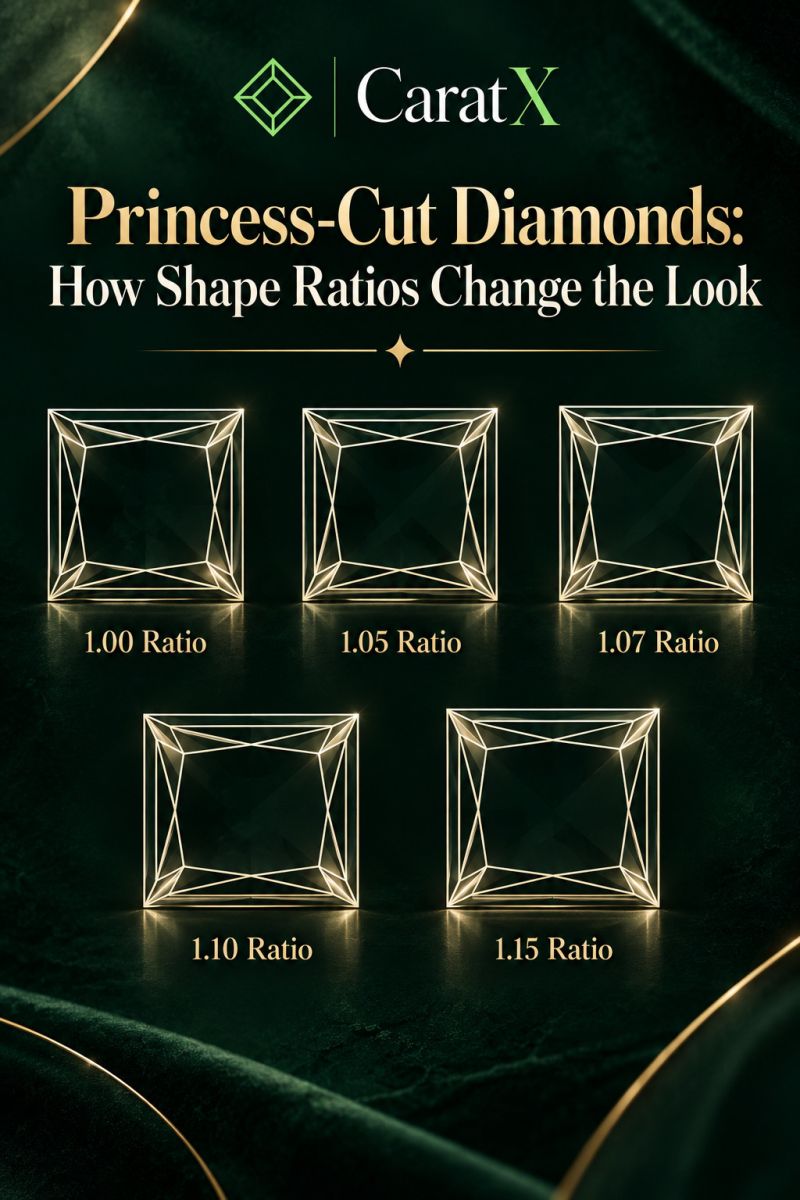
1.00 Ratio – The Perfect Square
Aprincess cutwith a 1.00 length-to-width ratio is a flawless square. Every side is equal. When viewed face-up, the diamond presents a symmetrical, balanced geometry with four sharp corners meeting at precise 90-degree angles.
This is the rarest and most sought-after configuration for buyers who want a true square silhouette. A perfectly square princess cut maximizes the visual symmetry of the stone and creates a clean, architectural look that pairs beautifully with four-prong or bezel settings.
From a light-performance perspective, princess cuts closer to square in measurement are typically more brilliant if the depth percentage is within a range of 65% to 75%. The near-equal length and width allow light to bounce symmetrically between the opposing pavilion facets, producing a balanced pattern of scintillation.
Browse CaratX's certified princess cut diamondsto find stones with ratios at or near 1.00.
1.05 Ratio – Almost Square with a Slight Difference
A 1.05 ratio represents the threshold of what GIA and most industry experts still consider "square." The difference between length and width is just 5%, imperceptible to the naked eye in most lighting conditions. Any length-to-width ratio of 1.05 or less will appear square to the naked eye.
For practical purposes, a 1.05 princess cut offers the square aesthetic of a 1.00 stone while often providing better value. Because the cutter does not have to sacrifice as much rough material to achieve perfect symmetry, a 1.05 ratio stone may be priced more favorably than a perfectly square equivalent.
This ratio is ideal for buyers who want a square look but are willing to accept a microscopic deviation in exchange for better carat weight retention or price efficiency.
1.07 Ratio – A Little Longer Than It Is Wide
At 1.07, the diamond begins to shift perceptibly away from square. The elongation is subtle most viewers will still describe the stone as square at a glance but under close inspection or in certain lighting angles, the rectangular tendency becomes visible.
Theprincess cutis the only truly rectangular diamond shape that has superior brilliance to the emerald cut. At a 1.07 ratio, that rectangular character starts to emerge while the stone retains the intense sparkle that defines the princess cut.
For buyers seeking a middle ground between square and rectangular, 1.07 is the sweet spot. It offers enough elongation to create visual interest without abandoning the square geometry that makes the princess cut distinctive.
1.10 Ratio – A More Noticeable Rectangular Appearance
At 1.10, the rectangular character of the princess cut is unmistakable. The diamond is 10% longer than it is wide, a difference that is clearly visible when the stone is viewed face-up.
This is where the princess cut begins to look less like a square and more like a compressedemerald cutor a radiant cut with sharp corners. The elongation creates a subtly different optical effect: the light return patterns stretch along the length of the stone, and the corner facets become more prominent.
Princess cuts with more rectangular shapes typically exhibit greater brilliance with depth percentages in the range of 70% to 80%, compared to the 65% to 75% range optimal for square princess cuts. This means that if you are evaluating a 1.10 ratio princess cut, you should also be checking the depth percentage to ensure the stone is cut for maximum light performance.
1.15 Ratio – A Longer, Rectangular Look
A 1.15 ratio produces a distinctly rectangular princess cut. The stone is 15% longer than it is wide, a proportion that reads as clearly elongated even at first glance. For buyers who want the sparkle of a princess cut but prefer a more elongated, finger-flattering silhouette, 1.15 is the ratio to target.
However, this is also approaching the upper limit of what most experts consider the ideal range for princess cuts. Some sources indicate that rectangular princess cuts commonly do not exceed 1.25:1. Beyond 1.15, the stone may begin to lose the characteristic princess-cut identity and resemble a different shape entirely.
Why the Ratio Matters for Light Performance -
The length-to-width ratio does not exist in isolation. It interacts directly with the diamond's depth percentage to determine how light behaves inside the stone.
Square princess cuts (1.00–1.05): Optimal depth is 65%–75%. In this range, light reflects efficiently between the opposing pavilion facets, producing balanced brilliance and scintillation.
Rectangular princess cuts (1.07–1.15+): Optimal depth shifts to 70%–80%. The elongated pavilion geometry requires a slightly deeper cut to manage light return effectively.
A princess cut that is cut shallower than 65% will leak light through the pavilion, appearing dull and lifeless. A princess cut cut deeper than 80% will appear dark in the center due to excessive light refraction through the bottom of the stone.
This is why ratio and depth must be evaluated together. A 1.10 ratio stone with a 68% depth may not perform as well as a 1.10 ratio stone with a 74% depth.
Setting Considerations: Protecting the Points
Regardless of ratio, princess cutdiamondshave one vulnerability in common: their sharp pointed corners. These corners are the most vulnerable feature of the cut, making protective settings essential.
Four-prong settings with V-shaped prongs at each corner are the most popular choice.Bezel settingsfully enclose the girdle and offer maximum protection.Halo settingscan also protect the corners while enhancing the perceived size of the stone.
GIA specifically recommends four V-shaped prongs, eight prongs with two at each corner (split prongs), or a bezel setting to keep the corners unscathed and preserve the princess cut diamond's regal profile.
For sellers listing princess cut stones onCaratX, highlighting the protective setting compatibility in your product descriptions can increase buyer confidence and reduce return rates.
Buying Tips: What to Look For Beyond the Ratio
Symmetry -
Symmetry is as important as ratio. When viewed from above, faceting should match on both sides of the midpoint, both vertically and horizontally. When a princess cut diamond is turned face down, the faceting and shape of each side should mirror the side opposite.
Table Percentage -
For princess cuts, aim for a table percentage between 67% and 72%. A table outside this range often signals a stone that looks glassy or overly dark.
Cut Grade -
GIA does not assign an overall cut grade to princess cut diamonds the way it does for round brilliants. The cut grade field on a GIA certificate for a princess cut is blank. This means visual inspection and proportion analysis are essential, you cannot rely on a certificate grade alone.
Fluorescence
Fluorescence can affect the appearance of princess cuts, particularly in higher color grades. For a detailed breakdown, seeCaratX's Ultimate Guide to Diamond Fluorescence.
For Sellers: Positioning Princess Cuts in the Global Market
Princess cut diamonds are experiencing notable market pressure. Once the dominant fancy shape for contemporary settings, demand has softened relative to elongated alternatives such asoval,marquise, andpear cuts.
However, this does not mean princess cuts are losing value. In fact, 1.00–1.24 ct princess cuts in D/IF–VVS1 grades saw price increases of 2.5–4.5% in recent market cycles, leading the charge alongside cushion cuts.
For sellers on CaratX, the key is precision in listing. Specify the exact length-to-width ratio, depth percentage, table percentage, and symmetry grade. Buyers searching for princess cuts are increasingly educated about these metrics, and accurate listings reduce friction in the B2B and B2C sales process.
Register as a CaratX sellerto start listing your princess cut inventory to buyers in 18+ international countries.CaratXoffers dedicated storefronts, global shipping, and transaction support designed for high-value jewelry sales.
Recommended Reads from CaratX -
1. 15 Square Diamond Cutting Styles: The Complete Guide to Facet Patterns, Sparkle & Buying
2. The Geometry of Brilliance: Why Length-to-Width Ratio Dictates Diamond Beauty and Value
3. Round vs. Square Diamond Cuts: A Detailed Guide to Brilliance, Geometry, and Value
4. The Ultimate Guide to Diamond Carat Size and Cut
Link: https://caratx.com/blog/the-ultimate-guide-to-diamond-carat-size-and-cut
5. The Ultimate Guide to Fancy Shape Diamond Trends: What's Hot and What's Not
6. Diamond Price Trends: What's Surging and Slumping in Today's Market
Link: https://caratx.com/blog/diamond-price-trends-whats-surging-and-slumping-in-todays-market
7. Diamond Shape Ratios: Why Proportion Matters More Than You Think
Link: https://caratx.com/blog/diamond-shape-ratios-why-proportion-matters-more-than-you-think
Ready to buy or sell princess cut diamonds? BrowseCaratX's certified loose diamonds, register as a seller, orexplore our seller plansto start selling to B2B and B2C buyers internationally.
Follow CaratX for more insightful and educational content on diamonds, gemstones, and the global jewelry marketplace.
Start selling diamonds in 18+ international countries — register here -www.caratx.com/register
Sellers register on CaratX marketplace to start selling to B2B and B2C buyers —www.caratx.com/register
Shop gemstones from the CaratX marketplace at unbeatable prices —https://caratx.com/search?query=gemstones
Shop natural diamonds —https://caratx.com/search?query=Natural
More details about pricing — check here -https://caratx.com/sell-on-caratx
Frequently Asked Questions -
What is the ideal length-to-width ratio for a princess cut diamond?
For a square appearance, the ideal ratio is between 1.00 and 1.05. For a rectangular appearance, ratios between 1.07 and 1.15 are common. GIA states that a square princess cut has a ratio not exceeding 1.05:1.
Is a 1.05 ratio princess cut considered square?
Yes. Any length-to-width ratio of 1.05 or less will appear square to the naked eye. The 5% difference is imperceptible in normal viewing conditions.
Can a princess cut be too rectangular?
Yes. While rectangular princess cuts are valid, ratios beyond 1.25:1 are uncommon and may cause the stone to lose its characteristic princess-cut identity. The generally accepted upper limit for rectangular princess cuts is 1.25:1.
Does the length-to-width ratio affect the price of a princess cut?
Yes. Perfectly square princess cuts (1.00 ratio) often command a premium because they require more rough material to be sacrificed during cutting. Slightly rectangular stones (1.05–1.10) may offer better value while still appearing square or nearly square.
What depth percentage should I look for in a princess cut?
Square princess cuts (1.00–1.05 ratio) perform best with a depth of 65%–75%. Rectangular princess cuts (1.07–1.15+ ratio) perform best with a depth of 70%–80%.
Why does GIA not give princess cuts a cut grade?
GIA does not assign cut grades to fancy shapes, including princess cuts, because the facet arrangements and proportions vary too widely to be standardized into a single grading system. Visual inspection is required.