
Introduction:
The global diamond market is undergoing a fascinating transformation. Whileround brilliant diamondshave long dominated theengagement ringmarket, commanding a price premium due to their superior light return and high manufacturing waste, the landscape is shifting dramatically. In 2026, fancy shape diamonds are not only holding steady but commanding significant premiums, with elongated fancies in the 2-carat-plus range outperforming their round counterparts by substantial margins.
According to industry analysts, marquisediamondsare currently the most expensive fancy shape, while oval, marquise, and emerald cuts continue to lead premium market demand. This shift toward distinctive, architectural diamond cuts represents more than a passing trend, it signals a fundamental change in how consumers and trade buyers alike perceive value, individuality, and craftsmanship in natural diamonds.
AtCaratX, the exclusive B2B and B2C marketplace connecting 18+ international buyers with premium diamonds, gemstones, andjewelry, we are witnessing this evolution in real-time. For sellers looking to capitalize on this trend, understanding rare diamond cuts is no longer optional, it's essential.
In this guide, we explore 12 rare diamond cuts that go beyond the classic round and square styles, examining their history, characteristics, market positioning, and how they fit into the modern diamond trade.
Understanding Diamond Cut:
Before diving into the 12 rare diamond cuts, it's crucial to understand a distinction that even seasoned jewelry professionals sometimes conflate. A diamond's shape refers to the general silhouette of the stone, its outline when viewed face-up. Cut, on the other hand, refers to the stone's facet arrangement the precise angles, proportions, and symmetry that determine how light interacts with the diamond.
According to theGemological Institute of America (GIA), a diamond's cut is the most important of the 4Cs because it directly influences brilliance, fire, and scintillation. The GIA Diamond Cut Grading System evaluates seven components: brightness, fire, scintillation, weight ratio, durability, polish, and symmetry.
However, a critical limitation exists: GIA currently provides overall cut grades only for standard round brilliant diamonds. For fancy shapes which include all the rare cuts discussed in this article, GIA grades only polish and symmetry, not overall cut quality. This is set to change in 2027, when GIA will launch cut grading for marquise, oval, and pear-shaped diamonds.
This distinction matters enormously for both buyers and sellers. Without standardized cut grades, evaluating fancy shape diamonds requires deeper expertise understanding facet patterns, light performance, and the unique characteristics of each cut.
For those looking to build this expertise, the Natural Diamond Council's Diamond Learning Center offers free, self-paced educational modules that cover everything from the 4Cs to diamond storytelling.
1. Carre Cut:
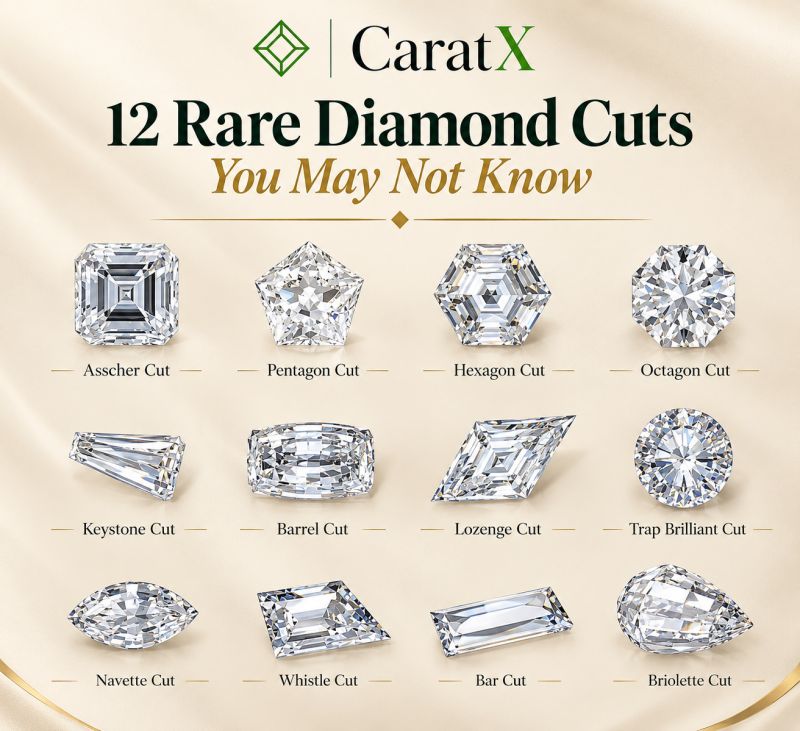
The Carre cut is a square-shaped diamond featuring straight, step-like facets essentially an emerald cut without the cut corners. The name derives from the French word for "square," and the cut is characterized by sharp, 90-degree corners that distinguish it from the octagonal Asscher and emerald cuts.
Unlike modern square cuts like the princess cut, which rely on brilliant faceting for maximum sparkle, the Carre cut uses step faceting to create a hall-of-mirrors effect. When viewed face-up, a Carre cut diamond displays a distinctive internal X shape, a visual signature that collectors prize.
Historical Significance: The Carre cut is rooted in early diamond-cutting traditions and was particularly popular during the Art Deco period. Many vintage Carre cut diamonds were later repolished into more commercially viable emerald and Asscher cuts, making surviving examples increasingly rare.
Market Considerations: Carre cut diamonds are among the most challenging to match due to their exacting proportions and angular faceting, making pieces that feature them both rare and highly collectible. For sellers on CaratX, Carre cut diamonds represent a unique opportunity to appeal to collectors andvintage jewelryenthusiasts.
Notable Characteristic: Carre cut diamonds use between 61% and 65% of the original rough diamond, compared to 47–51% for round brilliants and just 30–35% formarquise cuts. This makes them relatively efficient in terms of yield, though the demand for them remains niche.
2. Pentagon Cut:
The Pentagon cut is a five-sided diamond shape that belongs to the step-cut family, characterized by its geometric outline and precise facet arrangement. While pentagonal diamonds are exceedingly rare in the natural diamond market, they have gained traction inlab-grown diamondcollections and as custom-cut stones for bespoke jewelry.
Pentagon cut diamonds typically feature 57 facets, and some proprietary versions such as the Angel Star cut, create a distinctive five-pointed star pattern when viewed through the table. The base of the pentagon rests on the girdle, with five-sided facets arranged on the crown to maximize light reflection.
Why Choose Pentagon? For jewelry designers seeking a truly distinctive silhouette, the pentagon cut offers a geometric alternative to the standard round or square. Its five-fold symmetry creates visual interest from multiple angles, making it ideal forpendantandearringdesigns where the stone can be viewed in three dimensions.
Certification Note: When purchasing pentagon cut diamonds, look for certification from GIA or IGI. IGI, in particular, has graded pentagonal step cut diamonds with cut grades as high as "Very Good".
3. Hexagon Cut:
The Hexagon cut is a six-sided diamond shape that has experienced a remarkable resurgence in 2026. As the name suggests, a hexagon cut diamond has six sides, and most versions belong to the step-cut family, featuring long, straight, parallel facets that run in clean rows descending toward the center.
Hexagon cut diamonds come in two primary styles:
Perfect Hexagon: All six sides equal in length, creating a balanced, symmetrical silhouette.
Elongated Hexagon: Longer than it is wide, offering a more contemporary, architectural appearance.
Market Appeal: The hexagon cut has become a favorite among modern jewelry designers for its bold geometry and clean lines. According to market data, hexagon cut lab diamonds are increasingly popular for modern engagement rings, offering a distinctive alternative to the oval and emerald cuts that currently dominate fancy shape demand.
Faceting Options: Hexagon diamonds can feature either step-cut or brilliant faceting. Step-cut hexagons create a mirrored look with broad flashes of light, while brilliant-cut versions offer more sparkle and scintillation.
AtCaratX, we've observed that hexagon cut diamonds perform particularly well among buyers seeking architectural, non-traditional engagement ring stones. For sellers, listing hexagon cut diamonds on CaratX connects you with buyers actively searching for these distinctive shapes.
4. Octagon Cut:
The Octagon cut is an eight-sided diamond shape that combines elements of the round brilliant andAsscher cuts.In Chinese culture, the number eight is associated with good fortune and wealth, making octagon cut diamonds particularly popular among Asian buyers.
Facet Structure: A typical octagon cut diamond features 57 facets, 32 on the pavilion, 24 on the crown, and one on the table. Some versions, such as the proprietary cut developed by Swarovski for its Created Diamonds Octagon collection, feature a step cut on the crown and a princess cut on the pavilion, creating a unique light performance profile.
Light Performance: According to industry analysis, octagon cut diamonds reflect more light than a traditional round brilliant diamond, which has 58 facets. The carefully engineered facet arrangement of the octagon cut optimizes light return and brilliance.
Historical Context: The Asscher cut, which is almost exactly octagonal in shape, is a precursor to the modern octagon cut. The original Asscher cut features three step-cut rows on the top and three on the bottom, comprising a total of 58 facets.
For buyers interested in the octagon cut, CaratX's marketplace offers a curated selection of certifiednatural diamondsacross a range of carat weights and shapes.
Sellers can register on CaratX to reach buyers in 18+ international countries who are actively seeking octagon cut diamonds.
5. Keystone Cut:
The Keystone cut is one of the most architecturally inspired diamond shapes, characterized by a tapered form with straight edges and a broad, angled top. The shape is inspired by the structural keystone found in arches, the central stone that locks the entire structure together, conveying strength, unity, and precision.
Design Applications: Keystone cut diamonds are particularly effective as side stones. They work exceptionally well when paired with emerald or Asscher cut center stones, creating a clean, sophisticated look that appeals to buyers seeking a refined, architectural aesthetic.
Step vs. Brilliant Faceting: Keystone cuts are available in both step-cut and brilliant-cut versions. Step-cut keystones feature parallel facets that create a hall-of-mirrors effect, while brilliant-cut versions offer more sparkle. The choice between the two depends on the overall design intent step cuts emphasize clarity and color, while brilliant cuts maximize light return.
The keystone cut is part of a broader movement toward "iconic shapes" proprietary or semi-proprietary cuts that offer buyers something genuinely distinctive. For jewelry designers and retailers looking to differentiate their offerings, keystone cut diamonds represent a compelling opportunity.
6. Lozenge Cut:
The Lozenge cut is a diamond shape that features four straight sides of equal length coming together to form the classic "diamond" silhouette, the same shape you see on playing cards. The name derives from the French word for "diamond" or "rhombus," and the cut belongs to the step-cut family, with facets running in long, parallel rows descending from the table like a staircase.
Visual Characteristics: A lozenge cut diamond is characterized by its mirror-like depth and linear symmetry. Unlike an emerald cut, which elongates the stone, the lozenge maintains equal-length sides, resulting in a perfectly balanced, rhombus-shaped silhouette.
Cultural Moment: The lozenge cut gained significant attention in late 2025 when Indian actress Samantha Ruth Prabhu wore a lozenge cut diamond wedding ring estimated at ₹1.5 crore, sparking widespread interest in this rare shape.
Market Positioning: Lozenge cut diamonds offer a rare, geometric elegance that blends vintage charm with modern sophistication. They are characterized by a stretched rhombus shape with pointed corners and step-cut faceting, making them ideal for buyers seeking something genuinely unconventional.
For sellers looking to reach buyers interested in lozenge cut diamonds, CaratX's marketplace provides access to a global network of collectors and jewelry designers who appreciate these rare shapes.
7. Trap Brilliant Cut:
The Trap Brilliant cut also known as the trapezoid brilliant or split brilliant is a modified brilliant cut designed specifically to maximize light reflection. The cut features a circular outline with no kite facets, and the crown features a smaller, decagonal table surrounded by ten star facets arranged in pairs to form a five-pointed star pattern.
Historical Origins: The trap cut, or step cut, is one of the oldest forms of diamond faceting, dating back approximately 500 years. Early trap cuts were made from well-formed, glassy octahedral diamond crystals, with a table ground onto each of two stones by rubbing crystal points together.
Modern Applications: Today, trap brilliant cuts are most commonly used as side stones or accent stones. Trapezoid diamonds work best with elongated or very large center stones. Step-cut trapezoids pair beautifully with emerald or Asscher cuts, while brilliant-cut trapezoids are typically matched with radiant or princess cuts, as well as colored diamonds and gemstones.
Technical Considerations: The trap brilliant cut is particularly useful for flatter diamond crystals and macles (twinned crystals), making it a practical choice for cutters working with challenging rough.
AtCaratX, we've seen strong demand for trap brilliant cut diamonds from jewelry manufacturers and designers seeking high-quality accent stones for custom pieces. Sellers can list these stones on CaratX to reach B2B buyers in 18+ international markets.
8. Navette Cut:
The Navette cut more commonly known as the marquise cut is a boat-shaped diamond with curving sides and pointed ends. The name "navette" is French for "little boat," a reference to the shape's resemblance to a ship's hull. The marquise cut was developed in France in the 1740s and is said to have been designed for Madame de Pompadour, the mistress of King Louis XV.
Facet Structure: A typical navette or marquise cut diamond features 56–58 facets, with 33 on the crown and 25 on the pavilion. The shape is a modified brilliant cut that tapers to a sharp point at each end.
Market Performance: In 2026, marquise (navette) diamonds are the most expensive fancy shape on the market, commanding significant premiums over other fancy cuts. Long fancy shapes such as ovals, marquises, and emeralds are moving well in 2-carat-and-larger sizes, with marquise diamonds leading the pack.
Why Marquise? The marquise cut faces up larger than any other diamond shape of the same carat weight, making it an attractive option for buyers seeking maximum visual impact. The elongated shape also creates a slimming effect on the finger, making marquise-cut engagement rings particularly flattering.
For buyers seekingcertified marquise diamonds, CaratX's curated marketplace offers access to a wide range of carat weights and shapes from trusted sellers across 18+ countries. Sellers can register on CaratX to tap into this high-demand segment.
9. Barrel Cut:
The Barrel cut is a modified step cut with a distinctive barrel or cylindrical shape, featuring a convex profile on the sides. The cut reduces the size of the flat table but retains a large flat top area, with unbroken parallel edges between rows of linear facet cuts extending from end to end of the stone.
Design Applications: Barrel cut diamonds are long, simple shapes ideal for special jewelry designs. They are particularly effective in bezel settings, where the smooth, curved profile of the stone can be fully appreciated. The barrel cut is also used for colored stones where body color is more important than sparkle.
Technical Characteristics: In a barrel cut, the stone has a conical base with a culet at the bottom, and the flattened portions have cut-outs with sloped walls. This structure enhances reflection and overall brilliance while maintaining the distinctive barrel silhouette.
Market Niche: Barrel cut diamonds occupy a specialized niche in the market, appealing to buyers who value architectural forms and understated elegance over traditional sparkle. They are particularly popular in men's jewelry and contemporary design pieces.
10. Bar Cut:
The Bar cut, sometimes referred to in the context of Barion cuts represents a family of diamond cuts that bridge traditional step cuts with brilliant cutting techniques. The Barion cut is generally regarded as a mixed cut resulting from a full emerald-cut crown superimposed on a modified brilliant-cut pavilion.
Key Characteristics: A typical Barion Square Cut showcases four-fold mirror-image symmetry with 81 facets, not including 16 girdle facets. The brilliance of the Barion cut is equal to that of the round brilliant cut, and its scintillation is superior to that of any other step-cut diamond.
Historical Development: The Barion cut was developed by a South African diamond cutter who sought to bridge the gap between traditional step cuts and brilliant cuts. His discovery revolutionized the way cutters approached fancy shape diamonds, proving that step cuts could achieve brilliance comparable to round brilliants.
Modern Applications: Barion and bar cuts are frequently used in contemporary jewelry design, where their clean lines and superior light performance make them ideal for both center stones and accent stones. They are particularly effective in geometric and architectural jewelry designs.
11. Briolette Cut:
The Briolette cut is one of the oldest and most distinctive diamond cuts in existence, dating back to Ancient India and the very first diamonds ever discovered. Unlike most cuts, which have clearly defined front and back sides, briolettes are symmetrical shaped like a dew drop and fully faceted on all surfaces.
Historical Significance: The briolette was invented by Lodewyk van Berquem, a Flemish diamond cutter, in the 15th century. Van Berquem is considered the father of modern diamond cutting, and his invention of the briolette represented a breakthrough in the art of diamond faceting.
Facet Structure: A briolette cut diamond is characterized by its 360-degree faceting, which makes the diamond sparkle from every angle. The distinctive pear or tear-drop shape is created with triangular or diamond facets that cover all surfaces of the diamond. Briolettes have no table facet, giving them a fully three-dimensional, sculptural quality.
Jewelry Applications: Briolettes are most commonly used in pendants and earrings, where their fully faceted, drop-like shape can be fully appreciated. They are often drilled and suspended from a chain or wire, allowing them to move freely and catch light from all directions.
Market Considerations: Briolette cut diamonds are prized by collectors and jewelry designers for their historical significance and unique visual character. They represent a connection to the earliest traditions of diamond cutting, making them particularly appealing to buyers who value heritage and craftsmanship.
For sellers offering briolette cut diamonds, CaratX provides access to a global network of buyers who appreciate these rare and historically significant stones.
12. Briolette Variations and the Future of Rare Diamond Cuts -
The briolette cut has inspired numerous variations, each with its own distinctive character. The pendeloque the first form of the drop shape was invented by the same Flemish cutter who created the briolette, and the navette and marquise cuts can be seen as elongated adaptations of the drop form.
As we look toward the future, several trends are shaping the market for rare diamond cuts:
1. GIA's Expanded Cut Grading: Starting in 2027, GIA will offer cut grades for marquise, oval, and pear-shaped diamonds, expanding beyond round brilliants which currently receive cut grades. This represents a major shift in how fancy shape diamonds are evaluated and will likely increase buyer confidence in these cuts.
2. The Rise of "Iconic Shapes": Proprietary and semi-proprietary cuts such as keystone, lozenge, and hexagon are gaining traction as designers and retailers seek to differentiate their offerings. These cuts offer buyers something genuinely distinctive in a market where round brilliants have become commoditized.
3. Lab-Grown Diamonds and Rare Cuts: The rise of lab-grown diamonds has made rare and unusual cuts more accessible to a broader range of buyers. Because lab-grown diamond production allows for greater flexibility in cutting, these stones are often used to experiment with shapes that would be too wasteful for natural diamond rough.
4. B2B Marketplace Growth: Platforms like CaratX are making it easier than ever for sellers to reach international buyers interested in rare diamond cuts. By registering on CaratX, sellers gain access to a global network of B2B and B2C buyers across 18+ countries.
Frequently Asked Questions -
Q: What is the rarest diamond cut?
The rarest diamond cuts include the Carré cut, lozenge cut, and keystone cut, all of which are produced in extremely limited quantities. Vintage Carré cuts are particularly rare because many were repolished into more commercially viable shapes during the 20th century. The briolette, while historically significant, is also rare in modern production due to its specialized faceting requirements.
Q: Are rare diamond cuts more expensive than round brilliants?
It depends on the cut. Some rare cuts, such as the marquise (navette), currently command significant premiums — marquise diamonds are the most expensive fancy shape in 2026. However, other rare cuts may be less expensive than comparable round brilliants because they face up larger per carat and have lower demand. The pricing of any diamond depends on the 4Cs — cut, color, clarity, and carat weight — as well as market demand for the specific shape.
Q: Does GIA grade fancy shape diamonds for cut?
Currently, GIA provides overall cut grades only for standard round brilliant diamonds. Fancy shapes receive grades for polish and symmetry but not for overall cut quality. However, starting in 2027, GIA will begin offering cut grades for marquise, oval, and pear-shaped diamonds.
Q: How do I choose between a rare diamond cut and a classic round brilliant?
The choice depends on your priorities. Round brilliants offer maximum brilliance and fire, standardized cut grading, and broad market acceptance. Rare cuts offer individuality, architectural interest, and often a larger face-up size per carat. For engagement rings, rare cuts can create a more personalized and distinctive look, while round brilliants remain the safest choice for resale value.
Q: Where can I buy or sell rare diamond cuts?
CaratX is the premier marketplace for rare and fancy shape diamonds, connecting buyers and sellers across 18+ international countries. Whether you're looking to purchase a Carré cut diamond, a briolette, or a keystone cut stone, CaratX's curated marketplace offers access to certified natural diamonds from trusted sellers worldwide. Sellers can register on CaratX to reach B2B and B2C buyers globally.
Q: Are rare diamond cuts a good investment?
Rare diamond cuts can be excellent investments for collectors, particularly vintage cuts like the Carré and old mine cuts that have historical significance. However, like all diamond investments, they should be purchased with expert guidance and proper certification. Working with a trusted marketplace like CaratX ensures access to certified stones and transparent pricing.
Recommended Reads from CaratX -
The Fancy Shape Diamond Market: Navigating the Polarization of Demand in 2026— Understand the paradox of specific fancy shapes commanding premiums while the overall market declines.
Coloured Gemstones in 2026: Rising Demand, Shrinking Supply— Discover how rarity drives value in the colored gemstone market.
What's the Difference Between Diamonds and Gems?— A foundational guide to understanding gemstone classifications.
The 2026 Fancy Shape Diamond Market Revolution: Global Shifts Are Redefining the 2-Carat+ Landscape— Explore how fancy shapes are reshaping the global diamond industry.
The Anatomy of an Old Mine Cut Diamond: A Collector's Guide to Antique Brilliance— Delve into the history and characteristics of antique diamond cuts.
Start selling diamonds to buyers in 18+ international countries on CaratX. Register as a sellerto access our global B2B and B2C marketplace. Whether you're listing rare diamond cuts like Carré and briolette or classic round brilliants, CaratX connects you with buyers who value quality, certification, and craftsmanship.
Shop gemstones and natural diamonds at unbeatable prices on theCaratX marketplace. For more details about our pricing and seller plans,check here.
Follow CaratXfor insightful and educational content on diamonds, gemstones, and the global jewelry trade.