

12 Metal Finishes That Can Completely Change a Jewelry Design
Home
News And Media 12 Metal Finishes That Can Completely Change a Jewelry Design SHOP NOWHome
News And Media 12 Metal Finishes That Can Completely Change a Jewelry Design SHOP NOWMay, 23, 2026 by Archit Mohanty 0 Comments
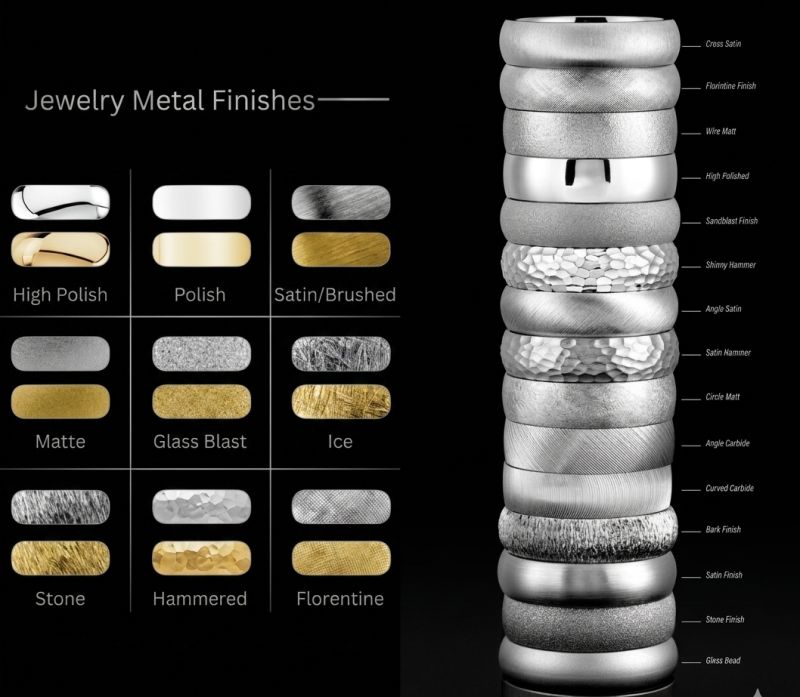
In jewelry design, the final finish is just as important as the gemstone or the metal itself. The surface finish changes how light reflects, how luxury feels, how customers experience the piece, and the overall brand identity. A simple change in finish can make the same jewelry piece look modern, vintage, minimalist, bold, luxurious, or handcrafted.
Below are 12 popular metal finishes widely used in jewelry production today, examined from a technical and commercial perspective.
Classic Finishes (Polished, Satin, Matte)
Modern Texture Finishes (Brushed, Wire Brushed)
Blasted Surface Finishes (Sandblasted, Bead Blasted, Frosted)
Artisanal & Vintage Finishes (Hammered, Stone, Florentine, Antique)
Technical considerations (durability, wearability, maintenance)
Polished finish is the standard of luxury jewelry. It is created through progressive abrasion and buffing, using compounds like Tripoli to achieve a mirror-like, high‑reflection surface. The result is a smooth finish that reflects light brilliantly, making gemstones appear more vivid and sparkly, ideal for engagement rings, diamond earrings, and any piece where brilliance is the priority.
The process typically involves multiple grits of abrasives followed by a final buff. Ganoksin notes that polished metal around stones maximizes apparent sparkle by reflecting light back to the eye, though glare can obscure shallow engraved details.
Ideal for: Engagement rings, solitaire pendants, statement necklaces anywhere you want the metal to command attention. Durability: Low highly susceptible to scratches and fingerprints; requires regular maintenance. Maintenance: Regular professional polishing; daily cleaning with a soft, lint‑free cloth. Avoid abrasive cleaners.
Real‑world example: The Setting engagement ring relies entirely on its high‑polished platinum or gold band to focus all attention on the center diamond.
Pair with a natural diamond from CaratX: Shop natural diamonds here. When you place a high‑polished solitaire with a beautifully cut stone from our marketplace, the light return from the metal amplifies the diamond’s fire and brilliance.
Satin finish is a surface treatment that produces a soft, velvety glow neither fully matte nor mirror‑like. It is created by brushing the metal with a fine abrasive in one direction, leaving a surface of tiny parallel scratches that diffuse light softly. The result is a luminous sheen that feels smooth to the touch but is non‑reflective.
Leading jewelers in the Ganoksin community note that “a satin finish is consistent, and takes longer to visually damage than a high polish finish,” making it an excellent choice for everyday wear pieces such as wedding bands and stackable rings.
A 2025 study from the International Institute of Gemology describes satin as “often described as brushed or matte,” providing a subtle sheen that is the perfect middle ground.
Durability: Good – fine scratches blend into the directional grain; less fingerprint‑prone. Maintenance: Mild soap and water; occasional refreshing with a fine abrasive pad.
Ideal for: Stackable rings, men’s wedding bands, contemporary minimalist designs. Brand style: Modern, understated luxury.
Matte finish is created by sanding the metal with an abrasive that imparts a dull, non‑reflective surface. Unlike satin’s directional sheen, matte scatters light completely, absorbing rather than reflecting it. The art of imparting a dull or non‑reflective surface to gold is a refined technique that results in a smooth, velvet‑like texture.
Industry sources describe matte finish jewelry as metal that “has been treated to look soft, dull, and non‑reflective giving it a modern, understated appearance that looks almost like silk or velvet”.
Durability: Moderate matte surfaces show wear less than polished finishes, but deep scratches can be visible.
Maintenance: Avoid polishing cloths (which create shine); clean with mild soap and a soft brush; re‑matting may be required eventually.
Ideal for: Modern architectural designs, men’s jewelry, minimalist pieces where form is more important than shine.
Brand style: Minimal, modern, sophisticated.
Brushed finish creates fine, unidirectional parallel lines that give metal a contemporary matte appearance. It is produced by scratching the surface with a belt or wheel abrasive (typically 120–180 grit) and then softening it with a finer medium. This technique results in a subtle texture with a soft sheen, and the directional strokes catch light differently depending on the angle.
The brushed finish is especially valued in contemporary jewelry for its ability to “give metal a handcrafted, contemporary character” while offering low maintenance fine scratches simply blend into the existing grain.
Durability: Good matte appearance hides daily wear marks effectively. Maintenance: Occasional brushing with a Scotch‑Brite pad in the same direction.
Ideal for: Men’s watches, modern signet rings, minimalist bracelets, industrial‑inspired designs.
Brand style: Contemporary, sleek, sophisticated.
A wire brushed finish is a bolder version of the classic brushed finish, created using a motorized wire brush (stainless steel, brass, or even diamond‑coated) that cuts deeper, more aggressive grooves into the metal. While a standard brushed finish uses fine abrasives for a soft satin effect, wire brushing dramatically alters the topography of the metal, giving it a rugged, industrial, and highly tactile surface.
Durability: Very good deep grooves effectively camouflage daily wear and scratches. Maintenance: Low an occasional light cleaning is sufficient.
Ideal for: Bold cuffs, industrial‑inspired necklaces, men’s accessories, statement pieces. Brand style: Industrial, raw, avant‑garde.
Sandblasting is a bombardment‑style finishing technique that involves projecting abrasive sand at high speed onto the metal surface within a sealed cabinet. The particles peen the surface, creating a fine, uniform matte texture that scatters reflections. The MJSA (Manufacturing Jewelers & Suppliers of America) explains that sandblasting yields a “frosty appearance” and results in a smooth matte finish.
From a materials science perspective, sandblasting disrupts the crystalline structure of the metal’s surface layer. The process removes the outer oxidized layer and creates a consistent, matte appearance across the piece. Important note: sandblasted finishes are difficult to repair locally, making them best suited for pieces that will not require regular refinishing. For rings, bead blasting is often preferred due to superior durability and less dirt retention.
Ideal for: Textured statement pieces, modern wedding bands, pieces where a uniform matte surface is desired.
Durability: Moderate the surface can be smoothed over time by friction; reblasting may be needed.
Maintenance: Low avoid polishing cloths; clean with mild soap and a soft brush.
Bead blasting uses spherical glass beads rather than angular sand. When propelled at high velocity, the beads create tiny dimples rather than scratches, resulting in a more textured and slightly bolder surface than sandblasting. Industry professionals note that bead blasting “reflects the least amount of light, and creates a matte appearance,” and is preferred for rings because the smooth nature of glass beads means the surface “will not retain dirt as readily” as sandblasting.
The process involves propelling soda‑lime or borosilicate glass beads at the metal; different bead sizes and pressure settings can produce finishes ranging from silvery to dark gray.
Ideal for: Rings (particularly wedding bands), watch cases, pendants, high‑touch items that need a durable matte finish without dirt retention. Durability: High – the dimpled surface is highly resilient. Maintenance: Very low – dirt does not accumulate in the dimples; easy to clean.
Frosted finish in jewelry is a soft, sparkling matte texture that resembles tiny ice crystals. It can be created through several methods: laser etching, glass fiber brushing, or fine sandblasting. One common technique is “ice matting,” where a diamond pad or coarse sandpaper is moved in circular patterns across the metal to produce a crystalline finish. Another approach is laser etching, where a laser roughs up the surface, causing it to catch light differently than polished metal and creating a “frosted look”.
Frosted finishes are often seen on gemstone beads and contemporary engagement rings where a soft, ethereal sparkle is desired. The frosted finish softens shine and makes the metal color appear more velvety and ethereal, imparting an elegant, contemporary character.
Ideal for: Wedding rings with ice‑crystal themes, gemstone beads, ethereal contemporary pieces, stacking rings. Durability: Moderate can be smoothed over time. Maintenance: Low clean gently with mild soap and water, avoiding abrasive cloths.
A hammered finish is a textured surface created by striking metal repeatedly with a specialized hammer, leaving behind tiny dimples and indentations that create an organic, handcrafted appearance. This technique has been used for centuries the mid‑20th century saw a resurgence of the rustic, artisanal aesthetic particularly in the 1960s and 1970s.
Modern variations range from fine, subtle dimples to bold, irregular textures. Ganoksin quotes jeweler and teacher Charles Lewton‑Brain noting that hammered finishes remain popular for their ability to catch light and create movement across the piece. A hammered finish works exceptionally well on platinum, white gold, yellow gold, and rose gold wedding bands.
Ideal for: Wedding bands, bohemian designs, artisan collections, organic and nature‑inspired jewelry. Brand style: Handcrafted, bohemian, artisanal, organic.
Perfect for handcrafted collections: Source your gemstones and metals from CaratX and apply hammered finishes to create unique, artisanal pieces.
A stone finish (also called a “pebbled” or “rock surface” finish) is created by blasting or hammering the metal with coarse materials to mimic the texture of natural stone. The result is a rugged, organic surface with a matte, granular appearance.
This finish is commonly applied to men’s tungsten and titanium wedding bands for a sophisticated, natural look. The “rugged” aesthetic appeals to a growing segment of consumers seeking jewelry that feels substantial, textured, and grounded.
Ideal for: Men’s wedding bands, nature‑inspired pieces, masculine designs, rugged outdoor brands. Brand style: Rugged, organic, sophisticated.
The Florentine finish is an Italian technique that creates a delicate cross‑hatch pattern across the metal surface using a specialized engraving tool. The A‑Z of Jewelry series from Sotheby’s defines it as a technique that “creates tiny cross‑hatch engraved lines across gold jewelry”. Fine parallel lines are cut in two directions, resulting in a diamond‑grid pattern that catches light from multiple angles. The interplay of these tiny cuts creates a subtle, shimmering effect.
Modern iterations include the “stardust finish” achieved through laser etching. Carolina Bucci is celebrated for her signature Florentine finish, achieved by “delicately stippling 18‑karat gold with a diamond‑tipped tool,” which makes the jewelry “glisten as though it’s frosted with tiny precious stones”.
Ideal for: Vintage‑inspired designs, Italian‑style jewelry, luxury watches, fine chains. Brand style: Vintage, refined, heritage Italian luxury.
Durability: Good – the cross‑hatch pattern maintains clarity if not overly abraded.
Maintenance: Mild soap and water, soft brush, avoid heavy abrasion.
An antique finish is created by intentionally oxidizing the metal, darkening recessed areas while leaving raised surfaces bright. The process typically involves applying a chemical solution (such as liver of sulfur) to the metal, which accelerates the natural tarnishing process.
Silver is particularly responsive to oxidation and is commonly used for antique finish pieces. The darkened finish highlights intricate details, adding depth to engravings and textures. The process can be controlled to achieve hues ranging from warm gray to deep black.
Ideal for: Vintage reproductions, engraved pieces, gothic styles, heritage brands. Brand style: Vintage, heritage, dark romantic. Durability: Low – the chemical patina can wear off over time, especially on high‑touch areas. Maintenance: Avoid silver dips and chemical cleaners; mild soap and water only; do not use polishing cloths.
A polished finish offers a luxurious and highly reflective appearance, making it a popular choice for formal jewelry and diamond pieces. However, it is more prone to scratches and fingerprints, requiring frequent polishing and higher maintenance.
A satin finish provides a soft and elegant texture with low maintenance requirements, making it ideal for wedding bands and everyday wear. It balances sophistication with practicality.
A matte finish creates a modern and minimalist look with moderate durability and medium maintenance needs. It is perfect for people who prefer understated and contemporary jewelry styles.
A brushed finish is known for its contemporary appeal and good durability. With low maintenance requirements, it is commonly used in modern jewelry designs and men’s accessories.
A wire brushed finish offers a textured, industrial-inspired appearance with very good durability and minimal maintenance. It works especially well for avant-garde and rugged jewelry designs.
A sandblasted finish delivers a smooth and uniform matte surface. While moderately durable, it requires little maintenance and is ideal for clean, understated jewelry pieces.
A bead blasted finish is highly durable and resistant to visible wear, making it an excellent option for rings, watches, and jewelry designed for regular use. It also requires very low maintenance.
A frosted finish gives jewelry a soft, icy appearance that feels ethereal and artistic. It has moderate durability and low maintenance requirements, making it suitable for unique statement designs.
A hammered finish features handcrafted textures that create a bohemian and artisan-inspired look. It offers good durability and is easy to maintain, making it popular for creative and rustic jewelry styles.
A stone finish is extremely durable with very low maintenance, giving jewelry a rugged and masculine appearance. It is often chosen for men’s jewelry and bold contemporary designs.
A Florentine finish is admired for its vintage-inspired Italian luxury look. It offers good durability but may require medium maintenance to preserve its intricate texture and detailing.
An antique finish creates a timeless, aged appearance often seen in vintage and engraved jewelry. While visually elegant, it has lower durability and requires moderate care to maintain its classic charm.
Elevate your jewelry business with CaratX’s B2B and B2C marketplace:
Shop natural diamonds: Shop natural diamonds on CaratX – find ethically sourced diamonds with full certification, perfect for high‑polished solitaires and antique settings.
Shop gemstones: Shop gemstones at unbeatable prices – enhance hammered, satin, or Florentine designs with premium gemstones.
Sell jewelry internationally: Sellers register here – start selling to buyers in 18+ countries through the CaratX seller plan.
Launch your products on CaratX: More details about our pricing
Educational content: Follow CaratX for insightful content subscribe for weekly updates on jewelry techniques, diamond grading, and market trends.
A: Bead blasted and stone finishes are the most durable for daily wear. Their textured surfaces camouflage scratches effectively and are less prone to showing wear. Among classic finishes, satin and brushed finishes offer the best balance of durability and aesthetic appeal, as the fine grain hides daily wear marks.
A: Absolutely. Combining finishes creates depth and visual interest. Popular combinations include high‑polished edges with a satin center, or a bead blasted surface with polished bevels. Mixed‑finish designs are especially effective for engagement rings and statement cuffs.
A: Satin and brushed finishes are relatively low maintenance. Clean with mild soap, warm water, and a soft brush. Avoid polishing cloths (which will impart shine). To refresh the finish, gently brush the surface in the original direction using a fine abrasive pad (e.g., 3M Scotch‑Brite). For deep scratches, professional refinishing may be required.
A: Yes, the chemical patina of an antique finish can wear down over time, especially on high‑touch areas like ring shanks and bracelet links. The wear is usually gradual and can add a natural, evolving patina that many customers find appealing. To slow wear, avoid silver dips, harsh chemical cleaners, and abrasive cloths. The oxidized layer can be reapplied professionally or at home using liver of sulfur.
A: A polished finish directly surrounding gemstones maximizes brilliance by reflecting light back through the stone. As Ganoksin notes, “polished metal around stones can maximize apparent sparkle by reflecting light back to the eye”. For diamond engagement rings, a polished halo or polished prongs will enhance the stone’s fire and scintillation.
A: Align your finish with your brand story. Luxury and heritage brands gravitate toward polished and Florentine finishes. Modern minimalist brands prefer satin, matte, or brushed finishes. Bohemian and artisan brands shine with hammered and antique finishes. Men’s and rugged brands excel with bead blasted and stone finishes. Consider your target demographic’s lifestyle daily commuters need durable satin or bead blasted finishes, while occasional wear pieces can embrace high‑polish luxury..
Metal finishes are no longer an afterthought, they are a primary design tool. Whether you are a jeweler crafting a one‑of‑a‑kind piece or a brand building a collection, the 12 finishes outlined here offer a spectrum of possibilities: from the classic elegance of polished gold to the industrial edge of a wire brushed cuff, from the soft glow of satin to the rugged texture of a stone finish.
The right finish not only defines a piece’s aesthetic but also determines its durability, maintenance requirements, and market positioning. As the jewelry industry moves toward personalization and storytelling, understanding and mastering these finishes will set your work apart.
Transform your jewelry designs with premium materials from CaratX:
Register as a seller to reach 18+ international markets
Learn more about seller plans and pricing
Follow CaratX for more educational content on jewelry design, metalsmithing, and gemstone sourcing.
Jun, 18, 2026
Aug, 06, 2022
Aug, 06, 2022
0 Comments
Please login to leave a reply.