
In the world of fine jewelry, there is a distinct difference between a diamond that is merely "old" and one that carries the soul of a bygone era. Before the advent of electricity, precision lasers, and computer-aided design, diamonds were cut by hand, by eye, and by candlelight. The pinnacle of this artisanal craftsmanship is the Old Mine Cut diamond.
Often referred to as the "miner's cut" or the predecessor to the modern brilliant cut, these gems dominated the jewelry scene of the 1700s and 1800s. Today, they are experiencing a massive resurgence among collectors and brides seeking a sustainable, vintage aesthetic. At CaratX, we connect you with these pieces of history.
In this guide, we will dissect the anatomy of the Old Mine Cut, explore why it sparkles differently, and explain how to identify one in the wild. For those looking to buy or sell these antique treasures, we invite you to register on the CaratX marketplace to access a global network of buyers and sellers.
What Defines an Old Mine Cut? A Historical Context
To understand the Old Mine Cut, one must first understand its origin. The term "Old Mine" is believed to refer to Brazilian mines (which were the primary source of diamonds in the 18th and 19th centuries) or simply the "old" style of cutting used before the discovery of South African diamond deposits in the 1870s.
According to the Gemological Institute of America (GIA), the Old Mine Cut represents the culmination of early attempts to maximize brilliance. Unlike the point cuts of the Middle Ages, which merely polished natural crystal faces, the Old Mine Cut was designed with geometry in mind. It is essentially the evolution of the "Old Single Cut" into a shape with more facets, eventually giving way to the Old European Cut and finally the modern round brilliant.
These diamonds were cut for the soft, flickering glow of candlelight, which is why they exhibit a "chunkier" light return compared to the stark, clinical brilliance of modern lasers. You can explore the historical timelines of gemstone cutting on the GIA’s education library.
The Anatomy: Key Characteristics of an Old Mine Cut
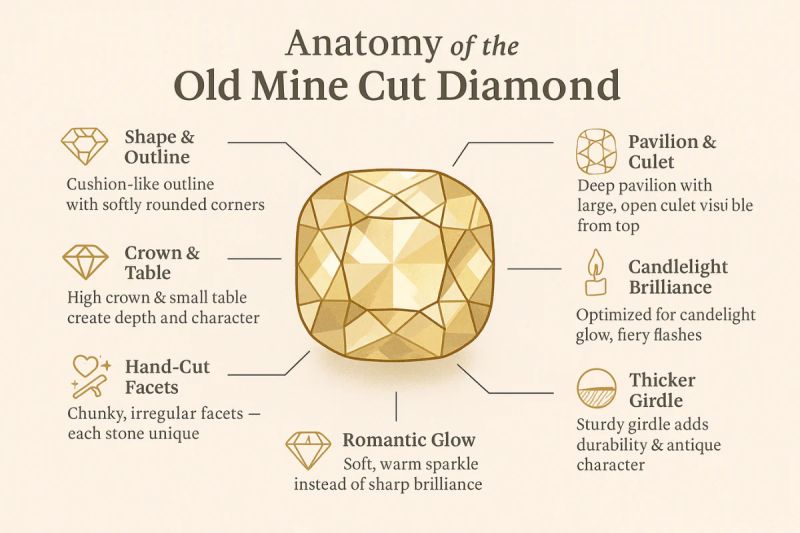
What makes these stones so unique is their individuality. Because they were hand-crafted, no two Old Mine Cuts are exactly alike. Here is a detailed breakdown of their anatomy:
1. The Soft, Cushion-Like Shape -
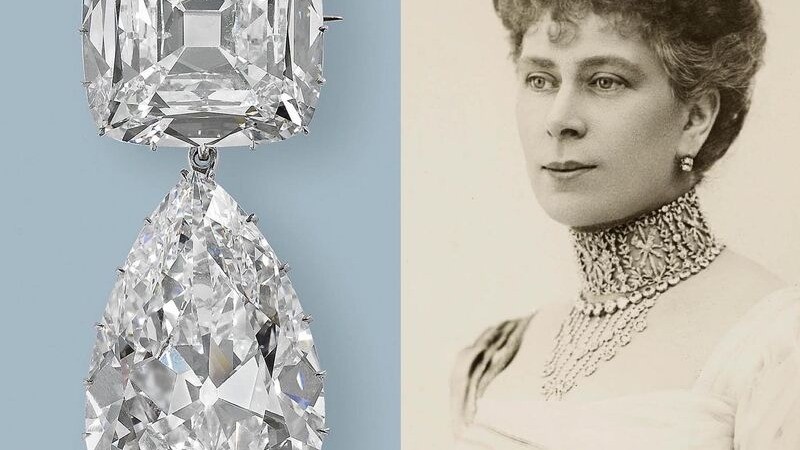
While often described as "round," most Old Mine Cuts actually have a rounded square or rectangular outline. This is known as a cushion shape. Pre-industrial cutters followed the natural shape of the rough diamond crystal (often an octahedron) to preserve as much carat weight as possible.
Why it matters: This results in a stone that looks beautiful from every angle, with soft, pillowy corners that are less prone to chipping than the sharp corners of modern princess cuts.
Visual Cue: The shape is rarely perfectly symmetrical, adding to its handmade charm.
2. The High Crown -
The crown is the top portion of the diamond above the girdle. In Old Mine Cuts, the crown is noticeably tall and steep.
Why it matters: A high crown acts like a prism. It catches light and disperses it into colorful flashes (fire) before it travels down into the pavilion. This height gives the stone substantial face-up presence, often making it appear larger than its carat weight suggests.
The Candlelight Effect: This height was specifically designed to refract light in the low-light conditions of 18th-century ballrooms.
3. The Small Table -
The table is the large, flat facet on the very top of the diamond. Compared to modern rounds (which have large tables for maximum brilliance), the Old Mine Cut features a small table.
Why it matters: A small table creates a fascinating "hall of mirrors" effect. It forces the eye to travel deeper into the stone, emphasizing the play of light within the pavilion rather than just on the surface. This results in a deeper, more mysterious look.
4. Large, Chunky Facets -
Modern diamonds often have dozens of tiny, precise facets (like the 57 facets of a modern brilliant). Old Mine Cuts typically have 58 facets, but they are cut much larger and with less mathematical precision.
Why it matters: These large facets act like big windows into the stone. They produce broad flashes of light and dark (scintillation) rather than the tiny, glittery sparkle of modern cuts. This is often described as a "romantic" or "sleepy" glow.
5. The Open Culet -
This is one of the easiest ways to identify an antique diamond. The culet is the tiny point at the bottom of the diamond. In modern diamonds, it is cut to a sharp point or a tiny facet. In Old Mine Cuts, the culet is ground down to create a flat, open facet.
Why it matters: When you look directly down through the table of the diamond, you can often see a small, geometric "hole" or circle in the center. This open culet served a practical purpose: it prevented the delicate tip of the diamond from chipping during setting. Today, it is a hallmark of authenticity.
6. The Warm Sparkle -
Perhaps the most defining characteristic is the light performance. Modern round brilliants are engineered for "brilliance" white light return. Old Mine Cuts are engineered for "fire" (dispersion of color) and contrast.
Why it matters: You will see large dark areas (pavilion shadows) next to bright flashes of light and rainbow colors. This creates a high-contrast, mesmerizing pattern that changes dramatically as the stone moves.
Why Choose an Old Mine Cut Today?
In the current market, there is a massive shift toward individuality and sustainability. Old Mine Cut diamonds are the ultimate expression of "slow fashion."
Sustainability: These diamonds are inherently recycled. They require no new mining, making them an eco-conscious choice.
Uniqueness: In a sea of identical lab-grown and modern laser-cut diamonds, an Old Mine Cut stands out. It tells a story.
Perceived Value: Because of the high crown and large facets, a 1.0-carat Old Mine Cut can often face up the same size as a 1.20-carat modern cut.
Craftsmanship: They are a testament to human skill, cut with basic tools but incredible artistry.
If you are looking to add a piece of history to your collection, browse our selection of antique cut diamonds at CaratX.
How to Identify an Old Mine Cut vs. Other Cuts
It is common to confuse the Old Mine Cut with the Old European Cut. Here is a quick cheat sheet:
Comparison of Diamond Cuts by Era
1. Shape
Old Mine Cut (1700s–1800s): Cushion-shaped / rounded square
Old European Cut (Late 1800s–Early 1900s): Circular
Modern Round Brilliant: Perfectly round
2. Culet
Old Mine Cut: Large, open culet
Old European Cut: Small to medium open culet
Modern Round Brilliant: Pointed or extremely small culet
3. Facets
Old Mine Cut: Chunky, uneven facets
Old European Cut: More uniform, still “chunky”
Modern Round Brilliant: Precise, mathematically calculated facets
4. Girdle
Old Mine Cut: Thick, often rough or lightly faceted
Old European Cut: Thick, usually polished
Modern Round Brilliant: Typically faceted or bruted
5. Light Performance
Old Mine Cut: Soft, romantic, high contrast “candlelight” glow
Old European Cut: Brighter than OMC but still warm
Modern Round Brilliant: Extremely bright, sharp sparkle with an “ice-like” appearance
Buying Guide: What to Look For
When purchasing an Old Mine Cut, the 4 Cs are still relevant, but they are weighted differently:
Cut (The most important): Don't look for perfect symmetry. Look for life. Does the stone blink back at you? Does it have dark and light contrast? Ensure the chunky facets aren't too deep that the stone appears dark (often called a "nail head").
Clarity: These stones were cut long before magnification was standard. They often contain inclusions. Look for "eye-clean" stones where inclusions are not visible to the naked eye.
Color: Warmer colors (K, L, M) are actually desirable in these cuts. A warm yellow or champagne tone enhances the antique vibe.
Carat: Because of the depth, make sure you check the face-up dimensions, not just the weight.
Ready to sell your antique diamond? Don't let it sit in a safe. List it on CaratX and start selling to over 18+ international countries today.
Caring for Your Antique Diamond -
Old Mine Cuts are robust, but they require specific care:
Check the Setting: The girdles are often thicker than modern diamonds, but they can be brittle in very thin spots. Have a jeweler check the prongs regularly.
Cleaning: Because of the open culet and large facets, dirt can accumulate in the pavilion. Use a gentle jewelry cleaner and a soft brush. Avoid ultrasonic cleaners if the diamond has significant inclusions or fractures.
Frequently Asked Questions (FAQs)
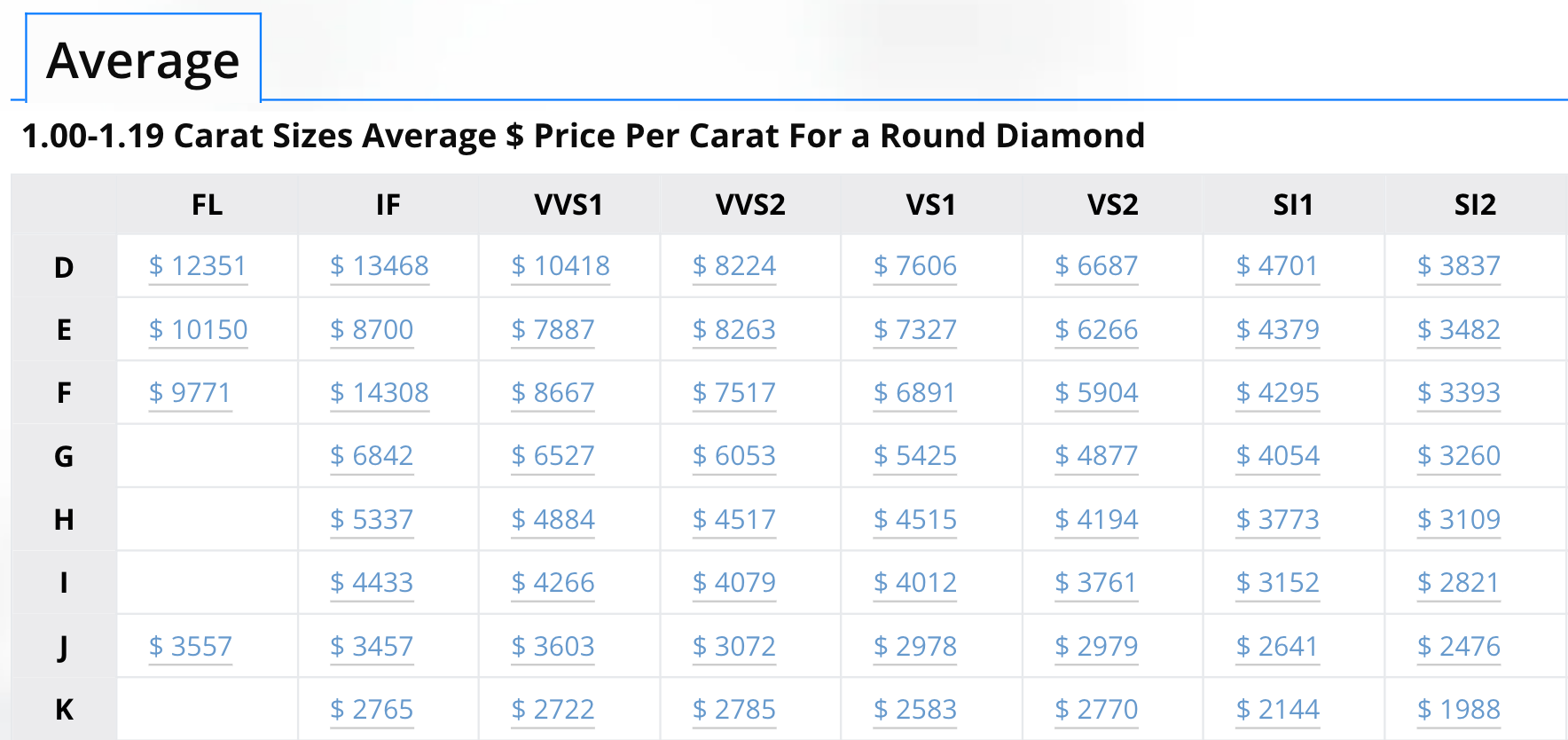
Q: Are Old Mine Cut diamonds more expensive? A: Generally, they are priced lower per carat than D-Flawless modern rounds but can carry a premium for high-quality, well-preserved examples due to their rarity and desirability among collectors.
Q: Is an Old Mine Cut the same as an Antique Cushion? A: In modern trade terminology, they are often used interchangeably. However, technically, an "Antique Cushion" refers to the shape, while "Old Mine Cut" specifically refers to the facet arrangement (the pattern of the cuts) from that era.
Q: Can I find a GIA-certified Old Mine Cut? A: Yes. The GIA will grade these diamonds. On a GIA report, they are usually described as "Antique Brilliant Cut" or "Cushion Modified Brilliant" with a note specifying "Old Mine Cut" characteristics.
Q: Are they suitable for engagement rings? A: Absolutely. They are incredibly romantic and durable (hardness of 10 on the Mohs scale). They are a perfect choice for someone looking for a vintage aesthetic or a unique alternative to a standard round brilliant.
Sell and Shop with CaratX -
Whether you are a seasoned collector or a first-time buyer, navigating the antique diamond market requires a trusted partner. At CaratX, we bridge the gap between the past and the present.
For Sellers: Unlock global demand. Our platform connects you with verified B2B and B2C buyers across 18+ countries. Don't limit your inventory to local pawnshops. Register as a seller on CaratX now to showcase your collection to the world.
For Buyers: Discover a world of natural diamonds and fine jewelry. From investment-grade stones to everyday luxury, our marketplace offers unbeatable prices and authenticity. Shop natural diamonds at CaratX.
For Jewelry Businesses: Expand your reach. Our seller plans are designed to help you scale internationally. Learn more about our pricing and launch plans.
Sources & Citations -
To ensure the accuracy and authority of this guide, the following sources were referenced:
Gemological Institute of America (GIA). (n.d.). Diamond History and Lore. Retrieved from GIA.edu
American Gem Society (AGS). (n.d.). Antique Diamond Cuts. Retrieved from AmercianGemSociety.org
The Gemmological Association of Great Britain (Gem-A). (2018). A History of Diamond Cutting. Retrieved from Gem-A.com
Image Credit - Zuvelio