
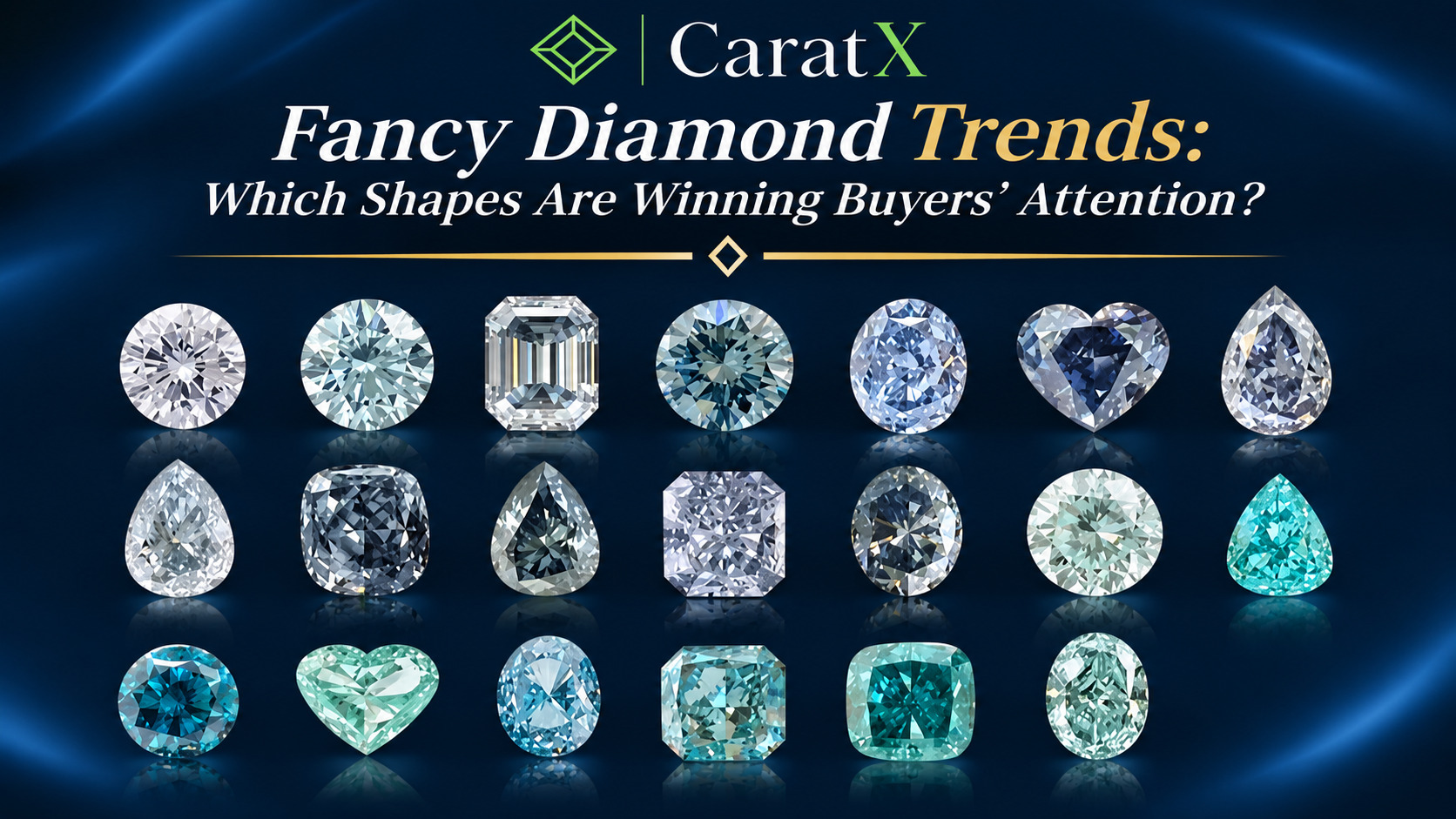
The diamond market is splitting in two. Whileround brilliantsunder 1.20 carats continue to lose momentum, fancy shapes in the 2-carat-and-above segment are not just surviving they are outperforming rounds across every major trading hub.
For sellers, buyers, and jewelers, this is not a temporary aesthetic shift. It is a structural re-pricing of what the market values. Below, we break down the five fancy-shape stories defining 2026 with the data, the supply constraints, and the strategies that separate winning inventory from dead stock.
The Big Picture: Why Fancy Shapes Are Outperforming Rounds
Long fancy shapes such as Oval, Marquise and Emerald [are] doing better than rounds in 2 ct. and larger. This is not a one-week anomaly. The same assessment appears in reports from December 2025, November 2025, October 2025, and April 2026 a sustained pattern that points to a genuine demand shift rather than seasonal noise.
Two forces are converging. On the demand side, consumers particularly in the US bridal and self-purchase segments are gravitating toward shapes that offer greater face-up size, finger elongation, and visual individuality. The GJEPC’s US market analysis describes a “clear move away from the icy diamond perfection that was in vogue a few seasons ago,” with elongated silhouettes and vintage-leaning geometry gaining ground.
On the supply side, the cutting yield for elongated fancy shapes is lower, and manufacturers cannot simply flood the market with well-proportioned stones. The result is a quality-driven supply squeeze: very well-cut fancy shapes are difficult to find and command premiums, while poorly proportioned fancies sit illiquid.
This bifurcation is the single most important thing to understand about the current fancy-shape market. Shape alone does not guarantee value. Proportion, cut quality, and supply scarcity do.
1. Oval Diamonds: The American Workhorse of Fancy Shapes
Theoval cuthas become the quiet powerhouse of the fancy-shape category. In the United States, demand for elongated ovals in the D–I color and VS–SI clarity range remains solid, and ovals are consistently priced 5% to 10% higher than pears of comparable grade. The strongest action is in stones 2 carats and above, whereovalsare benefiting directly from the trade’s migration away from rounds.
What makes this notable is the discipline in the market. The oval segment is not a free-for-all. Manufacturers have been shifting back into rounds amid a glut of less desirable, poorly proportioned ovals, which has created a two-tier market: good ovals are scarce and command premiums; bad ovals drag. For buyers, the implication is clear the oval’s value proposition is entirely dependent on length-to-width ratio and the absence of a prominent bow-tie. CaratX’s oval diamond guide notes that because ovals do not receive a GIA cut grade, the burden of evaluating proportion falls squarely on the buyer or their sourcing partner.
CaratX’s curated selection ofOval Diamondsincludes certified natural and lab-grown ovals across the size and quality ranges that are moving fastest.
2. Marquise Diamonds: The Most Expensive Fancy Shape in the World Right Now
No fancy shape is tighter, more supply-constrained, or more expensive per carat than themarquise. The scarcity is structural: the marquise’s pointed ends and curved sides require a high-skill cut that yields less from the rough, and well-proportioned stones with good “points” and minimal bow-tie are genuinely rare.
The demand side has also received an unexpected boost from popular culture. Selena Gomez’smarquise engagement ringhas helped reposition the shape as both glamorous and fashion-forward, with its elongated silhouette offering dramatic finger coverage and a face-up spread that makes the stone appear larger than its carat weight. The GJEPC’s US market report likewise identifies marquise cuts as “generating particular strength” among New York designers and retailers.
For sellers, marquise is a premium inventory play, not a volume play. The spread between a well-cut marquise and a poorly proportioned one is enormous, and the latter is effectively illiquid in the current market. CaratX’s marquise-focused content explains the historical and commercial logic behind the shape’s resurgence, from its French royal origins to its modern ratio-driven appeal.
Browse certifiedMarquise Diamondson CaratX.
3. Long Cushion Cuts: The 20–25% Elongation Premium
The cushion cut story is one of the clearest examples of the “elongation premium” at work. The trade is sharply differentiating between square cushions and long (rectangular) cushions, with long cushions trading at a 20% to 25% premium over square ones.
This is not simply a fashion preference for rectangles. Thelong cushioncombines the pillow-soft faceting and brilliance that consumers love about cushions with a more slender silhouette that reads as more modern and more flattering on the hand.
GJEPC’s US market analysis groups cushions among the vintage-leaning design cues alongside emerald cuts, movals, and old European cuts that are “bringing history into a more modern context.” Forbes’ engagement-ring trend coverage likewise links the renewed interest in elongated cushion shapes directly to the celebrity-driven revival of vintage cuts following Taylor Swift’s 2025 engagement ring.
Supply is tight. High-quality long cushions and long radiants are repeatedly listed alongside marquises as short in supply, which means the premium is being reinforced by genuine scarcity rather than marketing alone.
CaratX’sCushion Cut Diamondsinclude elongated and square options across certified natural and lab-grown categories. For a foundational read, seeAll You Need to Know About Cushion Cut Diamonds.
4. Princess Cuts: Demand Is Improving, but Prices Remain Under Pressure
Theprincess cutoccupies a more complicated position. Demand is showing signs of improvement,princess cutsare no longer uniformly weak in every size and quality band, and some retail data points suggest renewed consumer interest in square silhouettes. But the pricing picture remains soft, and princess cuts are consistently described in trade reports as weak relative to the long fancy shapes driving the market.
The disconnect is instructive. Princess cuts offer higher rough yield than rounds and can deliver strong brilliance in a square form, but the market’s current preference for elongation and vintage character works against the princess’s sharp, modern geometry. The result is a shape that is liquid at the right price but not commanding a scarcity premium. For sellers, princess inventory should be managed as a volume and price-point category, not as a premium fancy-shape bet.
ExplorePrincess Cut Diamondson CaratX.
5. Antique Cuts:
The antique-cut story moved from niche to mainstream in 2025, and the data is dramatic. Following Taylor Swift’s August 2025 engagement with an old-cut diamond ring, online searches for old-cut diamonds surged by as much as 10,000%, and the demand spike has persisted into 2026. But the revival was already underway before the celebrity moment: dealers report that demand for old cuts had been rising steadily for a decade and sharply over the last five years, with elongated old mine and cushion cuts leading the category.
What makes antique cuts different from other fancy shapes is the authenticity constraint. True old-cut diamonds were hand-cut by eye, with broad facets and irregular proportions that produce a softer, candlelit brilliance impossible to replicate with modern machine cutting.
The number of artisans capable of producing genuine old cuts has declined sharply, and much of the modern “antique-style” supply consists of recut stones or reproductions rather than true period cuts. Pricing is correspondingly selective: rare, characterful old cuts can command premiums, while ordinary antique goods trade on a different value logic than modern brilliants.
For buyers and sellers, antique cuts are a curation and authentication game. The upside is a differentiated, story-rich product that resonates with consumers seeking uniqueness over icy perfection. The risk is misclassification and supply illiquidity.
For anyone trading fancy shapes, the operational takeaway is straightforward: do not treat “fancy shape” as a single quality tier. The spread between a well-proportioned 2-carat marquise and a poorly proportioned one is wider than the spread between many shapes. Sourcing partners who can evaluate length-to-width ratio, bow-tie severity, facet alignment, and point symmetry are worth more in this market than in a round-driven one.
Market-by-Market Snapshot: Where the Demand Is Concentrated
United States: The deepest and most consistent fancy-shape demand. Long ovals, marquises, and long cushions are the standout performers, with strong interest in D–I color, VS–SI clarity goods in the 2-carat-plus range. Old mine and old European cuts have moved into mainstream retail conversations.
Hong Kong and Greater China: Steady interest in 1.70 to 3-carat ovals, emeralds, and marquises in the F–I, VS–SI range, particularly for bridal and gifting. Goods under 1 carat remain harder to move.
India: A more bifurcated market. Small ovals and pears in the 0.30–0.79 carat range have seen price softening, while ideal long models hold firm. The domestic market is cautious, and synthetics are taking share in smaller sizes.
Belgium and Israel: Focused, quality-sensitive buying. Long fancies in G, SI1–SI2 are moving in Belgium, while Israeli dealers report stable US orders for larger goods and continued weakness under 1 carat.
Recommended Reads from CaratX -
Fancy Shape Diamonds: A Deep Dive into Market Trends, Consumer Preferences, and Strategic Insights
The Global Diamond Market: An In-Depth Analysis of Current Trends and Fancy Shape Dominance
Diamond Price Trends: What’s Surging and Slumping in Today’s Market
The Geometry of Brilliance: Why Length-to-Width Ratio Dictates Diamond Beauty and Value
All You Need to Know About Cushion Cut Diamonds
Ready to trade fancy shapes where the demand is? Start selling on CaratXto reach vetted B2B and B2C buyers across 18+ international markets. You can alsoshop certified natural diamondsandbrowse the full CaratX marketplaceto see what is moving.
FAQs: Fancy Diamond Trends for Buyers and Sellers
Which fancy shape is currently the most expensive? The marquise is consistently identified across trade reports as the most expensive fancy shape per carat, driven by supply shortages and high cutting loss. High-quality marquises command the strongest premiums in the current market.
Why are long cushions more expensive than square cushions? Long (rectangular) cushions are trading at a 20%–25% premium over square cushions because of stronger consumer preference for elongated silhouettes and tighter supply of well-proportioned long stones. The premium reflects both demand and genuine scarcity.
Are oval diamonds still a good buy? Yes, but selectivity matters. Elongated ovals of 2 carats and above, with good shape and quality in the D–I/VS–SI range, remain in solid demand, especially in the US. Poorly proportioned ovals are oversupplied and illiquid. The oval is a good buy when the ratio and bow-tie are right.
Why are princess cut prices still low if demand is improving? Princess cuts benefit from higher rough yield, which supports supply, but the market’s current preference for elongation and vintage character is limiting pricing power. Princess demand is improving selectively, but the shape is not experiencing the same scarcity-driven premium as marquise or long cushion.
Are antique cuts a safe investment? Antique cuts offer differentiation and story, and true old cuts are genuinely scarce. However, the category requires authentication expertise and carries liquidity risk because the buyer pool is narrower than for modern brilliants. The upside is strongest for characterful, well-preserved old mine and old European cuts with documented provenance.
How can I sell fancy-shape diamonds to international buyers? CaratX connects sellers directly with B2B and B2C buyers in 18+ countries. You canregister as a sellerto list certified diamonds, gemstones, and jewelry, or review theseller plans and pricingbefore going live.