

Decoding PP, P, and PR: A Detailed Analysis of Pink Diamond Suffixes
Home
News And Media Decoding PP, P, and PR: A Detailed Analysis of Pink Diamond Suffixes SHOP NOWHome
News And Media Decoding PP, P, and PR: A Detailed Analysis of Pink Diamond Suffixes SHOP NOWMay, 19, 2026 by Archit Mohanty 0 Comments
Pink diamonds are among the rarest and most coveted gemstones on Earth, formed under immense pressure and temperature billions of years ago. Only one out of every 10,000 carats of mined diamonds exhibits any fancy color, and pink diamonds are rarer still. For investors and collectors, understanding the nuanced color grading system particularly the specific suffixes that denote a stone’s secondary hues is critical, because these tiny letters determine a diamond’s rarity, beauty, and price.
This in‑depth guide explains the three most important pink diamond suffixes: PP (Purplish Pink), P (Pink), and PR (Pink Rose). We will explore how each grade is defined, why it matters for investment, and how you can navigate the market with confidence.
Before we analyze the suffixes, it is essential to understand the two grading systems that define how pink diamonds are described.
The Gemological Institute of America (GIA) is the world’s leading authority on diamond grading. For fancy‑color diamonds, GIA evaluates three attributes: hue (the primary color), tone (lightness or darkness), and saturation (color intensity).
Pink diamonds are graded on a scale from Faint to Fancy Vivid, with the latter being the most intense and valuable. GIA’s research shows that pink coloration is typically caused by plastic deformation of the crystal lattice, often accompanied by pink graining inside the diamond.
The now‑closed Argyle mine in Western Australia produced more than 90% of the world’s pink diamonds. To better capture the unique pink hues found there, Argyle created its own color classification system.
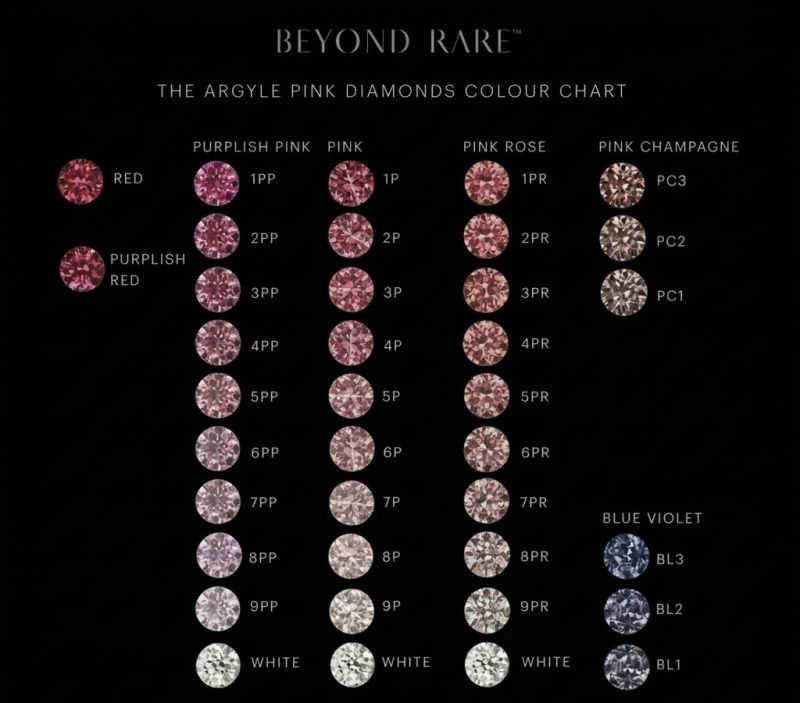
Argyle’s system is built around three primary pink hues: PP (Purplish Pink), P (Pink), and PR (Pink Rose), each further subdivided by intensity levels from 1 (most intense) to 9 (least intense). Because no new Argyle pink diamonds will ever be mined again, these designations carry a significant premium.
PP (Purplish Pink) diamonds exhibit a distinctive pink hue with a secondary purple undertone. This purple modifier creates a cooler, deeper, more complex color that is exceptionally rare. In the Argyle scale, PP stones sit at the very top of the value hierarchy.
Key characteristics:
Visual appearance: Cooler, deeper, violet‑tinted pink.
Formation cause: The unusual purple hue is linked to rare structural changes (plastic deformation) that selectively absorb light in the visible region.
Rarity: Among all pink diamonds, purplish pink tones are some of the scarcest. The Argyle mine produced only a tiny fraction of its output in PP grades.
Market and investment value:
PP diamonds command the highest prices within the same color intensity category.
According to 2025 market data, red and purplish‑pink (PP) categories have seen the most dramatic value increase, with some rare stones doubling or tripling in price on the secondary market since the Argyle mine closed in 2020.
In many cases, PP stones can trade 20%–40% higher than PR diamonds of the same grade.
Collectors and investors actively seek PP diamonds for their rarity and cooler aesthetic.
If you are looking for top‑tier investment‑grade pink diamonds, CaratX offers a curated selection of natural pink diamonds, including certified PP stones, through its online marketplace.
P (Pink) diamonds are those with a pure pink hue, free of strong secondary color influences. This is the classic, instantly recognizable pink diamond appearance that most people envision.
Key characteristics:
Visual appearance: Clean, balanced pink color without noticeable purple or brown modifiers.
Market demand: Highly desirable for fine jewelry and engagement rings.
Availability: More common than PP but still extremely rare compared to colorless diamonds.
Market and investment value:
P diamonds occupy the mid‑value range within their grading category.
They have strong, consistent global demand, especially from the bridal and luxury jewelry markets.
While they may not achieve the same peak premiums as PP stones, they offer excellent liquidity and steady appreciation.
For those seeking a classic pink diamond with proven investment potential, browse the natural pink diamonds available at CaratX.
PR (Pink Rose) diamonds display a warmer pink tone with subtle rose or orange influences. The “rose” description often replaces older terms like “brownish pink,” as the rose connotation is more appealing and accurately describes a soft, antique pink color.
Key characteristics:
Visual appearance: Softer, warmer, romantic pink with a gentle orange or brownish undertone.
Unique personality: PR diamonds stand out for their vintage, feminine charm.
Market and investment value:
PR diamonds are generally the most affordable among the three suffixes in the same intensity grade.
They offer a more accessible entry point for buyers who love pink diamonds but may not require the rarest modifier.
However, their value is still substantial, and fine PR stones have appreciated significantly since the Argyle closure.
Within the same color intensity grade (e.g., Fancy Intense), the typical price hierarchy is as follows:
Among the different pink diamond suffix categories, PP (Purplish Pink) diamonds command the highest market value due to their extreme rarity and strong demand from sophisticated collectors and investors.
P (Pink) diamonds hold medium relative value, as they are rare and continue to see broad and consistent investor interest.
Meanwhile, PR (Pink Rose) diamonds generally carry the lowest relative value among the three, although they remain significant in the market due to their moderate rarity and growing niche demand.
The reason PP diamonds achieve such a premium is largely driven by both scarcity and aesthetics. Purplish pink diamonds occur far less frequently than pure pink or rose-tinted stones, making them exceptionally exclusive. In addition, their cool, violet-tinged appearance gives them a distinctive visual appeal that is highly sought after in high-end auctions and among discerning investors worldwide.
The suffix (PP, P, PR) is the single most important factor when evaluating a pink diamond’s potential as an investment. Two diamonds with the same carat weight, clarity, cut, and intensity grade can differ in price by 20–40% simply because one is PP and the other is PR. That’s why working with a reputable platform that provides full transparency on color grades is essential.
Always insist on a certified grading report from a reputable laboratory such as GIA or IGI. The report will explicitly state the primary and secondary hues (e.g., “Fancy Intense Purplish Pink”). This guarantees that the diamond’s suffix is authentic and reliable.
CaratX connects sellers and buyers of certified natural diamonds, including pink stones with clear GIA and Argyle color designations.
Whether you are looking to sell diamonds to buyers in 18+ international countries or shop for natural diamonds at unbeatable prices, CaratX provides a secure, transparent marketplace.
Identify your goal: Are you collecting for rarity (PP), seeking a classic look (P), or want a romantic, affordable pink (PR)?
Verify the suffix: Examine the GIA or Argyle certificate. A “Fancy Purplish Pink” is a PP stone; “Fancy Pink” is P; “Fancy Pink‑Rose” is PR.
Compare prices: Understand that within the same intensity, PP will carry a significant premium over P and PR. Use resources like the Fancy Color Research Foundation (FCRF) indices to gauge fair market value.
Shop smart: Access global inventory through a reliable platform. Shop gemstones from the CaratX marketplace to compare certified pink diamonds from multiple sellers.
Highlight the suffix: When listing a pink diamond, prominently display its color suffix (PP, P, PR) and provide a clear image of the certificate.
Price appropriately: Research current premiums. For PP diamonds, you can command a 20–40% higher price than equivalent PR stones.
Leverage global demand: Pink diamonds enjoy strong demand in Asia, the Middle East, Europe, and North America. Use a platform that gives you access to buyers across these regions.
Sell internationally: Sellers can register on CaratX to reach B2B and B2C buyers in 18+ international countries, expanding your market far beyond local boundaries.
A: Yes. GIA and Argyle reporting can include multiple modifiers. When this happens, the primary hue (pink) is stated first, followed by secondary hues (e.g., “brownish purplish pink”). In such cases, the price impact is more complex, but generally, the purple modifier still adds value, while the brown modifier may reduce it.
A: Typically, yes. Argyle pink diamonds command a premium because the mine produced 90% of the world’s pink diamonds and is now closed. Provenance, documented by an Argyle certificate, adds significant value.
A: Pure pink (P) or pink rose (PR) diamonds are often preferred for engagement rings because they offer a classic, romantic look. PP diamonds are equally stunning but may be too rare and expensive for some budgets.
A: You can list your pink diamonds on CaratX to access a global network of serious buyers. CaratX’s seller plan enables you to start selling jewelry and loose diamonds internationally with ease.
A: Stay informed through the Fancy Color Research Foundation (FCRF), GIA’s Gem & Gemology journal, and the International Gem Society (IGS). These organizations provide authoritative data and analyses.
Navigating the complex world of investment‑grade pink diamonds requires a trusted partner. CaratX is a global B2B and B2C marketplace designed for diamond sellers and buyers. Here’s why industry professionals choose CaratX:
Global reach: Sell diamonds and jewelry to buyers in 18+ international countries.
Certified inventory: All diamonds listed are accompanied by certification (GIA, IGI, etc.), ensuring full transparency on color suffixes like PP, P, and PR.
Competitive pricing: Buyers can shop natural diamonds at unbeatable prices and sellers can maximize their returns.
User‑friendly platform: Easy registration, listing, and secure transactions.
Ready to start?
Sellers: Register on CaratX to list your diamonds and jewelry – www.caratx.com/register
Buyers: Explore our marketplace for certified pink diamonds and other colored gemstones – www.caratx.com
Learn more about pricing and plans: https://caratx.com/generic-pages/launch-your-products-on-caratx
Whether you are a collector seeking a rare PP diamond, a jeweler looking to buy P or PR stones for your next collection, or an investor diversifying with pink diamonds, understanding suffixes is your first step toward a successful purchase or sales.
May, 18, 2026
Aug, 06, 2022
Aug, 06, 2022
Oct, 16, 2025
0 Comments
Please login to leave a reply.