
Metal wire is far more than a basic supply, it is the foundational skeleton and expressive soul of jewelry design. Choosing the right wire in terms of material, gauge, shape, and hardness is what separates amateur craft from professional artistry.
This comprehensive guide delves beyond the basics to explore the nuanced decisions that shape exceptional, enduring jewelry, equipping you with the knowledge to select the perfect wire for any project.
Choosing Your Metal:
The metal you choose defines your piece's appearance, durability, workability, and value. Understanding the spectrum of options is your first critical decision.
Copper: An excellent and cost-effective choice for beginners. It is very malleable and allows for extensive practice without significant expense. Its rich, warm color suits rustic designs, though it tarnishes and can cause skin discoloration for some wearers.
Brass: Offers a rich golden color at a lower cost than gold. It can be slightly stiffer and more prone to kinking than copper or silver, but it yields a beautiful, warm finish.
Sterling Silver (.925): The most popular precious metal for jewelers. It is a versatile alloy of 92.5% silver and 7.5% copper, offering a perfect balance of malleability, strength, and value. It polishes to a bright white shine but will tarnish over time.
Fine Silver (.999): Composed of 99.9% pure silver, it is softer than sterling and much more resistant to tarnish. Its softness makes it ideal for intricate wire wrapping and bezel wire, but it may be too soft for structural components like ring bands.
Gold-Filled: A great middle ground for a gold appearance. It consists of a thick layer of karat gold (making up 1/20th of the total weight) bonded to a brass core. It is far more durable than gold plating but requires care to avoid exposing the core when filing or soldering.
Solid Gold (10K, 14K, 18K): Offers luxury and superior tarnish resistance. Karatage indicates purity: 14K (58.5% gold) is the most popular for jewelry as it provides a good balance of durability, color, and affordability. Higher karats like 18K are softer and richer in color.
For a stunning selection of precious metals to begin your project, explore the collection at CaratX for sterling silver and gold wire.
The Four Pillars of Wire Selection -
Four interconnected characteristics define every piece of wire. Learning to balance them is the key to successful design.
Material: Covered in detail above, this is your primary choice for color, value, and chemical properties.
Gauge (Thickness): This is the wire's diameter. Crucially, the gauge number is inversely related to thickness: a 24-gauge wire is thinner than a 16-gauge wire. It is measured in millimeters or by the American Wire Gauge (AWG) or Standard Wire Gauge (SWG) systems, which differ slightly.
Shape: The wire's cross-sectional profile (round, square, half-round, etc.) affects its function, strength, and aesthetic.
Hardness (Temper): This refers to the metal's malleability at the molecular level.
For tools that help you work with any temper of wire, from soft to hard, check out the professional jewelry tool collections available at CaratX .
Wire Shapes and Their Masterful Applications -
Each wire shape serves a distinct purpose in the jeweler's toolkit.
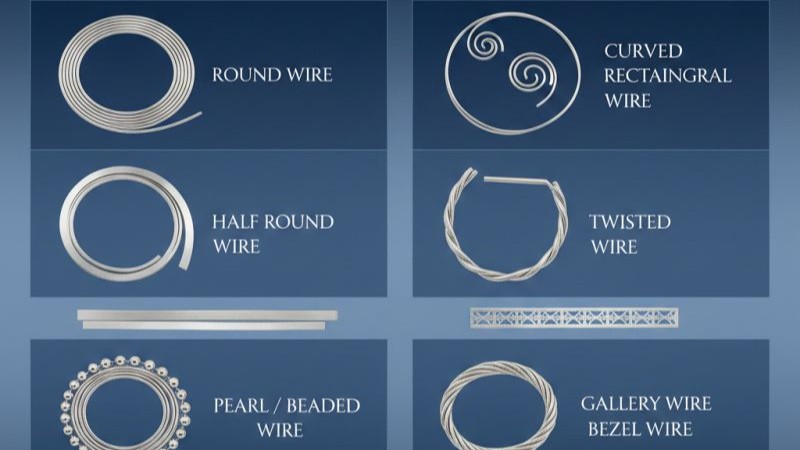
Round Wire: The most versatile and commonly used shape. It's essential for making loops, jump rings, headpins, and wire-wrapped elements, and comes in the widest range of sizes.
Half-Round Wire: Flat on one side, curved on the other. Its unique profile makes it perfect for wrapping comfortably around other wires or ring bands, providing a smooth interior surface.
Square & Rectangular Wire: Offers flat surfaces for stacking, forging, and creating modern, architectural looks. It provides significant strength and is often used for bold ring bands and statement cuffs.
Bezel Wire: A specialized strip, typically rectangular or pre-formed, used to create a collar that securely holds a cabochon stone. It is usually made from fine or sterling silver in thin gauges (often 28g-30g) for easier setting.
Decorative Wires (Gallery, Twisted, Pearl): These wires come with pre-textured or patterned surfaces (beads, twists, designs). They are primarily used as decorative accents, borders, or statement elements in a piece. Handle them gently, as they can be brittle.
To incorporate beautiful gemstones into your wire designs, source quality cabochons and faceted stones from the gemstone marketplace at CaratX.
The Professional’s Wire Gauge Guide (AWG)
Selecting the correct wire thickness is essential for achieving the right balance between aesthetics, strength, and durability. The following recommendations are based on the American Wire Gauge (AWG) system.
24–28 Gauge (0.51 mm – 0.32 mm)
Primary Use: Fine detail work
Common Applications: Weaving, coiling, intricate wrapping, and securing small beads or pearls.
22 Gauge (0.64 mm)
Primary Use: Versatile sculpting wire
Common Applications: Wire-wrapped pendants, rings, and small handmade clasps. A top choice for precision and flexibility.
20 Gauge (0.81 mm)
Primary Use: Jewelry findings
Common Applications: Strong headpins, ear wires, and light structural frames that require both durability and finesse.
18 Gauge (1.02 mm)
Primary Use: Structural elements
Common Applications: Heavier ear wires, bracelet and necklace frameworks, and wire-wrapped beads requiring extra strength.
16 Gauge (1.29 mm)
Primary Use: Bold statement construction
Common Applications: Ring bands, choker bases, and bangle cores designed for visual impact and durability.
14 Gauge & Thicker (1.63 mm+)
Primary Use: Heavy-duty jewelry construction
Common Applications: Substantial ring bands, men’s jewelry, forged components, and high-strength structural elements.
Expert Tip: When in doubt, purchase wire in Dead Soft temper. You can always work-harden a finished piece by hammering it with a rawhide mallet or tumbling it, but you cannot soften a half-hard wire without a torch.
Special Focus: Mastering the Bezel Setting
Bezel setting with wire is a fundamental and rewarding skill for securing cabochon stones.
Choosing Bezel Wire: For beginners, 28-gauge fine silver wire is highly recommended. Fine silver is softer and easier to push over the stone than sterling silver. The bezel height should be just above the stone's "shoulder" (where it begins to curve).
The Setting Process: After soldering the bezel strip into a perfect circle and attaching it to a backing plate, the stone is inserted. Using a bezel pusher or rocker, you gradually press the metal over the stone's edge, working evenly around the circumference. For stones with corners, always set the corners first before the straight sides.
Finishing: Once the stone is secure, use a burnisher to smooth and polish the bezel edge against the stone, creating a tight, professional finish.
Ready to practice? Find the perfect cabochon stones and fine silver bezel wire for your next setting project in the supplies section at CaratX.
Sourcing Quality Materials and Continuing Education -
Your work is only as good as your materials. Source wire from reputable jewelry supply specialists. Furthermore, the journey in jewelry making is continuous. Consider investing in books from established experts or taking online courses from professional academies to deepen your skills in specific techniques like advanced stone setting or metallurgy.
Frequently Asked Questions (FAQs)
Q: I’m a complete beginner. What wire should I buy first? A: Start with 20-gauge and 22-gauge dead soft copper wire. Copper is affordable, easy to work with, and behaves similarly to more expensive metals, making it perfect for practice.
Q: Why does my sterling silver jewelry turn black? A: This is tarnish, caused by a chemical reaction between the silver and sulfur in the air. Sterling silver (which contains copper) tarnishes more readily than fine silver. Regular polishing with a jeweler's cloth will maintain its shine.
Q: Can I solder gold-filled wire? A: Yes, but it requires extra care. You must use a barrier flux to protect the gold layer from fire-scale, and apply heat carefully to avoid delaminating the gold from the brass core.
Q: What's the difference between "hardness" and "temper"? A: In jewelry making, these terms are often used interchangeably to describe the wire's malleability. "Temper" is the more technically accurate metallurgical term for the condition of the metal, while "hardness" describes the feel.
Q: How do I make my delicate wire creations more durable? A: Work-harden your finished piece. You can do this by gently hammering it on a steel block with a rawhide or nylon mallet (which won't mark the metal), or by placing it in a rotary tumbler with stainless steel shot for several hours.
Ready to transform your designs from concept to reality? Source premium wires, exquisite gemstones, and professional tools to elevate your craft.
Begin your journey by exploring the extensive collections for jewelers at CaratX, or
register as a seller on CaratX to connect with a global audience of buyers.