

Hearts & Arrows Diamonds: The Definitive Guide to Optical Perfection
Home
News And Media Hearts & Arrows Diamonds: The Definitive Guide to Optical Perfection SHOP NOWHome
News And Media Hearts & Arrows Diamonds: The Definitive Guide to Optical Perfection SHOP NOWMay, 19, 2026 by Archit Mohanty 0 Comments
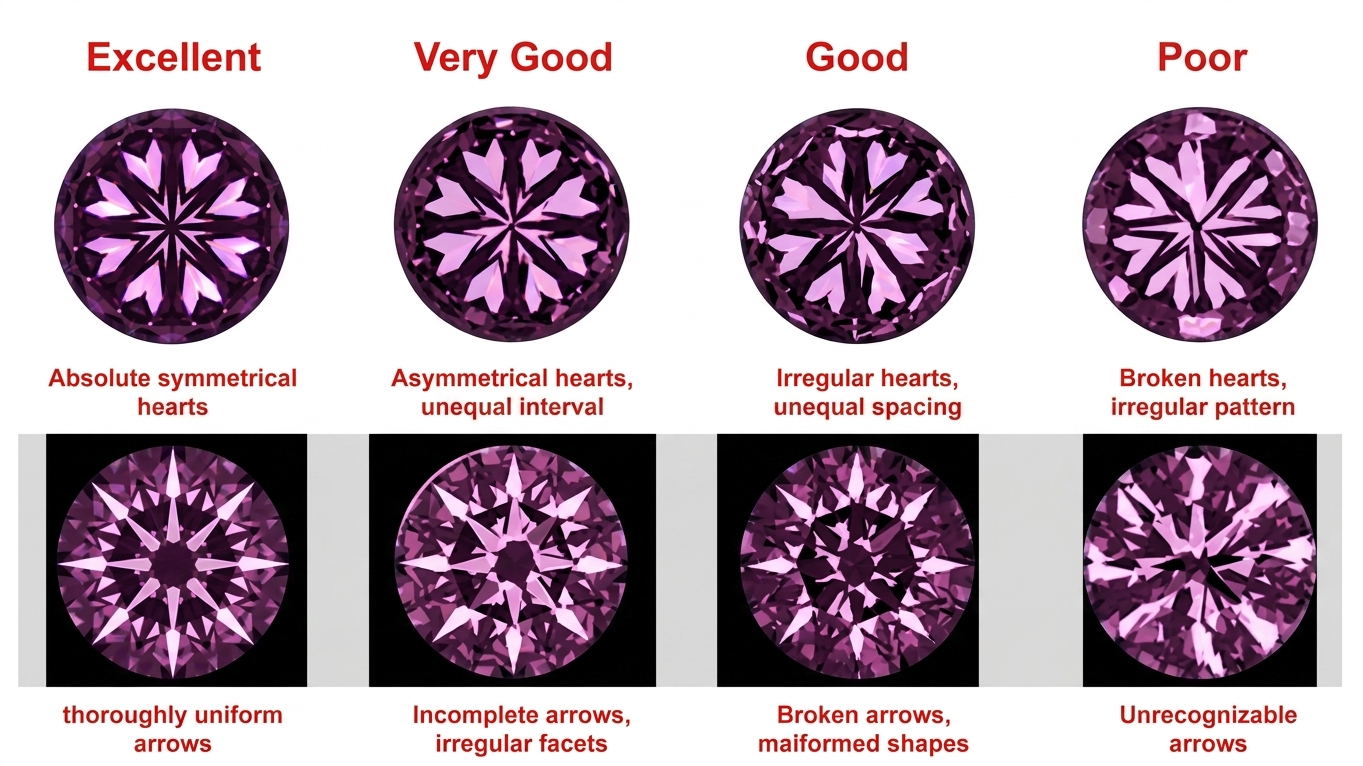
In the mid‑1980s, a quiet revolution was taking place in Japanese polishing ateliers. Master craftsmen, examining their work through specialised optical viewers, made a startling discovery. When a round brilliant diamond was cut with extreme precision, it revealed a hidden optical pattern: eight perfect hearts when viewed from below, and eight perfect arrows when seen from above.
This phenomenon, which would later captivate the global diamond industry, became known as Hearts & Arrows (H&A) the ultimate expression of diamond cutting perfection.
Today, true Hearts & Arrows diamonds represent less than 1% of the world’s polished diamonds. They are the crown jewels of the diamond trade, commanding premium prices and delivering light performance that ordinary diamonds can only aspire to. But what exactly makes these stones so extraordinary? Why do they command such respect and such prices in the luxury market? This guide will answer every question, from the scientific principles behind the pattern to practical advice for buyers and sellers alike.
At its core, a Hearts & Arrows diamond is a round brilliant diamond cut with such phenomenal optical symmetry that it creates a repeatable, near‑perfect pattern of eight symmetrical arrows when viewed face‑up (through the crown), and eight symmetrical hearts when viewed face‑down (through the pavilion). This visual phenomenon has earned the poetic nickname “Cupid effect,” and these diamonds have become among the most sought‑after gems on the planet.
Hearts & Arrows is not a brand, nor is it a separate diamond shape. Rather, it is a specific type of optical symmetry that emerges when a round brilliant diamond is cut within a very narrow range of proportions, with every facet aligned in three‑dimensional space to microscopic tolerances. The pattern serves as visible proof of invisible precision: when you see those crisp, eight‑fold patterns, you know the diamond has been cut by a master artisan.
No discussion of Hearts & Arrows diamonds is complete without honouring Marcel Tolkowsky, the Belgian‑born mathematician and gemologist whose 1919 PhD thesis, Diamond Design, laid the foundation for everything that followed.
Tolkowsky, an engineering student at the University of London, applied mathematical principles to calculate the ideal proportions for a round brilliant diamond. His work demonstrated that by precisely balancing crown angles, pavilion depths, and table sizes, a diamond could achieve maximum brilliance and fire.
Tolkowsky’s original “Ideal Cut” proportions were:
Table: 53% of the diamond’s diameter
Crown angle: 34.5°
Pavilion angle: 40.75°
Total depth: 59.3%
He designed a 58‑facet round brilliant, comprising 33 facets on the crown and 25 on the pavilion. For the first time, diamond cutters had a scientific formula to follow a blueprint for unlocking a diamond’s full light‑return potential.
More than six decades later, Japanese diamond polishers took Tolkowsky’s theoretical framework and pushed it to its logical extreme. Working in laboratories such as the Central Gem Laboratory (CGL) in Tokyo, these innovators realised that by tightening Tolkowsky’s proportions and demanding near‑flawless physical and optical symmetry, a hidden pattern would appear when the diamond was viewed through a special reflector.
The result was breathtaking: eight perfectly formed hearts visible through the pavilion, and eight crisp arrows visible through the crown. Japanese laboratories began grading diamonds specifically for this “Hearts & Arrows” effect, awarding an “Excellent” grade only to stones that displayed the full, symmetrical pattern. From Japan, the phenomenon spread across the globe, eventually becoming one of the most respected benchmarks for precision diamond cutting.
Key figures such as Kinsaku Yamashita are credited with refining the cutting techniques that made mass‑production of H&A diamonds possible, though the exact origins remain somewhat shrouded in the collaborative culture of Japanese manufacturing.
Creating a true Hearts & Arrows diamond is not a matter of luck or even standard skill. It is an exercise in extreme engineering. Every major facet must align in three dimensions with microscopic accuracy. The facets involved include:
Bezel facets (crown mains)
Pavilion mains
Upper girdle facets
Lower girdle halves
Star facets
These 57 or 58 individual polished planes must work together in perfect harmony. Even a tiny cutting error a misalignment of less than one degree, or a facet length off by a fraction of a percent can destroy the pattern entirely. Factories must employ 100× magnification and specialized tooling throughout every stage of production, and cutters may take up to three times longer to produce a single H&A diamond compared to a standard brilliant.
The result of this painstaking labour is a diamond that exhibits:
Maximum brilliance – The brightest possible return of white light
Maximum fire – Vivid dispersion of light into spectral colours
Maximum scintillation – Dynamic sparkle that dances with every movement
Near‑perfect light return – Minimal light leakage through the pavilion or crown
Hearts and Arrows diamonds deliver superior levels of light return because the pattern of hearts and arrows can only be produced within a narrow range of proportions, which also happen to produce maximum light return”.
Despite the global appetite for these stones, genuine H&A diamonds remain extraordinarily scarce. Fewer than 1% of all round brilliant diamonds meet the optical symmetry standards required for a crisp, complete hearts and arrows pattern. There are several reasons for this scarcity:
To achieve the exact proportions required for H&A, cutters must often reject large portions of the original rough crystal. Unlike commercial cutting, where yield is optimised for weight retention, H&A cutting prioritises optical perfection. This means significantly more rough diamond is lost during the polishing process often 50% or more, compared to 40%–50% for standard brilliants.
A standard round brilliant might take a skilled polisher several hours to complete. A Hearts & Arrows diamond, by contrast, requires triple the time or more. Every facet must be checked, adjusted, and re‑checked through specialized viewers to ensure alignment. Factories must stop production repeatedly to inspect patterns, slowing throughput dramatically.
Not every diamond polisher can cut H&A. The technique requires years of training and a level of spatial awareness that goes far beyond routine production. Master H&A cutters are among the most highly valued artisans in the industry, and their labour commands commensurate compensation.
One of the most confusing aspects of the Hearts & Arrows market is certification. Unlike colour, clarity, or carat weight, there is no single universally accepted “H&A grade.” Different laboratories have different standards, and some sellers use the term loosely as a marketing tool.
Over 13,000 variations of H&A patterns exist, with widely varying quality. Some manufacturers intentionally manipulate cutting angles to create the visual effect at the expense of optical performance. Always verify proportions and light performance data alongside any H&A claim.
What makes a Hearts & Arrows diamond visually superior to an otherwise well‑cut round brilliant? The answer lies in optical symmetry and its direct impact on brightness, fire, and scintillation.
Brightness refers to all internal and external reflections of white light within the diamond. In an H&A diamond, the precise alignment of pavilion mains ensures that light entering through the crown is reflected internally and returned through the table, rather than leaking out through the pavilion or sides. The result is a diamond that appears brilliantly white and radiant from every angle, even in less‑than‑ideal lighting conditions.
Fire is the rainbow‑coloured light that flashes from a diamond as it moves. The GIA defines fire as “the flashes of colour you see in a polished diamond”. H&A cutting optimises crown angles to disperse white light into its spectral components red, orange, yellow, green, blue, indigo, and violet creating vivid, dancing colour that distinguishes a top‑tier diamond from an average one.
Scintillation is the dynamic interplay of light and dark as a diamond moves, creating the “sparkle” that catches the eye. H&A diamonds, with their perfectly aligned facets, deliver a scintillation pattern that is both rapid and visually appealing a constant dance of light that draws the gaze.
The GIA’s own research on diamond cut grading notes that a well‑cut round brilliant diamond should have “a crisp, even face‑up pattern of light and dark, and plenty of brilliance and fire”. H&A diamonds represent the extreme end of this spectrum, where the balance of brightness, fire, and scintillation is so finely tuned that the diamond performs exceptionally across all lighting environments.
Given the difficulty of production, it is no surprise that premium Hearts & Arrows diamonds command higher prices in the luxury market. Buyers should expect to pay a significant premium typically 10% to 30% more than a comparable GIA Triple Excellent diamond without H&A certification.
This premium reflects:
Higher rough diamond costs (due to greater waste)
Extended manufacturing time (up to 3× longer)
Premium labour costs (master cutters only)
Specialised equipment and quality control
Certification costs (especially for AGS or GCAL 8X reports)
Is the premium worth it? For diamond connoisseurs, collectors, and those seeking the absolute best in light performance, the answer is a resounding yes. For budget‑conscious buyers, a well‑cut GIA Triple Excellent diamond without the H&A pattern may offer 95% of the visual performance at a significantly lower cost. The decision ultimately depends on individual priorities and budget.
H&A diamonds, particularly those with AGS Ideal or GCAL 8X certification, tend to hold their value better than average‑cut diamonds due to their rarity and desirability among discerning buyers.
If you are ready to invest in a Hearts & Arrows diamond, follow this checklist to ensure you are getting a genuine article:
Request the full proportion data from the diamond’s certificate. Look for:
Table: 53%–57%
Crown angle: 34°–35° (34.5° ideal)
Pavilion angle: 40.6°–40.8°
Lower girdle halves: 75%–80% (≈77% ideal)
Star facets: 45%–50%
Total depth: 58%–62%
Prioritise diamonds with certificates from:
AGS (look for “AGS Ideal” and the Optical Precision Map)
GCAL 8X (the gold standard for H&A documentation)
GIA (Triple Excellent, plus proportion data within optimal ranges)
IGI (if H&A is explicitly noted)
If possible, view the diamond through a hearts and arrows scope a specialised optical viewer that reveals the pattern. Look for:
Eight crisp, symmetrical arrows from the crown view
Eight perfectly formed, equally sized hearts from the pavilion view
No gaps, distortions, or missing elements
Sharp contrast between light and dark areas
Modern light performance imaging tools (such as ASET, Ideal Scope, or BrillianceScope) can reveal how a diamond handles light. Look for:
Even, balanced red/green distribution (ASET)
Crisp, symmetrical arrows pattern (Ideal Scope)
Minimal light leakage (blue or black areas in ASET)
If you have the opportunity, compare several H&A diamonds side by side. Even among certified H&A stones, subtle differences in precision create visible differences in brightness, fire, and scintillation. A true master‑cut H&A diamond should visibly outperform its peers.
The rise of laboratory‑grown diamonds has made Hearts & Arrows cutting more accessible than ever. Because lab‑grown diamonds are produced from consistent carbon sources under controlled conditions, their rough crystals are often more uniform than natural diamonds. This allows manufacturers to achieve H&A precision with greater consistency.
At CaratX, both natural and lab‑grown Hearts & Arrows diamonds are available through our global marketplace.
Lab‑grown H&A diamonds typically cost 30%–50% less than their natural counterparts while delivering identical optical performance. For buyers who prioritise ethical sourcing and budget efficiency, lab‑grown H&A diamonds represent an exceptional value proposition.
CaratX is the exclusive diamond, gemstone, and jewellery hub connecting buyers and sellers across 18+ international markets. Our mission is to reduce the costs of buying and selling online for the diamond, gemstone, and jewellery industry while ensuring authenticity, transparency, and quality.
When you shop for Hearts & Arrows diamonds on CaratX, you benefit from:
Verified sellers with documented industry credentials
Independent certification from GIA, AGS, GCAL, and IGI
Competitive pricing across a curated global inventory
Secure B2B and B2C transactions.
For sellers, CaratX offers a streamlined platform to reach international buyers without excessive overhead. Register as a seller today to list your Hearts & Arrows diamonds, lab‑grown diamonds, natural diamonds, and fine jewellery.
Sell diamonds in 18+ international countries
Sell jewellery internationally through our seller plan
Shop natural diamonds from our curated selection
Shop gemstones at unbeatable prices
A: Hearts & Arrows is a real optical phenomenon that occurs in round brilliant diamonds cut with extreme precision. However, the term has been over‑marketed, and not all diamonds advertised as “H&A” display the full, crisp pattern. Always verify with independent certification and proportion data.
A: No. GIA does not include a specific Hearts & Arrows grade on its reports. GIA considers H&A presence to be an insufficient guarantee of cut quality. However, GIA Triple Excellent diamonds with optimal proportions may still display the pattern.
A: AGS Laboratories (with their Optical Precision Map) and GCAL 8X (which explicitly includes H&A as one of eight excellence criteria) offer the most comprehensive H&A documentation.
A: Yes. Lab‑grown diamonds have identical optical, physical, and chemical properties to natural diamonds. A lab‑grown H&A diamond will display the same pattern and light performance as a natural H&A diamond, typically at a lower price.
A: You need a specialised hearts and arrows scope (also called an H&A viewer). These handheld devices direct light through the diamond to reveal the pattern. Reputable jewellers and online sellers can provide H&A scope images of their diamonds.
A: Yes. True H&A diamonds typically command a premium of 10%–30% over comparable GIA Triple Excellent diamonds without the pattern, reflecting the higher manufacturing costs and rarity.
A: “Ideal Cut” refers to proportions optimised for light return (following Tolkowsky’s or similar standards). “Hearts & Arrows” requires those ideal proportions plus exceptional optical symmetry that creates the visible pattern. All true H&A diamonds are ideal cuts, but not all ideal cuts display H&A.
Whether you are a buyer seeking the ultimate in diamond light performance or a seller looking to reach international markets, CaratX is your trusted partner.
Shop natural diamonds – Certified Hearts & Arrows, ideal cuts, and more
Shop lab‑grown diamonds – Ethically sourced, precision‑cut gems
Shop gemstones – Unbeatable prices on rubies, sapphires, emeralds, and more
Register as a seller – Start selling to B2B and B2C buyers in 18+ international countries
Sell jewellery internationally – Expand your business with our seller plan
View our pricing plans – Transparent, competitive rates
Follow CaratX for more insightful and educational content about diamonds, gemstones, and the jewellery industry.
Aug, 06, 2022
Aug, 06, 2022
0 Comments
Please login to leave a reply.