
Introduction:
If you were part of Australia’s jewellery industry in 2025, you felt the change in the air a tangible shift from the glittering showroom floors to the considered choices of the conscious consumer. Foot traffic in traditional stores softened, deep discounts became a routine strategy rather than a seasonal event, and purchasing decisions stretched from impulsive moments to deliberate journeys of research and reflection. This was not a story of vanished demand, but of profoundly transformed demand.
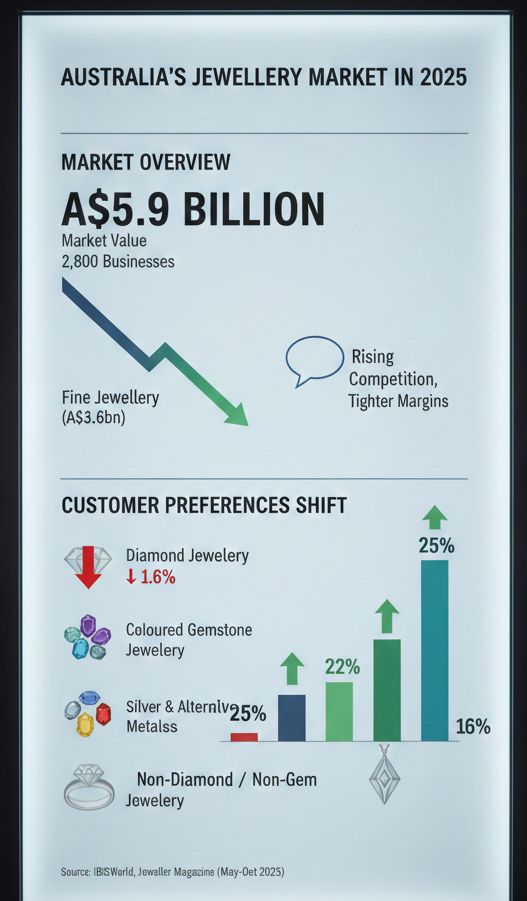
According to industry analysts at IBISWorld, the market held substantial value at approximately A$5.9 billion, supported by nearly 2,800 businesses nationwide. Yet, beneath this sizable figure, a crucial evolution was underway: the fine jewellery segment, once the undisputed leader, showed a clear multi-year decline, settling around A$3.6 billion.
This report delves into the powerful forces reshaping Australia's jewellery landscape, offering strategic insights for businesses ready to adapt, innovate, and thrive by connecting with the modern buyer's desire for meaning, versatility, and personal value.
The 2025 Market Snapshot –
The Australian jewellery retail environment in 2025 operated under a unique set of economic and social pressures that fundamentally altered its dynamics.
The Macro-Economic Squeeze: High interest rates and persistently rising gold prices created a dual challenge. For consumers, disposable income for non-essential luxury items contracted, making every purchase a more significant financial decision.
For retailers and independent jewelers, the cost of holding inventory especially high-value gold and diamond stock increased, squeezing already tight margins. This environment made the traditional model of high-volume, high-markup fine jewellery sales increasingly difficult to sustain.
A Segment in Subtle Decline: IBISWorld data pinpointed a slow but steady five-year decline in the fine jewellery segment. This category, traditionally defined by high-karat gold, platinum, and diamond-centric pieces, was facing headwinds. Large national brands publicly acknowledged rising competition and eroding profitability, signaling a sector-wide recalibration.
The Consumer Mindset Shift: Critically, people did not stop buying jewellery. Instead, as noted in trade publications like Jeweller Magazine, their preferences pivoted dramatically. Spending moved decisively "away from impulse and toward meaning, versatility, and personal value." This signaled a move from jewellery as a purely transactional luxury or gift to jewellery as a curated component of personal identity and expression.
Decoding the New Consumer Preferences -
The clearest evidence of change comes from consumer purchase data. An analysis of sales trends from May to October 2025, as reported by Jeweller Magazine, reveals a striking reallocation of consumer interest:
Jewelry Category Trends (May–October 2025)
1. Diamond Jewellery
Trend: ↓ 1.6%
Consumer Driver: Gradual shift away from traditional, high-cost staples
Buyers exploring alternatives that feel more personal or flexible in pricing
2. Coloured Gemstone Jewellery
Trend: ↑ 22%
Consumer Driver: Strong desire for unique colors and self-expression
Appeal of individuality combined with relatively accessible price points
3. Silver & Alternative Metals
Trend: ↑ 25%
Consumer Driver: Preference for versatile, modern aesthetics
Growing demand for cost-conscious luxury without sacrificing style
4. Non-Diamond / Non-Gem Jewellery
Trend: ↑ 16%
Consumer Driver: Emphasis on design-led pieces and craftsmanship
Interest in material innovation such as titanium, ceramic, and recycled materials
Interpreting the Shift:
The Rise of Color and Character: The surge in coloured gemstones such as sapphires, emeralds, and tourmalines indicates a desire for pieces that tell a story and reflect individual taste. Buyers are increasingly educated, often seeking stones with unique inclusions or custom cuts, moving beyond the standardized "four Cs" of diamonds.
For sellers, this means an opportunity to showcase a diverse and ethically sourced inventory of loose gemstones.
Metals for a Modern Wardrobe:
The 25% growth in silver and alternative metals is a direct response to the demand for versatility and everyday wear. Pieces in these materials often serve as affordable, stackable, and mixable essentials that cater to a more casual, personalized style ethos. They allow consumers to build a jewellery "wardrobe" without a massive upfront investment.
Value Beyond the Stone: The growth in non-stone jewellery highlights that for many, the value proposition is now centered on design innovation, craftsmanship, and ethical material sourcing. This opens the market to contemporary designers and artisans whose work prioritizes artistic statement over intrinsic material value.
Strategic Opportunities for Jewellery Sellers -
To succeed in this new landscape, businesses must align their offerings and operations with these dominant trends.
Curate for Meaning and Versatility: Stock must evolve. Prioritize collections that offer personalization (initial pendants, birthstone options, modular designs), narrative (gemstones with provenance, artisan collaborations), and layering potential. Highlight how pieces can be worn in multiple ways or integrated into a customer's existing collection.
Master the Omnichannel Narrative: The journey to purchase now involves extensive online research. Sellers need a strong digital presence that educates and inspires. This includes detailed product stories, blog content on how to style different pieces, and high-quality video that shows jewellery in motion. A seamless path from this digital discovery to purchase whether online or in-store is critical.
Leverage a Global Marketplace Platform: For Australian sellers, the domestic market's competitive pressure makes international expansion a powerful growth lever.
Platforms like CaratX provide a vital infrastructure to launch products internationally with reduced complexity.
By accessing buyers in 18+ countries, sellers can diversify their customer base, mitigate local market fluctuations, and achieve better economies of scale. Exploring a seller plan tailored to your business size can be a transformative step.
Embrace Transparency and Ethics: The thoughtful consumer demands knowledge. Providing clear information on material sourcing, manufacturing processes, and the ethical standards of your operations is no longer a bonus, it's a baseline expectation that builds crucial trust.
Overcoming Industry Challenges -
The path forward is not without obstacles. Key challenges include:
Margin Management: With downward pressure on prices and rising costs, operational efficiency is paramount. This makes the lower fee structures of direct-to-consumer or marketplace models increasingly attractive compared to traditional wholesale or high-overhead retail.
Inventory Risk: Holding slow-moving, high-cost stock is a significant liability. Strategies like on-demand manufacturing, pre-orders, and leveraging a platform's inventory analytics to identify fast-moving trends can help optimize stock levels and reduce financial risk.
Digital Competition: Standing out in a crowded online space requires more than just a website. It demands strategic content, targeted use of social media, and sometimes, partnership with platforms that offer featured listings and promotional support to increase visibility.
Conclusion:
The Australian jewellery market of 2025 presents a compelling paradox: a multi-billion dollar industry where traditional metrics of success are being rewritten by a more deliberate, values-driven consumer. The decline in some traditional segments is overwhelmingly offset by vibrant growth in others growth fueled by color, individuality, and conscious consumption.
The businesses positioned to win are those that listen to this new demand, adapt their offerings with agility, and leverage modern tools from digital storytelling to global e-commerce platforms to build authentic connections. The era of thoughtful demand is here, and it offers a more sustainable, creative, and personally resonant future for the industry.
Ready to adapt your business to the future of jewellery retail? Explore how a global marketplace can expand your reach.
Learn more about the features and benefits of different seller plans on CaratX designed to help businesses of all sizes connect with international buyers.
Frequently Asked Questions (FAQs)
Q1: As a small Australian jewellery designer, how can I compete with large brands in this new market? Your size can be your greatest advantage. Focus on your unique story, craftsmanship, and direct connection with customers. Leverage online platforms to tell that story globally. Consider starting with a plan that allows you to list a curated collection and access dedicated email support to navigate international sales.
Q2: Is selling internationally complex for a local business? While it involves logistics like shipping and customs, using an integrated marketplace platform significantly simplifies the process. Many platforms handle currency conversion, provide standardized shipping options, and offer a familiar checkout experience for international buyers, reducing the operational burden on you.
Q3: With the shift to colored gemstones, how do I ensure I'm sourcing ethically? This is a top concern for modern consumers. Seek suppliers who provide provenance information and adhere to recognized standards. Educational resources from authoritative institutions like the Gemological Institute of America (GIA) offer guidance on ethical sourcing. Transparency about your supply chain in your product listings builds essential trust.
Q4: What type of jewellery is best suited for international sales online? Pieces that are versatile, have a clear design story, and photograph well are strong candidates. Jewellery that caters to universal styles or emotions (e.g., minimalist daily wear, meaningful birthstone pieces) often translates easily across cultures. High-quality images and videos are non-negotiable for online success.
Sources & Citations
Industry market size, business count, and segment analysis derived from IBISWorld industry reports on Australian Jewellery Retailing (2025).
Consumer preference data (Diamond, Coloured Gemstone, Silver, and Non-Gem trends) sourced from sales analysis published in Jeweller Magazine, covering the period May-October 2025.
Insights on consumer mindset shifts and industry challenges are synthesized from contemporaneous analysis in trade publications including Jeweller Magazine and Retail Jeweller.
Information on e-commerce and marketplace selling models is based on publicly available platform data from CaratX.