

The Guide to Pear-Shaped Diamonds: Anatomy, Cut Quality, and Why They Dazzle
Home
News And Media The Guide to Pear-Shaped Diamonds: Anatomy, Cut Quality, and Why They Dazzle SHOP NOWHome
News And Media The Guide to Pear-Shaped Diamonds: Anatomy, Cut Quality, and Why They Dazzle SHOP NOWFeb, 26, 2026 by Archit Mohanty 0 Comments
Discover everything about pear-shaped diamonds, from their unique anatomy and cut quality to pricing. Learn why this elegant shape is a top choice for engagement rings. Shop certified natural diamonds at CaratX.
The pear-shaped diamond, also known as the pendeloque or drop cut, is a true hybrid in the world of gemstones. It masterfully combines the brilliant round cut's fire with the marquise cut's elongated elegance. At CaratX, we see a growing demand for this unique shape, which perfectly balances tradition with a modern, finger-elongating silhouette.
But why choose a pear shape? Beyond its aesthetic appeal, the anatomy of a pear-shaped diamond is a complex study in light performance. A poorly cut pear can suffer from a "bow-tie" effect, while a well-cut stone reflects light with mesmerizing intensity.
In this guide, we will dissect every part of the pear-shaped diamond, explain how to buy one online, and show you why the CaratX marketplace is the ideal place to find your perfect gem.
While the modern brilliant cut is often attributed to Lazare Kaplan in the 20th century, the pear shape has roots stretching back to the 1400s. Flemish polisher Lodewyk van Berquem is credited with inventing the "pendeloque" or briolette cut, an early precursor to the pear, by using a scaif (polishing wheel) to create symmetrical facets.
Historically, the pear shape symbolized tears of joy and was favored by royalty. One of the most famous pear-shaped diamonds in history is the Cullinan I (The Great Star of Africa), which adorns the British Crown Jewels. This 530-carat behemoth set the standard for how light interacts with a pointed stone.
For a deeper dive into historical diamond cuts, you can refer to the Gemological Institute of America (GIA) ’s research library here.
Today, this shape remains a symbol of sophisticated taste, making up approximately 5-7% of global diamond sales.
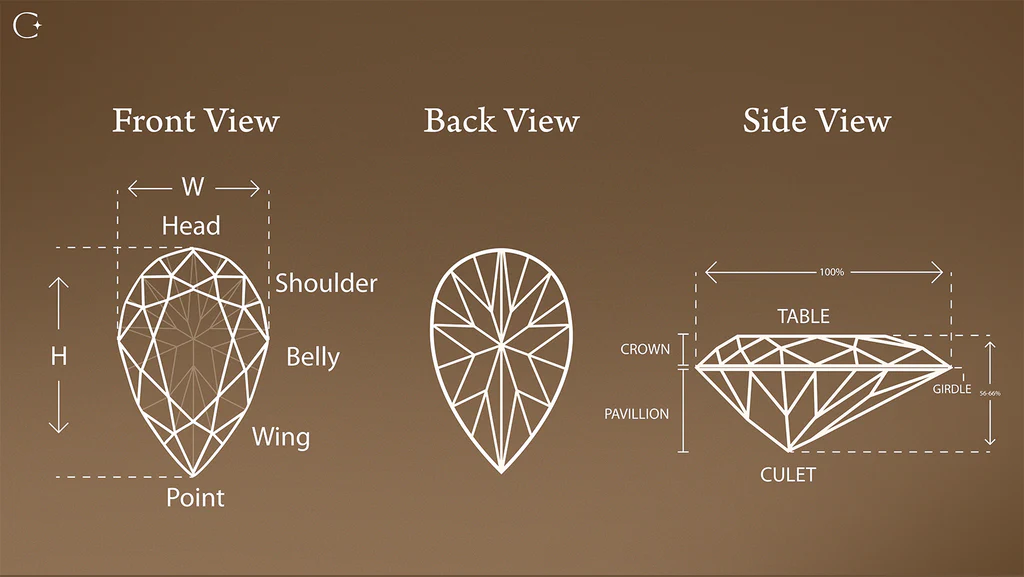
To understand the value of a pear diamond, you must first understand its unique parts. Unlike a round diamond which is symmetrical, the pear shape has distinct zones that affect its brilliance and durability.
Here is a breakdown of the key components:
The Head (Round End): This is the curved, rounded portion. It should be a perfect, smooth semicircle. If it is flat or lopsided, it diminishes the stone's brilliance. The head acts like a mini-round brilliant, concentrating light return.
The Shoulders: These are the "hips" of the diamond, connecting the round head to the belly. Well-defined shoulders give the diamond a balanced look.
The Belly (Widest Point): This is the area of maximum width. The placement of the belly dictates the stone's overall proportion. A belly that sits too high makes the diamond look bulbous; too low makes it look skinny.
The Wings: These are the gentle curves that guide the eye from the belly down to the tip.
The Tip (Pointed End): The most delicate part of the diamond. This is where the stone terminates. Because it is a point, it is susceptible to chipping if not protected by the prong setting.
The Table: The largest facet on the top of the diamond (the crown). Light enters here.
The Pavilion: The bottom portion of the diamond. In a pear shape, the pavilion facets are responsible for reflecting light back up through the table, creating "sparkle."
The Girdle: The thin perimeter that separates the crown from the pavilion. It acts as the diamond's "setting edge."
Explore the anatomy of different diamond cuts by browsing our collection of Natural Diamonds on CaratX.
When discussing pear-shaped diamonds, the dreaded "bow-tie" effect is unavoidable. This is a dark, shadowy area that appears across the belly of the diamond, resembling a bow tie. It occurs when light leaks out of the bottom of the stone (the pavilion) instead of reflecting back to the eye.
Why does this happen? It is a result of the elongated shape. If the diamond cutter prioritizes carat weight over optical precision, the pavilion angles become too deep or too shallow, causing extinction of light.
How to avoid it:
Look for Symmetry: A well-cut pear will have a symmetrical light pattern.
Video is Key: In an online marketplace like CaratX, high-resolution videos allow you to rotate the stone and check for darkness in real-time.
Proportions Matter: Generally, a length-to-width ratio between 1.45 and 1.75 helps minimize the bow-tie.
A study by the American Gem Society (AGS) suggests that diamonds with "Excellent" or "Ideal" cut grades on their light performance scale are significantly less likely to exhibit a distracting bow-tie. You can read more about their cut grading system on their official site here.
While the 4Cs (Cut, Color, Clarity, Carat) apply to all diamonds, the pear shape has specific nuances.
For a pear shape, "Cut" refers to three things:
Symmetry: The two halves of the diamond must be mirror images. The tip must align perfectly with the center of the head.
Polish: The quality of the surface finish. Poor polish can make the diamond look hazy.
Proportions: Depth and table percentages. For pear diamonds, an ideal depth is usually between 58% and 63% .
Because of the "bow-tie" effect and the large table, color can be more visible in a pear than in a round brilliant. The pointed tip often concentrates color. If you are setting the diamond in yellow gold, you can go down to J or K color. For white gold or platinum, we recommend H color or higher.
The pear shape's brilliant faceting pattern does a good job of hiding small inclusions. However, be wary of inclusions located near the tip. A inclusion at the tip can weaken the stone structurally and is difficult to hide with a prong.
Shop for high-clarity diamonds by filtering our inventory at CaratX Marketplace.
Pear shapes offer strong brilliance and a flattering elongating effect but require protective settings (like a V-prong) due to their pointed tip.
Oval diamonds perform similarly in brilliance and finger-lengthening but without the fragile point.
Marquise cuts elongate the most but have two delicate tips that need careful setting.
Round diamonds offer unmatched brilliance and durability but come at a higher cost per carat.
If you are a diamond dealer or jeweler, the pear shape represents a significant portion of the "fancy shape" market. At CaratX , we provide a platform to connect with B2B and B2C buyers in over 18 countries.
Why list on CaratX?
Global Reach: Access to international markets without the logistics headache.
Competitive Pricing: Our seller plans are designed to maximize your margins.
Diverse Inventory: Whether you sell natural diamonds, lab-grown, or finished jewelry, our platform supports you.
Ready to expand your business?
Register as a Seller on CaratX Today
Check our Seller Plans and Pricing
The setting you choose is crucial for protecting the delicate tip of the pear.
The V-Prong Setting: The most classic and recommended setting. A "V" shaped prong cradles the tip, protecting it from knocks. We have several pear-shaped jewelry options available for purchase here.
The Halo Setting: Surrounding the pear with a halo of smaller diamonds (melee) enhances the center stone's size and protects the head.
Three-Stone Setting: Flanking the pear with two smaller side stones (often tapered baguettes) creates a vintage, Art Deco look.
Q1: Do pear-shaped diamonds look bigger? A: Yes. Due to their elongated shape and large table facet, pear-shaped diamonds often face up larger than round brilliant diamonds of the same carat weight.
Q2: Is a pear-shaped diamond expensive? A: Generally, pear shapes are 10-20% less expensive per carat than a round brilliant of similar quality. This is because round cuts have higher manufacturing waste, driving up their cost. However, a premium pear with excellent cut and no bow-tie will command a higher price.
Q3: What is the best length-to-width ratio for a pear diamond? A: It depends on personal taste:
Classic (1.45 - 1.50): Looks well-proportioned and traditional.
Elongated (1.55 - 1.75): Offers maximum finger slimming effect. Modern buyers often prefer this.
Q4: Can you wear a pear-shaped diamond every day? A: Absolutely. With a protective setting (like a V-prong or bezel at the tip), a pear-shaped diamond is durable enough for daily wear. Hardness is 10 on the Mohs scale, but toughness depends on setting. The International Gem Society (IGS) discusses gemstone durability in detail here.
Q5: Does the tip need a special prong? A: Yes. Always ensure the tip is covered by a prong. If the tip is left exposed or "floating," it is highly susceptible to chipping.
The pear-shaped diamond is a testament to the artistry of diamond cutting. Its unique anatomy from the brilliant head to the delicate tip creates a silhouette that is both timeless and contemporary. Whether you are buying a stone for an engagement ring or adding to an investment collection, understanding the anatomy is the first step to making a wise purchase.
At CaratX, we bridge the gap between global sellers and savvy buyers. We offer a secure, transparent platform to trade natural diamonds and jewelry.
Ready to find your perfect gem?
Sell Your Diamonds to 18+ Countries
Explore Our Gemstone Collection
Image Credit - Carat Diamonds
Jun, 15, 2026
Aug, 06, 2022
Aug, 06, 2022

0 Comments
Please login to leave a reply.