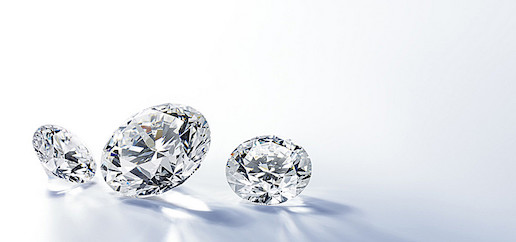

In the world of fine jewelry, the oval diamond has cemented its status as a timeless favorite. Popularized in the 1960s by Lazare Kaplan, who perfected the brilliant-cut oval shape from the rough, this modified brilliant cut combines the fire of a round diamond with a silhouette that flatters the finger.
However, not all oval diamonds are created equal. To truly understand what makes an oval diamond sing with brilliance or why some exhibit a dark "bow-tie" effect, you must understand its anatomy.
Whether you are a consumer looking for the perfect engagement ring or a seller looking to list your inventory, understanding these technical details is crucial.
At CaratX, we bridge the gap between B2B and B2C buyers and sellers across 18+ countries. If you have a collection of precision-cut gems, you should register as a seller on CaratX to reach a global audience.
Here is a deep dive into the facets, measurements, and optical science that define the oval diamond.
1. The Basic Anatomy: Breaking Down the Diamond
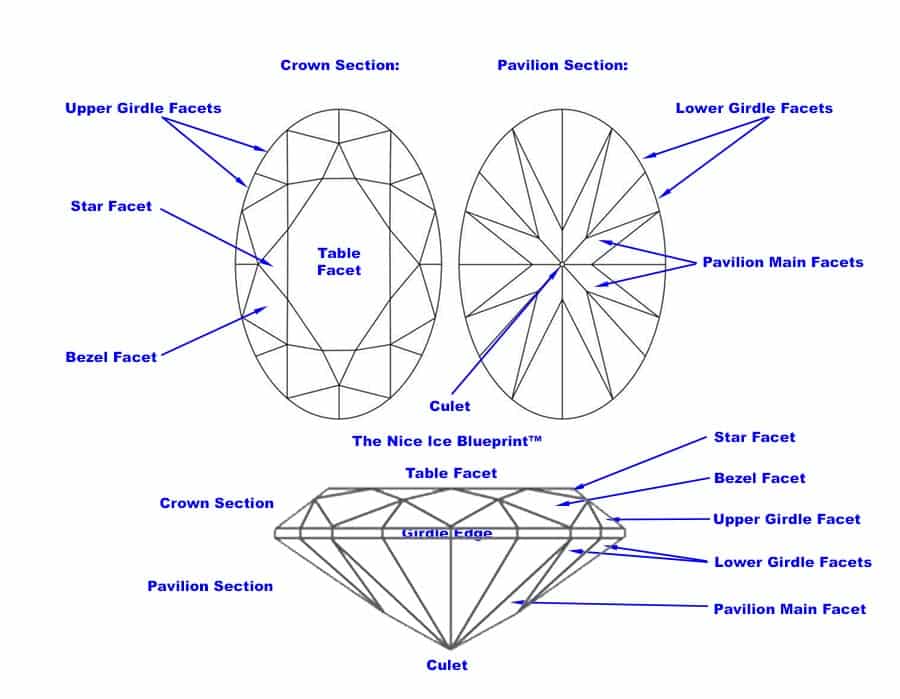
To evaluate an oval diamond, one must look beyond its elongated shape. Every oval diamond consists of specific structural components. The precision of these components determines how light interacts with the stone.
The Table Facet -
The table is the largest flat facet on the top of the diamond. It acts as a window, allowing light to enter the stone and travel toward the pavilion. In an oval diamond, if the table percentage is too large, the diamond can appear glassy and lack fire. If it is too small, the diamond might appear dark.
At CaratX , our listed diamonds feature detailed grading reports so you can inspect these metrics before purchase.
Browse natural diamonds to see high-resolution examples of well-proportioned tables.
The Crown -
The crown is the upper section of the diamond, sitting between the girdle and the table. It consists of angled facets (star facets, bezel facets, and upper girdle facets). The primary role of the crown is to disperse light into the spectral colors known as "fire."
According to the Gemological Institute of America (GIA), the crown angle is critical; if it is too shallow or too deep, light leaks out of the sides rather than reflecting back to the eye.
The Girdle -
This is the narrow perimeter that separates the crown from the pavilion. It is the outermost edge of the diamond and the part that is held by the prongs of a ring setting. Girdles can range from "Extremely Thin" to "Extremely Thick." For oval diamonds, a slightly thick girdle is often preferred to prevent chipping during the setting process, as the ends of the oval can be vulnerable points.
The Pavilion and Culet -
Located below the girdle, the pavilion is arguably the most important part of the diamond's light performance. The pavilion facets act as mirrors, reflecting the light entering through the table back up to the viewer’s eye. If the pavilion depth is off, the light "escapes" through the bottom or sides.
At the very bottom is the culet. In modern oval diamonds, the culet is usually a pointed tip or a very small facet. Old European cuts often have large culets, but today, a "none" or "pointed" culet grade is standard.
You can explore various pavilion structures and modern cuts available for purchase on our CaratX marketplace.
2. The Optical Challenge: Understanding the Bow-Tie Effect
One of the most talked-about phenomena in the world of oval diamonds is the Bow-Tie Effect.
This appears as a dark, shadowy area across the center of the diamond, resembling a bow tie. It is caused by the pavilion facets reflecting the shadow of the viewer's head or the obstruction of light. In oval diamonds, this effect is almost always present to some degree due to the elongated shape and the way light bounces within the stone.
However, a well-cut diamond minimizes this effect significantly.
Poor Cut: The bow tie is dark, muddy, and distracts from the brilliance.
Excellent Cut: The bow tie is faint or "reflective," appearing only as a slight shift in brilliance when the diamond is tilted.
As a seller, listing diamonds with ASET or Ideal-Scope images on CaratX can help buyers see exactly how light returns through the diamond, proving the cut quality.
If you are a vendor with precision-cut goods, you can start selling to B2B buyers who demand this level of optical precision.
3. Dimensions and Proportions: The Length-to-Width Ratio
The oval shape is defined by its Length-to-Width Ratio (L/W Ratio) . This ratio dictates the silhouette of the stone.
Ratio 1.30 – 1.40: This is considered a standard, classic oval. It has a balanced, elegant shape that is not too elongated.
Ratio 1.45 – 1.50+: This creates a "stretched" or elongated oval. This look can make fingers appear longer and slimmer, which is why it is popular for engagement rings.
There is no "right" ratio; it is purely a matter of aesthetic preference. The International Gem Society (IGS) notes that personal taste should guide this choice, as the facet pattern changes slightly with elongation.
To view diamonds across a spectrum of ratios, check the filters on the CaratX product page to compare shapes side-by-side.
4. Facet Patterns and Brilliance
Unlike a round brilliant, which has a standardized facet pattern, ovals can vary. Most modern ovals are "brilliant-cut," featuring triangular and kite-shaped facets designed to maximize brightness.
The interaction of these facets creates "scintillation" the flashes of light you see when the diamond moves. For a diamond to achieve top-tier brilliance, the facet junctions must be precisely aligned. Misalignment can lead to light leakage.
5. Selling Internationally:
If you are a manufacturer or wholesaler, understanding diamond anatomy is not just academic, it is financial. High-quality cuts with minimal bow-tie and excellent symmetry command premium prices in international markets.
CaratX empowers sellers to showcase these premium goods to a global audience. By listing on our platform, your diamonds are visible to verified buyers in over 18 countries. We handle the complexities of cross-border trade so you can focus on sourcing the best inventory.
For Sellers: Ready to expand your reach? Register on the CaratX marketplace here.
For Buyers: Looking for investment-grade natural diamonds? Shop our collection here.
6. Light Performance -
To truly rank for "diamond anatomy," we must touch on the optical physics. The "brilliance" (white light return) and "fire" (dispersion of light into colors) are governed by the diamond's critical angle approximately 24.3° for diamond due to its high refractive index of 2.42.
When a ray enters the diamond, it travels until it hits a facet. If the angle is steeper than the critical angle, it reflects internally (total internal reflection) and returns to the eye. If it is less, it leaks out.
Conclusion
The anatomy of an oval diamond is a beautiful blend of art and science. From the table to the culet, and from the girdle to the elusive bow-tie, every part plays a role in the final presentation. Whether you are purchasing a symbol of love or stocking inventory for your jewelry store, knowledge of these elements ensures you make an informed decision.
CaratX is your partner in this journey. As a global marketplace, we connect the finest diamond sellers with discerning buyers.
For more details on our pricing plans and how to launch your products globally, check our pricing and launch page.
Follow CaratX for more insightful and educational content.
Frequently Asked Questions (FAQs)
Q1: What is the best length-to-width ratio for an oval diamond? A: There is no universally "best" ratio, as it depends on personal taste. A ratio between 1.35 and 1.45 is generally considered the most popular range. Ratios above 1.50 are considered very elongated.
Q2: Can an oval diamond have no bow-tie? A: It is extremely rare to find an oval diamond with zero bow-tie effect. Due to the physics of light in an elongated shape, some shadowing is almost always present. However, a well-cut stone will have a light, subtle bow-tie rather than a dark, distracting one.
Q3: Is it safe to buy oval diamonds online? A: Yes, provided the platform provides detailed specifications. At CaratX, we encourage sellers to provide high-quality videos, certificates, and precise measurements so buyers can assess the anatomy and cut quality remotely.
Q4: How do I register as an international seller? A: You can register directly on our website. Visit www.caratx.com/register to create your seller account and start listing products to buyers in 18+ countries.
Q5: What is the Girdle on an oval diamond? A: The girdle is the outer edge or rim of the diamond where the crown (top) meets the pavilion (bottom). It is the part held by the setting's prongs.
Image Credit - SGDX Singapore Diamond Exchange