

Global Diamond Market Holiday Analysis 2025: Regional Trends, Strategic Insights, and Future Outlook
Home
Education Blog Global Diamond Market Holiday Analysis 2025: Regional Trends, Strategic Insights, and Future Outlook SHOP NOWHome
Education Blog Global Diamond Market Holiday Analysis 2025: Regional Trends, Strategic Insights, and Future Outlook SHOP NOWDec, 19, 2025 by Archit Mohanty 0 Comments
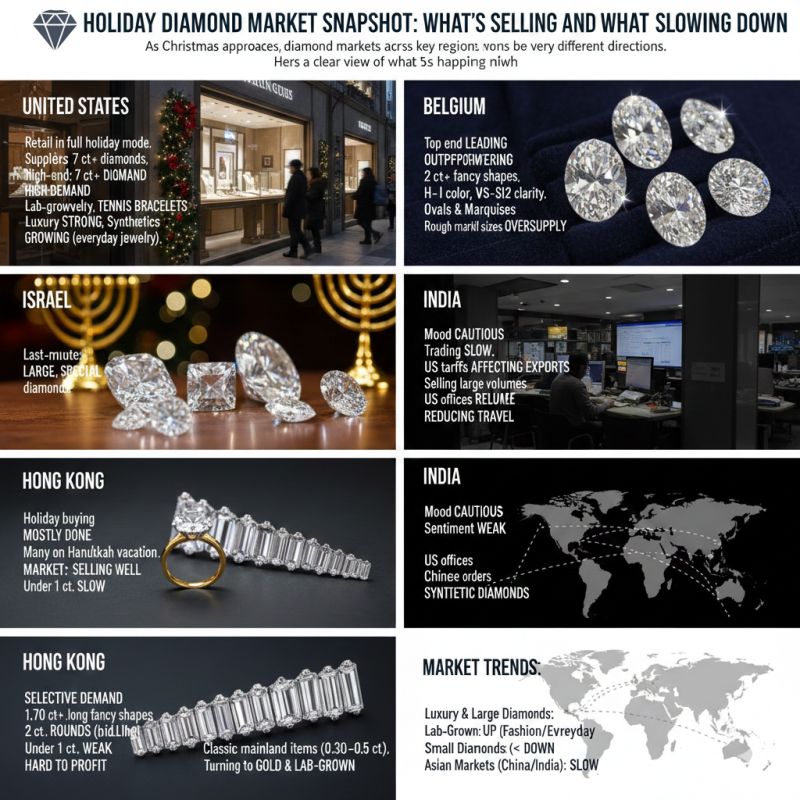
As the holiday season reaches its peak, the global diamond industry presents a fascinating study in contrasts. While some markets and product categories are experiencing robust demand, others face significant headwinds, creating a complex landscape for traders, retailers, and consumers.
This comprehensive analysis examines regional market dynamics across five key diamond hubs United States, Belgium, Israel, India, and Hong Kong to identify what's selling, what's stalling, and what strategic moves industry participants should consider. The data reveals a clear divergence: luxury and larger-carat goods are maintaining their allure, while smaller, commercial-grade stones and certain traditional markets are under pressure, accelerated by the continued rise of lab-grown alternatives and shifting global economic conditions.
The U.S. market demonstrates the most positive holiday momentum, with retailers reporting satisfactory Christmas sales. A distinct bifurcation is evident in consumer preferences:
High-End Segment Strength: Demand for 7-carat and larger natural diamonds remains exceptionally strong, particularly within the luxury gifting and self-purchase categories. This trend reflects continued wealth concentration and the desire for statement pieces among affluent consumers.
Lab-Grown Dominance in Fashion: The fashion jewelry segment is increasingly dominated by lab-grown diamonds, with specific strength in tennis bracelets and necklaces. According to research from the Gemological Institute of America (GIA), technological advancements have significantly improved the quality and reduced the production costs of synthetic diamonds, making them highly competitive in the accessible luxury segment.
This market duality suggests that American consumers are making clear distinction between investment-quality natural stones for special occasions and fashionable, more affordable lab-grown pieces for everyday wear. For retailers, this means maintaining a balanced inventory that caters to both ends of the spectrum. Explore the stunning selection of both natural and lab-grown diamonds available on CaratX's marketplace to see this trend in action.
Antwerp's diamond district reflects specialized, quality-driven demand:
Preferred Specifications: The most active trading involves 2-carat and larger fancy shapes (ovals and marquises leading) with H-I color and VS-SI2 clarity. This "sweet spot" represents optimal balance between visual size and value.
Rough Market Dynamics: The rough diamond market remains quiet, with particular oversupply in smaller sizes. This upstream softness contrasts with the polished market's selective strength, indicating careful inventory management by manufacturers. For those looking to source quality diamonds meeting these precise specifications, the CaratX natural diamonds collection offers curated options from trusted global sellers.
The Israeli market has largely completed its holiday cycle, with many dealers on Hanukkah vacation. What remains active is telling:
Last-Minute Luxury Requests: There continues to be specialized demand for large, exceptional stones (3 carats and above) for ultra-high-end clients, suggesting that the top tier of the market operates on a different timeline.
Clear Market Split: Goods under 1 carat are moving slowly, reinforcing the global trend of polarization where medium-sized commercial goods face the most pressure.
India's diamond sector faces multiple challenges that have created a cautious environment:
Export Challenges: Despite some November improvements, U.S. tariffs continue to negatively impact export volumes, forcing many Indian companies to establish U.S.-based offices to circumvent trade barriers and reduce buyer travel requirements.
Structural Shifts: Manufacturers are increasingly shifting toward synthetic diamond production in response to market signals, a trend documented by industry analysts. This pivot represents a significant long-term transformation of the world's largest diamond cutting center.
Volume Difficulties: The traditional business model of moving large volumes of smaller stones has become increasingly difficult, necessitating strategic adaptation.
Hong Kong's market reflects regional nuances in Asian diamond consumption:
Specific Product Demand: Long fancy shapes (1.70+ carats) and 2-carat round diamonds for bridal and gifting are performing well, while goods under 1 carat remain weak.
Mainland China Softness: Orders from mainland China continue to be slow, with traditional bestsellers (0.30–0.50 ct., D–H color, VS–SI clarity, triple excellent) offering minimal profit margins.
Diversification Trends: Dealers are increasingly turning toward gold and lab-grown diamonds as alternative revenue streams, reflecting adaptive strategies in a changing market.
Inventory Strategy: Focus on acquiring larger, special stones (2+ carats) with excellent make in fancy shapes or premium rounds. Reduce exposure to commercial goods under 1 carat unless specifically needed for calibrated jewelry lines.
Lab-Grown Integration: Develop a separate but complementary lab-grown category, particularly for fashion jewelry like tennis bracelets and necklaces where consumer acceptance is highest.
Supplier Diversification: Consider working with sellers who have U.S.-based operations to mitigate tariff impacts and ensure smoother logistics, especially when sourcing from traditional manufacturing centers like India.
Investment Perspective: If considering diamonds as an investment or heirloom piece, focus on natural stones of 2 carats or more with strong certification from reputable labs like GIA.
Fashion Perspective: For fashionable, trend-driven pieces, lab-grown diamonds offer excellent value, especially in larger carat weights for statement jewelry.
Timing Considerations: The period immediately following Christmas may present opportunities for negotiating on larger stones as dealers return from holidays with inventory to move.
The current market dynamics reflect broader transformations within the global diamond industry:
Polarization Acceleration: The gap between the luxury and accessible segments continues to widen, requiring businesses to strategically position themselves in one segment or expertly manage both with distinct branding.
Geographic Rebalancing: Traditional manufacturing and trading centers are adapting to new trade realities and shifting demand patterns, with some diversifying into synthetics while others deepen their expertise in specialty naturals.
Digital Transformation: Platforms that facilitate direct connections between global buyers and sellers are becoming increasingly valuable in a fragmented market. CaratX serves this exact need, connecting retailers in 16+ countries with trusted diamond, gemstone, and jewelry sources while reducing transaction costs.
For businesses looking to navigate these changes effectively, establishing a presence on a global marketplace is increasingly essential. Whether you're a seller seeking international buyers or a retailer looking to diversify your sourcing, launching your products on CaratX provides access to a networked marketplace designed for today's diamond industry realities. The platform offers tiered seller plans from free basic accounts to comprehensive go-to-market solutions with dedicated support.
Looking beyond the holiday season, several trends are likely to persist:
Continued Lab-Grown Growth: The synthetic diamond market will continue expanding, particularly in fashion and accessible bridal segments, potentially putting further pressure on the lower end of the natural diamond market.
Luxury Resilience: High-end natural diamonds will likely maintain their value proposition based on rarity and emotional significance, though the definition of "investment quality" may continue shifting toward larger, exceptional stones.
Supply Chain Adaptation: Manufacturers and traders will continue adjusting their business models, with possible consolidation among smaller players and increased vertical integration among larger firms.
Digital Integration: Online platforms and digital tools for diamond trading will become increasingly sophisticated, enhancing transparency and efficiency in a traditionally opaque industry.
For both industry professionals and consumers, staying informed about these market dynamics is crucial. Resources like the CaratX Diamond Guide provide essential education on diamond fundamentals including cut, color, clarity, and carat weight knowledge that becomes even more valuable in a complex and evolving market.
Q1: Why are larger diamonds (2+ carats) performing better than smaller ones in the current market? Larger diamonds are perceived as investment-grade luxury items less susceptible to economic fluctuations and competition from lab-grown alternatives. Smaller stones face more direct competition from synthetics and are more sensitive to discretionary spending changes.
Q2: How significant is the lab-grown diamond trend, and is it permanent? The trend is highly significant and structural, not temporary. According to industry research, lab-grown diamonds now represent a substantial portion of the fashion and entry-level bridal markets. Their market share is expected to continue growing as production costs decrease and consumer acceptance increases.
Q3: What should I look for when buying a diamond as an investment during this market? Focus on natural diamonds over 2 carats with excellent cut (triple excellent), GIA or similar reputable certification, and strong light performance. Fancy shapes like ovals and marquises in the H-I color, VS-SI clarity range currently offer good value. Always verify certification through official channels.
Q4: How are US tariffs affecting diamond prices and availability? A4: Tariffs primarily affect Indian exports to the US, creating price disadvantages that many manufacturers are circumventing by establishing US offices or adjusting pricing strategies. This has contributed to the cautious sentiment in manufacturing centers but has had less direct impact on retail prices for consumers.
Q5: Is now a good time to sell inherited or pre-owned diamonds? A5: The market for quality larger stones (3+ carats) remains strong, making it a reasonable time to sell exceptional pieces. For smaller commercial goods (under 1 carat), the market is soft, so patience may be warranted unless immediate liquidity is needed. Professional appraisal and selling through reputable platforms are essential.
Gemological Institute of America. (2024). Laboratory-Grown Diamond Reports. Retrieved from https://www.gia.edu/lab-grown-diamond-report
CaratX Diamond Marketplace. (2024). Diamond Guide and Education. Retrieved from https://www.caratx.com
CaratX Seller Platform. (2024). Launch Your Products on CaratX. Retrieved from https://caratx.com/generic-pages/launch-your-products-on-caratx
Jun, 18, 2026
Aug, 06, 2022
Aug, 06, 2022
Feb, 18, 2025
Oct, 01, 2024
0 Comments
Please login to leave a reply.