
The global diamond industry is a complex ecosystem, pulsing with the rhythms of geopolitical shifts, consumer demand, and inventory cycles. As we navigate the current landscape, the market presents a study in contrasts.
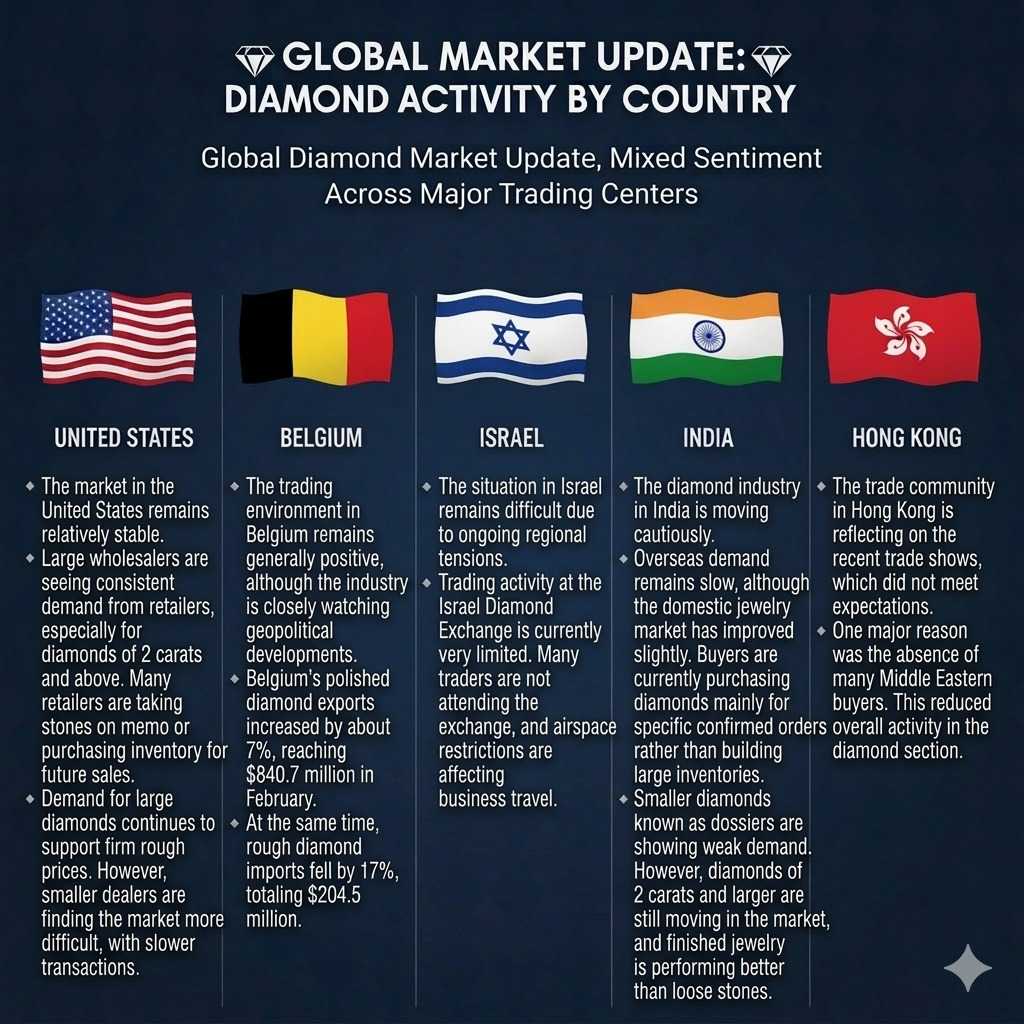
While the United States shows resilient demand for larger stones and Belgium reports a surge in polished exports, significant headwinds persist in Israel and India. Meanwhile, Hong Kong reflects a broader uncertainty following lackluster trade shows.
For industry stakeholders from wholesalers and retailers to investors understanding these regional nuances is critical. This detailed report breaks down the latest trends across major trading hubs and provides a forward-looking analysis of the diamond market.
United States:
The U.S. market remains the bedrock of the global diamond trade, and current indicators suggest a steady, if bifurcated, environment. Consumer spending, while showing signs of normalization post-pandemic, remains robust for high-ticket items.
The Polarization of Demand: A clear trend is emerging where demand is split between large-scale wholesalers and smaller dealers. Major wholesalers are reporting consistent orders from retailers. The sweet spot remains diamonds of 2 carats and above, which continue to see healthy movement.
This sustained demand for larger, high-quality goods is a primary factor keeping rough diamond prices firm. Many retailers are opting to take stones on memo (consignment) to avoid tying up capital in inventory, a practice that has become increasingly common in a high-interest-rate environment.
Challenges for Small Dealers: Conversely, the lower end of the market is feeling a squeeze. Smaller dealers and manufacturers are experiencing slower transactions and tighter margins. This indicates a "flight to quality," where liquidity is concentrated in the most desirable, larger categories.
The resilience of the U.S. consumer is a key theme. According to a recent economic report from the Federal Reserve, consumer spending has remained surprisingly resilient, which bodes well for the luxury sector heading into the latter half of the year.
Looking Ahead: The upcoming holiday season will be the ultimate test. If you are a seller looking to tap into this stable demand, particularly for larger stones, listing your inventory on a global platform is essential.
Sellers can register on the CaratX marketplace here to connect directly with vetted B2B and B2C buyers in the U.S. and beyond.
Belgium:
Antwerp, the historic diamond capital of the world, is currently sending mixed signals. While the trading environment remains generally positive, the industry is acutely aware of the geopolitical dominoes that could disrupt supply chains.
Export/Import Data Deep Dive: The latest figures from Belgium are telling. Polished diamond exports saw a healthy increase of 7%, reaching $840.7 million in February.
This suggests that Antwerp's cutting and polishing houses, as well as its traders, are successfully moving finished goods. However, a significant red flag is the 17% drop in rough diamond imports, which totaled just $204.5 million. This sharp decline is a direct consequence of the conflict affecting the Middle East.
The Dubai Factor: The Dubai Diamond Exchange (DDE) has cemented its role as a critical global trading hub for rough diamonds. The ongoing regional tensions have created concerns about the security and stability of rough supply routes passing through or originating near the conflict zone. This has made Antwerp's manufacturers cautious, as securing a consistent flow of rough goods is becoming more challenging.
The Strategic Response: In times of supply chain uncertainty, diversification is key. For buyers, this means looking for reliable sources of polished diamonds that are not dependent on volatile rough supply chains. You can shop a wide selection of natural diamonds on CaratX , sourced from stable, global inventories.
Israel:
The situation in Israel remains the most difficult of all major trading centers. The ongoing regional conflict has brought business activity at the Israel Diamond Exchange (IDE) to a near standstill.
Operational Hurdles: Trading activity is currently very limited. Many traders are physically unable or choose not to attend the exchange. Furthermore, airspace restrictions have severely impacted business travel, preventing international buyers from visiting and local traders from traveling to meet clients. This isolation has effectively put a large portion of the Israeli diamond sector on hold.
Impact on Global Supply: While Israel is a major player in the midstream segment (particularly in larger and more intricate stones), its current dormancy creates a supply gap. This could put additional upward pressure on prices for specific categories of high-quality, precision-cut diamonds that are a specialty of the Israeli industry.
India:
As the world's cutting and polishing center, India's mood is a direct reflection of retail demand in the West. Currently, that mood is one of cautious, calculated movement.
Demand Dynamics: Overseas demand remains slow, leading Indian manufacturers to adopt a "just-in-time" inventory strategy. They are primarily cutting stones against specific, confirmed orders rather than building large stockpiles of finished goods.
Market Segmentation:
Weak Segment: Smaller diamonds, often referred to as "dossiers" (melee goods), are showing very weak demand. This is a common lagging indicator, as these stones are often used in volume jewelry, which is more sensitive to economic downturns.
Healthy Segment: Consistent with the U.S. trend, diamonds of 2 carats and larger are still moving. Finished diamond jewelry is also performing better than loose stones, suggesting that consumers are looking for final, ready-to-wear pieces.
India's labor force is the backbone of the diamond industry. For a perspective on the skills and craftsmanship involved, the Gemological Institute of America (GIA) offers extensive resources on the journey from rough to polished.
Leveraging the Indian Market: For international sellers, India represents both a source of beautifully cut stones and a growing domestic consumer base. The slight improvement in the domestic jewelry market noted in the update is a positive sign.
Explore the CaratX gemstone marketplace to find unique pieces that cater to diverse tastes.
Hong Kong:
Hong Kong has long been the gateway to the Greater China diamond market. However, recent trade shows have failed to meet expectations, prompting a period of reflection for the trade community.
The Missing Middle Eastern Buyer: One of the primary reasons for the subdued activity was the noticeable absence of many Middle Eastern buyers. Their participation is crucial for generating liquidity and excitement in the diamond pavilions.
The regional instability mentioned in the Belgium and Israel sections is clearly having a ripple effect, dampening buying power and travel confidence in Asia as well.
A Silver Lining in Fancy Shapes: Despite the overall quiet, a specific niche remains vibrant. Elongated fancy shapes such as emerald cuts, radiants, and ovals in sizes of 2 carats and above continue to show healthy demand. This aligns with a global consumer trend towards unique, personalized shapes over the classic round brilliant.
For broader economic context on how luxury markets in Asia are performing post-pandemic, reports from institutions like the Harvard Business Review on consumer behavior in China offer valuable insights.
The Digital Shift: The Hong Kong situation underscores a critical point: relying solely on physical trade shows is risky. The future is omnichannel.
Discover CaratX's competitive pricing and seller plans to ensure your inventory is visible 24/7, regardless of geopolitical disruptions.
The Diamond Market Outlook: Key Trends to Watch
The "2-Carat and Above" Rule: This is the unifying theme across the U.S., India, and Hong Kong. Consumer preference, driven by changing tastes and the search for value, is firmly planted in the larger size category. This segment is likely to remain the most liquid.
Geopolitical Risk is the New Normal: The conflict in the Middle East is no longer a distant headline; it is a tangible disruptor of rough supply and buyer attendance. Supply chain diversification will be a top priority for manufacturers and dealers in 2024 and beyond.
The Memo and Just-in-Time Trend: High interest rates and economic uncertainty are forcing retailers to be lean. They are shifting inventory risk back up the supply chain through memo agreements and only ordering what they need. This puts pressure on dealers' cash flow but stabilizes the end market.
Digital Adoption is Accelerating: With physical trading disrupted in Israel and travel to shows like Hong Kong hampered, the digital marketplace is no longer an option but a necessity. Platforms that offer transparency, security, and global reach are becoming the primary venues for trade.
Conclusion:
The global diamond market is navigating a period of significant transition. While the foundation of consumer demand particularly for larger, premium stones remains solid in the U.S., the pathways to market are being reshaped by geopolitics and economic pressures. Success in this environment requires agility, a keen understanding of regional nuances, and a robust digital strategy.
CaratX is at the forefront of this transformation, providing a secure and efficient platform for sellers to reach buyers in 18+ international countries. Whether you are looking to move 2-carat+ inventory, source fancy-shaped gemstones, or simply diversify your sales channels, CaratX offers the tools and reach you need.
Start Selling Globally: Register as a seller on CaratX and tap into a world of B2B and B2C opportunities.
Build Your Inventory: Sell your jewelry internationally through our tailored seller plans designed for businesses of all sizes.
Find Your Next Best-Seller: Shop natural diamonds and gemstones at unbeatable prices from verified sellers around the globe.
Understand Our Value: Check our pricing and plans to see how CaratX can maximize your profitability.
Frequently Asked Questions (FAQ)
Q1: What is a "2-carat" diamond, and why is it so significant in the market? A "2-carat" diamond refers to a diamond weighing 2.00 carats. It is a significant psychological and financial milestone in the diamond industry. It represents a "premium" size that is often associated with major life milestones like engagements and anniversaries.
As the market update shows, this category enjoys the most consistent demand across the U.S., India, and Hong Kong because it sits at the intersection of luxury and aspirational value. Browse our collection of 2-carat+ diamonds here.
Q2: What does "ideal cut" mean, and why is it important? "Ideal cut" is a grading term used to describe a round brilliant diamond that has been proportioned and polished to the highest possible standards to maximize brilliance and fire. It means the diamond's facets are aligned perfectly to reflect light back out through the top of the stone.
GIA provides a comprehensive guide to diamond cut. An ideal cut diamond will always be more valuable and sought-after than a poorly cut stone of the same carat weight and clarity.
Q3: What is the difference between a natural diamond and a lab-grown diamond? Natural diamonds are formed by the earth over billions of years, making them rare and finite geological wonders. Lab-grown diamonds are man-made in a laboratory setting and have the same chemical and physical properties as natural diamonds.
The market update focuses primarily on the natural diamond trade, as the dynamics of supply (mining), geopolitics, and rarity are unique to this sector. Shop for certified natural diamonds on CaratX.
Q4: What is "memo" or "consignment" in the diamond trade? As mentioned in the U.S. section, "memo" is a business arrangement where a wholesaler or manufacturer (the consignor) provides diamonds to a retailer (the consignee) without immediate payment.
The retailer only pays for the diamonds once they are sold to the end consumer. Unsold diamonds are returned. This allows retailers to offer a wide selection without a massive upfront investment.