
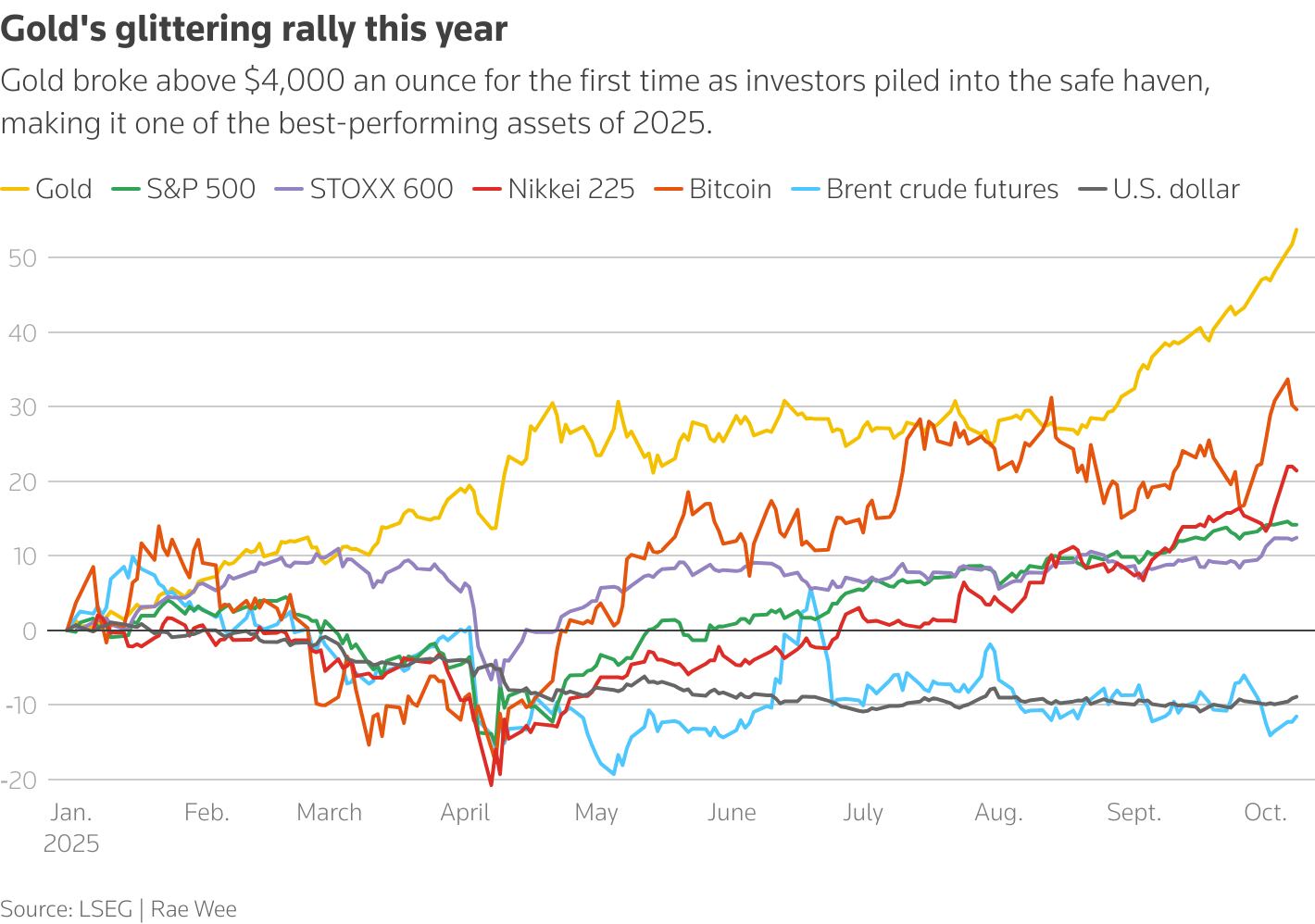
The year 2025 has been a historic chapter for precious metals. As the year draws to a close, gold has shattered records by soaring past $4,500 per ounce, while silver has staged an even more dramatic ascent, breaking above $70 per ounce. This isn't just a fleeting spike; gold is on track for its strongest annual gain since 1979, up approximately 70%, while silver has vastly outpaced it with gains exceeding 140% year-to-date.
This deep dive analyzes the complex market dynamics, separates narrative from data, and provides a clear-eyed outlook for the year ahead, offering practical guidance for navigating this golden era.
The 2025 Rally in Context:
The scale of the 2025 rally is monumental. Gold, often seen as a stable store of value, has demonstrated explosive growth, reaching an all-time high of $4,525.03 per ounce in December 2025. Silver's performance has been nothing short of spectacular, with its price more than doubling over the course of the year.
This surge is underpinned by a convergence of macroeconomic, geopolitical, and structural factors that have created a perfect storm for precious metals.
Key Drivers of the 2025 Precious Metals Boom -
Monetary Policy & Interest Rate Cuts
Impact on Gold: Lower interest rates reduce the opportunity cost of holding non-yielding assets like gold and weaken the U.S. dollar, supporting higher prices.
Impact on Silver: The same macro dynamics apply, but the effect is amplified due to silver’s higher price volatility.
Supporting Data: Markets are pricing in U.S. Federal Reserve rate cuts for 2026. The Fed Funds Rate stood at 3.75% as of December 2025.
Central Bank Demand -
Impact on Gold: Sustained large-scale central bank buying establishes a strong price floor and signals long-term confidence in gold as a reserve asset.
Impact on Silver: Some central banks, including Russia and India, have begun adding silver to their reserves, though at smaller scale.
Supporting Data: Central banks purchased over 1,000 tonnes of gold annually for three consecutive years.
Geopolitical Tensions -
Impact on Gold: Significant safe-haven inflows during periods of geopolitical uncertainty, such as regional conflicts or global power tensions.
Impact on Silver: Also benefits from safe-haven demand, though less directly and consistently than gold.
Supporting Data: Geopolitical risk has been cited as a primary driver behind gold’s rise toward $4,500.
Industrial & Green Energy Demand -
Impact on Gold: Limited direct influence, as only around 10% of total gold demand is industrial.
Impact on Silver: The primary long-term growth driver. Industrial demand from solar energy, electric vehicles, and electronics now exceeds 50% of total silver usage.
Supporting Data: Solar demand alone could exceed 300 million ounces annually by 2030. Electric vehicles use approximately 25–50 grams of silver per vehicle.
Supply Constraints -
Impact on Gold: Mine supply responds slowly to price changes due to long development timelines.
Impact on Silver: Structural supply limitations are more severe. Approximately 70% of silver production is a by-product of mining other metals, restricting rapid supply expansion.
Supporting Data: By-product dependence prevents quick supply responses even during periods of rising demand.
Gold in 2025:
Gold's journey to $4,500+ per ounce has been fueled by classic and new-age demand drivers working in unison.
The Dual Engine of Demand:
The third quarter of 2025 demonstrated extraordinary demand, with investors and central banks together acquiring approximately 980 tonnes of gold over 50% higher than the average of the previous four quarters. In dollar terms, this translated to a staggering $109 billion of quarterly demand inflow.
Central Banks as Structural Buyers: This institution-led buying is not speculative. It represents a strategic diversification away from the U.S. dollar. Globally, gold's share of official reserves has risen to nearly 20%, up from about 15% at the end of 2023. Analysts at J.P. Morgan note that if central banks with less than a 10% gold allocation moved to that level, it could require 2,600 tonnes of additional purchasing.
The Retail and Institutional Investor Revival: Alongside central banks, investor demand has roared back. Holdings in gold-backed ETFs, bars, and coins have swelled, with gold now representing about 2.8% of total global investor assets under management a significant increase from recent years. For those looking to own a piece of this timeless asset, exploring physical gold bullion offers direct exposure to this enduring value.
The Macroeconomic Backdrop: Rates, Dollar, and Debts
The expectation of a continued Federal Reserve easing cycle in 2026 is a powerful tailwind. Lower U.S. interest rates make gold, which pays no yield, more attractive relative to bonds. They also typically pressure the U.S. dollar, making gold cheaper for foreign buyers.
Furthermore, concerns over ballooning government debt and questions about central bank independence have revived the "debasement trade," where investors seek hard assets as a hedge against currency erosion.
Silver in 2025:
While gold's rally has captured headlines, silver's explosion has been the year's standout financial story. Its 140-150% year-to-date gain significantly outpaces gold's, highlighting its unique and powerful dual identity as both a monetary and an industrial metal.
The Industrial Supercycle:
This is the defining difference for silver in the 2020s. Over half of all silver demand now comes from industrial applications, making it a critical commodity for the global energy transition.
Solar Power: Silver paste is essential for conductivity in photovoltaic cells. Demand from this sector alone jumped over 25% in 2024 and is projected to continue climbing sharply.
Electric Vehicles: An average EV contains 25-50 grams of silver, compared to 15-28 grams in a conventional car. Future solid-state batteries could use a kilogram or more per vehicle.
5G, AI, and Electronics: Silver's unmatched electrical conductivity makes it irreplaceable in semiconductors, switches, and advanced computing components.
This structural demand surge collides with a persistent supply deficit. The Silver Institute projects a 2025 deficit of 115-120 million ounces, the fifth in a row. Because most silver is mined as a by-product of copper, zinc, and lead, supply cannot quickly respond to price signals, creating a fundamentally tight market.
For those interested in this versatile metal, whether for investment or creation, our curated selection of silver bullion and materials connects you directly to this market.
Investment Demand Catches Fire -
Recognizing this powerful narrative, capital has flooded in. By mid-2025, 95 million ounces of silver had flowed into ETFs globally, already surpassing total 2024 inflows. Total ETF holdings now stand at about 1.13 billion ounces, valued at over $40 billion. This investment demand physically removes metal from the market, exacerbating the supply crunch.
The resulting strain was evident in late 2025, when a physical squeeze in London vaults caused borrowing costs to spike to 200% on an annualized basis.
2026 Outlook: Forecasts, Diverging Views, and Key Risks
As we look ahead, the consensus among major institutions is broadly bullish, though forecasts vary in degree and timing.
Gold Price Forecasts for 2026-2027
J.P. Morgan Global Research: Maintains one of the most bullish stances, forecasting gold to push toward $5,000/oz by Q4 2026 and average $5,055/oz in that quarter. Their longer-term view sees prices rising toward $5,400/oz by the end of 2027.
Trading Economics Models: Based on global macro models, they estimate gold could trade around $4,614.58 within the next 12 months.
Contrarian View - Capital Economics: Strikes a note of caution, predicting the speculative boom could end, pulling gold down to $3,500 by the end of 2026.
Silver Price Forecasts for 2026-2030 -
Near-Term (2026): Analysts see continued strength. UBS projects a rise to $55/oz by mid-2026, while Bank of America sees potential for approximately $65/oz. Some experts believe a break above $75/oz is plausible in 2026 or 2027.
Long-Term (2030): Forecasts become wider. InvestingHaven targets $77-82/oz by 2030, while more aggressive scenarios from firms like LiteFinance discuss the potential for $133-$143/oz and even $200+ in the most bullish cases, driven by an accelerating industrial deficit.
Will Silver Outpace Gold Again in 2026 -
This is the million-dollar question. Over 50% of retail traders polled by Kitco believe silver will be the top-performing metal again in 2026. The logic is sound: if the bullish macro factors for precious metals persist (lower rates, geopolitical risk) and industrial demand remains robust, silver's smaller, tighter market could indeed see greater percentage gains.
However, experts caution that silver's higher volatility is a double-edged sword; it falls harder than gold during economic recessions or risk-off market events.
Practical Guidance for Investors and Collectors
Navigating this market requires strategy, not speculation.
Understand Your Objectives:
Capital Preservation & Safe Haven: Gold is typically the steadier choice. Its deep market and historical role as a crisis hedge make it a cornerstone for conservative portfolios.
Growth & Volatility Acceptance: Silver offers greater potential upside (and downside). It suits investors who believe strongly in the green energy/tech thesis and can tolerate significant price swings.
Consider Strategic Allocation: Financial consultants commonly recommend precious metals constitute no more than 5-10% of a diversified portfolio. Within that allocation, a mix of gold and silver can balance stability and growth potential.
Choose Your Method of Exposure:
Physical Ownership (Bullion, Coins): Offers direct ownership with no counterparty risk. Ideal for long-term holders. Explore options like gold and silver bullion for pure metal exposure.
Jewelry as Wearable Asset: For many, precious metals are not just an investment but an expression of culture and artistry. Beautifully crafted gold and silver jewelry from our marketplace allows you to own tangible assets that carry personal and aesthetic value.
Conclusion:
The 2025 rally is not an anomaly but a reflection of a world in transition. Gold is being revalued as central banks and investors seek anchors in a shifting monetary landscape. Silver is being rediscovered as an indispensable industrial metal powering our future.
While short-term corrections are always possible and even likely given the steep climbs the long-term fundamental drivers appear intact. For those looking to diversify, protect wealth, or gain exposure to critical commodities, understanding the distinct stories of gold and silver has never been more important. The trends that defined 2025 diversification, decarbonization, and demand are set to shape the precious metals narrative well into 2026 and beyond.
Sources and Citations -
This analysis was compiled from authoritative financial data, institutional research, and industry reports.
Gold Market Data & Analysis: Trading Economics, J.P. Morgan Global Research, World Gold Council (via secondary reporting).
Silver Market Data & Analysis: The Silver Institute (via secondary reporting in), Kitco News, CNBC.
Explore the world of precious metals, from investment bars to exquisite finished pieces, through our global marketplace at CaratX.
Whether you are a buyer seeking value or a seller looking to reach an international audience, CaratX connects you to the market.
Explore gemstones
Image Credit - Reuters