
Introduction:
In the fascinating world of colored gemstones, few topics generate as much discussion as the distinction between Rubellite and Pink Tourmaline. Are they the same gem? Is one merely a superior version of the other? The answer lies at the intersection of rigorous mineral science and centuries of jewelry trade tradition. While a chemist might classify them under the same complex mineral group, a gemologist or a seasoned jeweler applies nuanced criteria that dramatically affect perception, desire, and value.
This guide delves deep into the scientific composition, gemological standards, and market realities that separate the exceptional Rubellite from the broader category of Pink Tourmaline, empowering you to make informed decisions whether you are a collector, a jeweler, or an admirer of natural beauty.
The Scientific Foundation – Understanding Tourmaline
To appreciate the rubellite distinction, one must first understand the remarkable mineral it comes from.
A Complex Mineral Family -
Tourmaline is not a single mineral but a complex group of related silicate minerals sharing a similar crystal structure but varying dramatically in chemical composition. This diversity is the reason tourmaline occurs in virtually every color of the rainbow. The gemological and jewelry trade recognizes several key species within this group, primarily defined by their chemical makeup:
Elbaite: The most common source of gem-quality tourmaline in a vast array of colors, including pinks, reds, greens, and blues. It is rich in lithium, sodium, and aluminum.
Liddicoatite: Chemically similar to elbaite but rich in calcium. It is known for spectacular and complex color zoning and is named after Richard T. Liddicoat, the "Father of Modern Gemology".
Dravite & Uvite: Typically brownish to yellow varieties, formed in magnesium-rich environments.
Schorl: The most common tourmaline species in nature, but rarely used as a gem. It is opaque black due to high iron content.
Most pink and red tourmalines, including rubellite, belong to the elbaite or liddicoatite species.
The Origin of Color:
The captivating pink-to-red hues in tourmaline are primarily caused by the presence of manganese (Mn³⁺). An intriguing geological process often finalizes this color. Research suggests that when crystals first form, they may contain manganese in a different state (Mn²⁺), resulting in pale or colorless stones. Over millions of years, natural gamma radiation from surrounding rocks can change this manganese to the Mn³⁺ state, gradually building the rich pink or red color.
This same process can be replicated in a laboratory to enhance the color of pale stones, a common and generally accepted treatment in the industry.
The Core Distinction – Pink Tourmaline vs. Rubellite
Here is where science meets the art of the gem trade. All rubellites are pink-to-red tourmalines, but not all pink-to-red tourmalines qualify as rubellite.
The Defining Criteria
The trade name "Rubellite" is reserved for stones that meet higher, more specific standards. The key differentiators are color saturation, hue, and stability.
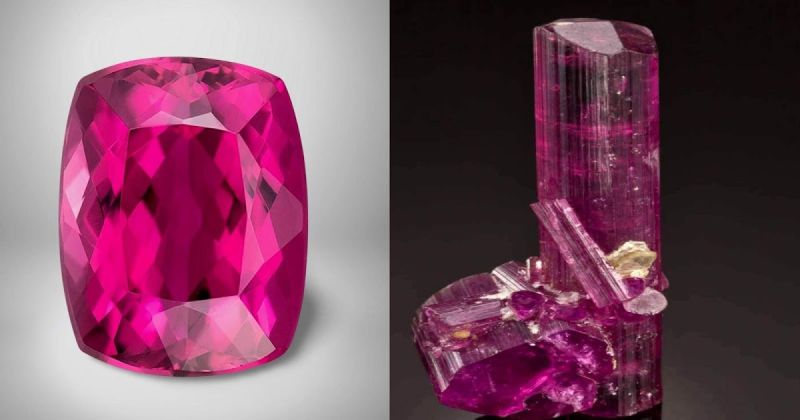
Color Saturation and Hue: While "pink tourmaline" encompasses a wide range of light to medium pink shades, Rubellite denotes a strong, vivid, saturated color. It ranges from purplish-pink and hot pink to raspberry red and true crimson. The most valued rubellites exhibit a pure, vibrant red or rich pink with no modifying brown or gray tones.
Color Stability (The Litmus Test): This is the most critical practical rule used by gemologists. A true rubellite must retain its appealing pink or red color under all light sources bright daylight, fluorescent office lighting, and warm incandescent or candlelight. Many pink tourmalines will show a noticeable color shift, turning browner or duller under warm indoor light. If a stone shows this undesirable shift, it is typically marketed as "pink tourmaline" rather than rubellite.
Pink Tourmaline vs. Rubellite: Key Differences Explained
1. Definition
Pink Tourmaline: A broad color variety within the tourmaline mineral group.
Rubellite: A premium trade term reserved for high-quality pink-to-red tourmaline.
2. Color Range
Pink Tourmaline: Light to medium pink tones, often with brownish or grayish modifiers.
Rubellite: Strong, vivid, and saturated hues ranging from purplish-pink and hot pink to raspberry red and crimson.
3. Key Gemological Rule
Pink Tourmaline: Color may shift or appear brown under different lighting conditions.
Rubellite: Color must remain stable and visually appealing in both daylight and incandescent light.
4. Typical Value
Pink Tourmaline: Generally more accessible and more affordable.
Rubellite: Commands a significant price premium due to stricter color requirements and greater rarity.
5. Analogy
Pink Tourmaline: Comparable to the broad category of “red wine.”
Rubellite: Comparable to a specific, top-tier classification such as “Grand Cru Burgundy.”
For a stunning example of gemstones that meet these high standards, explore our curated collection at CaratX.
A Historical Case of Mistaken Identity
The allure of rubellite's red hue is so powerful that it has fooled royalty. Historically, red tourmalines were often mistaken for rubies. The most famous example is the "Caesar's Ruby" pendant (255.75 carats) in the Russian Imperial Crown Jewels, which was later confirmed to be rubellite. This historical confusion underscores the depth and richness of color that the finest rubellites can achieve.
Practical Considerations for Buyers and Jewelers
Understanding the quality factors and care requirements is essential for anyone dealing with these gems.
Evaluating Quality: Beyond the 4Cs
Like diamonds, tourmalines are evaluated on criteria often summarized as the 4Cs, but with color being paramount.
Color: As established, this is the primary value factor. Look for vivid saturation, a pleasing hue (pure red or pink is most valued), and stability under multiple lights.
Clarity: Tourmaline commonly contains inclusions. Rubellite is graded as a Type III gemstone, meaning eye-visible inclusions are expected and often tolerated, especially if the color is exceptional. An eye-clean rubellite with superb color is exceptionally rare and valuable. Common inclusions include thread-like liquid cavities or thin hollow tubes.
Cut: Cutters often fashion tourmaline into long rectangles or ovals to preserve weight from the naturally elongated crystals. A skilled cutter will orient the stone to optimize its color, as tourmaline is strongly pleochroic (showing different colors from different angles).
Carat Weight: Fine-quality rubellite is rare in sizes above 5-10 carats. As with most gems, the price per carat increases significantly for larger stones of excellent quality.
Treatments and Enhancements -
It is important to be aware that many pink and red tourmalines on the market have been treated. Irradiation is frequently used to improve or create pink/red colors from paler material, and this treatment is generally stable and accepted. Reputable sellers should always disclose such treatments.
Care and Maintenance
With a hardness of 7 to 7.5 on the Mohs scale, tourmaline is suitable for everyday jewelry like rings, but care should be taken to avoid hard knocks.
Cleaning: Use warm soapy water and a soft brush. Avoid steam and ultrasonic cleaners, as heat and vibration can damage inclusions or fractures in the stone.
Storage: Store separately to prevent scratches from harder gems.
Market Perspective and Value
The distinction between pink tourmaline and rubellite has a direct and tangible impact on the market.
Rubellite, by its stricter definition, is rarer than general pink tourmaline. This rarity, combined with its more desirable visual properties, translates to a higher price point. Market data shows that for commercial-grade stones, rubellite consistently commands a premium. The value of all tourmalines, however, is also influenced by supply, demand, and origin. For instance, the discovery of vivid Paraiba tourmaline (colored by copper) in the 1980s created an entirely new high-value market segment within the tourmaline family.
When sourcing fine gemstones for your inventory or collection, partnering with a reliable platform is key. Consider registering as a seller on the CaratX marketplace to access a global network of buyers.
Conclusion
The journey from a pink tourmaline to a Rubellite is a journey towards color perfection. It is a designation earned through saturated hue, tonal purity, and the steadfast ability to glow with the same passion under a midday sun as it does by candlelight. This distinction, rooted in both gemological science and trade practice, is what makes Rubellite a special and coveted variety within the already extraordinary tourmaline family. Whether you are making a purchase or adding to your inventory, understanding this difference is the key to recognizing true quality and value.
Explore the new era of diamond jewelry with confidence.
Discover our curated collections of Premium Lab-Grown Diamonds for exceptional quality and value.
Explore the timeless beauty of our Natural Diamond Selection.
For jewelers and retailers looking to capitalize on this stabilized market, learn about our B2B Marketplace Solutions to access a global network of buyers.
Frequently Asked Questions (FAQs)
Q1: Can a gemological lab certify if my stone is a rubellite? While labs like the GIA will identify the stone as "tourmaline" and note its color, the term "rubellite" is a trade designation, not a scientific one. A lab report will provide the objective data (color description, measurements), but the final classification often relies on trade norms and the expert assessment of a qualified gemologist.
Q2: Where are the best rubellites found? Historically, Brazil has been a premier source for fine pink and red tourmaline. Other significant sources include Nigeria, Mozambique, Madagascar, and Namibia. The origin can influence market perception and value, though color quality remains the primary driver.
Q3: How does rubellite compare to ruby in terms of value? Ruby (a variety of corundum) is one of the traditional "precious gemstones" and, especially in fine qualities, is vastly more expensive than rubellite. Rubellite serves as a more affordable yet strikingly beautiful alternative with its own unique appeal.
Q4: Is rubellite a birthstone? Yes. Tourmaline is the modern birthstone for October. Rubellite, as a pink-to-red variety, is a perfect, colorful option for October birthdays.
Q5: Where can I learn more about pricing and sourcing different gemstones? For detailed insights into gemstone values and market dynamics, you can review our comprehensive pricing and product launch information at CaratX.
Sources and Citations
This article was synthesized from authoritative gemological institutions, academic resources, and trusted trade publications.
Gemological Institute of America (GIA). Tourmaline Description & Quality Factors.
International Gem Society (IGS) . Tourmaline: Rubellite and Indicolite.
Gem-A (The Gemmological Association of Great Britain). Buying Guide: Types of Tourmaline.
Wikipedia. Tourmaline (for mineralogical and chemical data).
Image Credit - Geology In