
Introduction: A Phenomenon Rarer Than Ball Lightning
There are few things on Earth so rare that scientists lack the ability to study them properly. Take ball lightning as an example spherical, exploding balls of electricity so infrequent that researchers cannot fully understand the phenomenon. The same can be said for red diamonds.
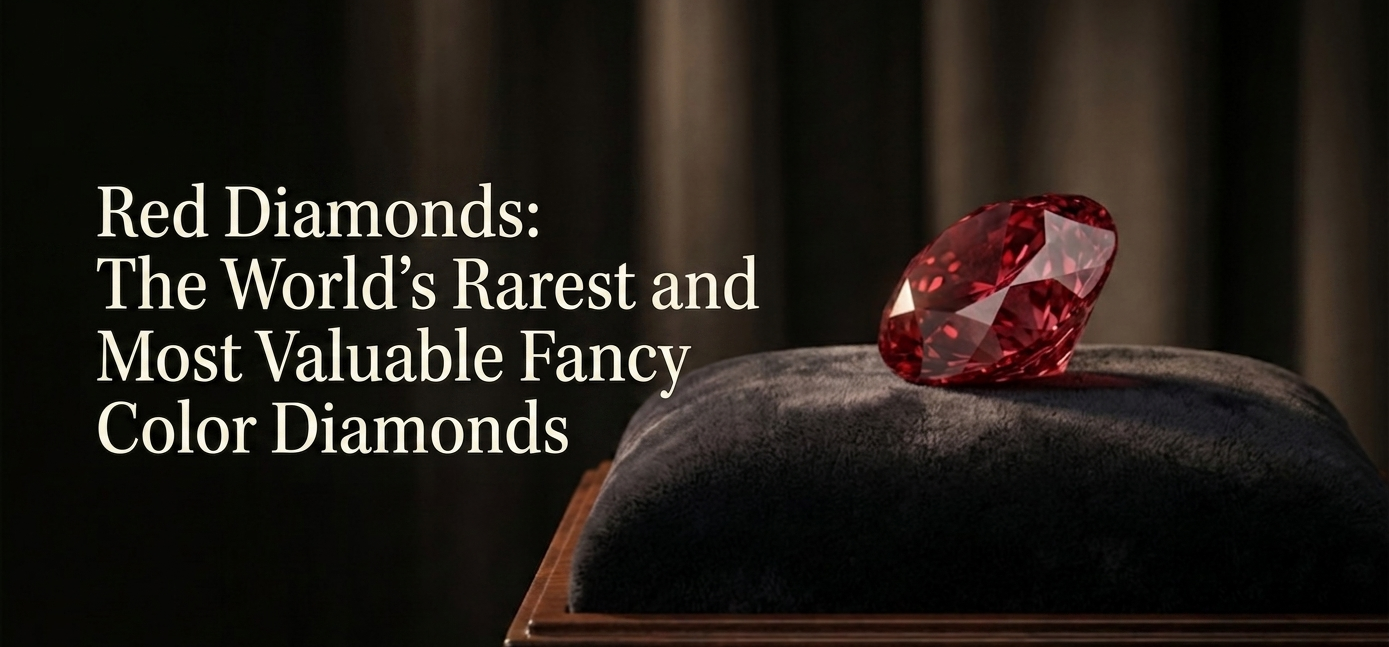
While natural diamonds as a whole are among the rarest substances on the planet, red diamonds sit at the very peak of scarcity. They are so elusive that fewer than thirty true red natural diamonds are known to exist in the entire world.
The Statistical Rarity of Fancy Color Diamonds -
According to the Gemological Institute of America (GIA), only 0.4% of all natural diamonds graded in the last twenty years have been fancy colors. When you break down that microscopic percentage, red is the rarest color among all fancy color diamonds.
Total known true red diamonds: Less than 30
Largest red diamond in existence: Only 5.11 carats (The Moussaieff Red)
Available intensity level: Only "Fancy Red" (no light, intense, or vivid variations)
Grant Mobley, Jewelry & Watch Editor of Only Natural Diamonds, a GIA Diamonds Graduate with over 17 years of experience, notes: "Among all those fancy color diamonds, red is the rarest color."
How Red Diamonds Get Their Color (No Trace Elements)
Unlike blue diamonds (caused by boron) or green diamonds (caused by natural radiation), red diamonds are not caused by foreign elements. Instead, scientists believe they result from an extreme version of crystal lattice distortion.
The Argyle Legacy – Where Red Diamonds Came From
Australia’s Diamond Mining Marvel -
For nearly four decades, one name dominated the world of pink and red diamonds: Argyle. Located in the remote East Kimberley region of Western Australia, approximately 2,200 kilometers (1,400 miles) northeast of Perth, the Argyle diamond mine was unlike any other diamond deposit on Earth.
Discovered in 1979 after systematic exploration that began in 1969, Argyle began production in 1985 and quickly became one of the world’s largest diamond mines by volume. Over its 37-year operational lifetime, Argyle produced more than 865 million carats of rough diamonds.At its peak in 1994, the mine produced an astonishing 42 million carats in a single year.
The Global Source for Pink and Red Diamonds -
While the vast majority of Argyle’s output was lower-value goods champagne and cognac diamonds that found their way into more accessible jewelry the mine’s true fame rested on one remarkable characteristic: Argyle produced over 90% of the world’s pink and red diamonds. In fact, some estimates place this figure as high as 95%.
The Argyle Tender:
Each year, Rio Tinto (Argyle’s owner) selected the finest pink and red diamonds from the mine’s production for the Argyle Diamond Tender, an exclusive, invitation-only event where the world’s wealthiest collectors and jewelry houses competed for the privilege of purchasing these stones.
Over 30 years of tenders, more than one thousand pink diamonds were offered but true red diamonds appeared only a handful of times. Among the most legendary stones to emerge from these tenders were:
The Argyle Phoenix (1.56 ct Fancy Red)
The Argyle Dauphine (2.51 ct Fancy Deep Pink radiant cut, the highest overall price paid for an Argyle diamond)
The Argyle Muse (various exceptional pinks and reds)
The Science of Lattice Distortion -
Deep within the Earth, up to three billion years ago, extreme heat and pressure applied from every direction after the diamond formed alters the position of carbon atoms. This distortion causes the diamond to reflect pink light and in the most extreme cases red light.
However, because the phenomenon is so rare, scientists cannot study it enough to fully understand the process. These conditions often destroy potential red diamonds, making their survival a geological miracle.
The Numbers Behind the Rarity, How Rare Are Red Diamonds ?
Red diamonds are considered the rarest diamonds on Earth. While the global diamond industry produces nearly 130 to 150 million carats of diamonds every year, true natural red diamonds exist only in extremely small numbers. Experts estimate that fewer than 30 known red diamonds exist worldwide today, making them rarer than almost any other gemstone category.
To understand their rarity better, fancy color diamonds themselves represent only a tiny fraction of total diamond production, usually between 0.01% and 0.4%. Within that already rare category, red diamonds account for only about 0.07% of all fancy color diamonds graded by the Gemological Institute of America (GIA). Even more astonishing, only around two dozen pure red diamonds above one carat are publicly known.
Their rarity is not limited to quantity alone. Most red diamonds discovered are extremely small in size, with the majority weighing less than one carat and many under half a carat. Finding a red diamond above one carat is exceptionally uncommon, while stones above five carats are considered almost legendary.
For comparison, colorless diamonds have been discovered in sizes exceeding 3,000 carats, and other fancy color diamonds occasionally appear at over 100 carats. Yet the largest red diamond ever discovered weighs only 5.11 carats, highlighting just how extraordinarily rare these gemstones truly are.
The 2020 Closure: A Seismic Shift in the Diamond Market
On November 3, 2020, mining operations at Argyle officially ceased.The closure was driven by simple economics: the mine had exhausted its economically viable reserves after nearly forty years of continuous production. But the impact on the diamond market was profound and lasting.
With Argyle’s closure, the primary source of new pink and red diamonds entering the global market vanished virtually overnight. While a few red diamonds are occasionally discovered elsewhere primarily in Brazil, South Africa, and historically in India the volume is negligible compared to what Argyle once produced.
The result, as predicted by industry experts, has been a sustained increase in the value of existing pink and red diamonds, particularly those with Argyle provenance. According to the 2025 Knight Frank Wealth Report, colored diamond values increased by 4.8% over the five years ending in Q3 2024, even as the broader diamond market faced turbulence.
To explore the current market for natural and fancy color diamonds, visit CaratX Marketplace where you can browse certified natural diamonds, gemstones, and jewelry from sellers across 18+ international markets. Sellers can register here to reach B2B and B2C buyers worldwide.
The Moussaieff Red Diamond:
The largest fancy red diamond ever recorded is The Moussaieff Red.
Weight: 5.11 carats (triangular brilliant cut)
Rough form: 13.90 carats
Origin: Discovered in the 1990s in the Minas Gerais region of Brazil (a source of natural color diamonds for hundreds of years)
Cutter: Legendary diamond cutter William Goldberg
Current Owner: London jeweler Shlomo Moussaieff
Sale History: In 2001, Goldberg sold the stone to Shlomo Moussaieff for a reported $8 million considered a bargain given its priceless nature today.
Understanding Red Diamond Color Grading -
Unlike other fancy colors that come in multiple intensities (fancy light, fancy intense, fancy vivid), red diamonds only come in one intensity level: Fancy Red.
Secondary Hues & The "No Red Secondary" Rule
Possible secondary hues: Purplish, brownish, and orangey (e.g., 'Fancy Purplish Red' or 'Fancy Orangey Red')
Crucial rule: Red cannot be a secondary color. You will never find a "reddish" blue diamond; red is always the dominant modifier.
The $1 Million Per Carat Club
Because so few exist, red diamonds command astronomical prices. They are most often purchased by investors due to their continuously rising value.
2022 Heritage Auctions Sale: A 1.21 carat fancy orangy red diamond sold for over $1.2 million per carat.
2024 Phillips Geneva Auction (The Argyle Phoenix): Sold for **4.2million∗∗ (approx4.2million∗∗(approx2.68 million per carat).
Famous Red Diamonds You Need to Know -
1. The De Young Red -
Weight: 5.03 carats (round brilliant cut)
Rank: Third-largest red diamond in existence
Location: Permanent collection of the Smithsonian Museum in Washington, D.C.
Note: Available for public viewing, a must-see on your D.C. itinerary.
2. The Winston Red Diamond -
Weight: 5.05 carats (among the largest Fancy Red diamonds)
Donor: Ronald Winston (1988)
Significance: Notable for its relatively pure red appearance (few secondary brown or purple modifiers). It serves as a crucial research reference for scientists.
3. The Hancock Red Diamond -
Weight: Just 0.95 carats
1987 Auction Price: Over $880,000
Legacy: Proved that rarity outweighs size. It established Fancy Red as the most valuable diamond color category on a per-carat basis.
4. The Argyle Phoenix (Record Breaker)
Weight: 1.56 carats (largest known round brilliant cut natural fancy red diamond)
Origin: Argyle mine, Australia
Buyer: Laurence Graff (founder of Graff Diamonds)
Sale Date: May 2024, Phillips Geneva
Price: 4.2million (approx4.2million (approx2.68 million per carat)
5. The Argyle Everglow
Weight: Just over 2 carats
Grade: Fancy Red
Significance: One of the final red diamonds to emerge from the closed Argyle mine. Its discovery during the mine's final years added emotional weight to its historic importance.
6. The Rising Sun and The Setting Sun -
Fourteen years ago, collector Mr. Kushal Sacheti accomplished the impossible: he matched two red-hued diamonds.
The Rising Sun: 1.49 carats (round brilliant)
The Setting Sun: 1.52 carats (round brilliant)
Believed to be: The largest matched pair of diamonds with red color to exist.
Gemologist Tom Gelb explains: "To have a matched pair like this beggars belief and seems almost impossibly lucky."
Regarding the orange/red color cause, Gelb adds: "One is due to nitrogen atoms replacing carbon atoms, and the other is still unknown. There are simply not enough of these diamonds available to study."
Where to See a Red Diamond in Person
While most of us may never own one, you can view two of the largest specimens for free:
The De Young Red (5.03 cts) – Smithsonian National Museum of Natural History, Washington, D.C.
The Winston Red (5.05 cts) – Smithsonian National Museum of Natural History
How CaratX Can Help You Access the Diamond Market
At CaratX, we are transforming the way diamonds, gemstones, and jewelry are bought and sold globally. Our technology-driven platform connects sellers with B2B and B2C buyers across 18+ international countries, offering:
Access to thousands of unique jewelry pieces, loose diamonds, gemstones, and pearls.
Sustainably and ethically sourced materials from mine to market.
Competitive pricing through reduced marketplace friction.
Comprehensive certification and quality verification.
For Sellers
If you are a diamond, gemstone, jewelry, or pearl seller looking to expand your global reach, register now on the CaratX marketplace:
Sellers registration portal – Start selling to B2B and B2C buyers in 18+ international countries
CaratX seller plans – Sell jewelry internationally to buyers through our platform
Pricing information – Details about listing fees and seller plans
For Buyers
Looking to purchase natural diamonds, colored gemstones, or finished jewelry? Shop at CaratX for:
Natural diamonds – Certified, ethically sourced, globally competitive prices
Gemstones – Unbeatable prices across our marketplace
Browse fancy colored diamonds – Including pink, blue, yellow, and other rare colors
Follow CaratX for more insightful and educational content on the diamond and gemstone industry.
Frequently Asked Questions (FAQs)
Q1: How rare are red diamonds compared to other diamonds?
Red diamonds are the rarest of all fancy color diamonds. Experts estimate that fewer than 30 true natural red diamonds exist worldwide. For comparison, the GIA reports that only 0.07% of all fancy color diamonds it examines are red. Out of more than one million colored diamonds analyzed by GIA, only 0.07% were red, and just over half received the “Fancy Red” grade.
Q2: What causes a diamond to be red?
Unlike most colored diamonds that derive their color from chemical impurities (nitrogen for yellow, boron for blue), red diamonds get their color from plastic deformation—a distortion of the diamond’s crystal lattice structure caused by extreme heat and pressure deep within the Earth after the diamond has formed. This process alters how light is absorbed and reflected, producing the red hue.
Q3: Where are red diamonds found?
Historically, red diamonds have been found in Australia (primarily the Argyle mine, now closed), Brazil, South Africa, and India. The largest known red diamond, the Moussaieff Red (5.11 carats), was discovered in Brazil. The second-largest, the Kazanjian Red (5.05 carats), was found in South Africa. Since the closure of the Argyle mine in 2020, no significant new source of red diamonds has been discovered.
Q4: What is the largest known red diamond?
The largest known red diamond is the Moussaieff Red Diamond, weighing 5.11 carats. It is a triangular brilliant cut (trilliant cut) diamond with an Internally Flawless (IF) clarity grade. Discovered in Brazil in the 1990s, it was sold to jeweler Shlomo Moussaieff in 2001 for $8 million and remains the largest fancy red diamond ever graded by GIA.
Q5: How are red diamonds certified and graded?
The Gemological Institute of America (GIA) is the world’s leading authority for colored diamond grading. Red diamonds receive a single designation “Fancy Red” unlike the nine-point scale used for other colors. GIA provides two types of certificates: a comprehensive Grading Report (including color origin, color grade, clarity, cut, and carat weight) and an Identification and Origin Report (focused on color origin and grade).
Q6: Why did the Argyle mine closing matter for red diamonds?
The Argyle mine in Western Australia produced over 90% of the world’s pink and red diamonds. When it closed on November 3, 2020, the primary source of new red diamonds entering the market vanished. Since closure, no other mine has emerged as a significant alternative source, making existing red diamonds even more rare and valuable.
Conclusion: Nature’s Rarest Masterpiece
Red diamonds represent the convergence of extreme geology, molecular perfection, and statistical impossibility. From the lattice distortion deep within the Earth to the auction rooms of Geneva and New York, they remain the holy grail of gem collecting.
Whether it is the record-breaking Argyle Phoenix, the historically significant Hancock Red, or the serendipitous pairing of The Rising Sun and Setting Sun, these gems remind us that the most beautiful things in nature are often the hardest to find.
Key Takeaway: If you ever encounter a verified Fancy Red diamond, you are looking at one of less than thirty ever verified by science. That is rarer than luck, it is a miracle.