
Fancy Color Diamond Market 2026: Rare Stones Continue to Hold Strong Value
Home
News And Media Fancy Color Diamond Market 2026: Rare Stones Continue to Hold Strong Value SHOP NOWHome
News And Media Fancy Color Diamond Market 2026: Rare Stones Continue to Hold Strong Value SHOP NOWMay, 27, 2026 by Archit Mohanty 0 Comments
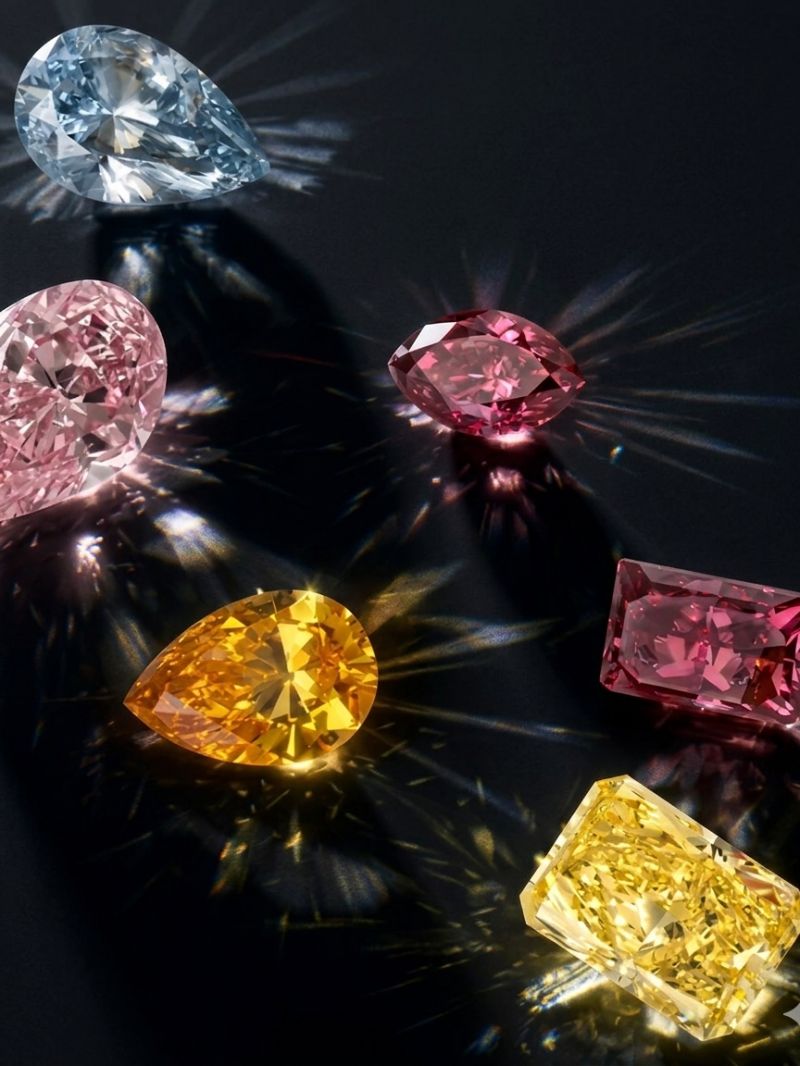
The fancy color diamond market remains one of the most resilient and intriguing segments of the luxury asset class. As we progress through 2026, data from the Fancy Color Research Foundation (FCRF) confirms that while broad-market corrections have occurred, the fundamental drivers of rarity, color saturation, and long-term value preservation continue to underpin the sector’s strength.
This analysis explores the current state of the market, the exceptional performance of premium stones, and why sophisticated collectors and institutional investors continue to allocate capital to these billion-year-old natural marvels.
The overall fancy color diamond market in Q1 2026 presented a picture of controlled moderation. The FCRF’s Fancy Color Diamond Index (FCDI) declined by approximately 0.9% year-on-year, with a sequential dip of just 0.2% from the previous quarter. This marginal contraction, rather than signaling weakness, indicates a market that is undergoing a “selective stabilization.”
In essence, the broad commercial-grade categories are seeing price adjustments, while the apex of the pyramid stones characterized by intense or vivid color saturation and significant carat weight continues to command premium valuations. This bifurcation is a hallmark of a maturing alternative asset class, where true rarity drives lasting value.
As the most abundant of the fancy colors, yellow diamonds are often seen as the entry point into colored diamond investment. The FCRF data reveals that the yellow diamond category recorded the most significant yearly decline, falling approximately 1.2% overall.
However, a granular analysis reveals a different story for investment-grade stones. The same report highlights that specific high-saturation yellow diamonds actually appreciated during this period:
1 Carat Fancy Intense Yellow: +1.9%
5 Carat Fancy Vivid Yellow: +1.8%
10 Carat Fancy Vivid Yellow: +1.1%
This data underscores a critical investment principle: when it comes to fancy color diamonds, saturation and size are the primary value accelerants. The broader yellow diamond market may be cooling, but “Fancy Vivid” and “Fancy Intense” hues in larger carat weights remain in tight supply, insulating them from broader price fluctuations.
Pink and blue diamonds continue to dominate the luxury investment conversation. While the Q1 2026 data showed minor year-on-year declines in some categories with overall pink prices slipping slightly and blue diamonds declining approximately 0.5% year-on-year the long-term trajectory and specific category performance tell a more compelling story.
Blue diamonds demonstrated remarkable stability, posting a +0.3% increase quarter-on-quarter, and the 1-carat Fancy Blue category gained a notable +1.3%. This resilience highlights blue diamonds’ status as a “blue-chip” alternative asset.
The pink diamond market saw some of the most pronounced bifurcation. While stones at the lower end of the intensity scale softened, the 1-carat Fancy Intense Pink rose by an impressive +1.9%. This suggests that the market is rewarding accessible luxury with high color impact, while certain larger investment-grade stones experienced price discovery.
At the same time, some larger vivid pink diamonds saw softer pricing:
2-carat Fancy Vivid Pink diamonds declined around 2.2%, 5-carat Fancy Vivid Pink diamonds fell around 1.9%, 3-carat Fancy Pink diamonds moved down around 1.7%, 3-carat Fancy Vivid Pink diamonds slipped around 1.5%.
To understand the pink diamond market, one must understand the seismic impact of the Argyle mine’s closure. Located in Western Australia, the Argyle mine was responsible for producing more than 90% of the world’s natural pink diamonds. When Rio Tinto ceased operations at the mine in late 2020, it permanently capped the primary source of these gemstones. The result has been a fundamental supply shock that has reshaped the secondary market.
As global inventory of certified Argyle pink diamonds dwindles, the prices for existing stones have not only stabilized but have, in many cases, soared. The annual Argyle Pink Diamonds Tender has become the industry’s most watched event, consistently setting benchmarks for price per carat. With no new pink diamond mines of significant scale discovered in the subsequent years, the supply-demand imbalance is structural and enduring.
According to GIA research, only one in 10,000 diamonds is classified as a “fancy color” diamond. Furthermore, the GIA notes that the formation process for these colors is exceptionally rare.
For instance, blue diamonds require the presence of boron an element rarely found in the Earth’s mantle where diamonds form making them scientifically distinct from their colorless counterparts. The GIA’s color grading scale, which ranges from Faint to Fancy Vivid, is the industry standard; stones graded Fancy Vivid represent the pinnacle of color intensity and command the highest premiums.
While short-term Q1 data informs quarterly trading, the long-term performance of fancy color diamonds is staggering. Since the FCRF began tracking data in 2005, the numbers reveal a consistent upward trajectory that has outpaced many traditional financial indices.
Pink Diamonds have risen by approximately 389%. This is the equivalent of a compound annual growth rate (CAGR) exceeding 8.5%, significantly outperforming the S&P 500 over the same period.
Blue Diamonds have increased by approximately 241%.
Yellow Diamonds have gained approximately 48%.
The Natural Diamond Council (NDC) reports that the overall wholesale value of fancy-color diamonds entering the market in 2024 exceeded $4.5 billion, and prices have grown at a compound annual rate of 5.7% over the past two decades.
These figures are not just statistics; they are a testament to the asset class's ability to preserve and grow wealth across multiple economic cycles, including the 2008 financial crisis, the post-pandemic inflation surge, and the current geopolitical uncertainties of 2026.
To gauge the true health of the fancy color diamond market, one must look no further than the major auction houses: Sotheby’s, Christie’s, and Phillips. In 2025 and early 2026, these venues have been the stage for historic sales that underscore the insatiable demand for top-tier stones.
The Pink Star: An 11.15-carat Fancy Vivid Pink diamond sold for $57.7 million at Sotheby’s Hong Kong, setting a world record price per carat for any diamond or gemstone.
The Azure Blue: A 31.62-carat Fancy Blue pear-shaped diamond hit the auction block with a pre-sale estimate of 6.5to6.5to8.5 million, highlighting the appetite for large, vivid blue stones.
The Mellon Blue: A 14.62-carat Fancy Vivid Blue diamond achieved $57.5 million at Christie’s Geneva, demonstrating that blue diamonds are consistently trading at the highest echelons of the market.
These auction results serve as a price-discovery mechanism for the entire industry. When a hedge fund manager or a sovereign wealth fund competes for a rare pink diamond, it validates the asset’s value and drives up the reserve prices for similar stones held by private collectors and investors.
For the uninitiated, the value differences between a “Fancy Light” and a “Fancy Vivid” diamond can be bewildering. However, this gradation is the most critical factor influencing price. As defined by the GIA, the color grading for fancy diamonds is based on three components: Hue (the dominant color), Tone (the lightness or darkness), and Saturation (the strength or intensity of the color).
Fancy Light: A soft, subtle presence of color. Desirable, but often lacking the “pop” for maximum investment returns.
Fancy: A clearly visible and balanced color.
Fancy Intense: A strong, rich color that is immediately noticeable. This is the threshold for serious investment.
Fancy Vivid: The highest intensity grade. These stones are exceptionally rare and typically command the highest prices per carat. As GIA data suggests, fewer than 100 high-quality Fancy Vivid stones reach the market annually.
For investors, the rule is simple: prioritize saturation. A smaller Fancy Vivid stone will almost always appreciate more than a larger Fancy Light stone.
As we look toward the remainder of 2026 and into 2027, several trends will likely shape the market:
Continued Polarization: The gap in value between high-saturation stones and commercial-grade stones will continue to widen. “Entry-level” fancy colors may underperform, while top-tier Fancy Intense and Vivid stones will likely appreciate.
The Argyle Legacy: As the finite supply of Argyle pinks is slowly absorbed into permanent collections, the secondary market for these stones will become even more illiquid, pushing prices higher.
Emerging Markets: The wealth creation in India and the Middle East is fueling new demand. High-net-worth individuals in these regions are increasingly viewing colored diamonds as both a cultural symbol of status and a reliable store of value.
B2B and B2C Digital Marketplaces: The days of buying colored diamonds only through private brokers or physical auctions are evolving. Platforms like CaratX are democratizing access, allowing sellers to reach 18+ international countries and enabling buyers to compare certified stones from a global inventory in real-time.
They are less liquid than publicly traded stocks but more liquid than physical art or real estate. A GIA-certified stone can be sold at auction, through a private dealer, or via online B2B marketplaces like CaratX within a matter of weeks. The most liquid categories are 1-3 carat Fancy Intense pinks and blues.
No. While lab-grown diamonds (LGDs) are chemically identical, their production is scalable and unlimited. As a result, LGDs experience rapid price deflation (often 50-70% over a few years) and have no secondary market value. Only natural fancy color diamonds exhibit the long-term price appreciation discussed in this report.
Market corrections are healthy and normal. The Q1 2026 declines in a few specific vivid categories likely reflect profit-taking after a period of explosive growth. These corrections often represent buying opportunities for new investors, as the underlying supply fundamentals have not changed.
No. For fancy colors, color is king. The cut is secondary, primarily serving to maximize the perception of color. Fancy cuts such as cushions, radiants, and ovals are preferred as they tend to hold onto color better than round brilliant cuts. Nevertheless, a well-executed cut that maximizes light return and color saturation will always command a higher price.
Ready to access the global fancy color diamond market? CaratX provides the infrastructure for modern diamond trading.
For Sellers: Start selling to diamonds in 18+ International countries - Register Here
For Buyers: Shop natural diamonds and gemstones from our marketplace at unbeatable prices - Shop Now
For Jewelers: You can now sell Jewelry Internationally to B2B and B2C buyers through our CaratX seller plan - Learn More
Pricing: More details about our transparent pricing structure - Check Here
Jun, 15, 2026
Aug, 06, 2022
Aug, 06, 2022
0 Comments
Please login to leave a reply.