
Introduction:
For thousands of years, humans have harnessed the power of fire to unlock the hidden beauty within gemstones. Heat treatment, the process of exposing gemstones to high temperatures to enhance their color and clarity, is not a modern invention but an ancient practice documented by Pliny the Elder over two millennia ago. Today, it remains the most common and widely accepted enhancement in the gemstone trade.
Yet, a significant dichotomy exists in the market: a clear distinction in rarity, value, and collector demand between treated and untreated stones. Understanding this difference is not merely academic; it is essential for anyone looking to make an informed purchase, whether as a collector seeking a one-of-a-kind treasure or a professional appraiser determining true value.
This guide will demystify the science behind the treatment, detail how experts detect it, and explain why an unheated ruby or sapphire can command a price premium of 50% to 100% or more.
Understanding Heat Treatment - Process and Prevalence
What is Heat Treatment -
Heat treatment involves carefully exposing natural gemstones to controlled high temperatures, typically between 500°C and 1800°C, in specialized furnaces. This process is conducted in various environments air, vacuum, or inert gases like argon to precisely manage the chemical and physical reactions within the stone.
The primary goals are to:
Improve Color: Lighten, darken, or entirely change a stone's hue. For example, heating can dissolve certain inclusions or alter the valence state of coloring ions (like turning Fe²⁺ into Fe³⁺), leading to a more desirable color.
Enhance Clarity: Reduce or dissolve microscopic inclusions (like "silk") that cause cloudiness, resulting in a clearer, more transparent gem.
Increase Stability: Make the gemstone's color more permanent and less prone to fading over time.
How Common is Heat Treatment -
For many gem varieties, treatment is the rule rather than the exception. It's estimated that approximately 90% of all natural rubies on the market have undergone heat treatment. The figure is similarly high for blue sapphires and many other corundum varieties. This prevalence makes untreated, top-quality specimens exceptionally rare.
The practice is so integral to the industry that some gemstones are primarily known in their treated form. For instance, the vibrant blue of most tanzanite and the golden oranges of citrine are almost always the result of heat treatment. Without it, the market supply of these beautiful stones would be far smaller and more expensive.
A Gemologist's Toolkit - Detecting Heat Treatment
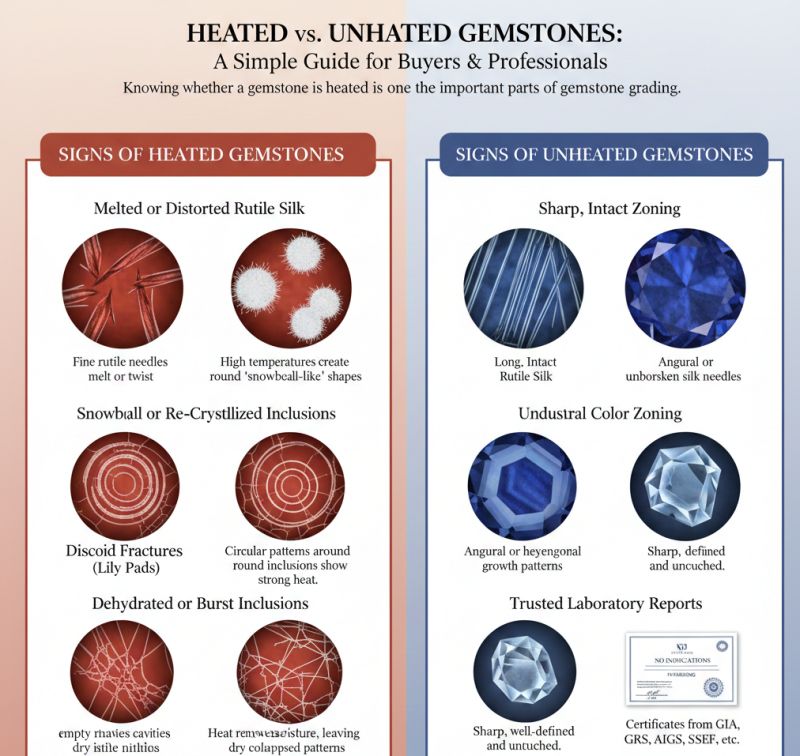
Determining whether a gemstone has been heated requires expert analysis, often with specialized equipment. Gemologists act as detectives, examining microscopic evidence left behind by the treatment process. Below summarizes the key indicators that differentiate heated from unheated stones.
The following outlines key diagnostic features for distinguishing heated from unheated gemstones, organized by characteristic.
Rutile Silk: In a heated gemstone, the fine rutile needles appear melted, beaded, or distorted, and may be partially or completely dissolved. In contrast, an unheated gemstone displays sharp, intact, and well-defined needles that often form clear geometric patterns.
Inclusions: Heated gemstones may exhibit "snowball" inclusions (recrystallized melt pockets), discoid fractures often called "lily pads," or dehydrated fluid inclusions that appear as empty cavities or collapsed fingerprint patterns. Conversely, unheated gemstones contain inclusions that appear natural and undisturbed, featuring sharp crystal faces, intact fluid feathers, and pristine growth patterns.
Color Zoning: Heat treatment can cause color zoning to become diffused or blurred as chromophores migrate, sometimes resulting in an unnaturally uniform color. In an unheated stone, color zoning is typically sharp, angular, or geometric, such as hexagonal zoning in sapphire, accurately reflecting the crystal's natural growth structure.
Surface Features: A heated gemstone may show surface pitting or an altered lustre, particularly at facet junctions, due to exposure to extreme heat. An unheated gemstone will have consistent facet polish and surface quality without any such heat-related damage.
Beyond the Microscope:
While the signs above are telltale, some treatments are more sophisticated. Advanced techniques like spectroscopic analysis are used by major gemological laboratories to analyze a stone's atomic structure and identify trace elements that signal treatment. For example, the presence of specific elements like beryllium (used in "diffusion" treatments) can only be confirmed with such equipment.
The Rarity and Value Proposition of Unheated Gemstones -
Why Are Unheated Stones More Valuable -
The premium for unheated gemstones is driven by a simple principle: rarity. In a market where the vast majority of stones are enhanced, a fine-quality gem that achieves its beauty through nature alone is a scarce commodity. This rarity is particularly pronounced for rubies and sapphires (corundum), where the combination of exceptional color, clarity, and natural origin is a true collector's prize.
Furthermore, an unheated stone represents a purer, unaltered specimen of nature's artistry. For connoisseurs, this has immense intrinsic value, similar to an untouched masterpiece. It assures the buyer that the gem's characteristics are entirely natural, which is a critical factor for investment-grade stones and heirlooms.
Laboratory Reports:
For both buyers and professionals, a report from a reputable gemological laboratory is non-negotiable for high-value unheated stones. Certificates from institutions like the Gemological Institute of America (GIA), GRS, AIGS, or SSEF provide an authoritative, unbiased assessment. A comment stating "No indications of heat treatment" is a powerful document that authenticates the stone's natural status and forms the basis for its significant value premium.
Pro Tip for Buyers: Always insist on a laboratory report from a major institute for any significant purchase of a purportedly unheated gemstone. The report is your guarantee and should be factored into the stone's value.
Other Common Treatments Buyers Should Know -
While heat is the most prevalent treatment, the gemstone enhancement toolbox is diverse. Full transparency requires awareness of other common methods:
Irradiation: Exposing gems to radiation to alter color. This is how most blue topaz is created a color that is extremely rare in nature. Some irradiated materials require careful handling to ensure any induced radioactivity has decayed to safe levels.
Fracture Filling: Using glass, resin, or oil to fill surface-reaching cracks, improving clarity. Common in emeralds (oiled) and some rubies (glass-filled).
Dyeing: Introducing colored dyes into porous or fractured stones to enhance or change color. Often seen in jade, turquoise, and lower-quality pearls.
Bleaching & Coating: Using chemicals to lighten a stone or applying a thin surface layer to improve color or lustre.
Each treatment has different implications for durability, care, and value. For example, a fracture-filled ruby may be less durable if exposed to ultrasonic cleaners or high heat, while a dyed gemstone's color may fade over time.
A Buyer's Action Plan: How to Shop with Confidence
Navigating the gemstone market requires a strategic approach. Follow this actionable guide to protect your investment:
Educate Yourself: Use resources like the CaratX Diamond Guide to understand the 4Cs (Cut, Color, Clarity, Carat) as a foundation before diving into treatments.
Demand Disclosure: Reputable sellers are legally and ethically obligated to disclose any and all treatments. Ask direct questions: "Has this stone been heated or treated in any way?"
Trust, But Verify with Labs: For any significant purchase, especially of an unheated stone, require an independent laboratory report. The report from GIA, AIGS, or similar is your objective proof.
Assess Value Realistically: A beautifully heated sapphire is a wonderful, durable piece of jewelry and often represents excellent value. An unheated sapphire of similar visual quality is a rarer asset with a higher price tag. Decide which proposition aligns with your goals and budget.
Work with Experts: Whether you're a private buyer or a business, partner with knowledgeable professionals. Platforms that connect you with vetted sellers, like the global marketplace at CaratX, can provide access to both treated and untreated gems with clear provenance.
For jewelry professionals and retailers looking to source these gems directly, consider the advantages of a dedicated marketplace.
By registering as a seller on platforms like CaratX, you gain access to a global network of suppliers.
You can explore different seller plans tailored to your business needs on their Pricing and Launch page.
Conclusion:
Heat treatment is a well-established, accepted part of the gemstone world that makes beautiful jewelry accessible. However, the natural, unheated gemstone occupies a special tier of rarity and desire. The key to smart participation in this market is knowledge and transparency.
By understanding the science behind the treatment, learning the signs of enhancement, and relying on professional verification, buyers and professionals can make confident decisions. Whether you choose the vibrant perfection of a heated stone or the rare, natural beauty of an unheated treasure, your choice will be informed, secure, and reflective of true value.
Frequently Asked Questions (FAQs)
Q1: Is a heated gemstone "fake"? A: No. A heated gemstone is a natural stone that has been altered by humans to improve its appearance. It is fundamentally different from a synthetic gemstone, which is created entirely in a laboratory. Heated gems are genuine, but their aesthetic qualities have been enhanced.
Q2: Are heated gemstones less durable? A: Generally, no. Properly executed heat treatment is stable and permanent for most gems like ruby and sapphire. The stone's fundamental hardness and durability remain unchanged. However, some other treatments (like certain fracture fillings or dyes) can require special care.
Q3: Why should I pay more for an unheated gemstone if the heated one looks just as beautiful? A: You are paying for rarity and provenance, not just beauty. An unheated stone is a scarcer natural artifact. For collectors and investors, this rarity drives value. For some, the knowledge that a gem's color is 100% natural has significant personal or symbolic worth.
Q4: Can I detect heat treatment myself? A: While some signs may be visible under a good loupe, definitive detection almost always requires the skill of a trained gemologist using a microscope and often advanced laboratory equipment. It is not a reliable DIY task for high-value stones.
Q5: Where can I find reputable gemological information? A: Authoritative resources include the Gemological Institute of America (GIA) website, academic texts hosted on platforms like LibreTexts, and research from institutions like the Smithsonian National Museum of Natural History. For industry insights and marketplace trends, following established hubs like CaratX can also be valuable.
This guide is intended for educational purposes. For critical buying decisions, always consult with a certified gemologist and obtain an independent laboratory report.