
Every diamond possesses an innate fire and brilliance, but its true potential is unlocked by the artistry of its setting. The way a gemstone is mounted influences everything from its perceived size and sparkle to its security and comfort. Beyond the setting, a frequently overlooked yet critical design element is the ring profile, the cross-sectional shape of the band.
This guide delves deep into the world of diamond settings and ring profiles, equipping you with the knowledge to make an informed choice for your next piece of fine jewelry.
Diamond Settings –
A setting is far more than just a mechanism to hold a stone; it’s a framework that manipulates light, protects your investment, and defines aesthetic character. Here, we expand on 13 quintessential styles.
1. Prong Setting (Claw Setting)
The Classic Maximizer of Light Prong settings use four to six metal claws to securely grip the diamond’s girdle. This minimalist use of metal allows for maximum light penetration from all angles, which is essential for achieving superior brilliance and fire.
Best For: Solitaire engagement rings, center stones where brilliance is paramount.
Considerations: Prongs can snag on fabrics and may require occasional retipping over decades of wear. Higher prongs offer more light entry but less protection.
Explore Prong-Set Masterpieces: View our curated collection of Classic Solitaire Engagement Rings.
2. Bezel Setting
The Modern Fortress In a bezel setting, a thin rim of metal completely encircles the diamond’s circumference. This design offers superior protection against impacts and is remarkably secure, minimizing the risk of the stone loosening.
Best For: Active lifestyles, modern jewelry designs, and gemstones like emeralds or opals that benefit from extra protection.
Considerations: It can make a stone appear slightly smaller by covering more of its perimeter and allows slightly less light entry than a prong setting.
3. Pave Setting
The Continuous Sparkle Derived from the French word for "paved," this technique sets numerous small diamonds closely together, securing them with tiny, almost invisible metal beads or prongs. The result is a continuous surface of scintillation.
Best For: Adding sparkle to ring bands, halos, and earrings. It creates a luxurious look without the cost of a large central stone.
Considerations: Requires skilled craftsmanship. The tiny beads can wear over time, necessitating check-ups.
Discover Pave Designs: Adorn your band with extra brilliance from our Diamond Eternity & Band Collection.
4. Channel Setting
The Streamlined Elegance Diamonds are set into a carved channel between two parallel metal walls. The stones sit flush with the band, creating a smooth, continuous line with no prongs protruding.
Best For: Wedding bands and anniversary rings. It’s secure, comfortable, and offers a sleek, modern look.
Considerations: If a stone becomes loose, it may affect the stability of neighboring stones. Sizing can be more complex.
5. Tension Setting
The Illusion of Floating Magic This avant-garde style uses the precise pressure of the band’s metal to hold the diamond in place, creating the dramatic illusion that the stone is suspended in mid-air.
Best For: Bold, contemporary statement rings. It offers a unique, minimalist aesthetic.
Considerations: Requires expert engineering and a specific metal type/strength. Not typically recommended for extremely active wearers. Repairs and resizing are highly specialized.
6. Halo Setting
The Amplifier A circle (or square) of smaller pave or micro-pave diamonds surrounds a central stone. The halo enhances the perceived size and brilliance of the center diamond, creating a majestic effect.
Best For: Anyone wanting to maximize the visual impact of their center stone. Popular in vintage-inspired and modern engagement rings alike.
Find Your Halo: Browse our stunning array of Halo Engagement Rings.
7. Cluster Setting
The Illusionist Multiple smaller stones are arranged closely to form the shape of a single larger gemstone, often a floral or geometric motif. This provides a substantial look at a more accessible price point.
Best For: Vintage-style rings and cocktail rings where a bold look is desired.
8. Flush Setting (Gypsy Setting)
The Ultimate in Practicality The diamond is set into a pre-drilled hole in the band, sitting perfectly flush with the metal surface. This creates a smooth, snag-free, and extremely durable finish.
Best For: Men’s wedding bands, signet rings, and jewelry for people with hands-on professions.
9. Bar Setting
The Structured Showcase Similar to channel setting, but each diamond is separated by a vertical metal bar. This allows more light to enter each stone from the sides compared to a channel setting, while still offering a smooth feel.
Best For: A clean, architectural look with enhanced sparkle over channel setting.
10. Invisible Setting
The Sleight of Hand A technically brilliant method where specially cut stones (with grooves) are set into a hidden metal grid or frame, leaving no visible metal from the top. The surface appears as a mosaic of gems.
Best For: High-fashion rings, bracelets, and brooches. It represents the pinnacle of craftsmanship.
Considerations: Extremely complex to create and repair. If one stone is damaged, the entire piece may need disassembly.
11. Bead Setting
The Artisan’s Touch A single small metal bead is raised from the band and tooled over the diamond’s edge to secure it. It’s a classic technique that allows each stone to shine individually.
Best For: Vintage and antique-style jewelry, adding delicate sparkle.
12. Micro-Pave Setting
The Peak of Detail An evolution of pave using even smaller diamonds (often below 0.01 carats each) and finer, more numerous beads. This creates an exceptionally dense and luxurious field of light.
Best For: High-end, detailed luxury pieces where no amount of sparkle is too much.
Experience Luxury: Explore our finest Designer & High Jewelry Collections.
13. Basket Setting
The Secure Foundation A metal framework resembling a basket (often with open sides and a base) cradles the diamond. It provides excellent security and allows light to enter from below, often used as a substructure for prong settings.
Best For: Engagement rings where security and classic design are key. Allows for elegant detailing underneath the center stone.
Ring Profiles –
While the setting focuses on the stone, the profile focuses on you the wearer. It’s the secret determinant of daily comfort, durability, and how a ring stacks with others.
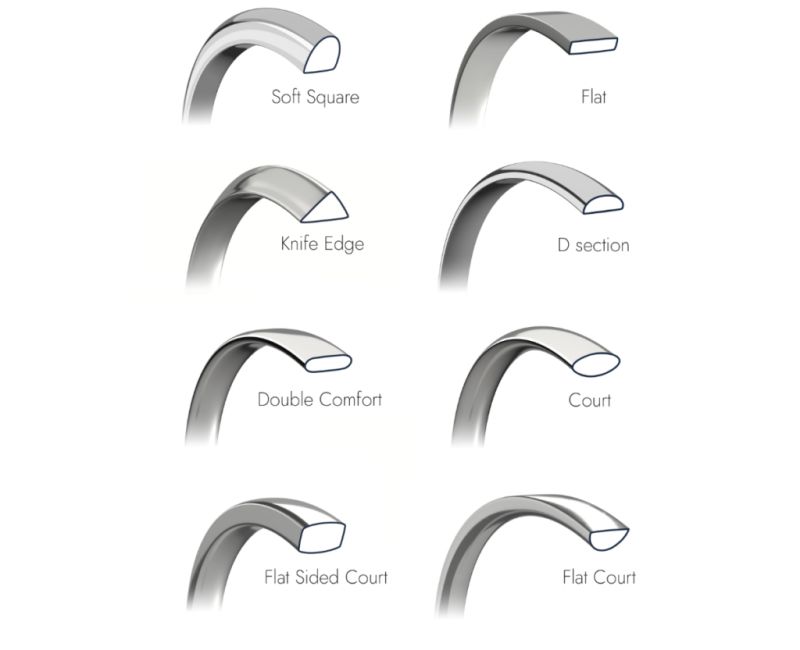
Soft Square Profile
A modern take on the square band, where all edges are gently rounded. It offers a contemporary, gender-neutral look without the harshness of sharp corners.
Ideal For: Modern wedding bands and fashion rings.
2. Flat Profile
Features completely straight edges and a flat top surface. This minimalist profile is sharp, architectural, and highly contemporary.
Ideal For: Simple bands, unisex designs, and a clean, modern aesthetic.
3. Knife Edge Profile
The band tapers to a raised, sharp ridge along its center. This clever design makes the ring appear larger and more substantial from the top while using less metal, making it lightweight.
Ideal For: Creating a bold, sculptural statement with elegance and less weight.
4. D-Section (Half-Round) Profile
The exterior is rounded like a classic band, while the interior is flat. This traditional shape balances a classic look with improved comfort over a fully round band.
Ideal For: Traditional wedding bands and heirloom-style jewelry.
5. Double Comfort Profile
Both the inside and outside surfaces are fully rounded. This profile is exceptionally smooth against the skin and adjacent fingers, making it a top choice for daily wear.
Ideal For: Wider bands and those who prioritize all-day comfort above all else.
6. Court Profile (Comfort Fit)
The interior is domed, allowing the ring to slide over the knuckle with ease and sit comfortably on the finger. This is one of the most popular profiles for wedding bands.
Ideal For: Anyone seeking a classic ring with superior, proven comfort. Discover the feeling with our Comfort Fit Wedding Bands.
7. Flat-Sided Court Profile
A hybrid design with flat, contemporary sides but a comfort-fit curved interior. It offers the best of both worlds: a modern exterior and a comfortable interior.
Ideal For: Those who want a contemporary look without sacrificing wearability.
8. Flat Court Profile
The exterior is flat for a modern appearance, while the interior is curved (comfort fit). It’s a sleek, low-profile option that sits neatly on the finger.
Ideal For: Modern engagement rings and bands where a low, clean silhouette is desired.
Making the Right Choice –
When selecting your jewelry, consider these factors:
Lifestyle: Active hands demand secure settings (bezel, flush) and comfortable profiles (court, double comfort).
Aesthetic: Do you prefer classic (prong, D-section), modern (tension, flat profile), or vintage (cluster, bead) styles?
Stone Size & Shape: Larger center stones often benefit from the security of a basket or bezel. Halos enhance round and cushion cuts beautifully.
Stacking: If you plan to wear multiple rings, consider lower profiles (flat court, flat) and settings that won’t scratch adjacent bands.
For authoritative information on diamond quality and grading beyond settings, resources like the Gemological Institute of America (GIA) provide essential education. You can explore their extensive Gem Encyclopedia for in-depth knowledge.
Frequently Asked Questions (FAQs)
Q: Which setting is the most secure for an engagement ring? A: Bezel and flush settings offer the highest security as they fully or largely encase the diamond, protecting its edges. Pavé and channel settings are very secure for side stones.
Q: Is a comfort-fit profile noticeably more comfortable? A: Yes, for most people. The curved interior reduces friction against the skin and makes putting on and taking off the ring easier, especially for wider bands.
Q: Can I resize a ring with a channel or invisible setting? A: Resizing is possible but is more complex and expensive. It requires a highly skilled jeweler as it involves the entire structure of the ring. Always consult with a professional.
Q: How often should I get my prong-set ring checked? A: We recommend having a professional inspection every 6-12 months. They will check for prong wear, stone looseness, and general integrity.
Q: Where can I find a wide variety of rings incorporating these settings and profiles? A: CaratX offers an extensive global marketplace featuring thousands of designs. Whether you're looking for a specific profile or a unique setting, explore our full range of Natural Diamonds and Fine Jewelry.
Sources & Further Reading
Gemological Institute of America (GIA). Gem Encyclopedia. https://www.gia.edu/gem-encyclopedia
Ready to Find or Create Your Perfect Piece? Understanding settings and profiles empowers you to make confident decisions.
As a global marketplace, CaratX connects you with artisans and jewelers worldwide. Sellers, expand your reach by registering on the CaratX marketplace to start selling to buyers in 18+ countries.
Buyers, discover unparalleled selection and value by shopping for gemstones, natural diamonds, and finished jewelry today.
For sellers interested in our structure, learn more about Pricing and Launching Your Products on CaratX.
Image Credit - Anna Loucah