

The Ultimate Guide to Metal Recyclability: Rates, Processes, and a Sustainable Future
Home
Education Blog The Ultimate Guide to Metal Recyclability: Rates, Processes, and a Sustainable Future SHOP NOWHome
Education Blog The Ultimate Guide to Metal Recyclability: Rates, Processes, and a Sustainable Future SHOP NOWJan, 19, 2026 by Archit Mohanty 0 Comments
In an era of finite resources and growing environmental consciousness, metal recycling stands as a cornerstone of the circular economy. Recycling metals conserves natural ores, reduces energy consumption by up to 95% compared to primary production, and dramatically cuts greenhouse gas emissions. But not all metals are recycled equally. This deep dive explores the recyclability of key metals, the industries driving recovery, and the future of sustainable material use.
For businesses in the jewelry and precious metals sector, like those leveraging the CaratX global marketplace, understanding this landscape is crucial for sustainability and value.
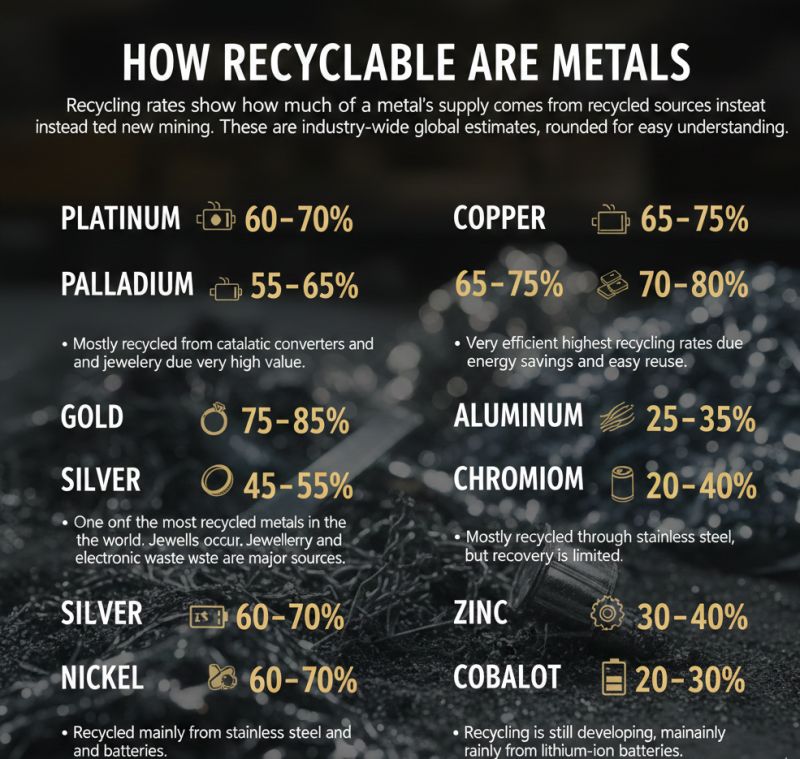
Recycling rates indicate the percentage of a metal’s total annual supply that comes from recycled scrap, as opposed to newly mined material. These figures are global estimates, reflecting industry-wide efficiency and economic drivers.
A dense, malleable, and highly non-reactive metal, platinum's exceptional properties make it invaluable. Its high recycling rate of 60-70% is driven by extreme value and concentrated use.
Approximately 70% of global platinum is used in catalytic converters for diesel vehicles, which are efficiently recovered at end-of-life. Jewelry, particularly in markets like China, is another major source.
Recycling Process: Automotive scrap is collected, shredded, and subjected to sophisticated smelting and chemical refining processes to extract pure platinum.
Challenges: While recovery from large items is efficient, microscopic losses in some industrial applications are inevitable.
Palladium, alongside platinum, is a critical component in autocatalysts for gasoline engines. Its 55-65% recycling rate is fueled by similar economic factors.
Over 80% of palladium demand comes from the automotive industry. Electronic components and a small amount of jewelry also contribute.
Market Driver: Its price, which has seen significant volatility, directly incentivizes recycling. High-value scrap streams ensure high recovery efforts.
Gold is arguably the world's most successfully recycled metal. With a staggering 75-85% recycling rate, it sets the benchmark for circularity.
Jewelry is the largest reservoir, with old pieces constantly being melted and remanetled. Electronic waste (e-waste) is a growing source, containing tiny but valuable amounts of gold in connectors and circuit boards. Central bank reserves also contribute.
Why So High? Gold is chemically inert, does not degrade, and retains its value indefinitely. The energy required to recycle gold is a fraction of that needed for mining, making it economically and environmentally logical.
Industry Connection: This efficient cycle is vital for modern jewelers and marketplaces. Platforms like CaratX facilitate the movement of gold jewelry and materials, ensuring they can re-enter the manufacturing stream efficiently.
Explore gold and diamond jewelry on CaratX to see contemporary designs that may one day be part of this recycling loop.
Silver's moderate 45-55% recycling rate belies its potential. It is the best electrical and thermal conductor of all metals.
Industrial applications (electronics, solar panels), jewelry, and silverware.
The "Loss" Challenge: Unlike gold, silver is used in many dispersive applications. It is used in tiny amounts in countless electronic products, making collection difficult. It's also consumed in some chemical processes (e.g., photography, though declining). Jewelry and silverware, however, are recycled at very high rates.
Copper is a poster child for sustainable metal recycling, with a 65-75% rate. It can be recycled infinitely without loss of performance.
Electrical wiring (building demolition), plumbing, electronics, and industrial machinery.
Process: Recycling is straightforward: scrap is melted and recast. The resulting metal is indistinguishable from primary copper, and the process uses up to 85% less energy.
Aluminium boasts one of the highest recycling rates at 70-80%, driven by massive energy savings.
The Energy Argument: Recycling aluminium requires only about 5% of the energy needed to produce it from bauxite ore. This creates a powerful economic incentive.
Beverage cans, automotive parts (alloys), construction materials, and aerospace components.
Infinite Recyclability: Like copper, aluminium does not degrade during recycling.
With a 60-70% recycling rate, nickel is efficiently recovered, primarily because it is a key ingredient in long-lived products.
Stainless steel (which is 8-12% nickel) accounts for the majority. Superalloys for aerospace and increasingly, lithium-ion batteries (in the form of nickel-cobalt-manganese chemistries) are growing sources.
Zinc's 30-40% recycling rate is moderate, with specific challenges.
Its main use is in galvanizing steel (coating for corrosion protection). This zinc is often not recovered when steel is recycled, as it volatilizes in the furnace and is captured in dust.
Efficient Streams: Zinc from brass alloys and die-cast components (like automotive parts) is more readily recycled.
Cobalt is a critical metal with a currently low 20-30% recycling rate, but this is poised for rapid growth.
The Battery Boom: Over 60% of cobalt is used in lithium-ion batteries for EVs and electronics. While the collection and recycling infrastructure is still developing, the high value and strategic importance of cobalt are driving massive investment in recycling technologies.
Challenges: Complex battery chemistry and safety concerns in handling make recycling technically challenging, but new hydrometallurgical processes are emerging.
Chromium, primarily used to make stainless steel (adding corrosion resistance), has a 25-35% recycling rate.
The "Passenger" Metal: It is almost exclusively recycled as a component of stainless steel scrap, not on its own. Recovery is limited by the overall efficiency of the stainless steel recycling process.
The high recycling rates of precious metals are not just statistics; they represent a living, breathing circular economy that businesses like CaratX participate in every day. When a piece of jewelry is sold or sourced through our platform, it is part of a chain that values material permanence.
For Sellers: By listing on the CaratX marketplace, you are ensuring your products whether they contain recycled gold, platinum, or palladium reach a global audience of B2B and B2C buyers who value quality and sustainability.
Register as a seller on CaratX to tap into this responsible market.
For Buyers: Purchasing from a platform that understands the metal lifecycle means investing in items with a past and a future.
The gemstones and natural diamonds you source can be set in metals that have been responsibly circulated for generations.
Industry Leadership: By facilitating efficient global trade, CaratX helps ensure that precious metals remain in the economic loop, reducing the environmental toll of new mining. Learn more about how you can launch your products on our innovative platform.
The trend is clear: recycling rates are rising. Drivers include:
Technology: Advanced sorting (AI, sensors), and improved chemical recovery processes.
Policy: Stricter e-waste regulations and producer responsibility laws in the EU, North America, and parts of Asia.
Economics: Volatile commodity prices make scrap a more stable supply source.
Consumer Demand: Growing demand for products with recycled content.
The journey for metals like cobalt and zinc is just accelerating, while precious metals continue to demonstrate a near-perfect circular model.
Q: Why isn't every metal recycled at a rate like gold's? A: Three main factors: Value (high price drives recovery), Concentration (easy to collect from large products like cars, hard from dispersed electronics), and Chemistry (some metals are alloyed or used in ways that make separation difficult or energy-intensive).
Q: Is recycled metal lower quality than newly mined metal? A: No. Metals like copper, aluminium, gold, and platinum can be recycled to a purity identical to virgin metal. For alloys like stainless steel, recycled content is standard and does not compromise performance.
Q: How can I, as a consumer, contribute to metal recycling? A: Recycle electronics responsibly at certified e-waste facilities. Sell old jewelry to reputable buyers or bullion dealers. Properly dispose of household items containing batteries or metals.
Q: What role do marketplaces like CaratX play in recycling? A: They create efficient, transparent channels for buying and selling products containing precious metals. This liquidity ensures items can be easily resold, remelted, and redesigned, keeping the metal in use and out of landfills.
Aug, 06, 2022
Aug, 06, 2022


Sep, 09, 2024

0 Comments
Please login to leave a reply.