
Pearls have captivated humanity for millennia, symbolizing purity, luxury, and timeless elegance. Unlike gemstones mined from the earth, pearls are organic treasures formed within living creatures, making each one a unique miracle of nature. For collectors, jewelers, and enthusiasts, understanding the nuances of pearl quality is essential.
This guide will explore the intricate world of pearls, from their formation to the key factors that determine their value, and how modern marketplaces like CaratX are revolutionizing access to these gems.
The Fascinating Formation of Pearls -
A pearl is born from a biological defense mechanism. When an irritant, such as a parasite or piece of tissue, enters a mollusk (like an oyster or mussel), the creature secretes layers of nacre a crystalline combination of aragonite and conchiolin to coat the intruder. This process, repeated thousands of times over months or years, results in the luminous gem we cherish.
There are two broad categories:
Natural Pearls: Formed without human intervention. These are exceptionally rare and constitute a tiny fraction of the market.
Cultured Pearls: The vast majority of modern pearls. A technician surgically implants a nucleus (usually a polished mussel shell bead) and, often, a piece of mantle tissue to stimulate nacre secretion. This is a sustainable practice that has made pearls accessible.
A World of Variety: Major Pearl Types
The type of pearl is the first determinant of its character and value, influenced by the mollusk species, water, and cultivation technique.
Akoya Pearls - Cultivated primarily in Japan and China, these saltwater pearls from the Pinctada fucata martensii oyster are classics. Known for their brilliant, mirror-like luster and perfectly round shapes, they are typically white or cream, often with rose or silver overtones. They are the quintessential strand pearl.
You can explore a curated selection of these timeless gems in the Pearls category on CaratX.
South Sea Pearls - Cultivated in the warm waters of Australia, the Philippines, Indonesia, and Myanmar, these are the aristocrats of the pearl world. Produced by the large Pinctada maxima oyster, they grow slowly, developing a thick nacre with a distinctive satiny luster. Their colors range from elegant white and silver to deep, precious gold.
Their large size (often 10mm to 20mm) and rarity command the highest prices. For those seeking investment-grade pieces, browsing CaratX's South Sea Pearl collection is essential.
Tahitian Pearls - Often called "black pearls," these are cultivated in French Polynesia from the black-lipped oyster Pinctada margaritifera. Their colors are naturally dark and mesmerizing charcoal gray, peacock green, eggplant purple, and metallic blue. They are rarely truly black. Their unique, exotic beauty makes them highly sought-after for statement jewelry.
Freshwater Pearls - Primarily cultivated in China in lakes and rivers, these pearls come from mussels. A single mussel can produce dozens of pearls at once. They are celebrated for their wide variety of shapes (including baroque and coin) and colors (white, peach, lavender, and more).
While their luster was once softer, modern cultivation techniques yield freshwater pearls with shine rivaling their saltwater cousins, offering exceptional value.
Discover the diverse range in the Freshwater Pearl section at CaratX.
The Four Pillars of Pearl Quality (The 4 S's) -
The value of any pearl is assessed on four critical factors, often called the "4 S's": Shape, Surface, Sheen (Luster), and Size.
Pearl Luster –
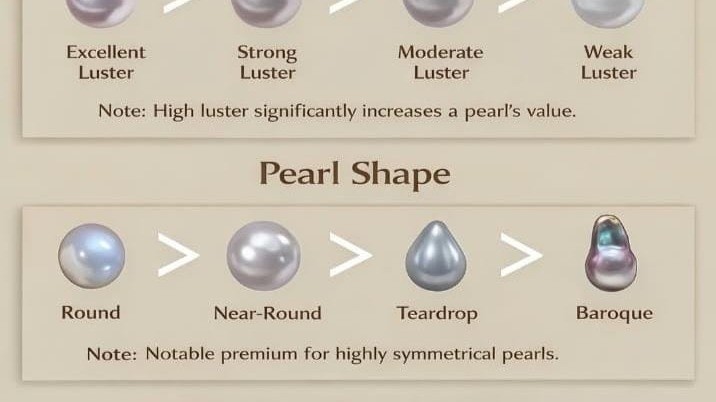
Luster is the most important quality factor. It refers to the sharpness and intensity of reflections on the pearl's surface, determined by the depth and quality of nacre.
Excellent Luster: Reflections are sharp, bright, and mirror-like. You can see clear, distinct images. This is a hallmark of high-quality Akoya and South Sea pearls.
Strong Luster: Very good shine with slightly softened reflections. Most fine jewelry pearls fall here.
Moderate Luster: A soft glow without sharp reflections. The pearl appears milky or chalky.
Weak Luster: Appears dull and hazy, with little to no reflective quality.
Gemological Institute of America (GIA) provide detailed scientific explanations of luster and nacre quality, which is a cornerstone of gemological education.
Pearl Shape –
Perfect symmetry in nature is rare and prized. Shapes are categorized as:
Round: The rarest and most valuable shape, especially for saltwater pearls. Perfect spheres command the highest premium.
Near-Round: Imperceptibly off-round to the naked eye but measured as slightly oval. Still highly valuable.
Oval / Button / Drop: Symmetrical in one axis, popular for earrings and pendants.
Baroque: Completely irregular and unique. Their artistic, organic forms make them popular for designer pieces. Baroque pearl jewelry on CaratX showcases stunning examples of this creative category.
Circled: Baroque pearls with distinct, concentric rings around their circumference.
Pearl Surface Quality –
Nacre deposition is an organic process, so most pearls have minor surface characteristics. Cleaner surfaces are rarer.
Clean / Flawless: Virtually no blemishes visible to the trained eye under optimal conditions. Extremely rare and expensive.
Very Slightly Blemished: Minor imperfections (tiny spots, wrinkles) that are not immediately obvious.
Slightly Blemished: Noticeable surface characteristics.
Heavily Blemished: Significant blemishes that can affect durability and brilliance.
Pearl Size –
Size matters, but in conjunction with other quality factors. Larger pearls are rarer, especially with high luster and clean surfaces. Size preference is also personal and cultural.
When considering size, also explore complementary gems; for instance, a large pearl pendant might be beautifully set with natural diamonds from CaratX for added brilliance.
Matching, Nacre Thickness, and Color -
Matching: For strands, earrings, or multi-pearl pieces, uniformity in all the above factors is critical and increases cost.
Nacre Thickness: Vital for durability and beauty. A pearl with too-thin nacre can appear dull and may peel or crack over time. This is a key grading criterion for cultured pearls.
Color: Composed of bodycolor (primary hue) and overtone (translucent secondary color). "Orientation" is a rare, iridescent rainbow effect. Color preference is subjective, but rarity influences value (e.g., natural golden South Sea pearls).
The Modern Pearl Marketplace: Why Platforms Like CaratX Matter
The traditional pearl market was opaque. Today, digital B2B marketplaces have transformed access and transparency.
CaratX connects sellers directly with a global network of buyers in over 18 countries, allowing jewelers to source everything from classic strands to unique gemstones at unbeatable prices.
For sellers, registering on the CaratX seller marketplace provides an unparalleled platform to launch products internationally, reaching both B2B and B2C buyers efficiently.
Understanding their pricing and product launch structure is key to leveraging this global reach.
FAQs: Your Pearl Questions Answered
Q: Are cultured pearls "real" pearls? A: Absolutely. They are formed by the same natural process within a living mollusk; humans simply initiate it. They possess identical physical properties to natural pearls.
Q: What's the best pearl type for an engagement ring? A: For durability in daily wear, a freshwater or Akoya pearl with very strong luster and good nacre thickness is recommended. Consider a protective bezel setting.
Explore CaratX's jewelry listings for design inspiration.
Q: How do I care for my pearls? A: They are soft (2.5-4.5 on Mohs scale). Put them on last (after perfume/cosmetics), wipe with a soft cloth after wearing, and store separately in a soft pouch to prevent scratches.
Q: Where can I learn more about gemological standards? A: The GIA (Gemological Institute of America) .edu site is the world's foremost authority on gemology, including pearls, offering extensive educational resources.
Q: As a jeweler, how can I source pearls reliably? A: Using a verified B2B platform like CaratX ensures access to a wide range of quality-graded pearls from international sellers, with the transparency needed to make informed purchases.
Sources & Further Reading -
Gemological Institute of America (GIA). GIA Pearl Guide. Retrieved from https://www.gia.edu/pearl-guide
CaratX. Pearl Buying Guide & Marketplace. Retrieved from https://www.caratx.com
Ready to explore or expand your pearl inventory? Register as a seller on CaratX to access a global buyer network, or shop directly from the CaratX marketplace to discover a world of natural diamonds, gemstones, and exquisite pearls at competitive prices.
Launch your products internationally today - https://caratx.com/generic-pages/launch-your-products-on-caratx