

💎The Ultimate Guide to Pearl Value: Decoding the 7 GIA Factors
Home
Education Blog 💎The Ultimate Guide to Pearl Value: Decoding the 7 GIA Factors SHOP NOWHome
Education Blog 💎The Ultimate Guide to Pearl Value: Decoding the 7 GIA Factors SHOP NOWMar, 03, 2026 by Archit Mohanty 0 Comments
When you look at a pearl, you are gazing at a miracle of nature, a gem created by a living organism. But not all pearls are created equal. In the world of gemology, few names carry as much weight as the Gemological Institute of America (GIA) . Just as they revolutionized diamond grading with the 4Cs, the GIA has established a universal language for evaluating pearls.
Whether you are a seasoned collector, a jewelry designer, or a bride-to-be shopping for that perfect strand, understanding these seven factors is crucial. At CaratX , we connect buyers with high-quality pearls and diamonds globally. But before you explore our pearl collection, let’s dive deep into what makes a pearl valuable.
Here is the definitive guide to the 7 Key GIA Factors that determine pearl value.
In the gem world, size matters. Pearls are measured by their diameter in millimeters. The GIA notes that pearl size is determined by two main factors: the species of mollusk and the age of the culture period.
The Size Spectrum: Most freshwater cultured pearls range from 3.0mm to 12.0mm. Akoya pearls, known for their classic elegance, typically fall between 2.0mm and 11.0mm.
The Giants of the Sea: South Sea pearls are the titans. Grown in the Pinctada maxima oyster, they regularly reach sizes of 10.0mm to 15.0mm, with exceptional specimens hitting 20.0mm. Because these oysters are larger, they can accommodate a larger nucleus, resulting in a larger pearl.
Rarity and Price: As size increases, price escalates exponentially, not linearly. A 9.0mm strand of Akoya pearls might be double the price of an 8.0mm strand because the larger mollusks are rarer and require a longer growth period.
Looking for a statement piece? Browse our selection of large South Sea pearls for sale.
Nature rarely creates a perfect sphere. This is why round pearls are the benchmark of value.
Round: Perfectly spherical. These are the rarest and most sought-after, especially in Akoya varieties. Less than 10% of cultured pearls are perfectly round, making them the pinnacle of the pearl grading system.
Near-Round: Slightly off-round but still spherical. They are less expensive than perfectly round pearls but offer a similar aesthetic.
Oval and Button: These are symmetrical but elongated (oval) or flattened (button). They are popular for earrings and pendants where the shape can be showcased.
Drop (or Teardrop): A symmetrical, pear-shaped pearl. These are highly desirable for elegant drop earrings.
Baroque: Asymmetrical and irregular. While historically considered flawed, baroque pearls like the famous "Mona Lisa" of pearls are now celebrated for their unique, artistic forms. Designers often seek these for modern, avant-garde jewelry.
Circled: Pearls with concentric rings or indentations. These are common in South Sea and Tahitian pearls and can add a unique textural element.
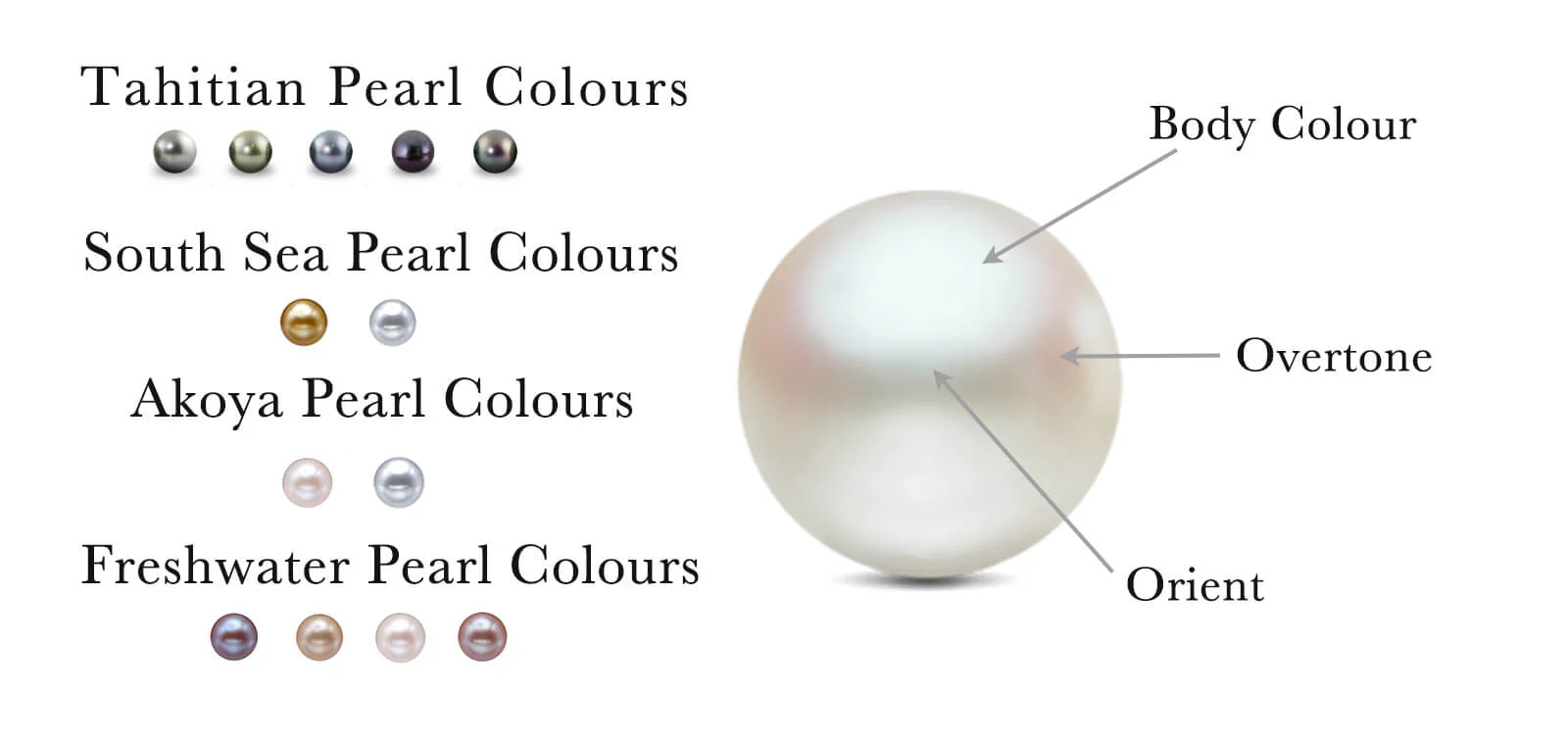
Pearl color is complex. The GIA breaks it down into three components: Bodycolor (the main color), Overtone (a translucent color on top), and Orient (iridescent rainbow colors).
White and Cream: Classic and timeless, often with rose, silver, or ivory overtones. Common in Akoya and Freshwater pearls.
Black: Naturally dark pearls, primarily from Tahiti. They can range from silver-gray to peacock green and aubergine.
Golden: The rich, 24-karat gold color of South Sea pearls is one of the most valuable in the world.
Pastels and Naturals: Freshwater pearls offer a rainbow of pastel shades lavender, peach, and pink that occur naturally without dyeing.
Explore the spectrum of colors available on our gemstone marketplace.
Luster is arguably the most important factor. It refers to the intensity and sharpness of the light reflected from the surface and just beneath the surface of the pearl.
High Luster: In high-quality pearls, the light reflections are bright, crisp, and mirror-like. You should be able to see your own reflection clearly on the pearl’s surface.
Low Luster: Pearls with poor luster appear chalky, dull, or milky. The reflections are blurred and hazy.
Pearls are organic gems, so they rarely emerge from the water without some evidence of their journey. The GIA grades surface quality based on the presence and severity of blemishes.
Clean Surface: A pearl with no visible marks or blemishes under 10x magnification is exceptionally rare and commands the highest price.
Lightly Blemished: Minor marks that are difficult to see with the naked eye.
Moderately Blemished: Noticeable spots, bumps, or cracks.
Heavily Blemished: Surface imperfections cover a significant portion of the pearl, impacting durability and beauty.
Common blemishes include spots, bumps, cracks, gaps in the nacre, and dull rings. A pearl with a clean surface is like a flawless complexion rare and beautiful.
Nacre is the substance secreted by the mollusk to form the pearl. It is composed of microscopic crystals of aragonite. The quality and thickness of this coating are vital.
Thick Nacre: This results from a long, healthy growth period. Pearls with thick nacre are durable, have excellent luster, and will last for generations. South Sea and Tahitian pearls are renowned for their thick nacre.
Thin Nacre: If a pearl is harvested too quickly, the nacre coating is thin. These pearls are less durable and may chip or show the "bead" nucleus through the surface. They also tend to have poor luster.
This factor applies to multi-pearl jewelry like necklaces, bracelets, or earrings. Matching is the art of selecting pearls that look like they belong together.
Uniformity: A perfectly matched strand has pearls that are virtually identical in size, shape, color, and luster. They should create a harmonious and consistent flow.
Gradations: Some strands are "graduated," with larger pearls in the center tapering to smaller ones at the clasp. In this case, the matching refers to the smoothness of the transition.
Creating a well-matched strand is incredibly labor-intensive. A pearl farmer might need to sort through thousands of pearls to find a dozen that match perfectly for a single necklace. This is why high-end strands are so expensive.
Sellers, do you have perfectly matched strands to offer? Register on CaratX today to reach buyers in 18+ international countries.
To put these factors into perspective, consider this: Top-grade pearls (those ranking highest in luster, surface, and shape) often represent less than 5% of the total harvest. Perfectly round pearls make up less than 10% of cultured pearls.
South Sea and Tahitian pearls are consistently among the most valuable in the world because they excel in the most critical areas:
Size: They are the largest.
Nacre: They have the thickest nacre.
Luster: They possess a deep, satiny luster unique to their species.
Rarity: They are the most difficult to cultivate, requiring pristine ocean conditions and long cultivation periods (2-4 years).
Understanding the 7 GIA factors empowers you to make informed decisions, whether you are investing in a timeless piece or designing your own jewelry. By appreciating the nuances of size, shape, color, luster, surface, nacre, and matching, you can distinguish a true treasure from a trinket.
At CaratX, we are committed to transparency and quality. We invite you to explore our marketplace to see these principles in action.
For Buyers: Discover a world of certified natural diamonds and exquisite gemstones, including high-quality pearls. Shop our collection now.
For Sellers: Expand your business globally. Our platform connects you with B2B and B2C buyers across 18+ countries. Register today and check out our seller pricing plans.
Q: Which is more valuable: Freshwater or Akoya pearls? A: Generally, Akoya pearls are more valuable than freshwater pearls due to their superior luster and perfectly round shapes. However, high-quality freshwater pearls with good luster can also be valuable. South Sea and Tahitian pearls are typically the most valuable overall.
Q: How can I tell if a pearl has good luster? A: Hold the pearl under a direct light. If you can see your own reflection clearly and sharply on the pearl's surface, it has excellent luster. If the surface looks milky or the reflection is blurry, the luster is poor.
Q: What does "orient" mean in pearls? A: Orient refers to the iridescent, rainbow-like colors that float just below the surface of a pearl. It is caused by light diffracting through the layered nacre structure. It is different from the body color or overtone and is a sign of exceptional nacre quality.
Q: Are saltwater pearls better than freshwater pearls? A: Not necessarily "better," but they are different. Saltwater pearls (Akoya, Tahitian, South Sea) typically have a rounder shape and higher luster. Freshwater pearls offer a wider variety of shapes and colors at more accessible price points. The "best" pearl depends on your budget and aesthetic preference.
Q: Can I sell my pearls on CaratX? A: Absolutely. CaratX is designed for sellers of all sizes. Whether you have a collection of loose pearls or finished jewelry, you can list them to reach a global audience. Click here to get started.
Image Credit - Pearl-lang
Aug, 06, 2022
Aug, 06, 2022
0 Comments
Please login to leave a reply.