
Diamonds have captivated us for centuries, often pulling us in with their incredible sparkle and brilliance. You've likely heard of the famous "4 Cs" Carat, Color, Clarity, and Cut the universal standard for assessing diamond quality. While the 4 Cs provide a crucial framework, they only tell part of the story. Hidden beneath every magnificent diamond is an even more important, yet often overlooked, secret to its beauty: its facets.
These small, meticulously arranged flat surfaces on a diamond are the true masterpieces of engineering and artistry. They work together in harmony, controlling how light enters, reflects, and returns to your eye to create the breathtaking fire, brilliance, and sparkle that diamonds are known for.
What Are Diamond Facets -
At its core, a facet is a smooth, flat, polished surface cut into a diamond. The entire design of a polished diamond its anatomy is a complex puzzle of these geometric planes. The number of facets can vary based on the cut of the diamond. For example, the iconic Round Brilliant cut typically has either 57 or 58 facets; the 58th being a tiny flat facet at the bottom known as the culet.
A common misconception is that a higher number of facets automatically means a brighter diamond. In reality, the number of facets affects the pattern of reflections; more facets create numerous smaller reflections rather than fewer larger ones. The actual brightness of a diamond is a function of its proportions, polish, and symmetry, not just its facet count.
When light strikes a diamond, it creates a spectacular display. This happens due to three key optical effects:
Brightness: The sum of all internal and external white light reflections.
Fire: The dispersion of white light into the rainbow flashes of spectral colors we see.
Scintillation: The dynamic pattern of light and dark areas that creates the "sparkle" when the diamond, light source, or observer moves.
All of these effects are profoundly influenced by the angles and arrangement of the diamond's facets.
The Anatomy of a Diamond: The Facets & Their Roles
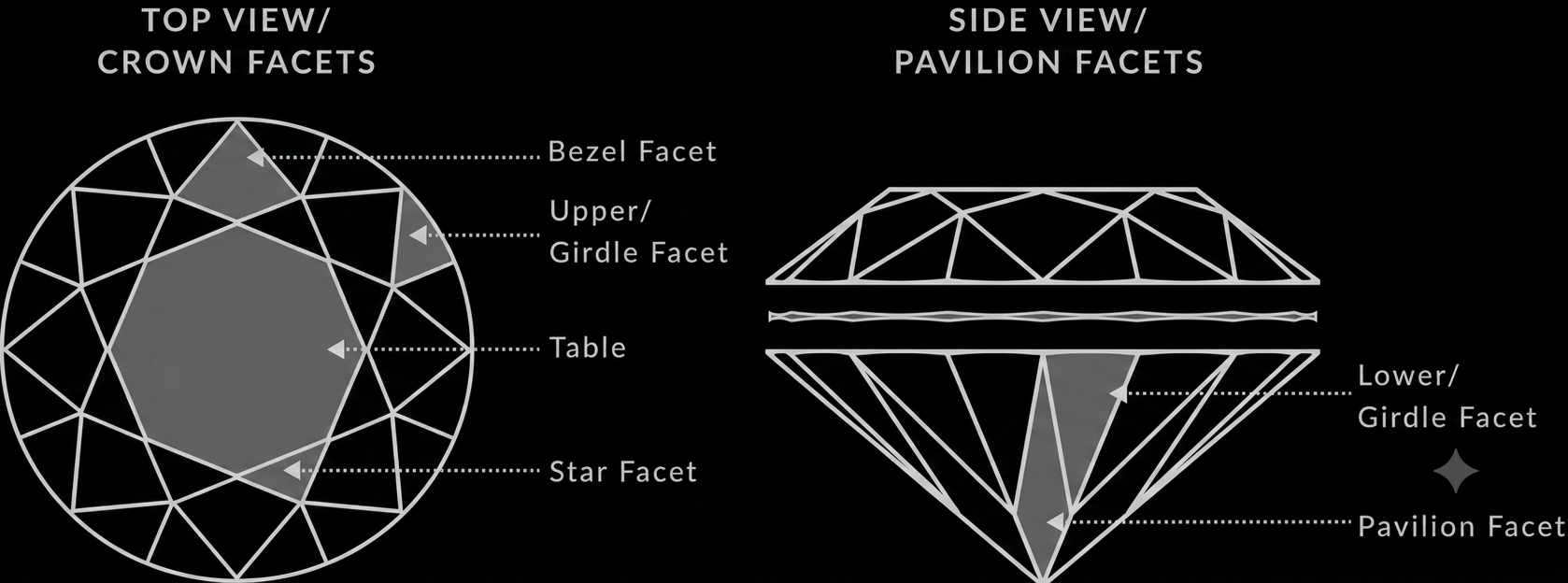
To appreciate how a diamond works, we must dissect its two main sections: the Crown (the top half from the girdle up) and the Pavilion (the bottom half from the girdle down). Each part contains specific facets with distinct functions.
According to a 15-year study by GIA, it was proven that while every individual facet matters, a diamond's beauty arises from the combined contribution of all its proportions. Let's explore the unique role of each facet type:
1. Crown Facets (The Light Managers)
The crown is where light first enters the diamond. It consists of several facet types working together:
Table Facet: This is the largest, flat facet on the very top of the diamond. It acts as the primary window, allowing most of the ambient light to enter the diamond. It also serves as the exit path for the internally reflected light to travel back to the viewer's eye.
Star Facets (8): Located around the table, these small triangular facets help diffuse light and enhance the diamond's sparkle by gently directing light from the table into the diamond's interior.
Bezel (Crown Main) Facets (8): These larger kite-shaped facets surround the star facets. They are primary light managers, refracting incoming light and sending it deep into the diamond's pavilion at specific angles to begin the reflection process.
Upper Girdle Facets (16): These are the small facets located just above the girdle. They connect the main crown to the girdle edge, further refining and improving the light distribution within the diamond.
2. Pavilion Facets (The Light Reflectors)
The pavilion is the "V" shaped section in the lower half of the diamond. It is arguably the most important section for brilliance.
Pavilion Main Facets (8): These are often considered the workhorses of the diamond. They are responsible for reflecting light back through the crown to the viewer. When light hits these facets, it should undergo total internal reflection, bouncing the light back up rather than letting it leak out. If a pavilion is too deep or too shallow, light will escape through the sides or bottom, resulting in a "fish-eye" or "nail-head" appearance and a dull, lifeless stone.
Lower Girdle Facets (16): These are located below the girdle and above the pavilion mains. They influence the diamond's pattern, contrast, and the intensity of its sparkle, significantly impacting the overall visual pattern of light and dark we see.
Culet: This is a small facet (or sometimes just a point) at the very bottom tip of the diamond. Its main purpose is practical: to protect the sharp point from chipping or abrasion. If a culet is too large, it can act like a window, causing light to leak out from the bottom and creating a distracting spot.
The Science of Sparkle: Light Mechanics, Modern Grading, and a Note on Rough Diamonds
What truly separates a stunning diamond from a mediocre one is the precision of its proportions. The diamond's high refractive index (approximately 2.42) enables its optical prowess.
When light enters, the diamond's facets especially the star and lower-girdle facets must be angled to ensure that most of this light is reflected internally and returns through the crown as the "sparkle" we admire. Modern grading systems have evolved to quantify this performance. The GIA Cut Grading System for round brilliants evaluates seven key components to assign a grade from Excellent to Poor.
Meanwhile, the American Gem Society (AGS) revolutionized diamond grading in 2005 with its Performance-Based Cut Grading System. AGS uses advanced 3D "ray-tracing" software that analyzes a diamond's actual light performance factors like brightness, contrast, leakage, and dispersion to assign its cut grade from 0 (Ideal) to 10. The AGS system measures the light contribution of every facet in a 3D model.
Finally, it's worth noting that a polished diamond's journey begins with a raw diamond, an uncut, unpolished stone that appears quite ordinary. It is the skillful cutting of facets that transforms that rough stone into a dazzling gem.
Conclusion:
So, the next time you gaze into a diamond, remember: you're not just seeing a shiny stone. You're witnessing a masterpiece of geometry and precision, a symphony of light directed by dozens of individually carved surfaces. The cut quality, defined by the relationships between table size, crown angle, and pavilion depth, is the single most important factor in creating a diamond's beauty.
A well-cut diamond will shine with captivating brilliance and fire even if it has lower color and clarity grades. In contrast, even a diamond with top color and clarity will look dull and lifeless if it is poorly cut. The magic truly lies in the facets.
Frequently Asked Questions (FAQs)
Q1: How many facets does a diamond have?
Q2: What does the diamond's culet do?
Q3: Does a diamond with more facets have more brilliance?
Q4: What is the most important part of a diamond for sparkle?
Q5: Does cut grade affect diamond price?
Shop Gemstones from Our Marketplace
Sell Diamonds in 18+ International Countries
Sellers: Register to Start Selling to B2B and B2C Buyers Now
Learn About CaratX Seller Plans to Sell Jewelry Internationally
Follow CaratX for more insightful and educational content on the world of diamonds, gemstones, and jewelry.