

Diamond Patterns: How Light and Dark Areas Define Quality
Home
Our Favorite Articles Diamond Patterns: How Light and Dark Areas Define Quality SHOP NOWHome
Our Favorite Articles Diamond Patterns: How Light and Dark Areas Define Quality SHOP NOWMar, 24, 2026 by Archit Mohanty 0 Comments
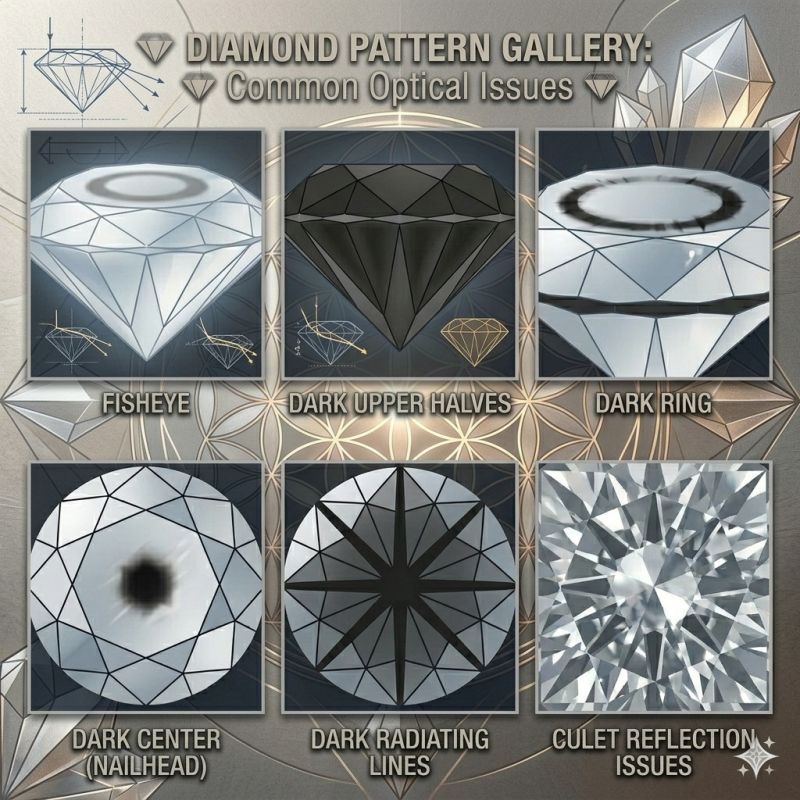
When you look at a diamond from the top known as the "face-up" view you are not merely seeing a stone; you are seeing a map of physics. The interplay of bright (white) areas and dark (black or gray) areas you observe is technically referred to as the diamond pattern. For many buyers and sellers, this pattern is the single most critical factor that separates a breathtaking gem from a dull one.
While the 4Cs (Cut, Color, Clarity, Carat) are the standard pillars of grading, the diamond pattern is the ultimate expression of how those factors come together to create beauty.
Understanding what these light and dark areas reveal about cut quality, proportions, and optical performance is essential whether you are a consumer looking for the perfect engagement ring or a seller listing inventory on a global marketplace like CaratX.
In this guide, we will dissect the anatomy of diamond patterns, explore common defects like "Nailhead" and "Fisheye," and explain how modern gemological standards validate the importance of pattern balance.
A diamond pattern is the specific arrangement of bright and dark facets visible when viewing a diamond face-up. This pattern is created by the journey of light:
Light Entry: Light enters the diamond through the table (the top flat facet) and crown.
Refraction and Reflection: It travels through the stone, bouncing off the pavilion facets (the lower cone).
Return: Light returns to the viewer’s eye, creating bright areas (brilliance), or escapes through the bottom/sides, creating dark areas (obscurity).
Contrary to popular belief, dark areas are not inherently bad. In fact, a diamond with zero dark areas would appear flat, white, and lifeless like a piece of frosted glass.
A high-quality diamond exhibits a pleasing balance of contrast. This contrast creates "sparkle" (scintillation) as the diamond moves, giving it a dynamic, lively appearance.
The pattern is a visual confession of the diamond’s engineering. It reveals three hidden structural elements:
Cut grade is the most important factor influencing a diamond’s beauty. A diamond cut to ideal proportions (such as those established by the Gemological Institute of America (GIA)) will produce a symmetrical pattern of alternating light and dark facets. If the cut deviates, the pattern breaks down, leading to specific flaws.
Symmetry refers to the exactness of the facet arrangement. If a diamond’s facets are misaligned, the pattern will appear distorted. You might see a "bow-tie" effect in fancy shapes (like ovals and pears) or uneven brightness in round brilliants. High symmetry ensures that the dark and light areas are evenly distributed.
Even minor changes in the crown angle (the top part) or pavilion angle (the bottom part) drastically alter the pattern. A shallow diamond allows light to leak out of the bottom, creating a dull, glassy look. A deep diamond traps light, causing a dark, dead center.
When evaluating diamonds on a platform like CaratX or in a physical store, recognizing these pattern issues can help you avoid low-quality stones. These issues are often seen in diamonds graded Fair or Poor by institutions like the American Gem Society (AGS) , which pioneered the study of light performance.
Visual: A gray, hazy, or cloudy ring visible just inside the outer edge of the table.
Cause: This occurs in shallow diamonds where the girdle (the outer edge) is reflected in the table. Essentially, the viewer sees a reflection of the girdle, which looks like a "fisheye" or a ring of dead light.
Quality Impact: This is a classic sign of a poorly proportioned diamond. It severely reduces brilliance and is common in stones that have been cut to maximize carat weight rather than beauty.
Visual: The top facets (near the crown) appear black or dark, even in bright lighting.
Cause: This is often due to a crown angle that is too steep combined with a pavilion angle that is misaligned. Instead of returning light to the eye, these facets act like mirrors reflecting darkness back to the viewer.
Quality Impact: It reduces the "crown brilliance," making the diamond look smaller and darker than it actually is.
Visual: A dark circle located just inside the perimeter of the table.
Cause: A "Dark Ring" is a proportion imbalance where the lower girdle facets are either too long or too short, causing an obstruction of light return in that specific zone.
Quality Impact: This creates a "lifeless" outer zone, making the diamond look like it has a dark halo inside the edge.
Visual: A prominent dark spot or black area in the absolute center of the diamond.
Cause: This is almost exclusively caused by a very deep pavilion. When the pavilion is too deep, light travels down, hits the bottom facets, and instead of bouncing back up, it bounces out the side of the diamond. The center of the stone receives no returning light, appearing as a "nailhead."
Quality Impact: Graded as Poor cut by most labs. It is perhaps the most detrimental pattern issue because the eye is naturally drawn to the center of a diamond.
Visual: Dark lines that radiate from the center outward, resembling the spokes of a wheel.
Cause: This can appear in various cut grades and is usually a result of high pavilion angles causing light to be blocked in the star facets or bezel facets.
Quality Impact: While sometimes acceptable in vintage cuts, in modern round brilliants, this creates a "striped" or busy look that detracts from the clean brilliance of the stone.
Visual: A busy, confusing pattern in the center, sometimes appearing as an extra "hole" or dark area.
Cause: The culet is the tiny facet at the very bottom of the diamond. If the culet is too large (graded as Medium or Larger), it acts like a window. You can see straight through the diamond, or it creates a distracting black dot that scatters the pattern.
Quality Impact: Affects visual clarity and symmetry, making the diamond look messy.
We subconsciously prefer diamonds where the contrast is crisp and the geometry is precise.
In the B2B and B2C markets, sellers often struggle with the misconception that "bigger is better." However, a poorly patterned diamond with a Fisheye or Nailhead effect will always sell for less and look inferior to a smaller diamond with an Excellent or Ideal cut grade.
For sellers and buyers alike, focusing on pattern and cut quality ensures the highest return on investment. A diamond with a balanced pattern:
Retains better resale value.
Looks larger and more brilliant than its carat weight suggests.
Generates better reviews and customer satisfaction.
If you are sourcing inventory, it is crucial to filter for these optical properties. Platforms like CaratX allow sellers to list natural diamonds and gemstones with high-quality imaging to showcase the pattern to international buyers.
To understand these concepts in practice, explore the high-quality inventory available on our platform:
Shop Natural Diamonds: Browse our collection of certified diamonds with verified cut grades to see balanced patterns in action. Shop Natural Diamonds here .
Shop Gemstones: While the physics differs, the importance of cut and pattern applies to colored gemstones as well. Explore our Gemstones Marketplace for unbeatable prices.
Sell Internationally: Are you a seller looking to reach 18+ international countries? Register to list your inventory on our B2B and B2C marketplace. Start Selling on CaratX .
Sell Jewelry: Expand your business by selling jewelry internationally through our CaratX seller plan. Register as a Seller .
Pricing Details: For more information on how to get started with our competitive pricing plans, check our Pricing Page .
The pattern of light and dark areas in a diamond is not a flaw; it is the fingerprint of its structural integrity. Whether you are seeing a Dark Center indicating a deep cut, or a Fisheye signaling a shallow cut, these visual cues are invaluable.
For the modern diamond seller or buyer, using a platform that supports high-quality visuals and certified grading is key. CaratX is dedicated to bridging the gap between international buyers and sellers, ensuring that quality measured by balance, pattern, and cut, is never compromised for size.
Remember: A diamond is a finite work of art. The pattern reveals the soul of the stone.
No. In fact, a diamond without any dark areas will look flat. The goal is a balanced "checkerboard" pattern of alternating light and dark facets. This contrast creates the sparkle.
A "Fisheye" effect appears as a dull gray ring just inside the edge of the diamond’s table. It is a sign of a shallow cut diamond and usually results in a Fair or Poor cut grade.
This is likely a "Nailhead" effect, caused by a pavilion that is too deep. The light is leaking out of the sides of the diamond instead of reflecting back to your eye. This is considered a Poor cut quality indicator.
Absolutely. A diamond with an Excellent or Ideal cut (and a balanced pattern) commands a significant price premium over a diamond with a Poor cut, even if they have the same carat weight and clarity.
Look for diamonds certified by the GIA or AGS with a Cut Grade of "Excellent" (GIA) or "Ideal" (AGS). Review high-definition images or videos often available on marketplaces like CaratX to visually inspect the pattern.
Ready to elevate your diamond game?
Join the CaratX marketplace today. Whether you are looking to buy certified diamonds or sell to a global audience of 18+ countries, CaratX provides the platform, the tools, and the audience you need.
Jun, 18, 2026


Aug, 06, 2022
Aug, 06, 2022


0 Comments
Please login to leave a reply.