
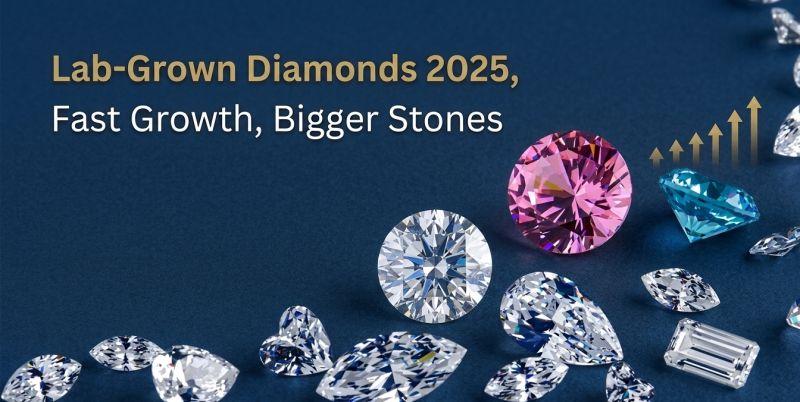
The diamond industry is undergoing one of the most dramatic transformations in its history. Just five years ago, lab-grown diamonds occupied a small, niche corner of the market often met with skepticism from traditional jewelers and consumers alike. Fast-forward to 2025, and the landscape has completely shifted.
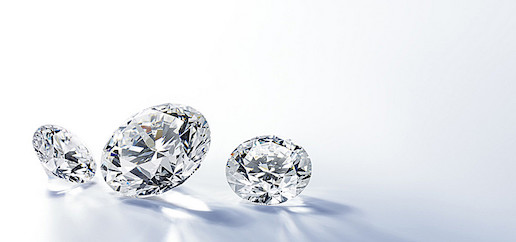
Lab-grown diamonds have not only gone mainstream they now dominate key segments of the diamond jewelry market.
In this guide, we’ll dive deep into the 2025 state of the lab-grown diamond industry: market size, price dynamics, engagement ring trends, consumer behavior, the natural vs. lab-grown divide, and what the future holds. Whether you’re a jewelry retailer, an investor, or a consumer shopping for your next diamond, this is your definitive resource.
Market Growth Snapshot:
The numbers tell a compelling story. According to BriteCo’s 2025 research report, lab-grown diamonds now account for more than 45% of all U.S. engagement ring purchases, evolving from a niche product into a mainstream choice.
The Knot’s 2026 Real Weddings Study, which surveyed over 10,000 U.S. couples married in 2025, found that 61% of consumers purchased an engagement ring featuring a lab-created diamond a staggering 239% increase since 2020.
Key market penetration figures for 2025:
Category Lab-Grown Market Share
Diamond jewelry sales (overall) ~ 42%
Engagement rings (center stones) ~48%
Other jewelry categories ~22%
Just a few years ago, lab-grown share was under 10% in most categories.
Global Market Valuation -
The global lab-grown diamond market size was valued at USD 29.46 billion in 2025, according to Fortune Business Insights. The market is projected to grow from USD 33.54 billion in 2026 to USD 91.85 billion by 2034, exhibiting a CAGR of 13.42% during the forecast period.
Other industry reports corroborate this trajectory, with 24 ChemicalResearch projecting growth from USD 32.1 billion in 2025 to USD 59.8 billion by 2032 (9.2% CAGR).
The Asia Pacific region dominated the lab-grown diamond market with a 34.54% share in 2025, driven by high manufacturing output in India and China, government R&D support, and strong demand for affordable jewelry.
For retailers looking to tap into this explosive growth: Sellers register on CaratX marketplace here to start selling to B2B and B2C buyers
Price Advantage:
The most powerful force behind lab-grown diamond adoption is price. The cost differential between lab-grown and natural diamonds has widened dramatically, making larger, higher-quality stones accessible to a much broader audience.
2025 Price Comparison (1-carat)
Diamond TypeAverage Price (2025)Natural diamond (1 ct)~$4,200Lab-grown diamond (1 ct)~$1,000 or less
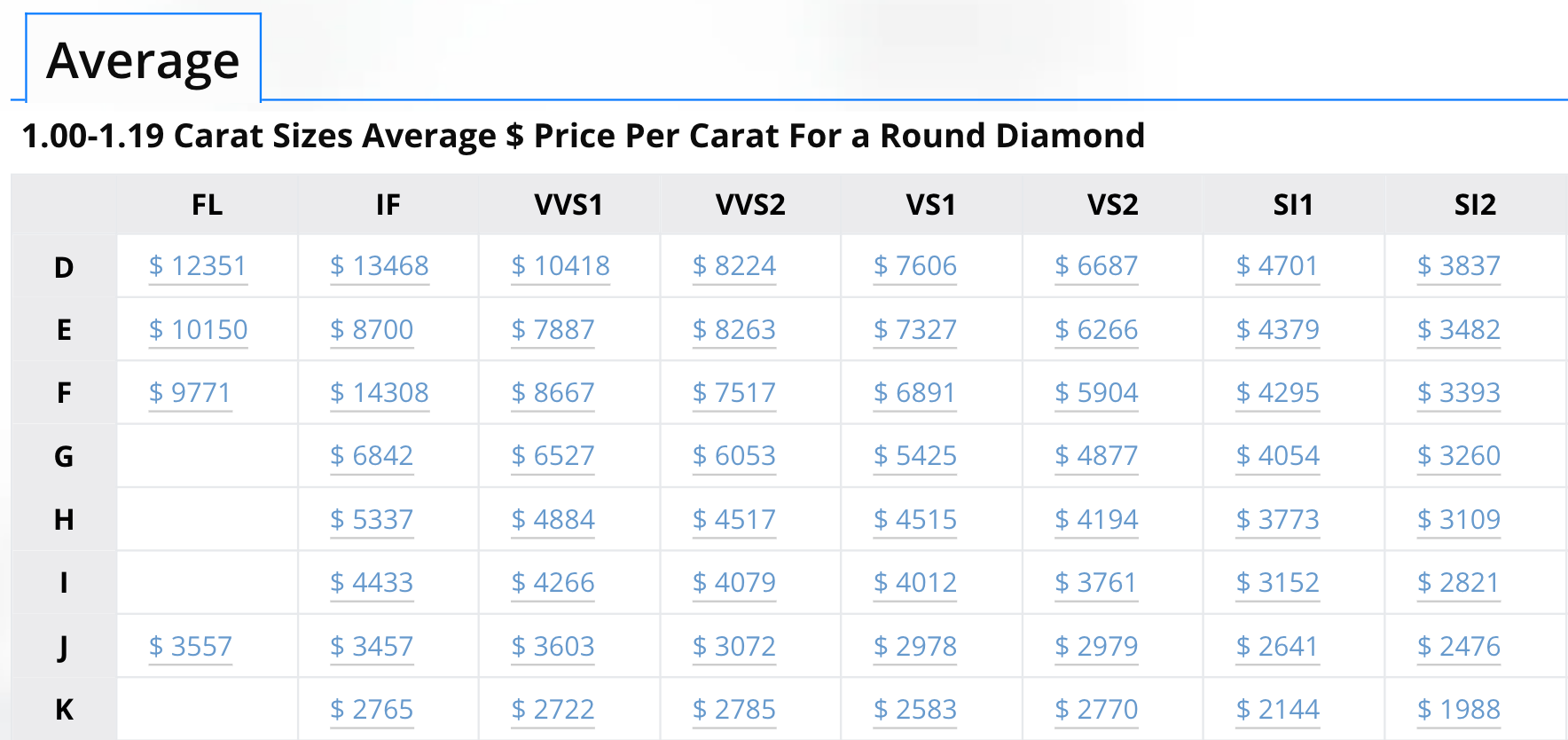
Lab-grown diamonds are typically 70–80% cheaper than their natural counterparts. BriteCo’s data indicates that by 2025, the average retail price of a 1-carat lab-grown diamond had fallen to $1,000 or less, compared to approximately $4,200 for a natural 1-carat diamond.
Price Erosion Trends -
The price decline has been even more dramatic for larger stones. The Natural Diamond Council (NDC) reports that the average price of a 1.5-carat lab-grown diamond plummeted 86%, from $10,750 in 2015 to just $1,455 in 2025. Wholesale prices for 1-carat VS1 F-G-H color lab-grown diamonds have fallen 95% since 2018, while retail prices have dropped 76%.
Industry analyst Edahn Golan notes that the average wholesale price of one-carat and two-carat lab-grown diamonds has fallen by as much as 96% since 2018. Looking ahead to 2026, 1-carat lab-grown diamonds are already being reported at approximately $750–$1,000, down 74% from 2020 levels.
What This Means for Buyers -
For consumers, the math is simple and powerful. With the savings from choosing a lab-grown diamond, buyers can:
Upgrade to significantly larger carat sizes.
Improve clarity and color grades (85.9% of lab-grown diamonds sold in 2025 were colorless, up from 37.7% in 2020)
Invest in higher-quality settings (18K gold settings grew 52.5% from 2020 to 2025 as jewelers adapted to maintain margins)
Explore our collection: Shop gemstones from CaratX marketplace at unbeatable prices
Engagement Ring Trends: The Bigger, The Better
Engagement rings represent the largest and most emotionally significant segment of the diamond market, and this is where lab-grown diamonds have made their biggest impact.
Average Center Stone Size: Then vs. Now
Year Average Lab-Grown Center Stone 20191.31 carats 20252.45 carats
Size demand has nearly doubled in just six years.
The Knot’s 2026 study confirms this trend: the average diamond size increased to 1.9 carats in 2025, up from 1.7 carats in 2024, while the average engagement ring price declined from $5,200 in 2024 to $4,600 in 2025.
For context, consumers who chose natural-diamond engagement rings paid an average of $7,000 for a 1.6-carat stone, while lab-grown buyers paid $4,300 for a 2-carat stone, a dramatic value differential.
Shape Trends: Oval Takes the Lead
For the first time in modern history, round brilliant is no longer the undisputed king of diamond shapes in the lab-grown category.
Oval cut is now the most popular shape for lab-grown engagement rings.
26% of buyers chose round, closely followed by 25% choosing oval.
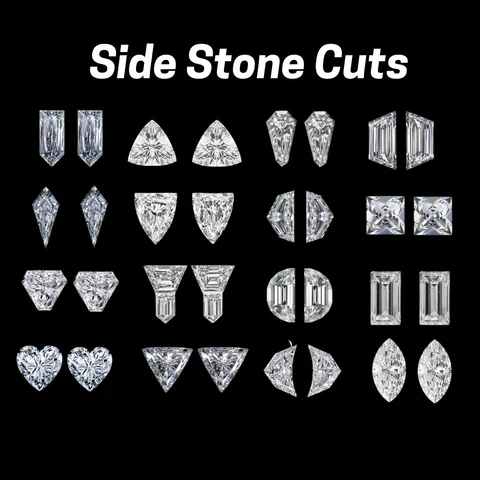
Other popular fancy shapes: emerald (8%), princess (8%), pear (8%), and marquise (8%).
83% of respondents selected a white/colorless diamond.
Metal Trends -
Yellow gold has made a strong comeback, now the most in-demand precious metal at 39% (up 140% over the past five years), while white gold continues its steady decline.
Customization and Shopping Behavior -
Nearly 90% of consumers chose to custom-design or make custom edits to their engagement rings. Stone shape ranked as the most important feature, followed by style/setting, and metal type.
Interestingly, more than half of consumers believe it’s important to shop for jewelry in person, with 64% making their purchases in physical stores and only one-third buying online.
Ready to start your diamond business? Start selling to diamonds in 18+ international countries
Natural vs. Lab-Grown: A Tale of Two Markets
The diamond market is increasingly bifurcating into two distinct segments with different value propositions, customer bases, and market dynamics.
Natural Diamonds -
Positioning: Luxury, exclusivity, investment value, heritage
Market role: Natural diamonds continue to lead in high-end luxury and investment segments. The natural diamond sector maintains value and market stability through controlled extraction volumes and enhanced certification systems.
Current trends: Natural diamond production worldwide touched 129 million carats in 2024, but is expected to dip to 125 million carats in 2025. Several major mines, including Australia’s Argyle and key sites in Canada, are approaching the end of their operational lifespans. The natural diamond industry has seen a price slump since mid-2022 after peaking earlier that year.
Lab-Grown Diamonds -
Positioning: Accessible luxury, everyday elegance, value, ethical sourcing
Market role: Lab-grown diamonds dominate in price-sensitive and fashion-forward categories. The expanding lab-grown diamond market is eroding natural diamonds’ market share, though oversupply has triggered a progressive decline in lab-grown diamond prices.
Current trends: Many retailers now offer both options side by side, with inventory turnover for lab-grown diamonds often faster than for natural diamonds. Lab-grown diamonds are growing fastest in markets like the United States, where they are increasingly seen as smart, value-conscious choices rather than mere “alternatives.”
Consumer Perceptions -
The Plumb Club’s 2025 Industry and Market Insights survey (over 2,000 jewelry consumers) found that 84% of respondents are aware of lab-grown diamonds in fine jewelry. There was a significant rise (+13%) in consumers who feel they know the differences between natural and lab-grown diamonds, and a decrease (-15%) in those who feel they don’t know the differences.
When asked about openness to receiving lab-grown diamonds:
83% are open to lab-grown diamonds for non-engagement jewelry.
74% are open to lab-grown diamonds for engagement rings.
83% are open to lab-grown gemstones (rubies, emeralds, sapphires).
However, when comparing two diamonds of identical cut, color, quality, and size, 49% of respondents still prefer natural diamonds highlighting the enduring power of natural diamond marketing and emotional resonance.
According to research from the Gemological Institute of America (GIA) published in the Journal of Gems & Gemmology, laboratory-grown diamonds are “man-made alternatives to natural diamonds with identical physical, chemical and optical properties”. The diamond industry has witnessed an exponential increase in the quantity and quality of laboratory-grown diamonds over the last 15 years, enabling these products’ commercialization on a large scale.
The Two Production Methods -
1. High-Pressure, High-Temperature (HPHT) Method
The HPHT method approximates the conditions required for diamond growth within the Earth. Pressures of 5–6 GPa (equivalent to 150–190 km depth in the Earth) and temperatures of 1,300–1,600°C are used. A small fragment of natural diamond “seed” is placed in a chamber filled with carbon, and the carbon crystallizes around the seed, growing about a millimeter per day.
2. Chemical Vapor Deposition (CVD) Method
The CVD method involves heating a gas mixture of hydrocarbon and hydrogen in a vacuum chamber, causing carbon atoms to separate from the gas and deposit as a layer of diamond onto a surface. The process can take several hours to create a thin layer, then repeated to create layers many millimeters thick.
Most laboratory-grown diamonds currently passing through GIA’s laboratories are grown by CVD, with most undergoing post-growth HPHT treatment to remove color. Modern CVD reactors can now produce gem-quality diamonds up to 40% faster than five years ago, maintaining exceptional clarity and color grades.
Distinguishing Lab-Grown from Natural Diamonds -
Synthetic diamonds are chemically and physically identical to naturally-occurring diamonds, and it can be very difficult to distinguish them using the naked eye or even a jeweler’s loupe. Specialist equipment measuring molecular characteristics such as absorption spectroscopy or photoluminescence is often required for definitive identification.
Modern testing methods include infrared (IR) spectroscopy, fluorescence/phosphorescence imaging, inclusion studies, and photoluminescence spectroscopy.
Shop with confidence: Shop natural diamonds from CaratX
What’s Ahead: Lab-Grown Diamond Market Projections to 2034
Industry analysts project continued strong growth for the lab-grown diamond market through the next decade.
YearProjected Market Size CAGR 2025 $29.46 billion 2026 $33.54 billion 2034 $91.85 billion 13.42%.
Source: Fortune Business Insights
Other projections include:
Research and Markets: $27.95 billion in 2025 → $30.16 billion in 2026 (7.9% CAGR)
Research Nester: $30.2 billion in 2025 → $99.7 billion by 2035
ChemicalResearch: $32.1 billion in 2025 → $59.8 billion by 2032 (9.2% CAGR)
Key Future Trends to Watch -
Brand Differentiation Challenges: Lab-grown diamond brand differentiation may blur, making the category more commoditized as natural diamond producers accelerate marketing efforts to justify higher values.
Everyday Wear Jewelry: Lab-grown diamonds could emerge as a new class of everyday wear jewelry due to affordability and consistent manufacturing quality.
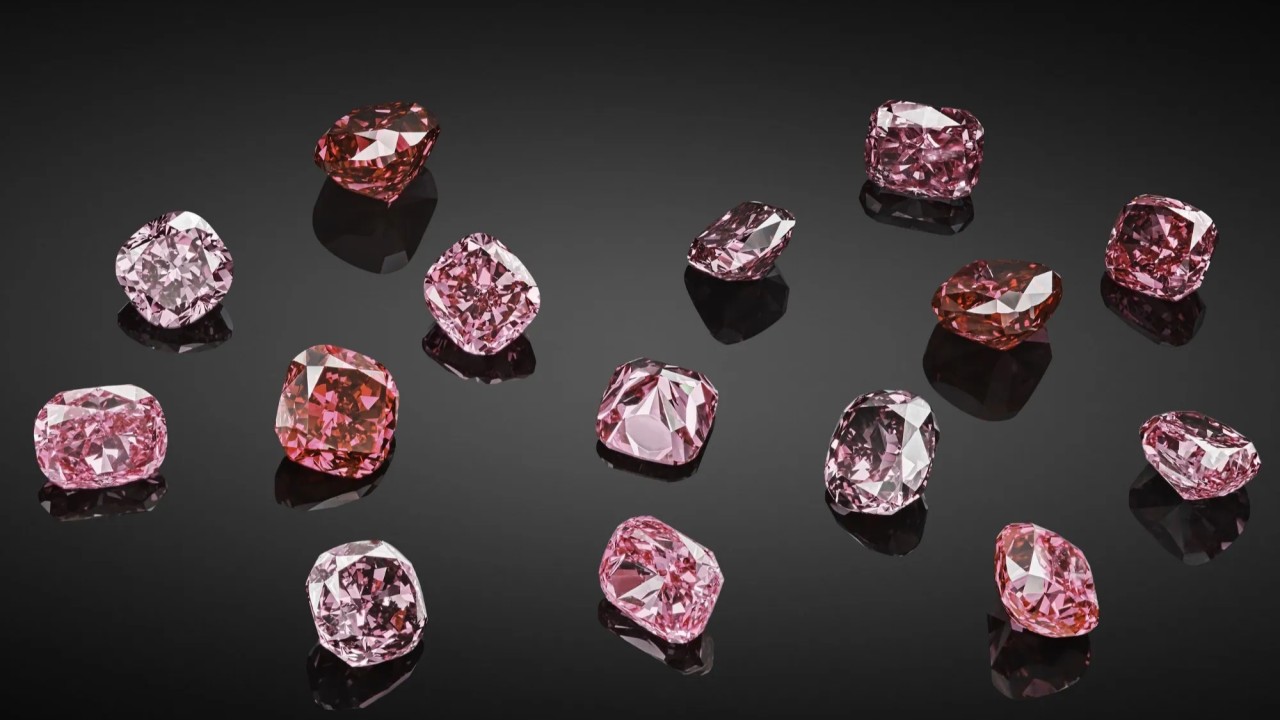
Fancy Colored Diamonds: Rising demand for fancy colored lab-grown diamonds due to lower cost and customizable production capabilities.
Industrial Applications: Beyond jewelry, demand from semiconductor, medical device, and cutting tool manufacturers is growing at 18% CAGR.
Lab-grown diamonds’ superior thermal conductivity (5× copper) and hardness make them ideal for high-performance applications.
Potential Swing Back to Natural: Some analysts predict a potential swing back toward natural diamonds for engagement rings, as natural diamonds saw a slight comeback in engagement ring sales in early 2025.
Why CaratX Is Your Global Diamond Marketplace Partner -
As the lab-grown diamond market continues its explosive growth, CaratX provides the platform for sellers and buyers to connect in 18+ international countries.
For Sellers -
CaratX offers a marketplace for diamond and jewelry sellers to reach B2B and B2C buyers globally.
With lab-grown diamonds seeing faster inventory turnover and growing consumer acceptance, there has never been a better time to expand your diamond business internationally.
Sellers register on CaratX marketplace here to start selling to B2B and B2C buyers
You can now sell jewelry internationally to buyers through our CaratX seller plan
More details about our pricing
For Buyers -
Whether you’re looking for natural diamonds, lab-grown diamonds, or gemstones, CaratX provides access to competitive pricing and a wide selection.
Shop gemstones from our CaratX marketplace at unbeatable prices
Shop natural diamonds from here
Start selling to diamonds in 18+ international countries
Frequently Asked Questions (FAQs)
Q1: Are lab-grown diamonds “real” diamonds?
A: Yes. According to the Gemological Institute of America (GIA) and the U.S. Federal Trade Commission, lab-grown diamonds are chemically, physically, and optically identical to natural diamonds. They are real diamonds just created in a laboratory rather than mined from the Earth.
Q2: How much cheaper are lab-grown diamonds than natural diamonds?
A: As of 2025, lab-grown diamonds are typically 70–80% cheaper than comparable natural diamonds. A 1-carat lab-grown diamond averages $1,000 or less, while a natural 1-carat diamond averages around $4,200.
Q3: Can you tell the difference between lab-grown and natural diamonds?
A: Not with the naked eye or a standard jeweler’s loupe. Specialist gemological equipment including infrared spectroscopy, photoluminescence, and fluorescence imaging is required for definitive identification.
Q4: What percentage of engagement rings use lab-grown diamonds?
A: Approximately 48% of engagement rings now feature lab-grown center stones. Among recently married couples surveyed in 2025, 61% purchased engagement rings with lab-created diamonds.
Q5: Do lab-grown diamonds hold their value?
A: Lab-grown diamond prices have declined significantly over time (95% wholesale price drop since 2018). They should be viewed as a consumer product rather than an investment asset. Natural diamonds maintain value differently through controlled extraction and certification systems.
Q6: Are lab-grown diamonds more ethical or sustainable?
A: The answer is complex. Lab-grown diamonds eliminate concerns about conflict minerals and land disruption. However, their production is energy-intensive, and sustainability claims vary by manufacturer. Research from the Journal of Bioeconomics provides detailed environmental impact comparisons.
Q7: What is the average size of a lab-grown diamond engagement ring?
A: The average lab-grown center stone size has nearly doubled from 1.31 carats in 2019 to 2.45 carats in 2025.
Q8: What is the most popular shape for lab-grown diamonds?
A: Oval cut has overtaken round brilliant as the most popular shape for lab-grown engagement rings, followed closely by round (26% vs. 25%).