

The Elongated Diamond Dominance: Why Oval, Marquise, and Emerald Cuts Are Commanding 2026 Premiums
Home
Education Blog The Elongated Diamond Dominance: Why Oval, Marquise, and Emerald Cuts Are Commanding 2026 Premiums SHOP NOWHome
Education Blog The Elongated Diamond Dominance: Why Oval, Marquise, and Emerald Cuts Are Commanding 2026 Premiums SHOP NOWMar, 13, 2026 by Archit Mohanty 0 Comments
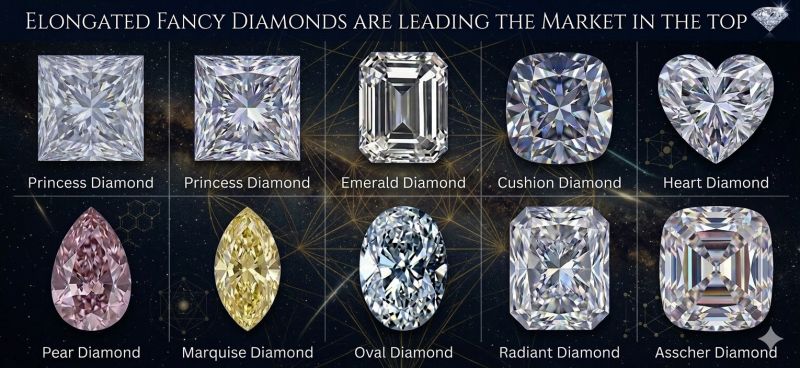
The global diamond industry is witnessing a significant paradigm shift. For decades, the Round Brilliant Cut has been the uncontested champion of bridal jewelry and investment. However, current market data and consumer behavior indicate a clear winner in the current cycle: Elongated Fancy Shape Diamonds.
As we move through 2026, the allure of the Oval, the elegance of the Emerald, and the regality of the Marquise are not just trends, they are fundamental shifts in buyer psychology. At CaratX , we are observing a surge in demand for stones that offer a unique silhouette, perceived size advantage, and modern aesthetic.
This shift is so pronounced that specific elongated cuts are now trading at significant premiums over their traditional counterparts, particularly in the 2-carat and above category. If you are a buyer, seller, or investor, understanding this market dynamic is crucial for capitalizing on current opportunities.
According to industry observations and recent trade reports, fancy shapes are outperforming rounds in key retail sectors. The demand is specifically tilted towards "long" models stones where the length-to-width ratio creates a slender, elegant profile.
Once considered a niche or vintage shape, the Marquise cut diamond is making a massive comeback. Its elongated silhouette offers one of the largest surface area appearances per carat, making a 1.50-carat Marquise face up as large as a 2.00-carat Round.
Market Insight: Trade publications note that Marquise diamonds are currently the most expensive fancy shape in some wholesale categories. This scarcity is driven by cutting challenges; to maintain a brilliant "bow-tie" free appearance, the rough diamond yield is lower, limiting supply.
CaratX Inventory: Explore our current collection of exquisite Marquise diamonds here .
Celebrities and tastemakers have long favored the Emerald cut for its "Hall of Mirrors" effect and understated sophistication. Unlike the brilliant cuts which hide imperfections with sparkle, the Emerald cut requires high clarity, making top-tier stones exceptionally rare.
Why it’s winning: In the 3-carat+ market, Emerald cuts are outperforming many brilliant cuts because they project confidence and luxury. They are a statement of pure clarity and proportion.
The Science of Cut: The Gemological Institute of America (GIA) emphasizes that the beauty of an Emerald cut relies entirely on its depth, table percentage, and length-to-width ratio. A poorly cut emerald looks dark and lifeless; a well-cut emerald is a liquid mirror. For more on grading standards, visit the GIA's official research library .
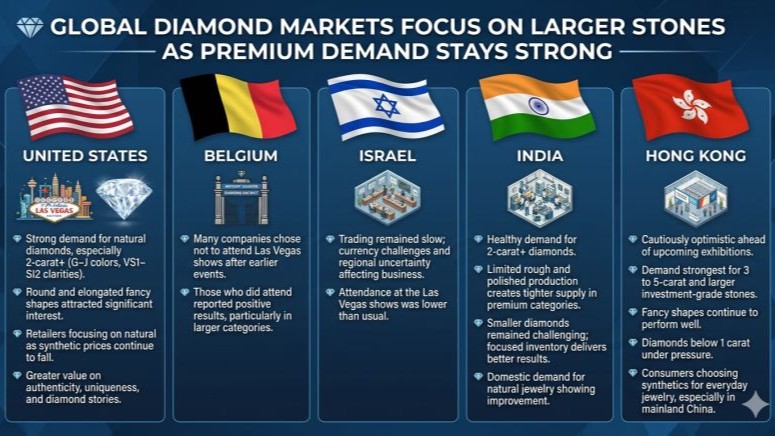
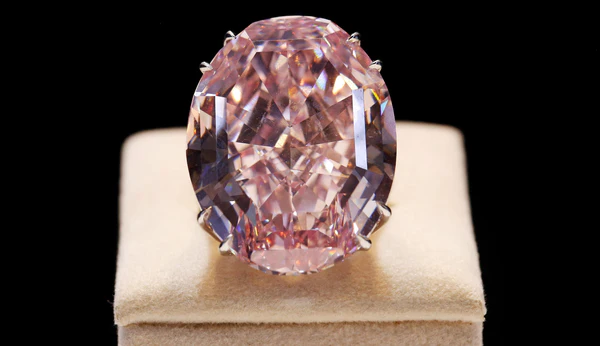
Elongated Ovals are currently performing exceptionally well in the US market, specifically in the D–I color range and VS–SI clarity categories.
Consumer Preference: Ovals offer the brilliance of a Round but with a modern twist. They also have the psychological advantage of making fingers appear longer and slimmer.
The "Bow-Tie" Factor: The market now punishes Ovals with poor light return. Premiums are paid for stones with minimal bow-tie effect and excellent symmetry.
While square Radiants and Cushions are plentiful, the market is currently starved for "Long Radiants" and "Long Cushions."
Pricing Dynamics: Data suggests that Long Cushion diamonds are trading at a 20%–25% premium compared to square cushions. This is a clear indicator that shape proportions are now the primary driver of pricing, beyond just color and clarity. Buyers are willing to pay significantly more for the correct "look."
Not all fancy shapes are sharing in this success. Understanding what is falling out of favor is just as important as knowing what is hot.
The Princess Cut diamond, once a staple of the 1990s and early 2000s, continues to face weaker demand. While it offers a modern, square shape, it is often perceived as less unique than the elongated cousins.
Market Saturation: The Princess cut is abundant in the secondary market, leading to price stagnation.
Vulnerability: The pointed corners of a Princess cut are vulnerable to chipping, a concern for the modern, active consumer that is less prevalent in the smooth contours of an Oval or the beveled corners of an Emerald.
The market for smaller stones (0.30 to 0.79 carat) in India and other trading hubs is showing mixed signals. Prices for smaller Ovals and Pear shapes are softening slightly.
Exception to the Rule: Even within this small category, "ideal long models" with perfect symmetry and proportions continue to perform well. The message is clear: Proportion is paramount.
To understand why this trend has staying power, we must look at consumer psychology and market structure.
Perceived Value: An elongated shape (Marquise, Oval, Pear) faces up larger than a round of the same carat weight. In an era where consumers are educated and value-conscious, getting a "bigger look" for the same price point is highly attractive.
The "Quiet Luxury" Effect: The understated elegance of an Emerald or elongated Cushion aligns perfectly with the "quiet luxury" trend. These shapes don't scream for attention with fiery brilliance; they command it through sleek lines and form.
Supply Chain Scarcity: The Kimberley Process and ethical sourcing have tightened the flow of rough diamonds. Cutters are now maximizing yield, but elongated shapes often require specific rough geometry, limiting the production of high-quality long stones. The World Diamond Council continues to monitor the ethical flow of these goods, ensuring that the demand for luxury does not compromise integrity.
For sellers, this trend presents a golden opportunity. If you possess well-cut, elongated fancy shapes particularly in larger sizes the global demand is at an all-time high. However, accessing international buyers has historically been complex, involving logistics, payment gateways, and trust issues.
This is where the CaratX Marketplace changes the game.
We provide a platform for sellers to list their diamonds and jewelry to a vetted audience of B2B and B2C buyers across 18+ international countries.
For Sellers: Don't let your inventory gather dust. If you have premium Long Cushions or rare Marquise stones, list them today. Register as a seller here and start shipping globally.
For Jewelry Designers: Are you creating pieces using these trending elongated shapes? You can now sell your finished jewelry internationally through our CaratX seller plan . Tap into the US and European markets without opening a physical storefront.
For Buyers: Looking for that specific 3-carat VS1 Emerald cut at an unbeatable price? Shop our curated selection of natural diamonds here .
If you are a consumer looking to purchase one of these trending shapes, you must be vigilant. Because the demand is high, there is a flood of poorly cut stones trying to ride the wave. Use this checklist:
Prioritize the Length-to-Width Ratio:
Check the GIA Report: Always insist on a grading report. Look at the comments section for mentions of "clarity characteristics" and ensure the plot matches the eye-clean appearance you desire. You can read more about understanding grading reports on educational platforms like the International Gem Society .
The "Black and White" Test: Look at a high-resolution video of the diamond on a white background. Does it have a dark bow-tie? Does it "wink" with light, or does it look dead? If the video doesn't look good, the stone won't look good in person.
The diamond market is cyclical, but the current preference for elongated fancy shapes feels more like a permanent evolution than a fleeting trend. Driven by social media, celebrity influence (think Hailey Bieber's oval or Jennifer Lopez's marquise), and a desire for personalization, the "long look" is here to stay.
At CaratX , we are committed to bridging the gap between this global demand and quality supply. Whether you are looking to invest in a high-premium Marquise or sell your inventory of Long Radiants, our platform provides the tools, reach, and security you need.
Q: Why are elongated fancy diamonds more expensive per carat than rounds in some cases? A: While rounds usually carry a premium due to rough waste, specific high-quality elongated shapes (like well-cut Marquise or Long Cushions) are becoming rarer. The demand for these specific cuts now outstrips the available supply of well-cut stones, driving premiums up by 20-25% in some categories.
Q: What is a "bow-tie" effect, and should I avoid it? A: A bow-tie is a dark, shadowy area that appears across the center of certain fancy shapes (Oval, Pear, Marquise) due to light leakage or the cut of the pavilion. A slight bow-tie is normal, but a dark, prominent one should be avoided as it detracts from the diamond's brilliance.
Q: Is it safe to buy diamonds online from international sellers? A: Yes, if you use a secure marketplace. CaratX provides a secure payment gateway and vets sellers, ensuring that your transaction is protected until you receive and approve the goods. We handle the complexities of cross-border trade so you can focus on finding the perfect stone.
Q: What is the best elongated shape for a small hand? A: Both the Oval and Marquise cuts are excellent for smaller hands. Their elongated shape creates an optical illusion that lengthens the finger, making the hand appear slender and elegant.
Q: Where can I sell my Princess Cut diamonds if demand is low? A: While demand is softer than for elongated shapes, Princess cuts still have a market, particularly in specific international regions.
You can list them on a global marketplace like CaratX to access a wider pool of buyers who may be looking for that specific shape.
Aug, 06, 2022
Aug, 06, 2022
Apr, 29, 2025

0 Comments
Please login to leave a reply.