

The Guide to Diamond Side Stones: Design, Anatomy, and Market Value
Home
Education Blog The Guide to Diamond Side Stones: Design, Anatomy, and Market Value SHOP NOWHome
Education Blog The Guide to Diamond Side Stones: Design, Anatomy, and Market Value SHOP NOWFeb, 23, 2026 by Archit Mohanty 0 Comments
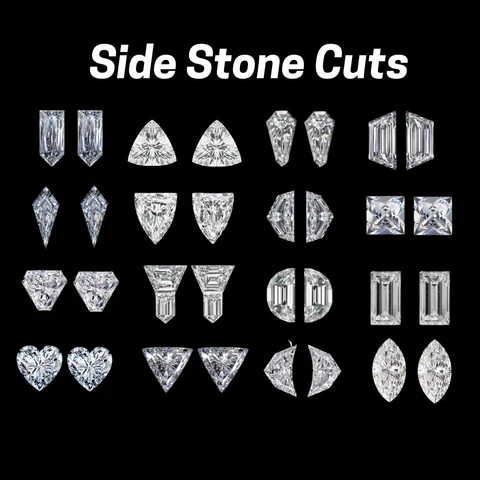
When designing a bespoke piece of jewelry be it an engagement ring, anniversary band, or cocktail ring the center diamond often gets all the attention. However, seasoned jewelers and gemologists know that the true character of a ring lies in its side stones.
These auxiliary diamonds do not just fill space; they are architectural elements that enhance the optical performance of the entire piece.
At CaratX , we connect global buyers and sellers with high-quality diamonds and jewelry. Whether you are looking to purchase loose diamonds or sell finished jewelry internationally, understanding the nuances of diamond anatomy is crucial.
In this guide, we will explore the specific cuts used for side stones, their optical properties, and how they affect the overall valuation of a ring.
Before diving into shapes, it is essential to understand the gemological purpose of side stones. A well-chosen side stone does two things:
Light Performance: It acts as a secondary light catcher. Light enters the side stone, is reflected, and bounces into the center stone, creating a "halo effect" of brilliance.
Proportion and Balance: Side stones alter the face-up appearance of the center diamond. A round brilliant center stone flanked by tapered baguettes, for example, makes the center stone appear longer and larger due to the illusion setting technique.
According to the Gemological Institute of America (GIA), the consistency of cut quality in side stones is just as important as in the center stone. Mismatched pavilion depths can create "dead" areas in the ring where light leaks out instead of reflecting back to the eye.
Here is a look at the most popular side stone cuts available on the market, many of which you can source directly through the CaratX marketplace.
The tapered baguette is the epitome of Art Deco elegance. These are step-cut stones (meaning parallel facets) that start wide at the shoulder of the ring and narrow as they meet the center diamond.
Design Aesthetic: They create a "boulevard" leading the eye to the center stone.
Market Insight: When sourcing tapered baguettes on CaratX , pay close attention to the "taper ratio." A mismatched taper can ruin the symmetry of a three-stone ring.
Half-moon diamonds are curved on one side and flat on the other. They are often used in semi-mount settings to create a continuous, flowing circle around a center stone.
Design Aesthetic: They are perfect for creating soft, feminine curves and are frequently used in "toi et moi" (you and me) settings or as accents in cluster rings.
Pairing: They pair exceptionally well with oval or pear-shaped center diamonds because the curves mimic the outline of the center stone.
Trapezoids are the unsung heroes of high-end jewelry. They feature two parallel lines (the top and bottom) and two angled sides.
Design Aesthetic: They offer a bold, architectural look. They are often used to fill the gaps between a round center stone and a square band, creating a seamless transition.
Availability: You can browse a wide selection of precision-cut trapezoid diamonds for your custom designs on CaratX .
For those seeking a truly unique and artistic piece, kite cuts are becoming increasingly popular. As the name suggests, they resemble the shape of a kite.
Design Aesthetic: They are often used in East-West settings or as standalone accents in vintage-inspired bands. When used as side stones, they create a sense of movement and directionality.
Trend Alert: According to trend forecasts from the Natural Diamond Council, geometric shapes like kites and shields are seeing a resurgence among younger buyers looking for non-traditional engagement rings.
Shield cuts are similar to kites but have a more truncated, triangular base, resembling a heraldic shield.
Design Aesthetic: They are bold, protective, and strong. They are frequently found in men's wedding bands or as side stones in rings designed for maximum finger coverage.
Historical Context: The shield cut has historical significance in antique jewelry, often found in Victorian-era pieces.
Using pear-shaped diamonds as side stones (usually set with the point facing outward) is a technique used to maximize the perceived size of the ring.
Design Aesthetic: They add a "drip" effect to the ring, extending the visual length of the finger.
Sourcing Tip: If you are a jeweler looking to create a "hidden halo" effect, consider pairing a pear-shaped center with matching pear side stones.
Register your business on CaratX to access competitive wholesale pricing on calibrated pairs.
The round brilliant is the most popular diamond shape in the world, and for good reason. It has been scientifically optimized for maximum brilliance through its 57 or 58 facets.
Design Aesthetic: Universally flattering. Whether used in a pavé band (small diamonds set closely together) or as a three-stone ring, rounds provide the most sparkle.
The round brilliant cut maximizes light return due to its critical angle of total internal reflection. This makes round side stones the safest choice for maximizing a ring's overall fire.
For sellers and manufacturers, consistency is key. When listing jewelry on a global platform like CaratX, "calibrated" side stones are vital. Calibrated means the stones are cut to exact standardized measurements (e.g., 3mm round, 4x2mm baguette).
This allows jewelers to create semi-mount settings without having to recut the seats (the holes where the diamonds sit) for every single stone.
If you are a seller looking to expand your reach to B2B buyers across 18+ countries, ensuring your inventory consists of calibrated, well-matched pairs will increase your sell-through rate significantly.
When sourcing diamonds, whether for a personal project or commercial inventory, use the "Four Cs" adapted for small stones:
Cut (The most important): For small side stones (melee), precision is often compromised to retain weight. Look for stones with good optical symmetry.
Color: Side stones should match the color grade of the center diamond or be one grade lower. If the center is G, side stones should be G or H. If they are too white (D-F) against a G center, they will look stark and mismatched.
Clarity: Because side stones are small, inclusions are harder to see with the naked eye. SI (Slightly Included) clarity is usually acceptable for melee, provided the inclusions are not black or centrally located.
Carat: Consistency in weight and dimension is non-negotiable for symmetrical design.
You can shop for natural diamonds of various clarities and cuts by visiting our CaratX marketplace today.
The global diamond trade is shifting towards digital transparency. CaratX empowers jewelers, wholesalers, and manufacturers to bypass traditional middlemen and sell directly to a global audience.
B2B Opportunities: Connect with verified buyers looking for specific side stone lots.
B2C Reach: Showcase your finished jewelry designs to retail consumers.
Simple Pricing: We offer transparent plans to help you launch your products globally.
If you are ready to scale your business, sellers can register on the CaratX marketplace here to start selling to B2B and B2C buyers in 18+ international countries.
For detailed information on our commission structures and seller tools, check out our Pricing and Launch page.
Q: Can I mix different shapes of side stones in one ring? A: Absolutely. This is known as a "mixed cut" design. A popular modern trend is pairing an oval center diamond with trapezoid side stones and a round diamond pavé band. However, it requires a skilled setter to ensure the heights align so the girdles don't chip.
Q: Are side stones real diamonds? A: In fine jewelry, yes. However, "melee" diamonds (small diamonds under 0.2 carats) are still real diamonds. At CaratX , we deal exclusively in natural diamonds and high-quality gemstones. Be wary of rings that use CZ (Cubic Zirconia) as side stones unless specified.
Q: Do side stones make the center diamond look bigger or smaller? A: Generally, they make it look bigger. This is called the "halo effect." However, if the side stones are very large and bright (like trillion cuts), they can compete with the center stone, making it look smaller by comparison.
Q: How do I clean rings with complex side stone settings? A: Use a soft toothbrush with warm water and mild dish soap. Avoid ultrasonic cleaners if the stones are set in "invisible" settings or if the diamonds have significant fractures, as the vibrations can loosen them.
Q: Where can I buy certified loose side stones in bulk? A: You can buy certified loose diamonds and gemstones in any quantity on our platform. Shop natural diamonds from here to find the perfect accents for your next project.
To ensure the accuracy and authority of this information, the following sources were consulted. These links provide further reading on gemology, historical jewelry design, and market trends.
Gemological Institute of America (GIA) - The world's foremost authority on diamonds, colored stones, and pearls.
Natural Diamond Council (NDC) - An organization dedicated to inspiring and educating consumers about the world of natural diamonds, including trend forecasting.
International Gem Society (IGS) - Provides educational articles on gemstone identification, valuation, and jewelry design for professionals and enthusiasts.
Image Credit - Cooper Jewelers
Jun, 15, 2026
Aug, 06, 2022
Aug, 06, 2022
Sep, 25, 2024
Feb, 25, 2026
0 Comments
Please login to leave a reply.