

Pink Diamonds: Understanding the GIA Color Scale Behind Their Value
Home
News And Media Pink Diamonds: Understanding the GIA Color Scale Behind Their Value SHOP NOWHome
News And Media Pink Diamonds: Understanding the GIA Color Scale Behind Their Value SHOP NOWMay, 26, 2026 by Archit Mohanty 0 Comments
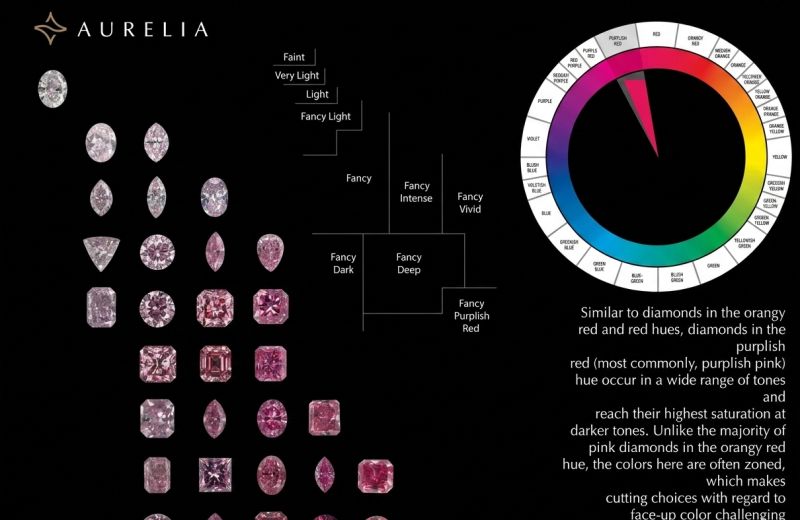
The world’s most captivating gemstones are arguably pink diamonds. These geological marvels are a true paradox flawless in the eyes of collectors yet born from extreme atomic stress deep within the Earth.
Their hypnotic beauty and extreme rarity have placed them at the pinnacle of the gemstone world, making them highly sought after by investors, connoisseurs, and jewelry enthusiasts. But not all pink diamonds are equal. The key to unlocking their true value lies in a precise and internationally recognized language: the GIA color grading scale.
This guide will take you through the geological origins, the scientific intricacies of the GIA grading system, the dramatic market dynamics shaped by the Argyle mine closure, and the compelling investment performance of these rare assets. By the end, you will have the expertise to distinguish a subtle Fancy Light from an ultra-rare Fancy Vivid, empowering you to make informed decisions in the high-stakes world of pink diamonds.
Before we delve into the art of grading, we must first understand the science of creation. Most gemstones owe their color to trace elements nitrogen makes a diamond yellow, and boron produces a blue. Pink diamonds defy this standard.
GIA research confirms that the color in approximately 99.5% of natural pink diamonds is not caused by chemical impurities. Instead, it results from a physical anomaly: a distortion in the diamond's crystal lattice. Deep within the Earth’s mantle, immense geological stress and pressure cause the diamond’s atomic structure to bend, or "slip," along specific planes. This plastic deformation creates defects that absorb specific spectrums of light, reflecting the pink or red hues back to the eye.
Essentially, the diamond’s beauty is a permanent record of the tremendous trauma it endured millions of years ago. Because this extreme deformation requires such specific and rare pressure conditions, pink diamonds are far rarer than their yellow or brown counterparts.
For decades, the Gemological Institute of America (GIA) has been the ultimate authority in diamond grading. Before the GIA’s refined system was introduced in 1995, there was no standardized language to describe the subtle nuances of fancy colored stones. Today, the GIA evaluates three key color attributes: Hue (the dominant color), Tone (how light or dark), and Saturation (the strength or intensity of the color).
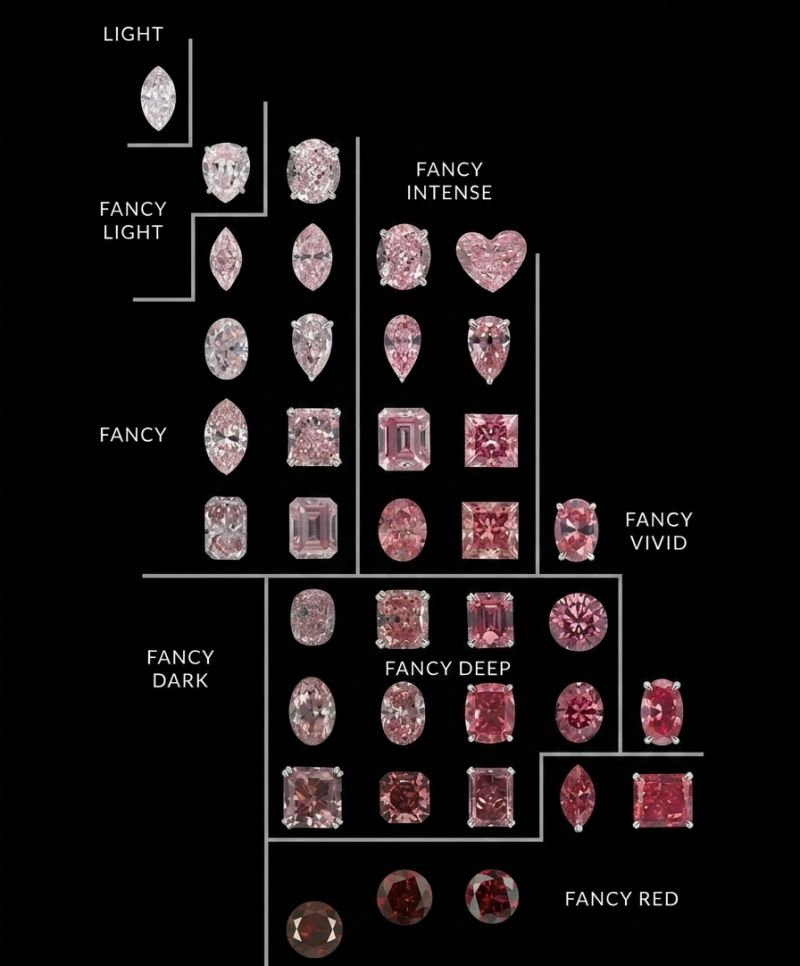
Unlike the D-to-Z scale for white diamonds, colored diamonds are graded using a descriptive scale ranging from Faint to Fancy Deep. For pink diamonds, the market focuses primarily on four major investment-grade categories:
This category is the entry point into the world of investment-grade pink diamonds. The diamonds display a soft, delicate tone with lighter saturation, often described as a pastel blush. While the color is visible, it is not overwhelming.
For buyers seeking a beautiful pink tint without the immediate multi-million-dollar price tag, Fancy Light represents a remarkable intersection of elegance and relative accessibility. They are often the starting point for collectors, offering a "wearable" luxury that is still incredibly rare.
When a diamond moves to a Fancy Pink grade, the color becomes much stronger and more apparent to the naked eye. These stones are significantly rarer than their lighter counterparts and are highly desired by collectors. The pink is unmistakable, marking a clear shift from "trace of color" to "colored diamond."
As we ascend the scale, the laws of supply and demand become punishing. Fancy Intense Pink diamonds exhibit a deep, rich appearance with much higher saturation. These stones are far more difficult to find in nature, as the crystal lattice must have been distorted with high uniformity to create such a powerful absorption band. They command significant premiums in the wholesale market, representing a serious investment for sophisticated buyers.
This is the highest grade on the GIA scale for pink diamonds. Fancy Vivid Pink diamonds display an extremely strong, vibrant, and saturated color. They are the rarest of the rare. Of the miniscule percentage of diamonds that are pink, only a fraction of one percent achieve this Fancy Vivid classification.
These stones dominate global auction records, often achieving prices per carat that are several times higher than even a Fancy Light Pink of similar weight and clarity. A Fancy Vivid Pink is not just a gemstone; it is a multi-million-dollar financial asset with provenance.
No discussion of pink diamonds is complete without acknowledging the elephant in the room or rather, the mine that is no longer there. The Argyle mine in Western Australia, which closed permanently in 2020, was responsible for producing over 90% of the world’s natural pink diamonds. While Argyle produced a massive volume of diamonds, less than 0.01% of all diamonds mined globally are naturally pink.
With the closure of Argyle, the primary source of new pink diamonds vanished. Rio Tinto, the mine's operator, now only supplies stones from dwindling stockpiles for its famous annual tender. This scarcity has had a dramatic impact on values. Prices for top-grade pink diamonds have soared, with some categories appreciating by over 390% since 2005.
The lack of fresh supply has supercharged the secondary market, where provenance especially an "Argyle Origin" has become a critical value driver. An Argyle pink with a known history can often command valuations far exceeding those of non-Argyle stones of similar grade, as the secondary market has become the only source for these coveted gems.
Beyond their beauty, pink diamonds have proven to be exceptional financial assets. According to the Fancy Color Research Foundation (FCRF), pink diamonds have been the best-performing colored diamond segment. While the broader market may experience short-term fluctuations, the long-term trajectory for pink diamonds has been one of sustained growth and wealth preservation.
In 2025, while some segments of the diamond market faced headwinds, specific pink diamond categories demonstrated remarkable resilience.
According to the FCRF Q4 2025 Index, pink diamonds have appreciated approximately 391% since 2005 the strongest performance of any fancy color category. Even amid broader market adjustments, specific categories like 1-carat fancy pinks (up 2.24%) and 1.5-carat fancy intense pinks (up 1.55%) posted notable gains.
Furthermore, the Natural Diamond Council (NDC) reported in its 2025 Fancy Colour Diamond Report that rare colored stones have climbed 205 percent since 2005, with pink diamonds alone up by nearly 400 percent. This performance has outpaced gold and many major equity indices. We have seen evidence of this at the auction houses, where record-breaking sales continue to capture headlines.
Fancy Light Pink diamonds display soft pastel tones with delicate color saturation. They are considered rare entry-level pink diamonds and generally serve as the baseline for pricing and investment value.
Fancy Pink diamonds show a more noticeable and stronger pink color. These diamonds are very rare and can command prices around 3 to 8 times higher than Fancy Light Pink diamonds, depending on factors like carat weight, clarity, and origin.
Fancy Intense Pink diamonds feature deep, rich color saturation with a more vivid appearance. They are extremely rare and are often valued at approximately 8 to 20 times the baseline Fancy Light Pink pricing.
Fancy Vivid Pink diamonds represent the highest level of pink color intensity, with vibrant and striking saturation. These ultra-rare diamonds are considered the peak of the market and can achieve investment values ranging from 20 to over 100 times the baseline Fancy Light Pink price.
Overall, these market multiples are general estimates, and actual prices can vary significantly based on the diamond’s size, clarity, cut quality, and origin.
❓ What is the difference between clarity and color for pink diamonds? For pink diamonds, color is the primary driver of value. While clarity still matters, it takes a backseat to color saturation. A general rule of thumb in the industry is that one color grade is equivalent to three clarity grades in price determination.
❓ Which is rarer: a pink diamond or a blue diamond? Both are exceptionally rare, but pink diamonds are statistically rarer in terms of supply volume. However, because the Argyle mine produced most of the world’s pinks (even if only a tiny percentage were gem-quality), natural Blue diamonds (which generally come from the Cullinan mine in South Africa) are also highly scarce. For large stones over 10 carats, the numbers are so small that auction records often set new benchmarks regardless of color.
❓ Are Argyle diamonds worth more than non-Argyle pinks? Yes, substantially. Provenance is paramount. Since the Argyle mine closure, Argyle-origin pink diamonds (especially those with an Argyle certificate or laser inscription) have developed a "mintage" status similar to rare coins.
Non-Argyle pinks such as those sourced from Brazil or South Africa are still valuable, but they lack the specific brand equity and scarcity narrative of the Argyle label. Consequently, Argyle pinks have shown stronger secondary-market price appreciation.
❓ Can laboratory-grown diamonds replicate the pink color? GIA researchers confirm that lab-grown pink diamonds do exist, but they are generally detectable through advanced spectroscopy.
The pink color in lab-grown diamonds is often more saturated and lacks the specific 550nm absorption band or distinct "pink graining" found in natural stones. While affordable, lab-grown pinks have virtually no resale value compared to their natural counterparts.
❓ Is a pink diamond a good investment for 2026? Based on current FCRF data, pink diamonds have shown a stabilization trend with pockets of growth. While the price acceleration has moderated from the extreme highs of the 2010s, the lack of new supply from Argyle suggests that fundamentals remain strong. For wealthy investors, pink diamonds serve as portable, tangible assets that have outperformed many traditional financial instruments over the past two decades.
In the modern digital economy, trading high-value assets like pink diamonds requires a platform that offers security, global reach, and transparent pricing. Whether you are looking to sell a family heirloom or acquire a Fancy Intense Pink to diversify your portfolio, the market is now accessible at your fingertips.
CaratX serves as the premier international B2B and B2C marketplace for natural diamonds and jewelry. By registering on the CaratX platform, sellers gain immediate access to a database of qualified buyers across 18+ countries. You can Start selling to diamonds in 18+ International countries by joining our network.
For buyers, the platform offers an inventory of natural diamonds and gemstones sourced from verified sellers worldwide.
You can Shop natural diamonds from here and explore our curated selection of high-value assets. The marketplace is designed to streamline the traditionally opaque process of diamond trading, providing a secure escrow system and verified logistics.
Sellers: Looking to liquidate pink diamond assets or expand your jewelry business internationally? Our seller program connects you with serious buyers and collectors across the globe.
Sellers register on CaratX marketplace here to start selling to B2B and B2C buyers directly.
Buyers: Seeking a Fancy Vivid Pink for investment or a Fancy Light for an engagement ring? Shop gemstones from our CaratX marketplace at unbeatable price and gain access to a global inventory.
Jewelry Retailers: Expand your product offerings without holding physical inventory. You can now sell Jewelry Internationally to buyers through our CaratX seller plan, tapping into a global dropshipping network.
Get Started: The registration process takes only a few minutes. Sellers register to start selling to 18+ buyers now and transform your business model.
For specific fee structures, More details about our Pricing, check here.
The world of pink diamonds is a universe governed by atomic physics, geological lotteries, and strict gemological standards. The journey from a rough stone with a distorted lattice to a polished Fancy Vivid Pink diamond selling for millions per carat is one of nature's most exclusive stories.
The GIA color scale provides the crucial framework that allows us to differentiate the beautiful from the extraordinary, and the extraordinary from the priceless.
With the Argyle mine closed and secondary markets tightening, the supply of these magnificent gems is finite.
For the savvy investor or passionate collector, understanding the nuances of color intensity and the dramatic price jumps between Fancy Light and Fancy Vivid is not just an intellectual exercise; it is the key to unlocking lasting value in an asset class that has consistently defied market gravity. As you navigate this rarefied space, let certification, provenance, and the science of color be your guide.
Image Credit - Aurelia
Jun, 15, 2026
Aug, 06, 2022
Aug, 06, 2022

0 Comments
Please login to leave a reply.