

The Journey of Diamond Cutting: From Ancient Mystery to Modern Mastery
Home
News And Media The Journey of Diamond Cutting: From Ancient Mystery to Modern Mastery SHOP NOWHome
News And Media The Journey of Diamond Cutting: From Ancient Mystery to Modern Mastery SHOP NOWApr, 07, 2026 by Archit Mohanty 0 Comments
The diamond on your finger today began its journey billions of years ago, forged in the Earth's mantle. But the breathtaking brilliance you see is a relatively recent invention, a testament to centuries of human ingenuity, artistry, and scientific discovery. The evolution of diamond cutting is a fascinating story that transformed rough, unassuming stones into the most celebrated gemstones on the planet.
For the modern collector, jeweler, or seller, understanding this history is crucial. It's not just about appreciating beauty; it's about recognizing value, identifying rare antique cuts, and understanding the science that separates a dull rock from a radiant masterpiece.
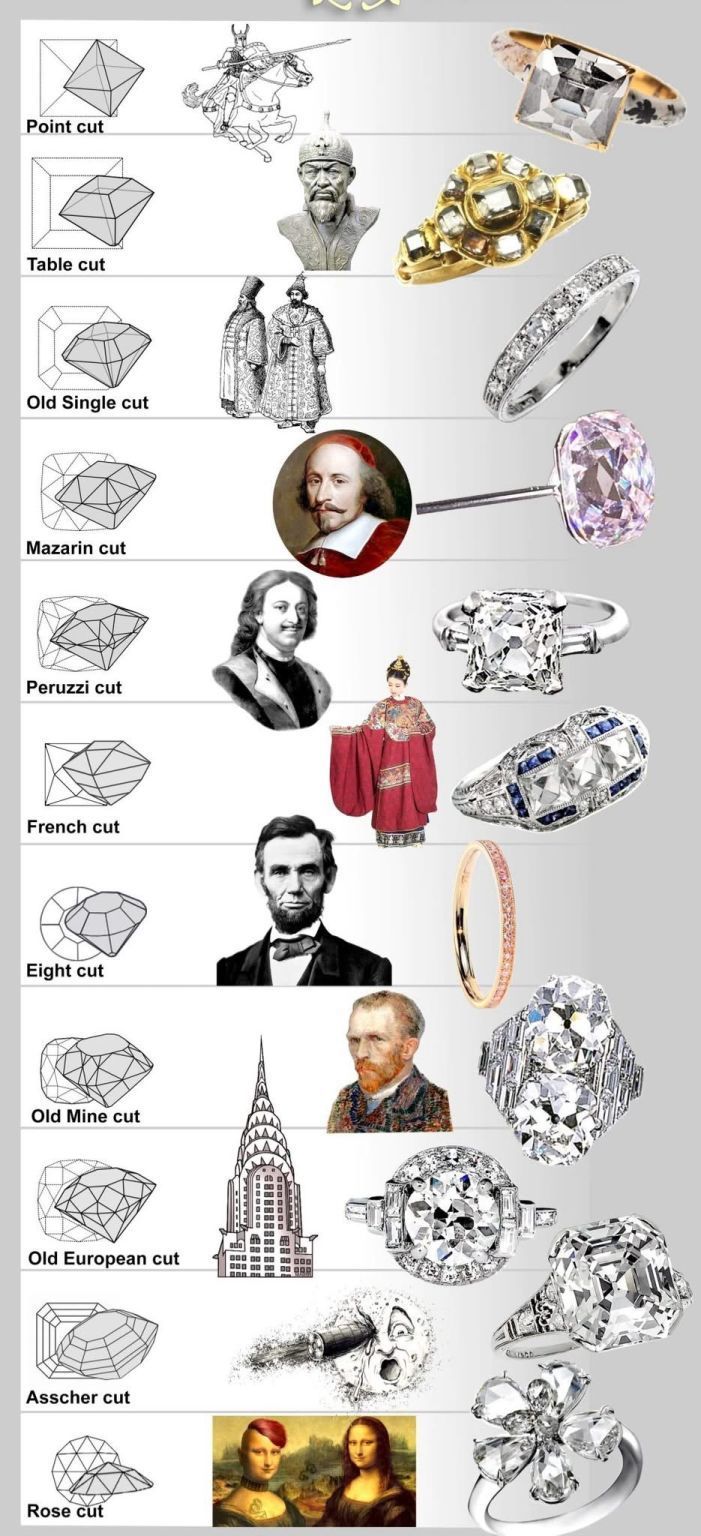
The earliest diamonds were not cut at all. In ancient India, diamonds were valued for their metaphysical properties and natural octahedral shape. The first known diamond cut, the Point Cut, emerged in Europe during the later half of the 14th century. This simple technique involved polishing the natural octahedral crystal along its existing faces, creating a symmetrical, pyramid-like shape.
While it enhanced the stone's natural geometry, it did little for sparkle. The Point Cut was less about brilliance and more about preserving the diamond's mysterious, talismanic quality.
The true turning point came in the 15th century with the Table Cut. For the first time, cutters lopped off the top point of an octahedral crystal, creating a large, flat "table" facet. This seemingly simple act allowed light to enter the diamond and reflect internally, creating a noticeable sparkle for the first time.
The Table Cut marked the beginning of faceting and is considered the grandfather of all modern brilliant cuts. As early as the 1300s, European stone cutters were changing crystals by polishing their faces so that no natural irregularities of the original crystal remained.
Building on the Table Cut, the Old Single Cut (or Single Cut) added a small octagonal table and a set of crown and pavilion facets, totaling 17–18 facets. This early brilliant-style cut improved light reflection and began to unlock the diamond's hidden fire, setting the stage for more complex faceting patterns.
The Rose Cut was a radical departure from earlier designs. Featuring a flat bottom and a domed top covered in triangular facets (usually 12 or 24), it was designed to look spectacular under the warm, flickering light of candles. Rather than exploding with brilliance, the Rose Cut glows with a soft, mysterious luster. It became a favorite in the Georgian and Victorian eras and remains highly sought after today in vintage jewelry.
According to the Gemological Institute of America (GIA) , rose cuts came later as a typical product of the sixteenth and seventeenth centuries, employing a cutting process that began with a rough cleavage fragment from a diamond octahedron.
The 17th century saw the first true "brilliant" cuts. Cardinal Mazarin, an advisor to King Louis XIV, is credited with a cut that featured 34 facets, designed to maximize sparkle. Later in the century, the Venetian cutter Peruzzi expanded the facet count to 58, creating a cut with a smaller table, larger facets, and the beginnings of the modern brilliant's fire. These cuts laid the mathematical and optical foundation for everything that followed.
As diamond supplies surged from the Brazilian mines, a new cut emerged: the Old Mine Cut. This cut is characterized by its deep proportions, small table, high crown, and a large, flat culet. When viewed from above, its outline is a soft, squarish cushion shape. The Old Mine Cut was the pinnacle of hand-cut diamonds and was designed to sparkle in candlelight.
Its chunky, geometric facets create a warm, "cushion of fire" effect that is now highly prized by collectors. This cut became popular a few decades after the discovery of the Brazilian diamond fields in the 1720s.
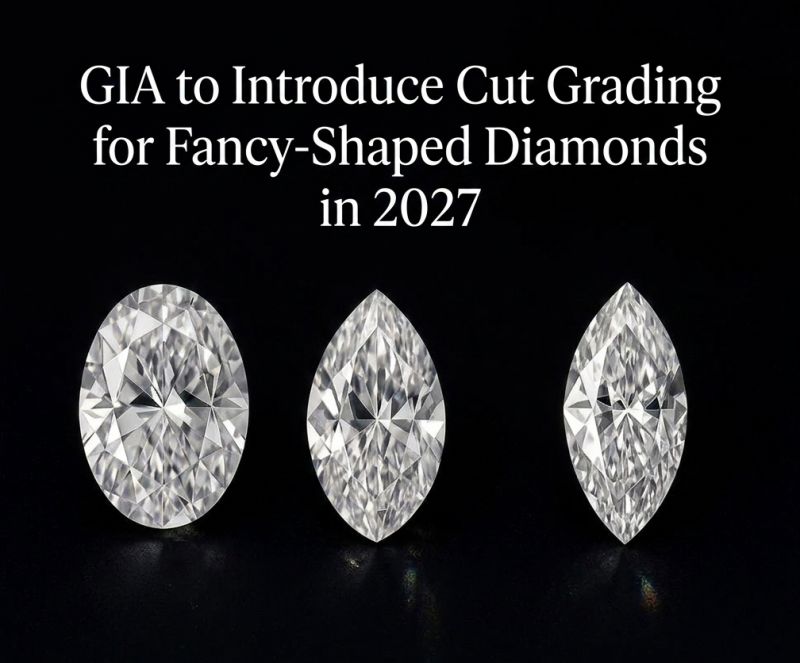
The Marquise Cut (or Navette cut) is said to have been commissioned by King Louis XV of France, who wanted a diamond that resembled the smile of his mistress, the Marquise de Pompadour. Its elegant, boat-like elongated shape with pointed ends was a marvel of craftsmanship. Today, it remains a bold, sophisticated choice for engagement rings and statement jewelry.
The Old European Cut was the first round brilliant cut, predating the modern version by decades. It was a direct predecessor to the Old Mine Cut and featured a perfectly round girdle, a high crown, a small table, and a large culet.
The facet pattern (often 58 facets) was more symmetrical and geometric. This cut was designed for the new gaslights of the late 19th century, and its brilliance was a significant leap forward.
The late 19th century brought mechanization. The invention of the steam-driven bruting machine allowed cutters to create perfectly round girdles with unprecedented consistency. This era of Transitional Cuts saw a shift from the deep, chunky Old European style to a cut with a shallower pavilion and a larger table, improving brilliance and light return. For the first time, optics and geometry began to be systematically applied to diamond cutting.
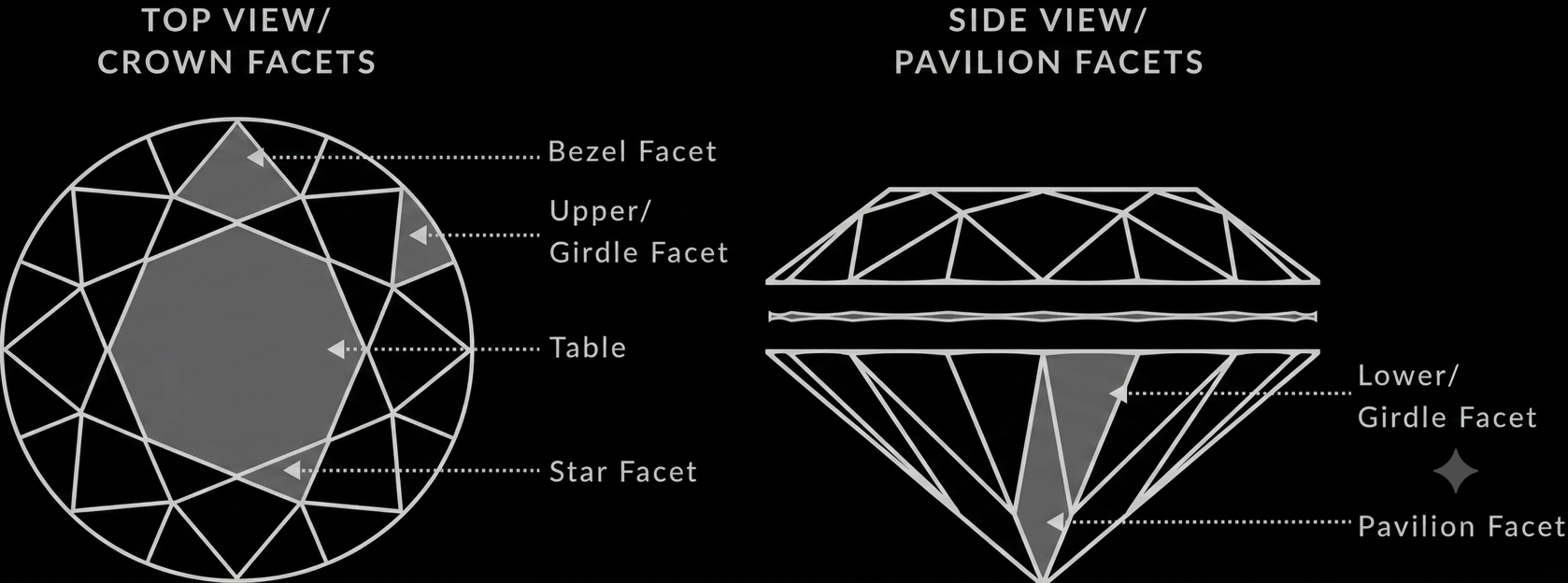
In 1919, a Belgian mathematician and diamond cutter named Marcel Tolkowsky published his thesis, Diamond Design. Using the principles of light refraction and total internal reflection, Tolkowsky calculated the mathematically "ideal" proportions for a round brilliant diamond to maximize both brilliance (white light return) and fire (colored light dispersion). The result was the Modern Round Brilliant Cut, a design with 57 or 58 precisely angled facets that is the global standard today.
Tolkowsky provided mathematical support for a new style of cutting round brilliant diamonds that was becoming increasingly popular in his time, especially in America.
Modern research from GIA further explains that this symphony of reflected light is made up of brilliance (the total light reflected from a diamond), fire (the dispersion of light into the colors of the spectrum), and scintillation (the pattern of light and dark areas and the flashes of light or sparkle when a diamond is moved). Today, 70–75% of all diamonds sold worldwide are round brilliants, a testament to Tolkowsky's genius.
Facet Count: Early cuts like the Point Cut had 0 facets, while the Rose Cut had up to 24. The Old Mine Cut had around 58 chunky facets, and the Modern Round Brilliant has 57–58 precisely cut facets.
Light Reflection: Modern ideal-cut diamonds can reflect over 90% of the light that enters them, compared to the 50–60% of earlier cuts.
Market Trends: Antique and vintage cuts (Old Mine, Old European, Rose) are experiencing a resurgence in popularity, with demand rising by 15–20% in vintage and estate jewelry markets.
Value Impact: Precision cutting is a science. A well-executed modern cut can increase a diamond's value by up to 30% compared to a poorly cut stone of the same carat weight, color, and clarity. On CaratX, you can find both precision-modern cuts and rare antique cuts to suit every taste and investment strategy.
Old Mine Cut: Look for a soft, cushion-shaped outline (almost square with rounded corners), a very deep pavilion, a large, open culet (the point at the bottom), and a small table. The facets are large and chunky.
Old European Cut: This is round in outline, with a high crown, a very small table, a large culet, and a distinct "pinwheel" or "pavilion" facet pattern visible from the top.
Rose Cut: Identify it by its flat bottom, domed top, and triangular facets that come to a point in the center, resembling a rosebud. It has no pavilion facets.
Single Cut: A very simple cut, often used for small accent stones. It typically has a round outline with a table, a crown with 8 facets, and a pavilion with 8 facets.
Understanding the history of diamond cutting empowers you to make informed, confident decisions, whether you're buying a vintage treasure, a modern masterpiece, or looking to sell. At CaratX , we connect you to a world of possibilities.
For Buyers: Explore a vast, curated marketplace of loose diamonds, gemstones, and finished jewelry. Whether you're seeking the warm glow of an Old European Cut or the fiery brilliance of a Modern Round Brilliant, you can find it here.
For Sellers: Are you a jeweler, wholesaler, or designer? CaratX is your global B2B and B2C marketplace. Join our platform and sell your inventory to buyers in 18+ international countries.
Learn More: Deepen your knowledge with our CaratX Diamond Guide and Education resources, where we break down the 4Cs and more.
The Modern Round Brilliant Cut is scientifically designed to produce the highest level of brilliance and fire. Its 57-58 facets are mathematically proportioned to act as a series of tiny prisms, reflecting the most light back to the viewer's eye.
Not necessarily. While some old cuts may have lower "cut grades" by modern standards, many are highly sought after for their unique charm and historical character. Antique cuts like the Old Mine and Old European are experiencing a surge in demand, often commanding premium prices in vintage markets.
The key difference is the outline. An Old Mine Cut has a squarish, cushion-like shape, while an Old European Cut is perfectly round. Both have a high crown, small table, and large culet, but the Old European's facet pattern is more symmetrical.
The Round Brilliant Cut consistently holds its value best due to its universal and enduring popularity. It accounts for approximately 70-75% of all diamonds sold, making it the most liquid shape in the secondary market.
The Rose Cut is among the most distinctive and rarer antique cuts, especially larger stones. Its flat-bottomed, dome-topped design is less common than the Old Mine or Old European cuts.
Follow CaratX for more insightful and educational content on diamonds, gemstones, and the art of fine jewelry.
Jun, 15, 2026
Aug, 06, 2022
Aug, 06, 2022

0 Comments
Please login to leave a reply.