
The global diamond market has entered 2026 in a state of careful recalibration. Overall trading activity remains subdued, shaped by geopolitical uncertainty, tariff volatility, and a cautious consumer environment.
Yet beneath the broad softness, a clear and persistent trend is taking hold: demand for larger, higher-quality natural diamonds is holding remarkably steady, while smaller stones continue to face sustained pricing pressure. For industry participants, the message is unmistakable the market is not shrinking uniformly but redistributing value upward, rewarding quality, certification, and strategic positioning.
This detailed report examines the major forces shaping the diamond trade today, including supply and demand dynamics, regional market performance, corporate realignments, and the growing importance of ethical sourcing and gemological standards.
It also provides actionable guidance for sellers and buyers looking to navigate the current environment through the CaratX marketplace a global platform connecting the diamond, gemstone, and jewelry industries.
Supply and Demand: A Tale of Two Markets
Overall Softness with a Strong Premium Core
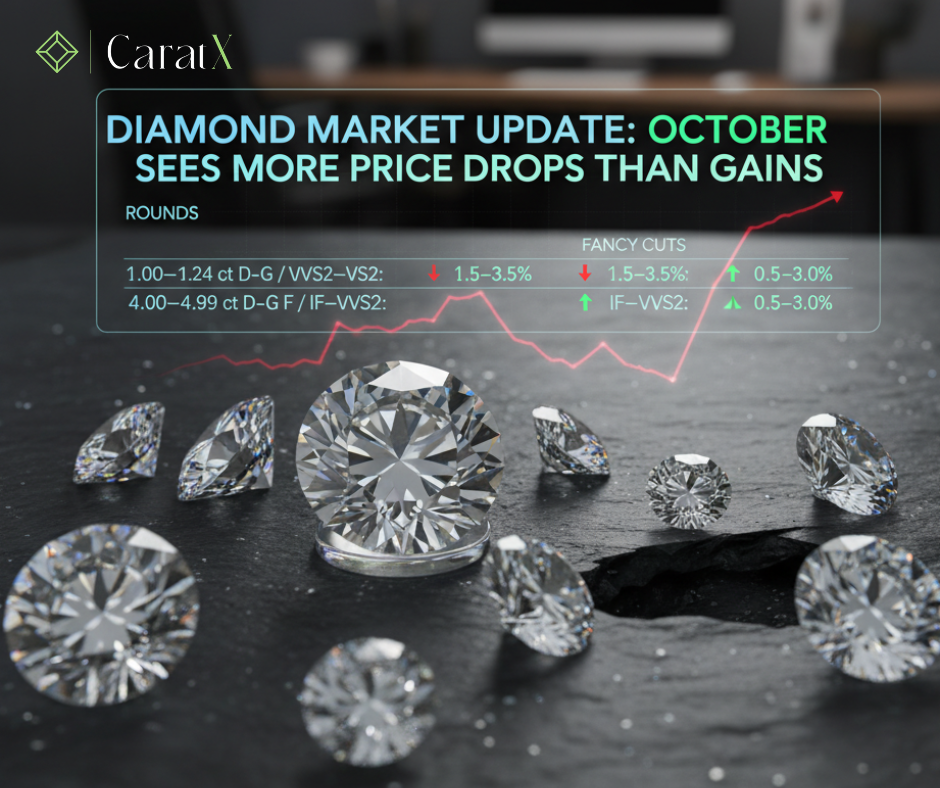
The diamond market opened 2026 with subdued sentiment and familiar pressures. According to Rapaport, December 2025 trends underscored a clear divide: polished diamonds above 1 carat held firm, while smaller goods saw sharp price corrections.
The RapNet Diamond Index for 1-carat diamonds fell 2.3% in December, while 0.30-carat and 0.50-carat goods dropped 9.3% and 6.4% respectively. The 3-carat index edged up, confirming that larger stones remain resilient.
This bifurcation deepened in February 2026. The RapNet Diamond Index for 1-carat goods fell another 1.3%, while prices for 0.30-carat, 0.50-carat, and 3-carat diamonds increased 1%, 0.3%, and 0.2% respectively. The pattern is consistent: the smallest categories are under the most pressure, while the largest are demonstrating genuine strength.
Supply Constraints Support Larger-Stone Valuations
Natural diamond production is at multi-decade lows. Global output was estimated at just over 100 million carats in 2025, the lowest annual volume since 1992. For 2026, supply is forecast to rebound only moderately to around 105 million carats down from over 150 million carats as recently as nine years ago.
Major producers are actively restricting output to support prices. De Beers cut its 2026 production guidance to 21–26 million carats, down from a previous 26–29 million carats. The company is estimated to be producing at as much as 35% below capacity. Russia’s ALROSA is also producing below capacity, albeit at a more moderate 15%.
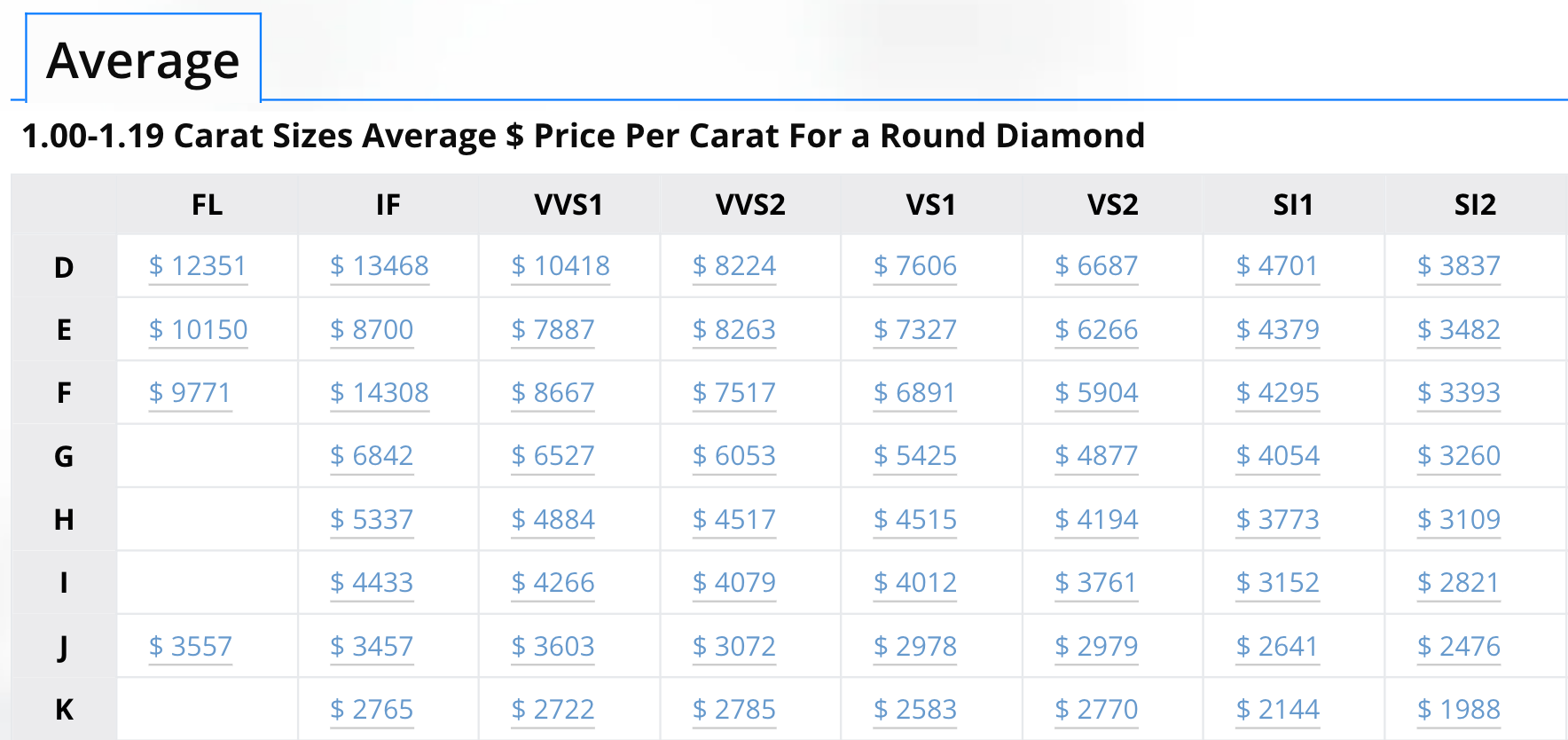
This supply discipline, combined with sustained demand for premium goods, has created a favorable environment for oversize diamonds (2.50–2.99 carats) in D–J color and VS2–SI2 clarity, which remain in short supply. Clean stones those free of black spots or large inclusions are particularly sought after by both B2B buyers and retail consumers.
For sellers looking to move premium inventory, the CaratX marketplace provides access to buyers across 18+ international markets, helping connect well-graded stones with the demand they command.
Regional Market Insights:
India:
India’s diamond market remains under significant pressure. Sentiment is low, impacted by U.S. tariff volatility and broader Middle East tensions. February 2026 export data tells a mixed story: polished exports declined 1% year-on-year to $1.1 billion, while rough imports increased 8% to $799 million. The divergence suggests manufacturers are cautiously building rough inventory in anticipation of future demand, while polished sales remain constrained by weak international orders.
The U.S. and India reached an agreement on February 2, 2026, that reduced duties on Indian diamonds to 25%, with plans to abolish levies completely.
For Indian manufacturers and exporters, navigating this environment requires efficient access to international buyers. The seller registration portal on CaratX enables Indian diamantaires to connect directly with B2B and B2C customers in over 18 countries, bypassing some of the traditional distribution friction.
Dubai and Israel:
The Dubai and Israel diamond markets are operating at near standstill levels. Trading activity is minimal, with limited movement in both rough and polished segments. The Iran war has added to uncertainty, particularly affecting Israel, while Dubai an important trading hub for both rough and polished diamonds has seen reduced commercial volumes. Regional conflict and supply chain disruptions have dampened activity, though market participants are watching for signs of stabilization later in the year.
De Beers Sightholder Restructuring
De Beers is undertaking a major restructuring of its sightholder network. The company has cut its roster of authorized buyers from approximately 70 to between 45 and 50 a reduction of roughly one-third. This is reportedly the second-largest cut since the sightholder system was introduced in 1934. Existing contracts, originally signed in 2021 and extended through June 30, 2026, will be replaced by a new roster effective July 1, 2026.
The revised list is expected to include only a limited number of sightholders in traditional centers such as New York and Israel, while at least one new entrant from India has reportedly been added. The move reflects De Beers’ strategy of creating a more selective client base capable of reliably taking volume during tough market conditions. The sightholder network has contracted dramatically from its peak of more than 350 in the 1970s.
World Federation of Diamond Bourses:
Amid these challenges, the World Federation of Diamond Bourses (WFDB) has approved a significant and dedicated budget for the global promotion of natural diamonds. The organization intends to focus primarily on Millennials and Generation Z, expanding its program across digital and social platforms. WFDB president Yoram Dvash noted that the industry is seeing early signs of a reversal in the rough market, with demand strengthening and premiums returning in some segments.
For sellers aligned with this push toward natural diamonds, the CaratX platform offers an ideal channel. Buyers can shop natural diamonds directly from the marketplace, with access to verified inventory and transparent pricing.
Retail and Corporate Performance:
Signet Jewelers: Strong Profit Recovery
Signet Jewelers, the world’s largest diamond jewelry retailer, reported full-year fiscal 2026 sales of $6.81 billion, a 1.3% same-store sales increase. More striking was the profit performance: net income surged 381% to $294.4 million, up from $61.2 million in fiscal 2025. Operating income increased to $393.1 million, compared to $110.7 million in the prior year.
Average unit retail (AUR) increased approximately 7% annually, with growth in both bridal and fashion categories. This underscores the broader market trend: consumers are spending more per transaction, even if overall unit volumes remain under pressure.
Gem Diamonds:
In contrast, Gem Diamonds reported a challenging year. Revenue fell 36% to $98.4 million, driven by a $77.5 million impairment of the carrying value of its Letšeng mine in Lesotho. The impairment was attributed to “downward pressure on the rough diamond market” and currency effects.
The company recorded an overall pretax loss of $92.1 million, compared to a $12.4 million profit a year earlier.
The Letšeng mine remains one of the world’s highest-value diamond deposits, known for producing large, exceptional white diamonds.
Lucara Diamond:
Amid the general softness, Lucara Diamond Corp. provided a bright spot with the recovery of a 36.92-carat Type IIb blue diamond from its Karowe Mine in Botswana. The stone rare due to the presence of boron, which imparts a blue hue was recovered through X-ray transmission (XRT) technology processing historic stockpile material. Lucara has also recovered five diamonds exceeding 100 carats from stockpile processing in 2026 to date.
The find underscores that high-value, exceptional stones remain a critical revenue stream for producers, even as the broader rough market faces headwinds.
The Natural vs. Lab-Grown Debate:
Lab-Grown’s Growing Footprint -
Lab-grown diamonds continue to capture market share, particularly in the engagement ring segment. According to The Knot, synthetics now account for 61% of U.S. engagement-ring center stones. This represents a dramatic shift from just a few years ago and has intensified pricing pressure on smaller natural diamonds.
For sellers and buyers on CaratX, understanding these grading standards is essential. The platform provides access to certified diamonds and gemstones, enabling informed transactions based on verified quality metrics.
Strategic Implications for Sellers and Buyers
For Sellers:
The current market environment favors sellers who can supply premium, well-graded stones in larger carat weights. Oversize diamonds (2.50–2.99 carats) in D–J color and VS2–SI2 clarity remain in short supply, while smaller diamonds face persistent price pressure. Clean stones free of black spots or large inclusions command meaningful premiums.
International expansion is a key opportunity. CaratX enables sellers to reach buyers in over 18 countries, bypassing traditional distribution bottlenecks. The seller registration portal allows manufacturers, wholesalers, retailers, and dealers to list their inventory and connect with global demand.
For those selling jewelry internationally, the CaratX seller plan for jewelry provides a dedicated pathway to B2B and B2C customers worldwide.
Detailed pricing information is available for sellers looking to optimize their marketplace strategy.
For Buyers:
Buyers seeking high-quality natural diamonds will find the best value in the premium segments where supply is constrained. The CaratX marketplace offers access to natural diamonds, gemstones, and jewelry at competitive prices, with transparent grading and verification.
Gemstone buyers can shop gemstones from the same marketplace, accessing a curated selection of colored stones at unbeatable prices.
Looking Ahead: Market Outlook for 2026 and Beyond
Price Stability Expected by Mid-2026
Industry analysts expect price stability to return by mid-2026, though caution that stability should not be mistaken for growth. Long-term demand remains intact, particularly at higher price points, as affluent consumers continue to value natural diamonds for their rarity, heritage, and enduring appeal.
Frequently Asked Questions (FAQ)
Q1: Are larger diamonds a better investment than smaller ones right now? Yes, current market data shows that diamonds of 2 carats and above are holding value significantly better than smaller stones. The 3-carat RapNet index has shown resilience while 0.30- and 0.50-carat goods have seen sharp declines.
Q2: How do I sell my diamonds internationally? CaratX provides a direct channel to buyers in over 18 countries. Register as a seller to list your inventory and access global B2B and B2C demand.
Q3: Are lab-grown diamonds ethically superior to natural diamonds? The answer depends on which factors you prioritize. Lab-grown diamonds generally have a lower carbon footprint per carat. However, natural diamond mining, when responsibly managed, provides employment and economic development in resource-dependent communities. The University of Delaware’s Dr. Saleem Ali notes that social impacts are more complex and require case-by-case assessment.
Q4: What is the Kimberley Process? The Kimberley Process Certification Scheme (KPCS) is an international certification system that requires rough diamond shipments to be accompanied by a forgery-resistant certificate, ensuring they are sourced from conflict-free zones. The process is governed by a rotating chair, with India serving as Chair for 2026.
Q5: How can I verify diamond quality before purchasing? Reputable sellers provide certification from established gemological laboratories such as GIA. Educational programs in gemology are offered at institutions like the University of Arizona and City University of Hong Kong, which teach the 4Cs grading system. On CaratX, all listings are subject to quality assurance standards.
Q6: Is the diamond market expected to recover in 2026? Analysts expect price stability to return by mid-2026, but caution that stability should not be mistaken for growth. Supply discipline from major miners (De Beers and ALROSA) is supporting prices, while demand for premium goods remains intact.
Q7: Can I buy gemstones on CaratX as well as diamonds? Yes. CaratX is a full-service marketplace for diamonds, gemstones, jewelry, and pearls. You can shop gemstones alongside natural diamonds, all in one platform.
For the latest diamond market insights, follow CaratX . To start selling or buying diamonds, gemstones, and jewelry internationally, visit www.caratx.com or register as a seller at www.caratx.com/register.