
Ear piercings have evolved from a simple cultural tradition into a dynamic form of self-expression and fashion. In the modern era, curating the perfect "earscape" is akin to creating a piece of wearable art. Whether you are considering your first piercing or looking to add to an existing constellation of jewelry, understanding the nuances of each style is crucial.
At CaratX, we bridge the gap between personal style and high-quality materials. As you plan your next piercing, remember that the jewelry you choose is just as important as the piercing itself. From hypoallergenic studs to elegant diamond hoops, shopping for certified jewelry on our marketplace ensures your style is both safe and stunning.
Here is an exhaustive deep dive into the world of ear piercings, designed to help you make informed decisions while understanding the anatomy, pain levels, healing times, and jewelry options available.
The Anatomy of the Ear:
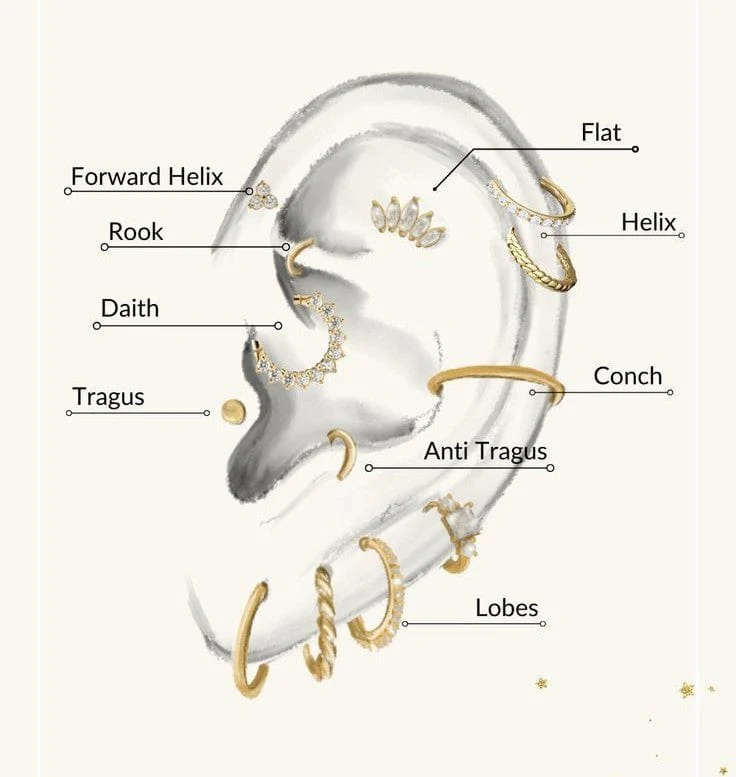
Before we delve into specific piercing types, it is essential to understand the basic anatomy of the ear. The ear is composed of soft tissue (the lobe) and harder cartilage (the rest of the outer ear). Cartilage piercings generally take longer to heal than lobe piercings because cartilage has less blood flow. This lack of vascularization means you must be more diligent with aftercare to avoid complications like hypertrophic scarring or keloids.
According to the Mayo Clinic, proper hygiene and choosing the right material for your jewelry are the most critical factors in preventing infection. This is why sourcing your jewelry from reputable marketplaces like CaratX is vital; we prioritize quality and authenticity.
A Detailed Breakdown of Popular Ear Piercing Styles -
Here is a look at the most popular piercings, from the classic lobe to the edgy industrial.
1. Lobe Piercing
Anatomy: The fleshy lower part of the external ear.
Pain Level: 2/10.
Healing Time: 6–8 weeks.
Details: This is the entry point for most people into the world of body modification. It is the most forgiving piercing due to the soft tissue and high blood flow, making it quick to heal. Because the lobe can stretch slightly over time, it is the perfect place to wear heavier statement earrings.
Jewelry Options: The possibilities are endless. You can start with classic diamond studs or simple gold balls. For those looking to upgrade their look, CaratX offers a wide range of natural diamond earring options suitable for healed lobes.
2. Upper Lobe Piercing
Anatomy: The cartilage/flesh transition zone just above the standard lobe piercing.
Pain Level: 3/10.
Healing Time: 2–4 months.
Details: This piercing is perfect for creating a "stacked" look. It allows for visual balance and symmetry when paired with a lower lobe piercing. It is often the first "cartilage-adjacent" piercing people get because it is still relatively easy to care for.
Jewelry Options: Small hoops or dainty studs work best here.
3. Helix Piercing
Anatomy: The upper outer rim of the ear, made of cartilage.
Pain Level: 4/10.
Healing Time: 3–6 months (sometimes up to a year).
Details: The standard helix is one of the most common cartilage piercings. Because it is located on the rim, it is prone to being snagged by hair, masks, or clothing. Patience is key during the healing process. You can also get a "Double Helix" or "Triple Helix," which follows the curve of the ear.
Jewelry Options: Tiny hoops, labret studs, or curved barbells. For a touch of luxury, consider browsing the gold jewelry collections available through our sellers on CaratX.
4. Forward Helix Piercing
Anatomy: The front side of the helix, where the ear cartilage meets the face/temple.
Pain Level: 5/10.
Healing Time: 4–7 months.
Details: This piercing sits in a slightly tucked-away area, making it a trendy and subtle choice. It is often done in sets of two or three to create a "constellation" effect along the front ridge.
Jewelry Options: Small gemstone studs or tiny bezel-set diamonds look incredible here. They catch the light from the front, adding sparkle to your profile.
5. Tragus Piercing
Anatomy: The thick, small cartilage flap that partially covers the ear canal.
Pain Level: 5/10 (Sharp pinch due to nerve density).
Healing Time: 6–12 months.
Details: The tragus is a trendy choice that frames the face beautifully. However, due to its location, it can be sensitive to pressure from earphones or headphones. It is essential to use high-quality materials here to prevent irritation.
The Association of Professional Piercers (APP) recommends implant-grade titanium or 14k+ gold for initial tragus piercings to avoid nickel allergies. You can find certified sellers on CaratX who meet these material standards.
6. Anti-Tragus Piercing
Anatomy: The ridge of cartilage opposite the tragus, directly above the earlobe.
Pain Level: 6/10.
Healing Time: 6–12 months.
Details: This is a more advanced and less common piercing. The anatomy of this area varies significantly from person to person; not everyone has a pronounced enough ridge to accommodate this piercing. It can be difficult to heal because of its location and thickness.
Jewelry Options: Small curved barbells or captive bead rings.
7. Conch Piercing
Anatomy: The large, bowl-shaped "inner shell" of the ear (the central cartilage area).
Pain Level: 5/10.
Healing Time: 6–12 months.
Details: There are two types: the inner conch (closer to the ear canal) and the outer conch. This area provides a beautiful canvas for jewelry. Many people start with a stud and later switch to a hoop that hugs the outer edge of the ear.
Jewelry Options: Large gemstones or ornate studs are popular. For a unique look, browse the loose diamonds and gemstones on CaratX to have a custom piece made by a jeweler.
8. Daith Piercing
Anatomy: The innermost fold of cartilage, located just above the ear canal opening.
Pain Level: 5/10.
Healing Time: 6–9 months.
Details: The daith piercing is often discussed in alternative health circles for its supposed ability to help with migraines. While Johns Hopkins Medicine notes that there is limited scientific evidence to support this (based on acupuncture pressure points), many individuals anecdotally report relief. Aesthetically, it is a stunning and intricate piercing.
Jewelry Options: Curved barbells or seamless rings are the standard choice.
9. Rook Piercing
Anatomy: The vertical ridge of cartilage located just above the tragus, in the anti-helix.
Pain Level: 6/10.
Healing Time: 6–12 months.
Details: The rook is a stylish, tucked-away piercing that adds an element of surprise to your ear curation. It is a vertical piercing, which means the entry and exit points are on the same ridge.
Jewelry Options: A curved barbell is the only suitable option for the rook's anatomy.
10. Snug Piercing
Anatomy: The horizontal ridge of cartilage running parallel to the outer edge of the ear, in the anti-helix area.
Pain Level: 7/10.
Healing Time: 8–12 months.
Details: Known as one of the most difficult piercings to heal, the "snug" (or anti-helix) requires a very specific anatomy. The ridge must be deep enough to accommodate the jewelry. Due to its location, it is prone to irritation and swelling.
Jewelry Options: A short, curved barbell is typically used.
11. Industrial Piercing
Anatomy: Two holes, one on the lower helix and one on the upper helix connected by a single piece of jewelry (usually a long barbell).
Pain Level: 7/10.
Healing Time: 9–12 months.
Details: The industrial is a statement piercing. It requires a consultation with a piercer to ensure your ear's anatomy has the correct angles. If the angles are off, the barbell can put pressure on the flat part of the ear, causing pain and migration (rejection).
Jewelry Options: A straight barbell is standard, though custom bent barbells are available for unique anatomies.
If you have a healed industrial and want to upgrade your jewelry, check out the CaratX B2B section where professional jewelers offer high-end titanium and gold components.
The Science of Healing:
Regardless of which piercing you choose, the healing process is universal. When you pierce the skin, your body initiates an inflammatory response. This is why redness, swelling, and tenderness are normal initially.
However, complications arise when the jewelry material contains impurities or allergens. Nickel is a common allergen found in cheap jewelry. According to a study cited by the National Center for Biotechnology Information (NCBI) , nickel allergy is one of the most common causes of contact dermatitis in the world.
To avoid this, always opt for:
Implant-grade Titanium (ASTM F-136)
Niobium
14k or 18k Solid Gold (not plated or filled)
Platinum
At CaratX, we ensure that all our sellers list the specifications of their products. You can filter for these high-quality materials to ensure your new piercing heals properly. Register as a Seller on CaratX today if you are a jeweler specializing in hypoallergenic body jewelry.
Curating Your Ear:
The modern trend is to view the ear not as a place for one or two piercings, but as a gallery space. Ear curation involves planning piercings over time to achieve a cohesive look.
Steps to Curate:
Consult a Professional: A piercer can assess your anatomy and suggest placements.
Start with the Lobe: Always get your foundational piercings (lobe and lower helix) first.
Heal Sequentially: Don't get more than 3-4 piercings healing at once, as this taxes your immune system.
Mix Metals and Textures: Once healed, experiment with mixing gold, silver, and diamonds.
Shop for Quality: When you're ready to invest in the final look, Shop Natural Diamonds at CaratX to find pieces that will last a lifetime.
Frequently Asked Questions (FAQ) -
Q: What piercing helps with anxiety? A: There is no scientific consensus, but the Daith piercing is often rumored to help with anxiety and migraines due to its location on an acupuncture pressure point. Always consult a medical professional for anxiety treatment.
Q: What is the most painful ear piercing? A: Generally, piercings through thicker cartilage, such as the Industrial, Snug, or Anti-Tragus, are considered the most painful due to the density of the tissue and the number of nerve endings.
Q: Can I wear headphones with cartilage piercings? A: During the healing process, it is best to avoid over-the-ear headphones as they press against the cartilage. Earbuds can also irritate a healing Tragus or Daith. Consider using speaker mode or bone conduction headphones until the piercing is fully healed.
Q: How do I know if my piercing is healed? A: Healing is a gradual process. The piercing will no longer be red, sore, or produce lymph fluid. However, cartilage can look healed on the outside long before it is healed on the inside. Wait the full recommended time (usually 6-12 months for cartilage) before changing jewelry or leaving it empty for extended periods.
Q: Where can I buy genuine diamond jewelry for my piercings? A: You can find certified, natural diamonds and gemstones perfect for upgrading your piercings on the CaratX Marketplace . We connect buyers with verified sellers globally.
Conclusion -
Ear piercings are a journey of self-expression. Whether you opt for the subtlety of a single lobe stud or the bold statement of an industrial bar, understanding the anatomy, healing process, and jewelry options is paramount. Remember, the cheapest part of getting a piercing is the piercing itself; the jewelry is your long-term investment.
By choosing high-quality materials and certified gemstones from trusted sources like CaratX , you ensure that your style remains timeless and your body remains healthy.
Ready to elevate your jewelry collection?
Shop for Certified Diamonds & Gemstones: https://caratx.com/search-results/diamond
Sell Your Jewelry to 18+ International Countries: www.caratx.com/register
Check Seller Pricing & Plans: CaratX Pricing
Follow CaratX for more educational content on diamonds, gemstones, and jewelry styling.
Image Credit - Jewelove