
The year 2025 has become a pivotal moment for the global jewellery industry, not due to a shift in design trends, but because of a fundamental reshaping of its very foundation: the metals themselves. For centuries, jewellery making has balanced artistry with material availability, but current macroeconomic forces are rewriting the rules.
Metals are no longer passive, inert substances; they are dynamic, strategic assets influenced by tectonic shifts in technology, energy, and geopolitics. This article delves deep into the top-performing metals of 2025, analyzes the complex forces driving their demand and supply, and provides a strategic roadmap for jewellery brands navigating this new, more volatile landscape.
The Macro Drivers:
To understand the jewellery industry's challenges, one must look beyond it. The global push for decarbonization, digitalization, and infrastructure renewal is creating an unprecedented resource nexus.
The massive rollout of solar panels, wind turbines, and grid-scale battery storage is consuming vast quantities of silver (for conductive paste), copper (for wiring), and palladium (in hydrogen technologies). The U.S. Geological Survey (USGS) highlights the critical mineral status of many of these metals, underscoring their strategic importance.
The next generation of semiconductors, 5G/6G infrastructure, and AI hardware requires specialized materials. Gallium, Indium, and Germanium are crucial, but this industrial focus tightens refining capacity and investment for traditional jewellery metals sourced from similar ores.
Nations are prioritizing supply chain security for critical materials. Initiatives like the U.S. Inflation Reduction Act and the European Critical Raw Materials Act are redirecting metal flows towards domestic industrial projects, creating competition between a national battery plant and a jewellery manufacturer for the same refined gold or palladium output.
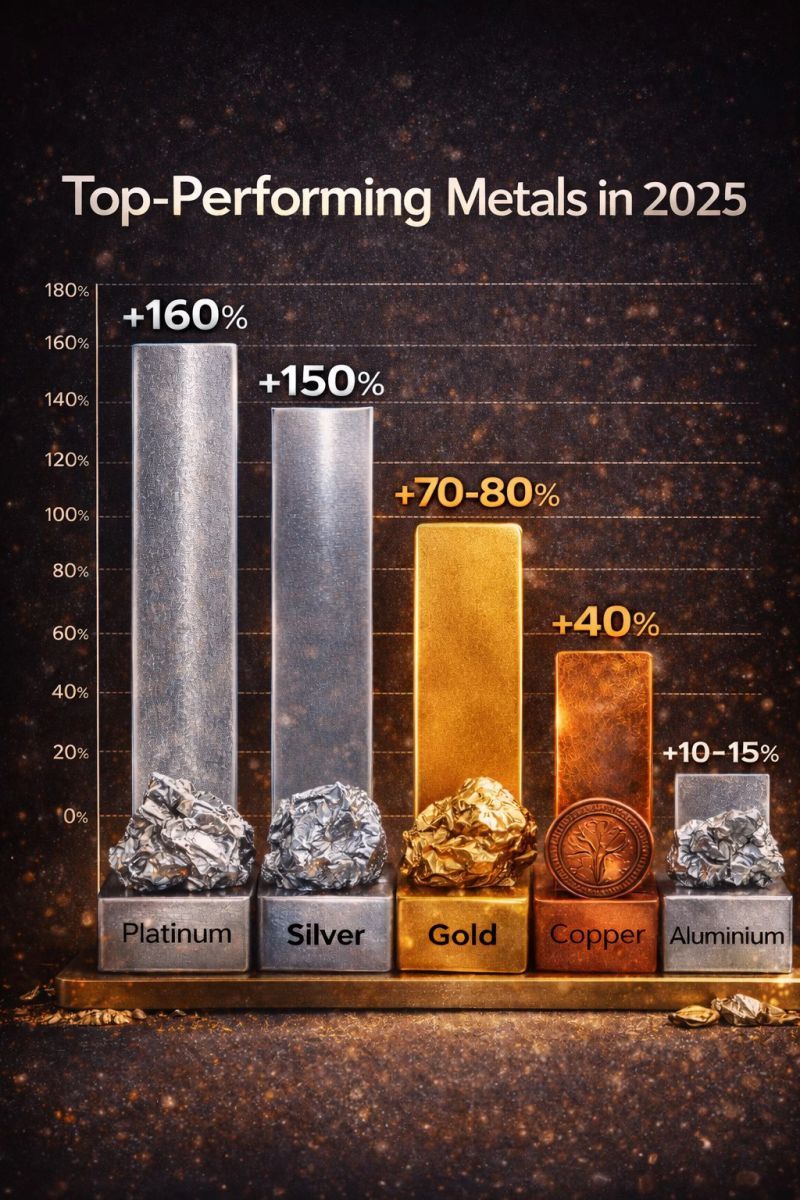
Top-Performing Metals of 2025:
1. Silver:
Performance: Exceptional demand, significant price volatility.
Drivers: Silver's unparalleled conductivity makes it indispensable in photovoltaics (over 100 million ounces consumed annually in solar panels) and a wide array of consumer electronics.
Impact on Jewellery: Jewellery, which accounts for a significant portion of silver demand, now competes directly with high-growth, policy-driven sectors. This leads to:
Tighter Margins: Brands must absorb or pass on sharper price swings.
Ethical and sustainable sourcing, like the silver available on our CaratX marketplace, becomes a key differentiator as buyers become more conscientious.
Design Innovation: Increased use of silver plating, vermeil, or composite materials to maintain affordability.
2. Gold:
Performance: Strong but pressured; high prices with supply constraints.
Drivers: While always a financial safe-haven, gold is also critical in high-end electronics (like the natural diamonds we source, often set in high-purity gold). Central bank buying continues at a record pace, as noted by the World Gold Council, draining above-ground reserves.
Impact on Jewellery: This creates a dual reality:
Luxury Segment Resilience: High-end consumers are less price-sensitive, but expect unparalleled craftsmanship and provenance.
Bridal & Volume Challenge: The core market feels the pinch. Brands respond with smarter engineering hollow designs, thinner bands, and precise alloying to maintain perceived value while controlling weight.
Exploring alternative gemstones as focal points can offset gold weight.
3. Platinum Group Metals (PGMs):
Performance: Extremely volatile, subject to sudden supply shocks.
Drivers: Platinum and Palladium are primarily driven by automotive catalytic converter demand (despite the EV shift) and emerging hydrogen economy applications. South Africa and Russia dominate supply, leading to geopolitical risk premiums.
Impact on Jewellery: PGM jewellery (especially platinum's prestige in bridal) faces unique challenges:
Price Unpredictability: Makes fixed-price marketing campaigns risky.
Supplier Partnership Imperative: Long-term contracts with trusted refiners are essential. For brands looking to offer PGMs, establishing a reliable B2B supply chain is non-negotiable.
4. Copper & Its Alloys:
Performance: Soaring demand, long-term supply concerns.
Drivers: Copper is the "metal of electrification." Every EV, charging station, and renewable energy project uses significantly more copper than its fossil-fuel counterpart.
Impact on Jewellery: While not always front-and-center, copper is the base for many brass, bronze, and shibuichi alloys. Rising copper costs ripple through all non-precious metal jewellery components and findings.
Strategic Implications for Jewellery Brands -
1. From Seasonal to Strategic Sourcing -
The era of ordering metal quarterly is over. Brands must develop 12-24 month sourcing forecasts and build deeper relationships with a network of verified suppliers. Platforms that offer transparent, auditable supply chains will be invaluable.
2. Dynamic Pricing and Margin Management -
Static pricing is a margin killer. Successful brands will implement technology-enabled pricing models that factor in real-time metal indices, hedging strategies, and product-level margin analysis.
3. Material Innovation as a Brand Pillar
This is the moment to champion innovation:
Revival of Alternative Alloys: Re-explore historical and cultural alloys like shakudo (gold-copper) or tumbaga.
Embrace of Recycled Content: Marketing jewellery made from 100% recycled precious metals isn't just eco-friendly; it's a supply chain buffer. Learn more about sustainable sourcing on our Pricing and Launch information page.
Transparency as Marketing: Educate consumers on why a piece costs what it does. A story about responsibly sourced, traceable metal adds tangible value.
4. Designing for the New Reality
Weight Optimization: Use advanced CAD software to design pieces that are structurally sound but materially efficient.
Modularity: Create systems where precious metal elements can be added to a base.
Focus on Craft & Stone: Let intricate craftsmanship or stunning gemstones from our CaratX marketplace become the primary value driver, with metal as the exquisite setting.
Conclusion:
The jewellery industry of 2025 is at a crossroads. The forces squeezing metal supply chains are not cyclical; they are structural, tied to the global energy and technology transition. The brands that will not only survive but thrive will be those that treat materials as a strategic discipline embracing forecasting, forging unbreakable supplier links, innovating in design, and educating their clientele.
This new landscape rewards knowledge, agility, and partnership. It demands a platform that provides not just products, but market intelligence, supply chain stability, and global reach.
Ready to future-proof your jewellery business? Establish your brand on a global marketplace built for this new era.
Sellers, register on the CaratX marketplace here to start selling to 18+ international B2B and B2C buyers. www.caratx.com/register
Explore our core offerings to build your collection:
Source exceptional, natural diamonds: https://caratx.com/search-results/Natural
Find unique gemstones at unbeatable prices: https://caratx.com/search-results/gemstones
Understand our full seller plan and pricing: Launch Your Products on CaratX
Frequently Asked Questions (FAQs)
Q1: Should I stop using silver due to its volatility? A: Not necessarily. Silver's beauty and tradition are enduring. The key is to manage it strategically: use recycled silver, consider it for accent details rather than full pieces, or employ hedging in your purchasing. Transparency with customers about its value story is also effective.
Q2: How can a small independent brand secure a reliable metal supply? A: This is precisely where a platform like CaratX provides leverage. By aggregating demand from many independent brands, it creates buying power and access to vetted, wholesale suppliers that individual small businesses might not secure on their own.
Q3: Are lab-grown precious metals a solution? A: While lab-grown gold and silver are technically possible, they are not currently economically or energetically viable at a commercial scale for jewellery. The focus for now remains on efficient use and recycled content.
Q4: What is the most stable metal for jewellery in this climate? A: "Stability" is relative. Gold remains the most liquid and widely traded, but its price is high. The true stability comes not from picking one metal, but from building a diversified sourcing strategy and flexible designs that can adapt to multiple material scenarios.