
When most people admire a diamond, they see beauty, status, and brilliance. But beneath the sparkle lies a universe governed by strict physical laws. While aesthetics catch the eye, it is science that defines a diamond’s true value and performance. For professionals, understanding the physics behind a diamond’s light behavior isn’t just academic it builds credibility, enables smarter pricing, and empowers confident transactions.
This deep dive into the “optical DNA” of a diamond will explore the measurable properties that separate exceptional stones from mediocre ones, and explain how you can leverage this knowledge in the marketplace.
The Core Optical Properties:
1. Refractive Index (RI):
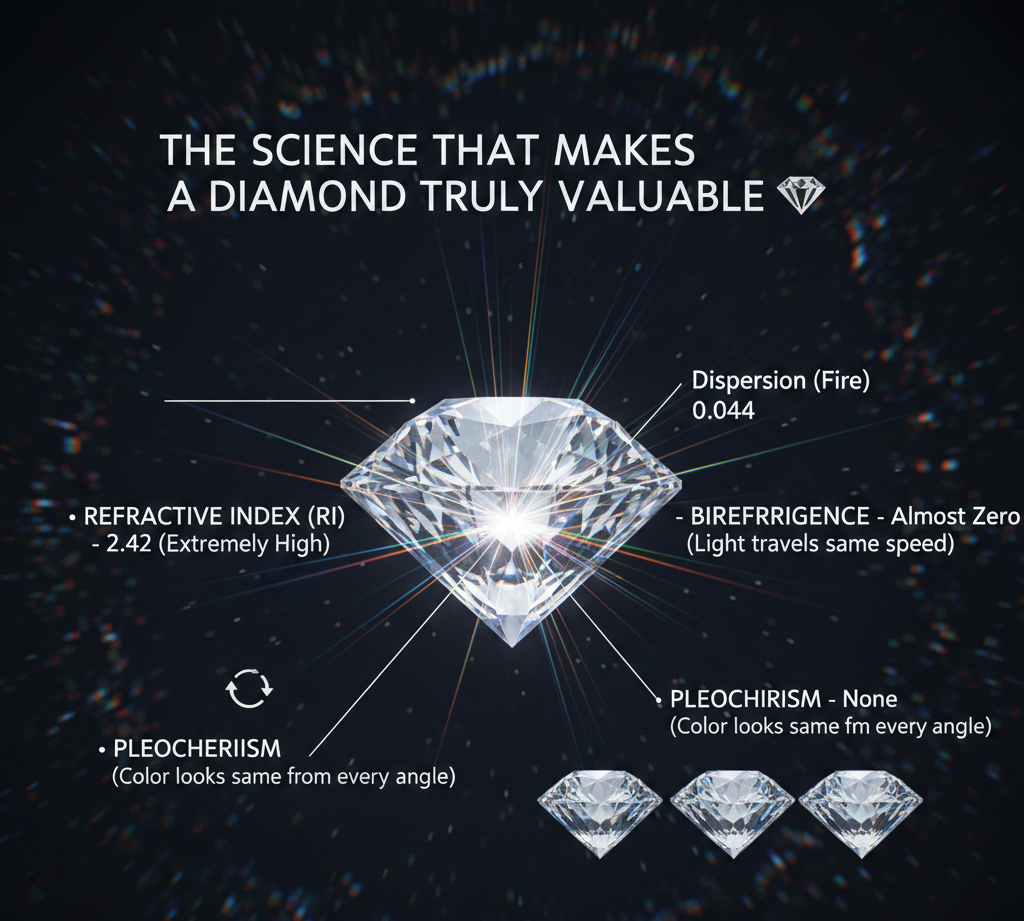
A diamond’s legendary brilliance begins with its exceptionally high Refractive Index (RI) of 2.42. To put this in perspective, most common gemstones like quartz (1.54) or even corundum (sapphire/ruby at 1.76) have significantly lower RI. This property measures how much light slows down and bends or refracts when it enters the gem from air.
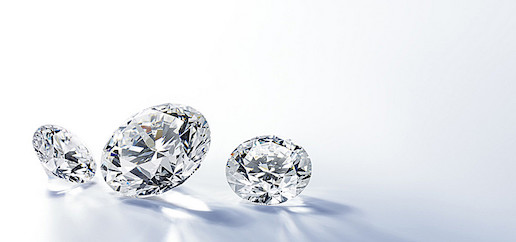
When light hits a diamond’s surface, its high RI causes a dramatic bending of light rays toward the normal (an imaginary line perpendicular to the surface). This intense refraction is the first step in creating the “life” within the stone. The light is directed inward, where it reflects off internal facets before returning to the viewer’s eye as dazzling white light, known as brilliance.
Gemologists use a gemological refractometer with a special high-RI contact liquid (typically containing sulfur and di-iodomethane) to measure this. A diamond will read “over the limit” on a standard scale, confirming its identity. For a deeper dive into refractive indices in gemology, authoritative resources like the Gemological Institute of America (GIA) Education site provide excellent reference material.
Understanding RI helps explain why a well-proportioned diamond outperforms a similarly sized stone with poor cut. It’s not magic, it’s optics. When browsing our curated inventory of natural diamonds at CaratX, you can appreciate the precision cutting that maximizes this inherent property.
2. Birefringence:
Birefringence, or double refraction, is a property where light splits into two rays traveling at different speeds through a crystal. Diamond, being an isotropic gemstone (cubic crystal system), possesses almost zero birefringence.
In anisotropic minerals like calcite or moissanite, double refraction can cause facet edges to appear doubled or blurred. Diamond’s singular refraction results in sharply defined facets and a clean, crisp sparkle. This is a key identifier in separating diamond from its common simulant, moissanite, which exhibits strong birefringence.
Using a polariscope, a gemologist can quickly observe this characteristic.
This property is crucial for authentication. A stone with sharp, singular facet reflections commands higher confidence and value. For sellers, this knowledge is power.
By registering as a seller on the CaratX marketplace, you can confidently list diamonds with verified optical characteristics, appealing to discerning B2B and B2C buyers globally.
3. Pleochroism:
Pleochroism is the display of different colors or color intensities when viewed from different crystal directions. Diamond shows no pleochroism.
Due to its cubic crystal structure and single light ray path, a diamond’s body color remains consistent regardless of viewing angle. This is particularly important for fancy color diamonds. A yellow diamond will show the same hue saturation from every direction, unlike a pleochroic gem like iolite, which can appear blue, gray, or yellow.
A dichroscope is used to check for pleochroism. Its absence supports a diamond identification and ensures accurate color grading.
For fancy color diamonds, the absence of pleochroism means the color grade is stable and viewable in any orientation, enhancing its rarity and price. Explore our exclusive collection of gemstones and colored diamonds on CaratX to see this uniformity in premium stones.
4. Dispersion:
Dispersion is the ability of a material to split white light into its spectral rainbow colors. Diamond has a dispersion value of 0.044 (measured as the difference between RI at the B and G Fraunhofer wavelengths). This is what creates the stunning flashes of red, blue, green, and orange known as fire.
When white light enters a diamond, its different wavelengths (colors) refract at slightly different angles due to dispersion. Upon exiting, these separated colors are visible as sparkling rainbows. A well-cut diamond balances brilliance (white light) and fire (colored light) for optimum beauty. In contrast, cubic zirconia (CZ) has a much higher dispersion (~0.060), which can create an excess of “fire” that appears artificial and soft to experts.
Understanding dispersion explains the visual difference between diamond, CZ, and moissanite. The International Gem Society (IGS) provides detailed charts comparing dispersion values across gem species.
A diamond’s subtle, elegant fire is a hallmark of its identity and superior cut quality. When you shop for excellent-cut natural diamonds on CaratX, you’re selecting stones optimized for this perfect balance.
Leveraging Optical Science in the Modern Diamond Trade -
Armed with this knowledge, professionals can move beyond subjective appraisal to objective analysis. This scientific framework allows for:
Accurate Valuation: Pricing based on measurable light performance.
Confident Authentication: Distinguishing diamond from advanced simulants.
Effective Communication: Explaining a diamond’s value to clients with authority.
For businesses, integrating this technical understanding with a robust sales platform is the key to growth. CaratX provides that very platform.
Your Gateway to the Global Market
Whether you are a seasoned dealer or a growing jewelry brand, the global marketplace is essential. CaratX facilitates seamless international trade.
For Sellers: Expand your reach instantly. By registering as a seller on CaratX, you gain access to a network of vetted buyers across 18+ international countries.
List your diamonds, gemstones, and jewelry with the technical descriptions that educated buyers seek. Our seller plan details outline how to launch your products effectively.
For Buyers: Source with confidence. Our marketplace offers natural diamonds and gemstones at competitive prices, backed by the scientific parameters that guarantee quality.
Frequently Asked Questions (FAQs)
Q1: Why does a diamond’s cut grade matter more than just its shape? A: The cut grade (Excellent, Very Good, Good, etc.) evaluates how well a diamond’s facets interact with light based on its proportions, symmetry, and polish.
A scientifically superior cut maximizes the optical properties discussed RI, dispersion, and internal reflection directly impacting brilliance and fire. A poorly cut diamond, even with high color and clarity, can appear dull.
Q2: How can I be sure I’m buying a real diamond and not moissanite or CZ? A: While simulants can look convincing to the untrained eye, their optical DNA differs. As discussed, moissanite shows double refraction (birefringence), and CZ has much higher dispersion. Always insist on a certificate from a reputable lab like GIA, AGS, or IGI, and purchase from trusted platforms like CaratX’s verified marketplace.
Q3: Do lab-grown diamonds have the same optical properties as natural diamonds? A: Yes, absolutely. Chemically, physically, and optically identical, lab-grown diamonds possess the same crystal structure, refractive index (2.42), and dispersion (0.044). They are real diamonds. Their value proposition is different, but their scientific performance is the same.
Q4: How does fancy color diamond science differ? A: While the core optics remain, color in diamonds is caused by trace elements (e.g., boron for blue, nitrogen for yellow) or structural anomalies (plastic deformation for pink/brown). The absence of pleochroism remains critical for consistent color grading. You can explore rare fancy color options in our gemstone and diamond collection.
Q5: As a seller, how technical should my product listings be? A: Striking a balance is key. Include the essential scientific data (cut proportions, certification lab notes on light performance) to appeal to informed buyers and build trust. The CaratX platform allows for detailed listings that can accommodate this information. Learn more about optimizing your listings on our seller information page.
Sources and Further Reading -
To ensure the highest accuracy and to provide avenues for deeper research, this article cites information from authoritative educational and scientific institutions in gemology and mineralogy.
Gemological Institute of America (GIA). Gem Reference Guide. "Diamond Optical Properties." GIA Edu
American Gem Society (AGS). The Science of Diamond Cut. AGS Lab
The Gemmological Association of Great Britain (Gem-A). Notes on Pleochroism and Birefringence. Gem-A Resources
Ready to apply science to your diamond business? Join a platform built for the modern trade. Register as a CaratX seller today and start selling to a global audience with the confidence that comes from true understanding.