
Colored Gemstone Prices Are Rising Fast in 2026: A Detailed Market Analysis
Home
News And Media Colored Gemstone Prices Are Rising Fast in 2026: A Detailed Market Analysis SHOP NOWHome
News And Media Colored Gemstone Prices Are Rising Fast in 2026: A Detailed Market Analysis SHOP NOWJun, 16, 2026 by Archit Mohanty 0 Comments
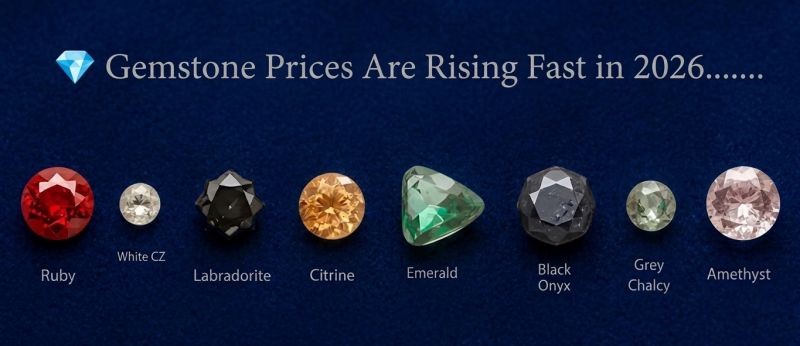
The colored gemstone market is experiencing one of its most significant rallies in recent memory. In 2026, prices for rubies, sapphires, emeralds, and a host of rare gemstones are climbing at unprecedented rates, driven by a perfect storm of supply constraints, surging global demand, and a fundamental shift in how luxury consumers perceive value.
This analysis examines the forces reshaping the gemstone industry and what they mean for collectors, investors, and jewelry professionals worldwide.
The global gemstone market has entered a period of sustained growth that industry analysts describe as structural rather than cyclical. According to Research and Markets, the gemstones market size grew from $32.96 billion in 2025 to $34.92 billion in 2026, representing a compound annual growth rate (CAGR) of 6%. Looking ahead, the market is projected to reach $44.25 billion by 2030 at a CAGR of 6.1%.
The certified gemstones segment is also expanding robustly, with projections showing growth from $10.1 billion in 2024 to $12.3 billion by 2030. Future Market Insights offers an even more optimistic forecast, projecting the global gemstone market to expand from $38.4 billion in 2026 to $72.8 billion by 2036, reflecting a 6.6% CAGR over the forecast period.
However, these aggregate figures mask a more dramatic story: the colored gemstone segment is outpacing the broader market by a significant margin. Industry reports indicate that select rubies, emeralds, and sapphires have seen prices rise three to four times in the last two years alone.
At a session on global benchmark pricing held in January 2026, noted that while colored gemstones account for about 10% of the jewelry market today, their price trajectory has been extraordinary, supported by long-term stability over five decades.
For those looking to capitalize on this trend, CaratX's marketplace offers direct access to natural diamonds, gemstones, and fine jewelry from over 16 countries and 4000+ artisan sellers.
The supply side of the gemstone equation is under immense pressure. Major mining operations are facing unprecedented challenges that are constricting the flow of rough gemstones to the market.
Gemfields, the world's largest colored gemstone miner, reported a difficult 2025 with total annual revenue dropping $64.3 million a 32.25% decline from $199.4 million in 2024 to $135.1 million.
The ruby supply situation is particularly acute. Myanmar's ongoing civil conflict has disrupted production from the world's most famous ruby sources. This has created a cascading effect throughout the supply chain, with prices for fine rubies escalating rapidly as buyers compete for diminishing inventories.
Few gemstones illustrate supply constraints more dramatically than Paraiba tourmaline. The Mozambique mine that produces some of the world's finest Paraiba tourmalines was the target of a series of land invasions in late 2024 and again in late 2025, with nearly 2,000 people illegally working the diggings during the first invasion. Concessions across Mozambique have been taken offline during civil unrest that has swept the country since disputed elections in October 2024.
The impact on prices has been staggering. Prices for Paraiba tourmaline have "doubled or even tripled since lockdowns," according to industry sources. A set of Brazilian Paraíba tourmaline earrings weighing more than 6.6 carats recently fetched $1.27 million at auction. Fine Brazilian stones can now command between $10,000 to $150,000+ per carat, with top-quality specimens reaching even higher.
The diamond sector, which shares supply chains and market dynamics with colored gemstones, is also experiencing significant production declines. In 2026, supply is forecast to only moderately rebound to around 105 million carats, remaining at multi-decade lows. De Beers Group reported a sharp 35% decline in diamond production for the fourth quarter of 2025.
These supply constraints are not temporary. The absence of new major gemstone discoveries, combined with the increasing difficulty and cost of mining, suggests that supply will remain tight for the foreseeable future.
Explore natural diamonds available through CaratX's curated selection of certified stones.
Auction houses and luxury brands are reporting extraordinary interest in colored gemstones. Recent sales data from Dawsons Auctioneers shows that auction demand is "shifting towards more ostentatious statement pieces," with colored gemstones experiencing "an explosive resurgence in auction popularity". The days of "stealth wealth" appear to be fading, replaced by a return to maximalism in jewelry design.
The numbers tell a compelling story. A Cartier brooch featuring a Kashmir sapphire recently sold for £340,000, a 325% increase from its original estimate of £80,000. A Victoria sapphire and diamond cluster bangle went for £70,000 after an original estimate of just £15,000. These aren't isolated incidents; they represent a broader trend of collectors and consumers placing unprecedented value on colored gemstones.
According to industry analysis, this demand is being fueled by generational shifts toward individuality, bespoke design, and stones with narrative depth. Millennials and Gen-Z consumers, in particular, are less attached to traditional diamond hierarchies and more receptive to expressive color.
Colored gemstones are increasingly viewed as alternative investments. With gold prices surging 39% year-on-year in 2025, some consumers are turning to gemstone-focused investments, viewing rare natural stones as inflation-resistant assets.
The price appreciation of colored gemstones has been remarkable. Prices of select rubies, emeralds, and sapphires have risen three to four times in the last two years. In some markets, gemstone prices have already risen 30% to 40% over the last two years due to supply shortages and increased demand.
The 2026 Christie's Geneva Magnificent Jewels auction provided powerful evidence of this trend. A 22.28-carat unheated Kashmir sapphire ring by Chaumet reached CHF 2.744 million. A Bvlgari 9.82-carat Kashmir sapphire crossed CHF 1.36 million. A 76.39-carat unheated cabochon sapphire mounted by Harry Winston sold for CHF 1.768 million. These prices reflect not just the beauty of the stones but their status as stores of value in an uncertain economic environment.
Register as a seller on CaratX to access 18+ international markets and connect with global buyers.
Rubies continue to command the highest prices of any colored gemstone. The per-carat prices of fine-quality rubies have been rising consistently, frequently breaking auction records.
The price disparity between untreated and treated rubies is striking. A fine 1-carat unheated Burmese ruby can sell for $35,000 per carat, while a heated African stone of similar size might bring closer to $4,000. A 4.2-carat unheated Mozambique ruby recently sold for $28,500 per carat.
The finest rubies come from Myanmar and are known for their vivid "pigeon blood" red color, with top specimens reaching up to $1.2 million per carat. However, Myanmar's ongoing civil conflict has severely disrupted production, further constraining supply and driving prices higher.
Sapphires, particularly unheated stones from Kashmir and Burma, continue to achieve record prices at international auctions.
High-quality unheated sapphires are seeing price increases of 15% to 20%, with rare Kashmir and Burmese stones commanding extraordinary premiums. Unheated sapphires are typically priced 30-50% higher than comparable heated stones. Over the past decade, the price of unheated sapphires has steadily increased due to rising demand and limited supply.
The market for large-carat unheated sapphires is particularly robust. With no meaningful increase in rough supply expected, natural sapphires of 5 carats and above especially from Sri Lanka are poised for renewed price momentum.
The emerald market has shown remarkable resilience despite broader luxury market volatility. Recent Gemfields auctions of higher-quality emeralds achieved total revenues of $32 million, with 100% of lots sold and an average price of $160.78 per carat. The inclusion of exceptional material, such as the 11,685-carat Imboo emerald, reinforced both scarcity and confidence in the market.
The finest emeralds typically range from $10,000 to $30,000 per carat, while commercial-grade stones sell for $500 to $3,000 per carat. Untreated emeralds are extremely rare and command premium prices due to their unaltered state. However, the type and extent of treatment must be disclosed, as more intensive treatments typically lower an emerald's value compared to lightly oiled stones.
Shop gemstones from CaratX's marketplace at competitive prices.
Paraíba tourmaline has emerged as one of the most valuable gemstones in the world. Its neon blue color, found only in Mozambique, Nigeria, and Brazil, has captured the imagination of collectors and luxury brands alike.
The price trajectory of Paraíba tourmaline is extraordinary. In the early 1990s, fine Brazilian stones sold for $2,000-$5,000 per carat. By the 2010s, prices had reached $30,000-$60,000 per carat. Today, top-quality specimens can exceed $300,000 per carat. The Financial Times recently reported that Paraíba tourmaline is "outpacing gold and inflation," with prices growing more than 15 times faster than gold.
Luxury brands such as Bvlgari and Tiffany & Co have heavily featured Paraiba tourmaline in their collections since the pandemic. Demi Moore wore a $7.3 million Chopard necklace at the 2024 Cannes Film Festival featuring a giant 34-carat Paraíba. Katy Perry, Rihanna, Beyonce, and Zendaya have all been seen wearing Paraibas.
Spinel is experiencing a renaissance among collectors. Vietnamese spinel in pastel colors is in particularly high demand, with prices rising due to the fact that only small finds are being mined now.
One of spinel's key advantages is that it tends not to be heated or treated the way rubies and sapphires often are, so customers can be confident that what they are buying is a truly natural gemstone. This authenticity, combined with its beauty and rarity, has made spinel increasingly popular with discerning collectors.
Learn more about selling jewelry internationally through CaratX's seller plan.
One of the most significant trends in the 2026 gemstone market is the growing premium placed on untreated stones. Untreated gemstones are the most valuable, particularly when they exhibit fine color and clarity.
While common treatments such as heat treatment for sapphires and rubies are widely accepted and reflected in pricing, more invasive treatments such as fracture filling, beryllium diffusion, or heavy oiling significantly reduce value.
Check CaratX pricing details for sellers.
Industry analysts project sustained growth for the gemstone market through the next decade. Key drivers include:
Increasing consumer interest in luxury jewelry items across global markets.
Rising popularity of gemstones in investment markets as alternative assets.
Growing demand for rare gemstone collections from high-net-worth individuals.
Expansion of online and e-commerce distribution channels.
Growing focus on traceability and ethical sourcing of gemstones.
The gemstone market is expected to grow at a CAGR of 6.6% from 2025 to 2031. The colored gemstone segment, however, is expanding even faster, with some forecasts estimating growth above 10% annually.
A significant trend shaping the future of the gemstone market is bifurcation. Lab-grown diamonds are dominating lower-cost segments, while natural diamonds and colored gemstones are occupying the high-end, investment-grade tier.
This bifurcation reinforces the value proposition of natural, untreated gemstones. As synthetic alternatives flood the lower end of the market, the rarity and authenticity of natural stones become even more pronounced, driving prices higher for top-quality specimens.
Sell diamonds and gemstones to buyers in 18+ international countries through CaratX.
For collectors and investors, several factors are becoming increasingly important in determining gemstone value:
Origin: Stones with verified provenance (like Kashmir sapphires or Colombian emeralds) command significant premiums
Treatment: Untreated gemstones often hold more value; heat-treated stones are common but should always be disclosed
Size: The price per carat increases significantly with size, particularly for rubies and other rare stones
In 2026, rarity is becoming one of the strongest drivers of value. Natural, untreated gemstones with exceptional color and clarity are increasingly scarce, and prices reflect this scarcity. As one industry observer noted, stones whose natural scarcity means prices tend to move in only one direction upward.
Shop natural diamonds from CaratX's curated marketplace.
As the gemstone market expands and becomes increasingly global, platforms that connect buyers and sellers efficiently are becoming essential. CaratX serves as the exclusive diamond and gemstone hub, connecting the diamond, gemstone, jewelry, and pearl industry on a single marketplace.
CaratX brings thousands of unique jewelry pieces, loose diamonds, gemstones, and pearls from over 18 countries and 200+ artisan sellers. The platform reduces costs for buyers and sellers while providing a safe, responsible, and trusted network for transactions.
For sellers, CaratX offers access to 18+ international markets, allowing businesses to reach global buyers efficiently. The platform's modern inventory system and e-commerce capabilities help businesses reduce costs and increase sales.
Sellers: Register on CaratX to start selling to B2B and B2C buyers in 18+ international countries
Buyers: Shop gemstones and natural diamonds at competitive prices
Learn more: Check CaratX pricing and seller plan details
The colored gemstone market in 2026 represents a convergence of multiple powerful trends: supply constraints that show no signs of easing, demand that continues to grow across multiple demographics, and a fundamental shift in how consumers and investors perceive the value of natural, untreated gemstones.
As the market expands and becomes increasingly global, platforms like CaratX are playing a crucial role in connecting buyers and sellers, providing transparency, and reducing costs. Whether you're looking to acquire exceptional gemstones or reach international buyers, the opportunities in today's market are unprecedented.
The question is no longer whether colored gemstone prices will continue to rise, it's how high they will go.
Colored gemstone prices are rising due to a combination of factors: limited mining supply, growing global demand from collectors and jewelry buyers, increasing interest in rarity and origin, strong auction prices for exceptional stones, and a growing preference for untreated natural gemstones. Prices of select rubies, emeralds, and sapphires have risen three to four times in the last two years.
The "Big Three" rubies, sapphires, and emeralds continue to lead price appreciation. However, rare stones like Paraíba tourmaline and spinel are also seeing significant gains. High-quality unheated sapphires are seeing price increases of 15% to 20%, while rare Kashmir and Burmese stones continue to achieve record prices at international auctions.
Yes. Untreated gemstones are typically priced 30-50% higher than comparable treated stones. They are harder to find, making them more desirable for collectors and investors. Over the past decade, the price of unheated sapphires has steadily increased due to rising demand and limited supply.
CaratX connects buyers and sellers of diamonds, gemstones, jewelry, and pearls on a single global marketplace. The platform brings thousands of unique items from over 16 countries and 200+ artisan sellers. Sellers can register to access 18+ international markets, while buyers can shop for natural diamonds and gemstones at competitive prices.

Jun, 15, 2026
Aug, 06, 2022
Aug, 06, 2022
Sep, 15, 2025
0 Comments
Please login to leave a reply.