

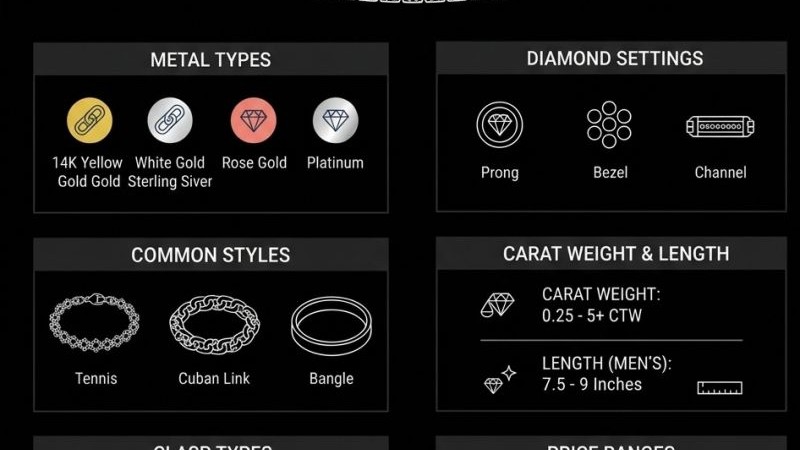
Introduction:
A diamond bracelet represents one of the most technically challenging pieces of fine jewelry ever created. Unlike rings or earrings that remain relatively static, a bracelet endures continuous motion, flexion, and impact with every wrist movement. A high-quality tennis bracelet may contain 30 to 60+ individual links, each requiring precise engineering to ensure smooth articulation without compromising stone security.
Diamond bracelets consistently rank among the most sought-after fine jewelry categories.
Industry data indicates that natural diamond jewelry sales experienced 2.1% growth in specialty jeweler sales in recent periods, with the average price of natural diamond jewelry rising 10% reflecting sustained consumer demand for these timeless pieces.
Online diamond jewelry sales now comprise approximately 17% of the U.S. market, highlighting the growing importance of digital platforms in the diamond trade.
This guide examines every structural component of a diamond bracelet through the lens of materials science, gemology, and mechanical engineering drawing on authoritative sources from leading gemological institutes, academic research, and industry standards organizations.
Jewelry Value Breakdown (Structured Overview)
1. Main Diamonds (60–80%)
Primary Value Driver
Carat Weight: Larger stones significantly increase value.
Color Grade: Closer to colorless = higher price.
Clarity Grade: Fewer inclusions = better quality.
Cut Quality: Impacts brilliance and sparkle.
2. Setting Metal Base (12–25%)
Foundation of the Piece
Metal Purity: 14K, 18K, or Platinum affects pricing.
Alloy Composition: Durability and color tone.
Craftsmanship: Precision in casting and finishing.
3. Links & Structure (5–10%)
Engineering & Durability
Link Count: More links = higher material + labor cost.
Articulation Engineering: Flexibility and comfort.
Metal Thickness: Strength and long-term wearability.
4. Clasp & Safety System (3–8%)
Security Component
Clasp Type: Box clasp vs. lobster clasp.
Safety Mechanism: Added latches for extra protection.
Spring Quality: Longevity and reliability.
5. Craftsmanship Labor (5–12%)
Hidden Value Layer
Setting Complexity: Intricate designs require expertise.
Polishing & Finishing: Final visual appeal.
Quality Control: Ensures durability and perfection.
Most buyers focus only on diamonds, but 20–40% of the total value comes from engineering, metal, and craftsmanship this is what defines longevity and wear experience.
What Makes Bracelet Diamonds Unique -
The diamonds in a bracelet face distinct challenges compared to stones in other jewelry types. Because bracelets move constantly, each diamond experiences repeated microscopic stress at its setting points. According to gemological research, although diamonds are generally considered extremely resistant gems, thermal or mechanical damage is possible during various stages including cutting, setting, soldering, and normal wear.
Matching Size, Color, and Clarity: The Critical Triad
For multi-stone bracelets, matching is paramount. Unlike a solitaire ring where a single stone stands alone, a bracelet features multiple diamonds that must appear visually consistent:
Color Matching: All diamonds should fall within 1-2 color grades of each other (e.g., all G-H range)
Clarity Matching: Inclusions should be similarly sized and positioned; a single heavily included stone will stand out
Size Matching: Diamonds must be within 0.05–0.10 carats of each other for visual uniformity
The Gemological Institute of America (GIA) founded in 1931 that sets and maintains the standards used to evaluate gemstone quality classifies diamond clarity across 11 grades ranging from Flawless (FL) to Included (I3). GIA graders evaluate clarity using 10× magnification under tightly controlled lighting conditions, considering the size, nature, position, color, and quantity of clarity characteristics.
Carat Weight vs. Total Carat Weight
Understanding the distinction between individual stone weight and total carat weight is essential:
Carat refers to the weight of a single diamond.
Total Carat Weight (CTW or TCW) refers to the combined weight of all diamonds in the bracelet.
For bracelet valuation, both measurements matter but matching individual stones is arguably more important than the total carat figure alone.
Setting Types -
The setting is arguably the most critical structural element of any diamond bracelet. Choose our lab diamond tennis bracelet collection for professionally set stones.
Prong Setting
The most popular choice for tennis bracelets, the prong setting uses small metal claws to hold each gemstone securely in place.
Technical Specifications:
Optimal prong angle: 70–80 degrees from the stone's girdle
Metal removal at bearing: 40–50% of prong thickness removed to create secure seating
Prong contact must be sufficient; insufficient contact barely secures the diamond and creates gaps where the bearing fails to conform to the stone's crown and pavilion angles
Security Implications:
Four prongs vs. six prongs: Six prongs hold a diamond more securely in place. If a prong is accidentally sheared off in a four-prong setting, the stone can easily fall out and become lost. If a prong breaks in a six-prong setting, the diamond will typically remain firmly in place.
Platinum prongs are considered very strong platinum is a dense, solid metal whose thin wires can sufficiently hold a gemstone securely, whereas gold prongs with sufficient alloys also give a strong grip.
Bezel Setting
A bezel setting completely encircles the diamond with a thin metal rim. Bezel settings offer maximum protection, encasing the gemstone with a metal rim that provides robust protection against impacts, chips, or dislodgement.
Key Advantages for Bracelets:
Best protection for active wearers.
Prevents snagging on clothing
Ideal for children's jewelry or high-activity lifestyles
Protects the girdle against bumps, bangs, and other accidents
Trade-off: A bezel setting conceals a small portion of the diamond's edges, potentially making the stone appear slightly smaller than it is.
Channel Setting
The channel setting completely encases gemstones in a metal track, protecting the stones from all sides and safeguarding them from daily wear and tear and hard impacts. Technical literature describes channel setting as more secure than prong or bezel settings positioning it as the most secure method for accent diamonds. In bracelets, channel settings:
Protect stone edges from impact damage
Create a smooth, continuous surface that won't snag
Allow stones to sit flush with the metal surface
Are particularly suitable for smaller accent stones
Pave Setting
In pave settings, small gemstones are tightly set to cover the metal surface, creating a continuous field of sparkle. According to technical gem-setting literature, the main objective of any stone setting is to hold a gemstone securely while enhancing its brilliance by effectively displaying its cut, clarity, and color.
For bracelets, pave settings offer:
Maximum diamond density per square inch
Continuous sparkle without visible metal breaks
Ideal for cuff bracelets and bangle styles
Links - The Structural Backbone
The links are the individual sections that connect the bracelet. A well-constructed diamond bracelet requires perfect alignment between links to achieve smooth movement without creating stress points that could lead to metal fatigue.
Link Engineering -
Technical jewelry patents and manufacturing literature address the common problem of broken links in articulated bracelets. An articulated bracelet with decorative links threaded onto a chain requires careful engineering to suppress or reduce bending stress that leads to link failure.
Link Quality Indicators:
Link count: More links generally mean better flexibility but increased failure points
Metal thickness at hinge points: Insufficient metal at connection points leads to premature failure
Solder quality: Poor soldering creates weak points susceptible to metal fatigue
Metal Fatigue and Longevity
Bracelets face more stress compared to rings or earrings because each link must flex repeatedly.
For practical bracelet durability:
Platinum is approximately four times stronger and significantly heavier than gold, making it well-suited for jewelry worn regularly
Platinum prongs are less likely to break than gold prongs, making platinum ideal for setting diamonds
Gold alloys are generally harder than platinum alloys and will resist scratches better, but platinum is almost twice as durable as gold and more ductile
Frame and Metal Base -
The frame (also called the metal base or mounting) supports the diamonds and provides overall shape and durability. The choice of metal significantly affects both security and long-term performance.
Metal Options Compared (Structured Overview)
1. Platinum
Durability: Highest (≈ 4× stronger than gold) Best For: Everyday wear, large center stones
Key Considerations:
Denser and heavier feel
Premium pricing
Less brittle, highly durable over time
2. 18K Gold
Durability: High Best For: Luxury bracelets and fine jewelry
Key Considerations:
Higher gold content (75%)
Rich color and premium appeal
Softer than 14K but still durable
3. 14K Gold
Durability: High Best For: Daily wear, value-conscious buyers
Key Considerations:
Most popular choice in the U.S. market
Stronger due to alloy mix
Balanced durability and affordability
4. White Gold
Durability: High Best For: Contemporary and modern designs
Key Considerations:
Coated with rhodium for bright white finish
Requires re-plating every 1–2 years
Slight maintenance over time
5. Palladium White Gold
Durability: Very High Best For: Corrosion-resistant, low-maintenance jewelry
Key Considerations:
Superior corrosion resistance vs. nickel white gold
Naturally whiter tone (less plating dependency)
Premium alloy option
If durability + low maintenance is your priority → Platinum / Palladium White Gold If budget + strength balance matters → 14K Gold If luxury appeal matters → 18K Gold
Clasps -
The clasp is arguably the second most important structural element after the setting. A beautiful diamond bracelet is worthless if it falls off your wrist.
Box Clasp vs. Lobster Clasp (Structured Overview)
1. Box Clasp
Security Level: Maximum Ease of Use: Moderate Durability: High (with proper maintenance) Best Application: Heavy, high-value, heirloom jewelry
Key Features:
Often includes additional safety latches
Provides a secure “lock-in” mechanism
Requires precise alignment to close properly
2. Lobster Clasp
Security Level: High Ease of Use: Excellent Durability: Very High
Best Application: Medium to heavyweight valuable pieces
Key Features:
Spring-loaded mechanism for quick fastening
Simple, user-friendly operation
Fewer moving parts → lower failure risk
Maximum security & premium pieces → Box Clasp
Ease of use & everyday reliability → Lobster Clasp
Security Analysis: Lobster clasps typically outlast square (box) clasps due to their simpler mechanism and fewer points of failure. However, a well-crafted box clasp maintained properly can last decades. The lobster clasp offers the perfect balance of security and ease of use for most fine jewelry.
Safety Latches
Many high-end bracelets use double-lock systems for extra safety. According to industry guidelines, it is recommended to:
Add a safety catch on the side of the bracelet for added protection
Have the tennis bracelet routinely checked by a jeweler to ensure the clasp, safety catch, and mountings are secure
Safety latch types include:
Single Latch Safety: A hinged supplemental clasp providing extra security to the closure
Double Latch: A safety mechanism that secures the clasp using two safety latches
Inner Finish -
The inner finish refers to the part of the bracelet that touches the skin. This surface must be exceptionally smooth for comfortable daily wear.
Quality Indicators for Inner Finish
Mirror finish interiors reduce friction and skin irritation
Smooth, rounded edges prevent sharp metal contact
Proper weight distribution prevents the bracelet from rotating uncomfortably
No burrs, scratches, or polishing compounds left on the surface
Poor inner finish leads to:
Skin irritation and redness
Premature metal wear
Accumulation of dirt and oils that damage the metal over time
Quality Control and Failure Prevention
Common Failure Modes
Poor craftsmanship can cause:
Broken links from inadequate metal thickness at hinge points
Loose diamonds from worn prongs or improper seating
Clasp failure from spring mechanism fatigue or misalignment
Metal fatigue from repetitive flexion without proper engineering
DIY Inspection Tips
According to gemological guidelines:
Gently shake the bracelet near your ear, if you hear rattling, stones may be loose
Examine prongs with a loupe (10× magnification) to check for lifting or gaps
Check clasp spring tension, it should snap back firmly
Inspect links for metal thinning or stretching at connection points
Sell Diamonds on CaratX: Your Global Marketplace
CaratX connects the diamond, gemstone, jewelry, and pearl industry on a single interconnected marketplace, reducing costs for buyers and sellers worldwide.
Register as a seller to connect with B2B and B2C buyers in 18+ international countries
Shop natural diamonds from ethically sourced, high-quality inventory
Shop gemstones at unbeatable prices from over 200+ artisan sellers
Learn about our seller pricing plans to start selling jewelry internationally
Read about lab diamond tennis bracelets the hottest trend in fine jewelry
Explore our diamond and gemstone marketplace for thousands of unique jewelry pieces, loose diamonds, gemstones, and pearls. Our mission is to bring retailers and consumers sustainable, ethically sourced materials from mine to market.
Join CaratX today and become part of the future of diamond commerce.
Conclusion
A diamond bracelet is a masterpiece of engineering, materials science, and gemological expertise. From the precisely matched diamonds to the intricately engineered links, from the security-conscious clasp design to the comfortable inner finish every component plays a vital role in creating a piece that sparkles brilliantly while enduring daily wear.
Whether you are a buyer searching for the perfect piece, a seller looking to enter the international diamond market, or a jeweler seeking to understand the technical requirements of quality construction, understanding diamond bracelet anatomy empowers informed decisions.
For professional-grade diamond sourcing and selling, register as a seller on CaratX to access B2B and B2C buyers across 18+ international countries.
Shop our marketplace for ethically sourced natural diamonds, lab diamonds, gemstones, and finished jewelry

0 Comments
Please login to leave a reply.