

The Complete Anatomy of Diamond Earrings: A Technical Deep Dive
Home
News And Media The Complete Anatomy of Diamond Earrings: A Technical Deep Dive SHOP NOWHome
News And Media The Complete Anatomy of Diamond Earrings: A Technical Deep Dive SHOP NOWApr, 28, 2026 by Archit Mohanty 0 Comments
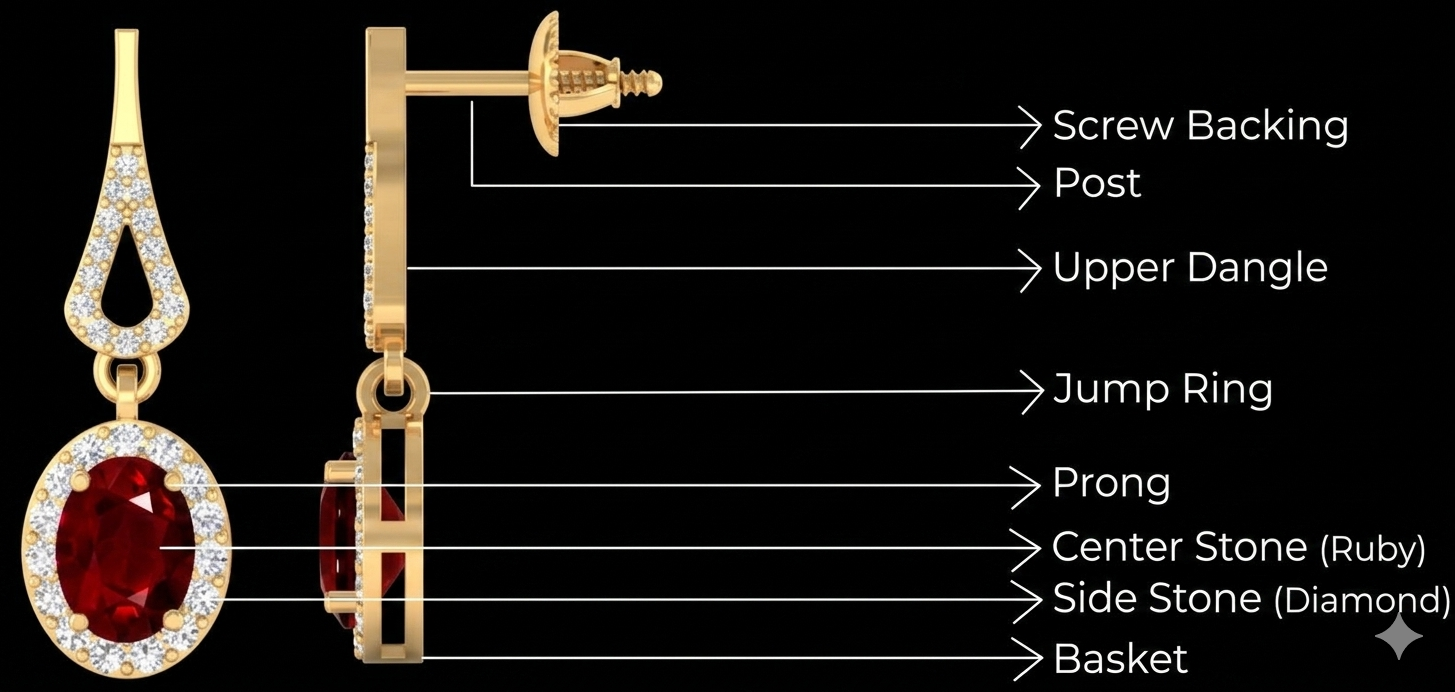
Diamond earrings represent one of the most significant fine jewelry investments a person can make. Yet most buyers focus exclusively on the diamond itself, overlooking the engineering marvel that keeps that precious stone secure, brilliantly lit, and comfortably wearable.
Understanding the anatomy of diamond earrings transforms an ordinary purchase into an informed investment. This guide dissects every component, from the microscopic facets of the center stone to the closure mechanism that prevents loss.
The center stone anchors the entire earring’s value and aesthetic identity. In diamond stud earrings, the center stone typically accounts for 50% to 70% of the total value of the piece a proportion that underscores why informed diamond selection impacts your bottom line directly.
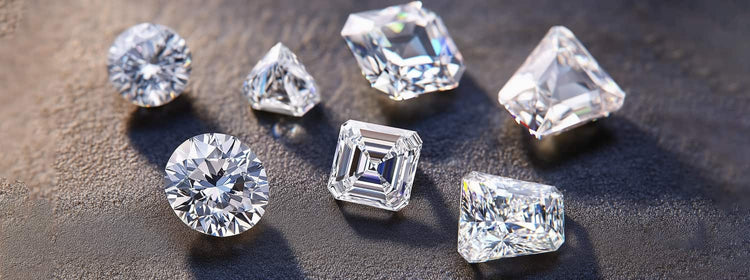
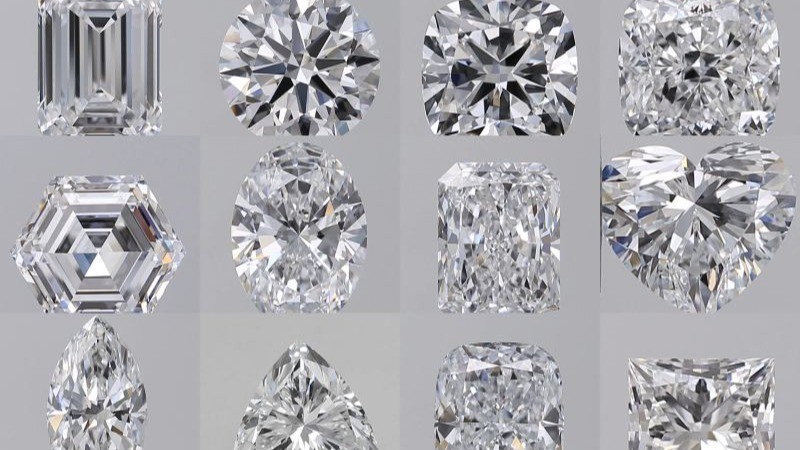
Diamonds available at the CaratX marketplace span natural and certified options across every conceivable shape and size.
The four cardinal attributes the 4 Cs established by the Gemological Institute of America (GIA) in 1953 govern every professional evaluation.
Consumers seeking certified natural diamonds should prioritize cut quality above color and clarity, as cut alone determines how effectively light returns to the observer’s eye.
When evaluating center stones for earrings, consider these shape-specific factors:
Round Brilliant: Maximum light return due to 57 or 58 precisely angled facets. Ideal for maximum sparkle in stud earrings.
Princess Cut: A modern square cut with sharp corners that require protective settings.
Emerald Cut: Step-cut facets create a “hall of mirrors” effect but show inclusions more readily.
Oval and Pear Shapes: These fancy shapes elongate the earlobe visually while offering unique facet arrangements.
Round Brilliant diamonds remain the most popular choice for solitaire studs precisely because their facet geometry maximizes brilliance.
Before understanding how earring components interact with the diamond, you must grasp the gem’s internal architecture. According to GIA’s diamond education resources, a standard round brilliant diamond consists of 57 or 58 facets, each contributing uniquely to the stone’s appearance.
The Five Major Components of a Diamond:
Location: Largest facet on the top
Function:
Gathers light from above
Directs light into the diamond’s interior
Reflects light back to the observer for brilliance
Location: Top section (from girdle to table)
Function:
Contains 8 bezel facets, 8 star facets, and 16 upper halves
Responsible for brightness, fire, and scintillation
Plays a major role in visual sparkle
Location: Perimeter where crown meets pavilion
Function:
Defines the diamond’s diameter
Impacts durability and structure
Thin girdles risk chipping; thick girdles add unnecessary weight
Location: Bottom section (from girdle to culet)
Function:
Contains 16 lower halves and 8 main facets
Reflects light back upward through the crown
Critical for overall brilliance and light performance
Location: Tiny facet at the tip of the pavilion
Function:
Prevents damage to the sharp point
Can be none, very small, or large
Larger culets may be visible and affect appearance
A diamond’s brilliance isn’t just about size, it’s how well each component works together to manage light efficiently.
The table percentage (table size ÷ average girdle diameter × 100) and total depth percentage profoundly affect how brilliantly a diamond performs when set into an earring. Generally, table sizes between 53% and 58% with crown angles from 32 to 36 degrees produce the most attractive, bright, and fiery diamonds.
The GIA 4Cs educational portal provides detailed proportion ranges for achieving Excellent cut grades.
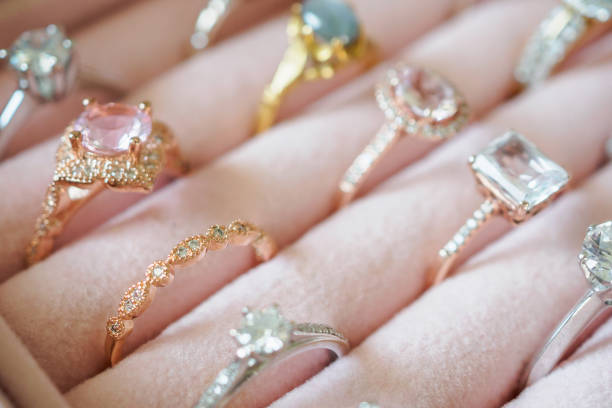
The setting also called the head is the metal framework that holds the center stone. It is arguably the most critical structural component of any diamond earring. A poorly constructed setting leads to loose stones; a well-crafted setting enhances security and light performance simultaneously.
The prong setting uses small metal claws rising from the base to grip the diamond at designated points along its girdle. Cerrone’s earring setting guide notes that claw settings allow maximum light to pass through the gem, enhancing sparkle, but may need periodic tightening to maintain security.
Why Choose It: Light enters the diamond from every angle, including sides and bottom the ultimate showcase for brilliance.
Best For: Diamond studs and solitaire gemstone earrings.
Security Note: Most jewelers recommend 4-prong settings for small to medium stones and 6-prong settings for larger diamonds exceeding 1 carat.
In a bezel setting, a continuous metal rim completely encircles the diamond’s perimeter. This design offers two major benefits: ultimate protection for the girdle from chipping, and snag-free wear without prongs catching on hair or clothing.
Why Choose It: Sleek, modern, and highly secure perfect for active lifestyles.
Best For: Everyday earrings or those worn in professional settings where prongs might snag.
Types: Full bezel (complete metal surround) and half bezel (sides open for light).
A 3-prong V-shaped setting that allows the diamond to sit closer to the earlobe, preventing the dreaded “droop” that occurs when heavy diamonds tilt forward. This setting is particularly popular for larger carat weights where gravity becomes a factor.
The word pave (pronounced pa-vay) derives from French for “paved.” This technique sets tiny diamonds so closely together that the metal surface underneath disappears, making the piece appear constructed entirely of diamonds.
Prongs are the small metal grips that extend from the setting to physically hold the diamond. For stud earrings, 3 or 4 prongs represent the industry standard, though larger stones may require 6 prongs for adequate security.
3-Prong Settings: Offer minimal metal coverage for maximum light entry, particularly common in martini settings.
4-Prong Settings: The most common configuration, balancing security and light exposure.
6-Prong Settings: Recommended for diamonds exceeding 1.5 carats, providing redundancy if one prong becomes damaged.
Shared Prong Settings: Adjacent stones share prongs, reducing visible metal and maximizing continuous sparkle.
Prongs must be tight and perfectly balanced a loose prong invites stone loss, while an overly tight prong risks stress fractures.
The basket also called the gallery is the metal framework positioned directly under the diamond that supports the setting from below. In basket settings, an open, basket-like structure holds the stone with prongs while allowing light to pass through from beneath.
Basket designs vary significantly:
Standard Basket: Flat base with 4 to 6 prongs rising vertically.
Cathedral Basket: Arched supports that rise from the base to meet the prongs.
Open Gallery Basket: Maximizes under-stone light entry with minimal metal infrastructure.
The basket is critical for two reasons: structural integrity (it distributes the stone’s weight across a wider metal surface) and light performance (an open basket allows light to enter the pavilion from below, enhancing brilliance).
The post also called the pin is the straight metal shaft that passes through the pierced earlobe. Standard thickness ranges from 0.7 mm to 1.0 mm, with 0.8 mm representing the most common gauge for fine diamond earrings. Comfort and strength compete here: thicker posts feel more secure but may be less comfortable for sensitive lobes; thinner posts prioritize comfort but may bend under heavier stones.
Post Material Considerations:
Hardness: Very High Hypoallergenic: Yes Price Premium: Highest
Key Considerations:
Extremely durable and long-lasting
Ideal for sensitive skin
Premium choice with a dense, luxurious feel
Hardness: High Hypoallergenic: Often (nickel-free required) Price Premium: Medium
Key Considerations:
Strong and suitable for daily wear
More affordable than higher karat gold
Check alloy composition for skin sensitivity
Hardness: Medium–High Hypoallergenic: Often Price Premium: High
Key Considerations:
Higher gold purity (75%)
Rich color and premium appeal
Slightly softer than 14K gold
Hardness: Very High Hypoallergenic: Yes Price Premium: Medium
Key Considerations:
Lightweight yet extremely strong
Highly resistant to corrosion
Modern, industrial aesthetic
Sensitive skin → Platinum / Titanium
Best durability + value → 14K Gold
Luxury + richness → 18K Gold
CaratX connects buyers with jewelry manufacturers producing posts in all major precious metals.
The earring back often overlooked until it fails is the closure mechanism that prevents the earring from slipping off the post. Loss prevention is non-negotiable when dealing with diamonds.
The most common type, consisting of a small metal “butterfly” that slides onto a straight post and holds by friction.
Pros: Easy on/off, affordable, widely available.
Cons: Can loosen with wear, vulnerable to loss.
The post is threaded, and the nut screws onto it, offering superior security. For medium to large-sized diamonds, screw-back earrings are highly recommended because of their better security.
Pros: Maximum security, ideal for active wearers and high-value stones.
Cons: Takes longer to put on/remove; damaged threads can render earrings unwearable.
Best For: Daily-wear diamond studs, children’s earrings, active lifestyles.
A curved wire with a hinged lever that closes completely behind the ear. Describes lever backs as secure closures less likely to fall off, making them perfect for drop earrings and dangle styles.
Pros: Elegant appearance, secure closure.
Cons: Typically only for drop-style earrings, not as compact as push backs.
A high-security back that locks in place with a spring-loaded mechanism, released by pinching two side tabs. This design is often used for high-value sapphire and diamond earrings.
Pros: Extremely secure, comfortable for extended wear.
Cons: More expensive, harder to replace than standard backs.
A halo is a ring of smaller diamonds or gemstones that surrounds the center stone. Beyond its decorative function, the halo serves two critical purposes: optical enlargement and brilliance amplification.
According to industry research, a well-designed halo can make the center stone appear 20%–30% larger than its actual carat weight. The surrounding diamonds catch light from multiple angles and direct additional light into the center stone, creating a “fireworks” effect that exceeds what a solitaire alone can achieve.
Halo settings are particularly popular for statement studs and bridal jewelry because they offer luxury and visual impact without dramatically increasing carat weight and price.
Halo Design Variants:
Single Halo: One complete ring of melee diamonds around the center.
Double Halo: Two concentric rings of smaller diamonds for maximum impact.
Hidden Halo: A subtle ring of diamonds set underneath the center stone, visible only from certain angles.
Geometric Halo: Angular or mixed-shape halo designs (cushion halo around a round stone, for example).
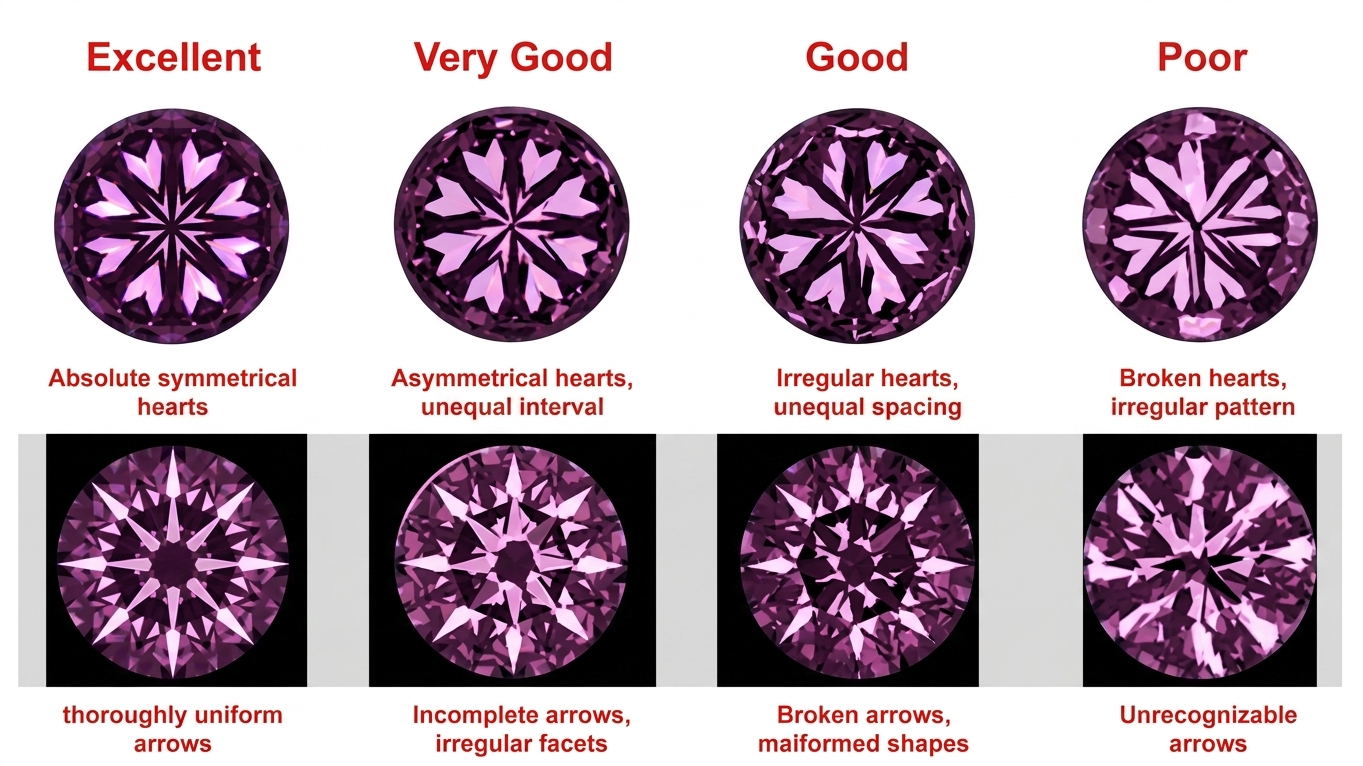
Cut is the most important of the 4 Cs more important than color, clarity, or carat weight combined. Why? Because cut determines how effectively the diamond interacts with light. A D-color flawless diamond with a Poor cut grade will appear dull and lifeless. An H-color SI2 diamond with an Excellent cut grade can outsparkle its more expensive counterpart.
GIA’s cut grading system evaluates three light-performance criteria for round brilliant diamonds:
Brightness: White light reflected from the diamond (internal and external reflections).
Fire: The scattering of white light into all the colors of the visible spectrum.
Scintillation: The pattern of light and dark areas caused by reflections within the diamond as it moves.
For round brilliant diamonds, the interplay between crown angle, pavilion angle, and table percentage determines final cut grade. Industry-optimized ranges:
Table %: 53–58% Crown Angle: 34–35° Pavilion Angle: 40.6–41.0°
Key Insights:
Optimal light performance and brilliance
Ideal balance between fire and sparkle
Premium grading with maximum visual appeal
Table %: 52–60% Crown Angle: 33–36° Pavilion Angle: 40.4–41.2°
Key Insights:
Strong brilliance with minor deviations
Slightly less precise than excellent cut
Great value-to-performance balance
Table %: 51–61% Crown Angle: 31–37° Pavilion Angle: 40.0–41.6°
Key Insights:
Acceptable light reflection
Noticeable reduction in sparkle compared to higher grades
More budget-friendly option
Even small changes in crown and pavilion angles can significantly impact how a diamond reflects light making cut quality the biggest driver of sparkle, not just carat size.
Poorly cut diamonds lose light through the pavilion (creating a “dark” or “fish-eye” appearance) or fail to properly refract light back to the viewer. Always request a GIA diamond grading report that includes the official cut grade it is the only objective measure of light performance available to consumers.
GIA’s diamond care and cleaning guide describes durability as a gemstone’s ability to withstand wear, heat, and chemicals a property comprising hardness (scratch resistance), toughness (break resistance), and stability (heat/chemical resistance).
CaratX serves as the Exclusive Diamond & Gemstone Hub®, connecting the diamond, pearl, jewelry, and gemstone industry on a single platform to reduce the costs of buying and selling online.
The marketplace brings retailers, wholesalers, manufacturers, independent stores, chains, brokers, and dealers together across 18+ international countries.
For Sellers:
Register on CaratX’s seller portal to reach B2B and B2C buyers globally.
List diamonds, gemstones, jewelry, and pearls through streamlined inventory management.
Access market-leading tools, personalized strategies, and international payment channels.
For Buyers:
Shop natural diamonds from verified global suppliers.
Shop gemstones at competitive, transparent prices.
Browse jewelry collections spanning rings, earrings, necklaces, and bracelets.
Pricing Information: Detailed fee structures and seller plans are available at CaratX’s pricing and launch page. The platform offers reduced costs compared to traditional marketplaces, with transparent fee structures designed to maximize seller profitability.
Q1: Are 3-prong or 4-prong settings more secure for diamond studs? A: 4-prong settings offer greater security and are standard for most diamond studs. 3-prong settings (martini style) sit closer to the ear for a more streamlined appearance but provide less redundancy if a prong is damaged. For diamonds exceeding 1 carat, 6-prong settings are recommended.
Q2: Can I wear diamond earrings every day without damaging them? A: Yes, with proper precautions. Choose a secure setting (bezel or heavy-duty prongs), select durable metal options (platinum or 14K gold), remove earrings before swimming, exercising, or applying hair products, and schedule annual professional inspections.
Q3: Do all real diamond earrings have screw backs? A: No. While screw backs offer superior security, push backs and lever backs are also found on authentic diamond earrings. The best back type depends on your lifestyle, activity level, and the earring design. However, most real diamond earrings use secure backing due to the value of the stones involved.
Q4: What does GIA certification guarantee? A: GIA certification provides an objective, unbiased assessment of a diamond’s 4 Cs: cut, color, clarity, and carat weight, along with proportions, finish, treatments, and a plotting diagram of inclusions. It does not assign a dollar value but allows informed comparison between diamonds.
Q5: How do I know if a diamond earring setting is high quality? A: Look for perfectly aligned, tightly gripped prongs with no gaps between metal and diamond; smooth, polished metal surfaces without rough edges; consistent metal thickness throughout; and proper weight distribution. For high-value purchases, request close-up photography of the setting before payment.
Q6: What is the best setting for an active lifestyle? A: A bezel setting offers maximum protection and snag-free wear, making it ideal for active wearers. The continuous metal rim protects the diamond’s girdle from chipping and prevents prongs from catching on clothing, hair, or equipment.
Q7: How much does a halo setting increase perceived diamond size? A: A well-designed halo can make the center stone appear 20% to 30% larger than its actual carat weight. The visual impact depends on halo design, melee diamond quality, and the proportion between center stone and surrounding diamonds.
Q8: Can I sell diamond earrings internationally through CaratX? A: Yes. CaratX supports international sales to 18+ countries. Sellers register here to list jewelry, diamonds, and gemstones for B2B and B2C buyers worldwide.
May, 18, 2026
Aug, 06, 2022
Aug, 06, 2022

0 Comments
Please login to leave a reply.