

Diamond Inventory Shift During the Iran Conflict: How the Global Diamond Trade Reacted
Home
News And Media Diamond Inventory Shift During the Iran Conflict: How the Global Diamond Trade Reacted SHOP NOWHome
News And Media Diamond Inventory Shift During the Iran Conflict: How the Global Diamond Trade Reacted SHOP NOWMay, 01, 2026 by Archit Mohanty 0 Comments
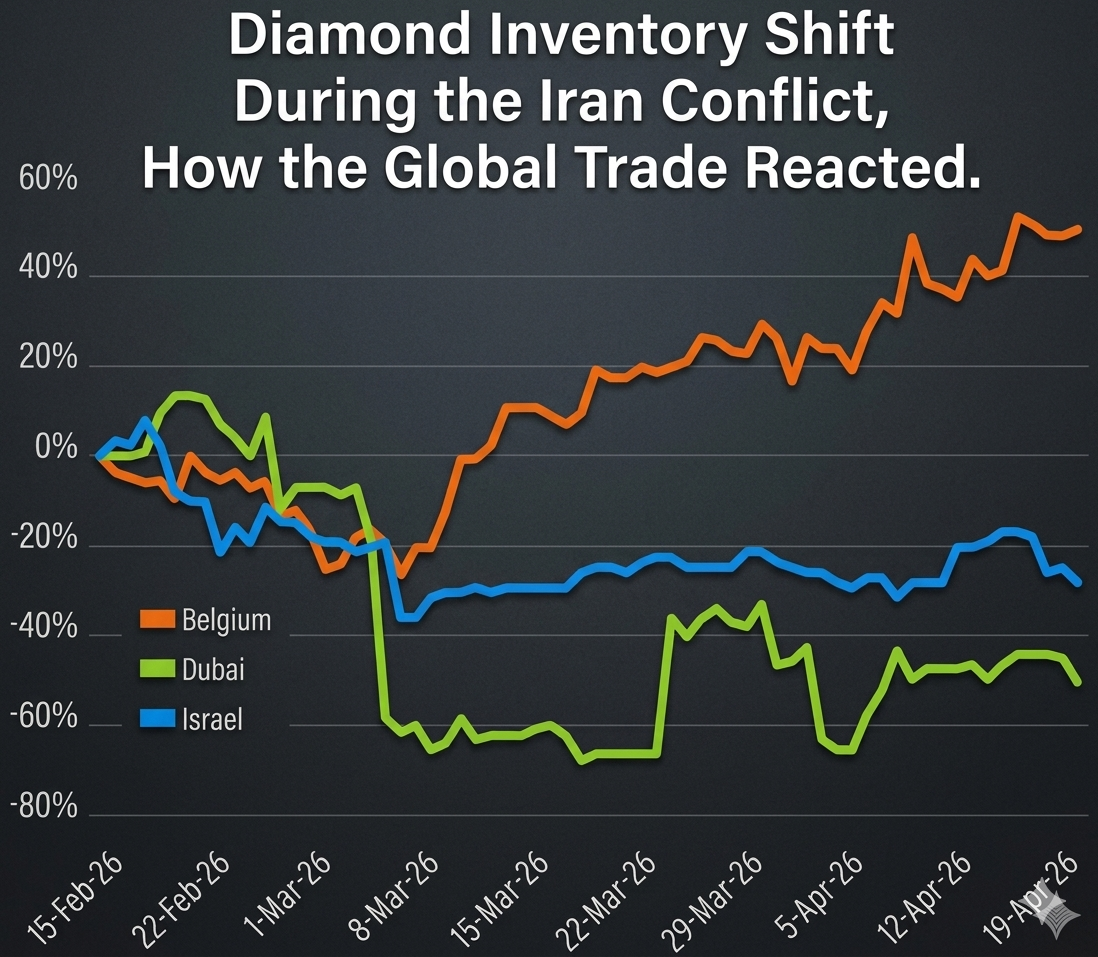
The global diamond industry entered 2028 with cautious optimism, only to be jolted by a major geopolitical event: the escalation of hostilities between Iran, Israel, and the United States. Beginning with joint military actions on February 28, 2026, the conflict rapidly disrupted the delicate mechanics of the global diamond trade, sending shockwaves through supply chains and forcing a swift, strategic realignment of inventory.
As trading froze in key hubs and air corridors closed, the diamond industry was forced into a high-stakes game of logistical chess. This analysis explores the market's detailed reaction, dissecting inventory shifts, supply chain breakdowns, and the resilient pivot to safe-haven hubs.
Any understanding of the global diamond trade must begin with its primary nerve centers. The conflict directly targeted two of the world's most important trading venues: Dubai and Israel. Together, these hubs form a critical axis for the flow of rough and polished diamonds, but their geographical location made them uniquely vulnerable to the escalation.
Dubai, as the host of the Dubai Multi Commodities Centre (DMCC) and the Dubai Diamond Exchange (DDE), has cemented its status as the world's leading trading hub for rough diamonds.
Its strategic position has made it an indispensable gateway, facilitating a massive portion of global trade, particularly with India, the world's largest cutting and polishing center, which processes nine out of every ten diamonds globally. Almost all flights between Dubai and India were canceled, bringing the daily movement of 400 to 500 diamond parcels to a complete standstill.
Market Freeze: According to multiple industry reports, trading in both Israel and Dubai froze completely in the early days following the Iranian missile strikes on February 28, 2026.
Supply Chain Disruption: The conflict triggered widespread flight cancellations and airspace closures, with Dubai suspending numerous cargo and passenger flights. This physical barrier cut off the arteries of the diamond trade, preventing the shipment of both polished diamonds and essential rough materials for manufacturing.
The most telling signal of the market's distress came not from official statements, but from the movement of the diamonds themselves. In the high-stakes world of diamond trading, inventory data acts as a real-time barometer of trader confidence. As international tensions escalated in the lead-up to February 28, a clear pattern of early inventory movement emerged, which then accelerated dramatically once the conflict began.
Inventory data from the RapNet Diamond Index (RAPI) and other industry sources shows a clear trend of supply tightening for larger diamonds in the impacted regions. The market remained split, with polished diamonds of 2 carats and larger in high demand but increasingly short supply. The data shows a clear three-stage exodus from the danger zone:
Pre-Conflict Flight (Feb 20-27): As warnings of a military strike proliferated, dealers in Israel and Dubai appear to have proactively shipped out high-value inventory. The most vulnerable stock was large, round, polished diamonds specifically in the 3-carat range which saw a noticeable decline in listed inventory during this period.
Trigger Event (Feb 28 - March 3): The immediate aftermath of the initial strikes was chaos. Any remaining export windows were slammed shut by airspace closures and a complete halt in commercial logistics.
The Acceleration (March 4 onward): As the security situation stabilized slightly, a frantic scramble began. Dealers who were stuck with goods accelerated shipments out of the region by any means possible. Once limited export windows reopened, polished diamonds were quickly rerouted.
The crisis made the region a "no-go" zone for inventory, validating the dealers' pre-emptive decision to move goods. The "report of price increases at De Beers’ March sight" for larger rough stones confirmed that the supply pipeline was under severe pressure globally.
The exodus of diamonds was enabled and, at times, hindered by the physical state of the region's logistics network. The Iran-Israel conflict did not just create economic uncertainty; it created a "physical fracture" in the world's aviation map. The Middle East, a critical crossroads for global air cargo, became a contested zone.
The closure of airspace across Israel and parts of the Gulf was immediate and comprehensive. This shutdown had a devastating domino effect on the diamond trade:
Re-Routed Supply Chains: The traditional, ultra-efficient hub-and-spoke model of Middle Eastern aviation collapsed overnight. Cargo that once transited through Dubai, Doha, and Abu Dhabi, the world's busiest aviation interchange was grounded.
Halted Shipments: The closure of air routes meant that high-value diamonds, which are almost exclusively transported by air for security reasons, were stuck. India's gems and jewellery exports, as well as imports of rough diamonds from the UAE, were immediately hit.
Rising Costs and Insurance: With major carriers suspending services, the logistics chain became unreliable. War-risk insurance premiums skyrocketed, adding another layer of cost to an already expensive operation. The resulting turbulence forced a rapid pivot to alternative trade routes, with many exporters boosting rough stone purchases from Antwerp and African suppliers.
In times of crisis, capital and commodities flow to safety. For the global diamond trade, that safe haven is Antwerp. As the largest diamond trading center in the world with approximately 80% of all rough and 50% of all polished diamonds passing through its famous square mile Antwerp's infrastructure, stability, and legal framework provide an unmatched level of security.
The massive inventory shift away from conflict zones is clearly visible in the trade data. The Antwerp World Diamond Centre (AWDC) , the official body representing the Belgian diamond industry, reported a staggering 70% year-on-year increase in polished diamond imports from the United Arab Emirates into Belgium during March.
This figure is one of the strongest possible confirmations of a "flight to quality." This shift highlights a crucial structural reality: while Dubai is a master of trade flow and logistics, Antwerp is the ultimate repository and clearing house for value. The market's reaction was to move diamonds to where they would be safe, both physically and financially.
The movement of inventory to Hong Kong presents a more nuanced picture. On one hand, Hong Kong is one of the world's most important diamond and jewelry markets, acting as the primary gateway for goods destined for mainland China and the wider Asia-Pacific region. Logic would suggest it was a natural recipient of redirected inventory. However, tracking these flows with the same clarity as the Antwerp data is more challenging for a major reason:
Overlapping Market Events: The beginning of March is the time for major trade shows in Hong Kong, including the Hong Kong International Diamond, Gem & Pearl Show. Significant inventory is always moved to Hong Kong at this time for the show.
This natural seasonal inflow makes it difficult to isolate inventory that was purely "diverted" due to the conflict. It is highly likely that some inventory was moved, but the signal is muddied by the noise of routine trade show preparations. The Hong Kong market remains a critical node in the global network and will likely play a more defined role in future supply chain reconfiguration.
The inventory shift was not uniform across all categories. Data indicates that the movement was most visible in 2-carat and 3-carat diamonds, with a lesser but still notable impact seen in 1-carat categories. This pattern is a critical insight into market psychology and the internal dynamics of the diamond industry.
Store of Value: Round 2-carat and 3-carat diamonds in top colors and clarities are not just a commodity; they are a portable store of value. For dealers facing a geopolitical crisis, moving these high-value, liquid assets to a safe location is the top priority. They can be sold or used as collateral anywhere in the world.
Exposure and Insurance: The dollar value of a 3-carat stone is significantly higher than that of a 1-carat stone. A dealer with a portfolio of large stones had far more financial exposure to loss from theft, damage, or logistical seizure. Therefore, getting those specific stones out was a higher-stakes imperative.
Supply Chain Specifics: Manufacturers often keep a flow of smaller stones for melee and mass-market jewelry. The larger stones, due to their rarity and higher price, often sit in inventory for longer periods, making them more vulnerable to an external shock. The market also reported a notable decline in the 0.50-1.99 carat sizes, confirming the broad-based nature of the pullback.
This combination of financial and logistical factors made the larger diamonds the "canaries in the coal mine," their movement providing the earliest and clearest signal of the market's underlying distress.The Road Ahead: Lessons and Long-Term Implications
The Iran conflict was a powerful stress test for the global diamond industry, revealing both its fragile dependencies and its remarkable capacity to adapt. The movement of inventory out of Dubai and Ramat Gan and into Antwerp was not just a crisis measure; it was a strategic, if forced, rebalancing of the world's diamond risk map.
Looking ahead, several long-term implications are clear:
Supply Chain Diversification: The event will accelerate the industry's search for more resilient supply chains. We are likely to see an increased strategic importance of trade corridors via Surat and Mumbai, as well as a further strengthening of Antwerp's role as a neutral, stable super-hub.
Technological and Contractual Shifts: The "fracture" of air corridors will prompt greater investment in digital inventory management, real-time logistics tracking, and more flexible force majeure clauses in contracts.
Re-evaluation of Dubai's Role: While Dubai remains a giant, this crisis will force its leadership and the DMCC to develop more robust contingency plans for times of regional turmoil. The suspension of 400-500 parcels a day is a massive hit that cannot be ignored.
The Resilience of Natural Diamonds: Amidst the chaos, the underlying value proposition of natural diamonds was reaffirmed.
The diamond market's reaction to the Iran conflict was a masterclass in high-stakes, real-time logistics and risk management. The initial panic, the strategic shifts, and the eventual stabilization have provided the industry with a valuable, if painful, template for navigating the geopolitically uncertain future of global trade.
The global diamond market is more dynamic than ever. Whether you are a professional trader looking to expand your reach, a jeweler sourcing high-quality stones, or a first-time buyer, CaratX provides the platform you need.
Start selling to diamonds in 18+ International countries: www.caratx.com/register
Sellers register on CaratX marketplace here to start selling to B2B and B2C buyers: www.caratx.com/register
You can now sell Jewelry Internationally to buyers through our CaratX seller plan: www.caratx.com/register
Shop gemstones from our CaratX marketplace at unbeatable prices: https://caratx.com/search-results/gemstones
Shop natural diamonds from here: https://caratx.com/search-results/Natural
Sellers register to start selling to 18+ buyers now: www.caratx.com/register
More details about our Pricing, check here: https://caratx.com/generic-pages/launch-your-products-on-caratx
Follow CaratX for such insightful and educational content.
Q1: Why did diamond inventory shift so dramatically during the Iran conflict? A1: The shift was a direct response to existential risk. With airspace closed, flights canceled, and a major power in the region (Iran) targeting the UAE, dealers moved their most valuable, portable assets (2-carat and 3-carat polished diamonds) out of harm's way. The primary destination was Antwerp, the world's most stable and secure diamond trading hub. The market correctly anticipated that a prolonged conflict would freeze all trade, making a proactive, defensive inventory move the only logical course of action.
Q2: How did the closure of air routes in the Middle East affect the diamond supply chain? A2: The closure of airspace across Israel and parts of the Gulf created a "physical fracture" in global trade routes. As diamonds are always shipped by air for security, this brought trade to a halt. Daily shipments of hundreds of parcels between Dubai and India were grounded. This forced the industry to re-route through alternative hubs like Antwerp and to adjust sourcing strategies, buying more rough from African suppliers. It also caused insurance costs to skyrocket and highlighted the vulnerability of relying on a single, concentrated logistics hub.
Q3: Which diamond sizes were most affected by the inventory movement? A3: The data shows the sharpest declines in inventory and subsequent tightening of supply for 2-carat and 3-carat polished diamonds. These are considered a liquid store of value. Dealers prioritized moving these high-dollar, easily transportable assets. The market for 1-carat diamonds was also impacted, but to a lesser degree. This pattern reinforces the idea that larger, high-quality diamonds are treated by professionals as financial instruments, making them the first to be moved in a crisis.
Q4: What is CaratX and how does it help diamond sellers and buyers? A4: CaratX is a modern B2B and B2C marketplace designed to connect diamond and jewelry sellers with a global network of buyers across 18+ international countries. It provides a secure, efficient platform for trading loose diamonds, jewelry, and gemstones. For sellers, CaratX offers access to a wider customer base and streamlined logistics. For buyers, it's a source for natural diamonds and gemstones at competitive prices.
Q5: Is it safe to trade diamonds online today given these disruptions? A5: Yes. While physical logistics faced a shock, the digital infrastructure for trading is more robust than ever. Reputable platforms like CaratX provide a layer of transparency, security, and conflict-free sourcing that was not available to past generations. By using these digital tools, traders can execute deals, secure inventory, and arrange for shipment to stable third-party locations like Antwerp, bypassing many of the risks associated with trading in a conflict zone.
Q6: How does the Kimberley Process (KP) relate to conflict diamonds in a war like the Iran-Israel conflict? A6: The Kimberley Process is an international certification scheme established in 2003 to prevent "conflict diamonds" (rough diamonds used to finance rebel movements) from entering the mainstream market. It requires member countries to certify that their rough diamond exports are conflict-free. In a state-based, inter-state conflict like the Iran-Israel war, the formal supply chains of KP-certified nations are not considered "conflict diamonds" under the official definition.
However, the disruption and diversion of legal goods create a risk that certified chains may be circumvented. The World Diamond Council (WDC) and other bodies are continuously working to reinforce the System of Warranties (SoW) to ensure that all diamonds, even those diverted by war, remain traceable and ethically sourced.
Jun, 18, 2026

Aug, 06, 2022

Aug, 06, 2022

0 Comments
Please login to leave a reply.